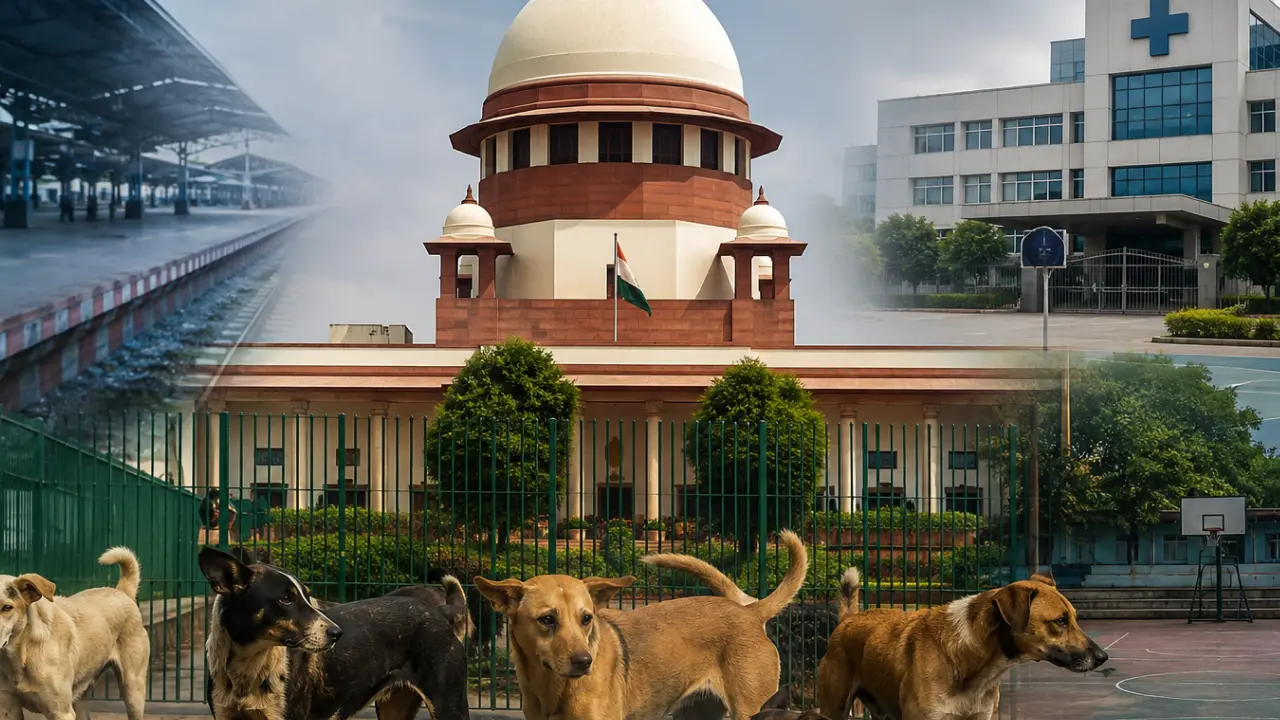
The Supreme Court of India has refused to recall its earlier directions ordering the removal of stray dogs from sensitive public spaces such as hospitals, schools, railway stations, bus depots, and sports complexes. At the same time, the apex court allowed authorities to carry out euthanasia of rabid, incurably ill, and demonstrably dangerous stray dogs under strict legal and veterinary supervision.
The ruling came while hearing multiple petitions and applications seeking modification of the court’s November 2025 order regarding stray dog management. A bench comprising Justice Vikram Nath, Justice Sandeep Mehta, and Justice N.V. Anjaria dismissed the pleas and maintained that public safety cannot be compromised due to the growing number of dog bite incidents across the country.
In its observations, the Supreme Court noted that incidents involving stray dog attacks, particularly against children and elderly citizens, have reached alarming levels in many parts of India. The court stated that authorities cannot ignore threats to human life and safety in crowded public areas.
The court clarified that stray dogs picked up from public institutions and high-footfall areas should not be released back into the same places even after sterilisation or vaccination. Instead, local authorities and municipal bodies have been directed to shift such animals to shelters or designated facilities in accordance with existing animal welfare laws and the Animal Birth Control (ABC) Rules.
A major part of the ruling involved the issue of euthanasia. The Supreme Court stated that in areas where stray dog populations have become dangerous and attacks are frequent, authorities may take legally permissible measures, including euthanasia, but only in cases involving rabid, incurably ill, or clearly aggressive dogs. The court emphasized that any such action must follow proper assessment by qualified veterinary experts and comply strictly with the Prevention of Cruelty to Animals Act, 1960, and Animal Birth Control Rules, 2023.
Animal welfare groups and activists had opposed the earlier directions, arguing that relocation of sterilised dogs could disturb territorial balance and create further complications. Some organizations also raised concerns regarding the lack of adequate shelter infrastructure and implementation capacity across states. However, the Supreme Court rejected the applications challenging both its previous directions and the Standard Operating Procedure issued by the Animal Welfare Board of India.
The court stressed that the right to live with dignity under Article 21 of the Constitution also includes the right of citizens to live without fear of stray dog attacks. Judges observed that while animal welfare remains important, human safety must receive priority when the two concerns come into conflict.
The decision has triggered strong reactions across the country. Many citizens welcomed the ruling, saying it addresses growing public safety concerns related to stray dog attacks and rabies cases. On the other hand, several animal rights activists criticized the judgment, arguing that long-term solutions should focus more on vaccination, sterilisation, waste management, and stronger implementation of humane animal control measures.
Legal experts believe the ruling could significantly influence future policies on stray animal management across India. Municipal corporations and state governments may now be required to strengthen shelter infrastructure, improve sterilisation programs, and ensure scientific handling of stray animal populations while balancing public safety and animal welfare obligations.
The Supreme Court’s latest order marks one of the most significant judicial interventions in India’s ongoing debate over stray dog management, public safety, and animal rights.