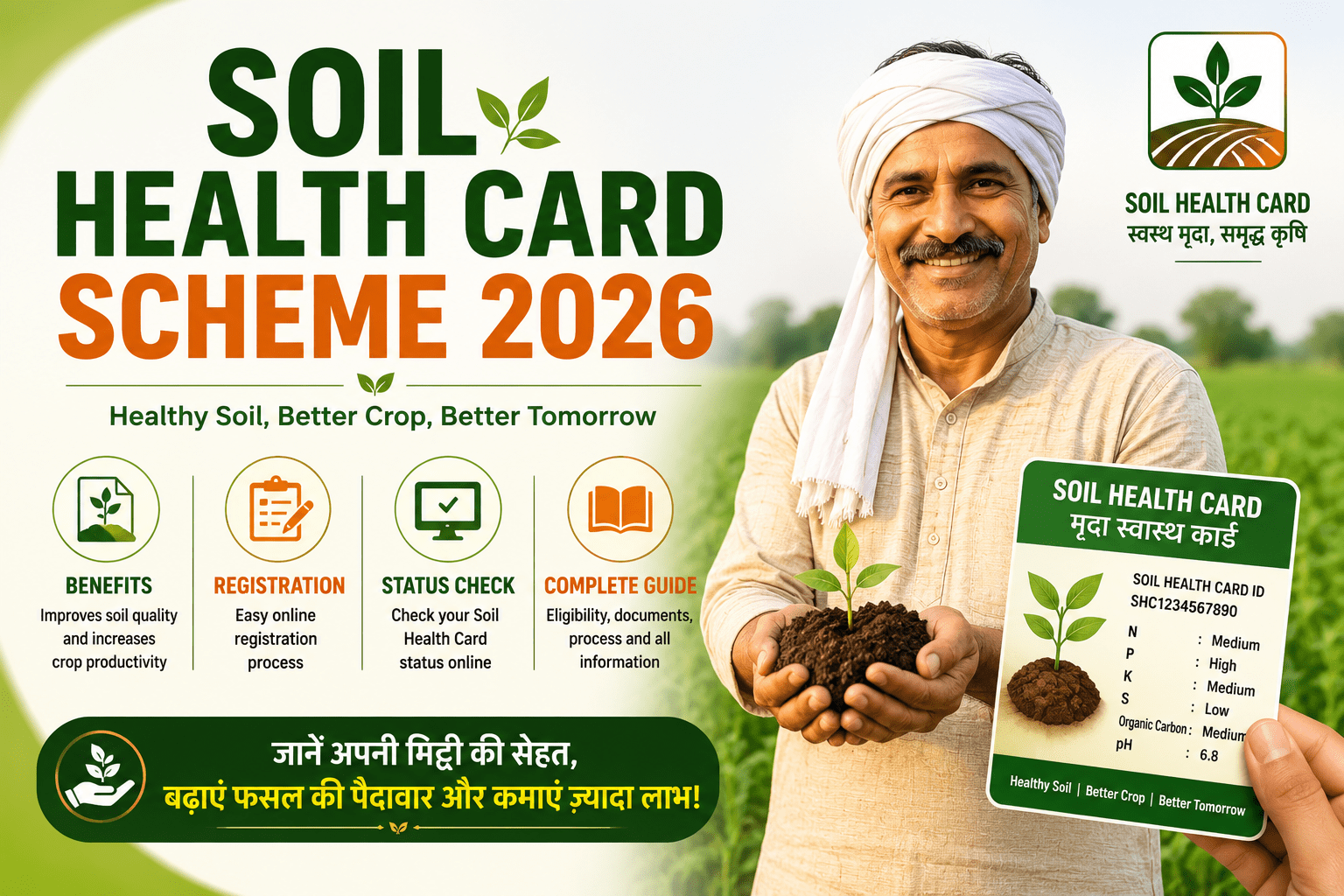
The Soil Health Card (SHC) Scheme is an important initiative launched by the Government of India to help farmers understand the nutrient status of their soil and adopt scientific farming practices. Under this scheme, soil samples from farmers’ fields are tested in authorized laboratories, and a Soil Health Card is issued with detailed information about soil nutrients, soil condition, and crop-wise fertilizer recommendations. The objective is to improve soil fertility, reduce unnecessary fertilizer use, increase crop productivity, and promote sustainable agriculture.
In 2026, farmers can register for the scheme through the Agriculture Department, Common Service Centres (CSCs), or state agriculture offices. They can also track their soil sample status and download or print their Soil Health Card through the official Soil Health Card Portal after laboratory testing is completed.
This guide explains everything about the Soil Health Card Scheme 2026, including its benefits, eligibility, registration process, soil testing procedure, status check, and frequently asked questions.
What is the Soil Health Card Scheme?
The Soil Health Card Scheme provides farmers with a report on the health of their agricultural land after scientific soil testing.
The card includes:
- Soil nutrient status
- Soil pH level
- Organic Carbon content
- Macro and micronutrient analysis
- Crop-wise fertilizer recommendations
- Soil improvement suggestions
The Soil Health Card is generally issued once every three years for a particular field.
Benefits of Soil Health Card Scheme
The scheme offers several benefits to farmers.
- Scientific fertilizer recommendations.
- Reduced cultivation costs.
- Improved crop productivity.
- Better soil fertility management.
- Balanced use of fertilizers.
- Increased farm income.
- Sustainable farming practices.
- Long-term improvement in soil health.
Eligibility Criteria
Generally, the following are eligible:
- Farmers owning agricultural land.
- Tenant farmers (subject to state guidelines).
- Individual farmers.
- Farmer groups and cooperatives.
Soil Parameters Tested
The Soil Health Card generally reports the status of 12 important soil parameters, including:
- Nitrogen (N)
- Phosphorus (P)
- Potassium (K)
- Sulphur (S)
- Zinc (Zn)
- Iron (Fe)
- Copper (Cu)
- Manganese (Mn)
- Boron (B)
- pH
- Electrical Conductivity (EC)
- Organic Carbon (OC)
Documents Required
Keep the following documents ready.
- Aadhaar Card
- Mobile Number
- Land Records
- Farmer ID (if applicable)
- Address Proof
- Passport-size Photograph
How to Register for Soil Health Card Scheme 2026
Follow these simple steps.
Step 1
Visit the nearest Agriculture Department office or Common Service Centre (CSC).
Step 2
Submit your application for soil testing.
Step 3
Provide your land and personal details.
Step 4
A soil sample is collected from your farm following the prescribed method.
Step 5
The sample is sent to an authorized Soil Testing Laboratory.
Step 6
After testing, the Soil Health Card is generated.
Step 7
Download or collect your Soil Health Card.
How Soil Testing Works
The process generally includes:
- Soil sample collection.
- Sample registration.
- Laboratory testing.
- Nutrient analysis.
- Fertilizer recommendation.
- Soil Health Card generation.
- Distribution to farmers.
How to Check Soil Health Card Status
Follow these steps.
- Visit the official Soil Health Card Portal.
- Click Track Soil Health Card.
- Enter the required details.
- View the status of your soil sample or Soil Health Card.
- Download or print the card after it is generated.
How to Download Soil Health Card
Once your card is available:
- Visit the official Soil Health Card Portal.
- Search using your farmer or soil sample details.
- Open your Soil Health Card.
- Download or print the PDF for future reference.
Why is Soil Testing Important?
Regular soil testing helps farmers:
- Identify nutrient deficiencies.
- Apply fertilizers in the correct quantity.
- Reduce unnecessary fertilizer expenses.
- Improve crop quality.
- Protect soil health for future farming.
Common Reasons for Delay
Your Soil Health Card may be delayed due to:
- Pending soil sample testing.
- Incomplete farmer details.
- Heavy workload at the laboratory.
- Incorrect land information.
- Technical issues in processing.
Important Tips
Before applying:
- Submit accurate land details.
- Allow proper soil sample collection.
- Follow fertilizer recommendations mentioned in the card.
- Test your soil periodically.
- Preserve your Soil Health Card for future reference.
Frequently Asked Questions (FAQs)
What is a Soil Health Card?
A Soil Health Card is a report that provides information about the nutrient status of a farmer’s soil along with fertilizer and soil improvement recommendations.
Who can apply for the Soil Health Card Scheme?
Eligible farmers, including landowners and other eligible cultivators as per state guidelines, can apply.
How often is a Soil Health Card issued?
Generally, one Soil Health Card is issued for a field once every three years.
Can I check my Soil Health Card online?
Yes. Farmers can track the status and download or print their Soil Health Card through the official Soil Health Card Portal after testing is completed.
Is there any fee for soil testing?
The availability of free or subsidized testing depends on the implementation guidelines of the concerned State Government and Agriculture Department.
Conclusion
The Soil Health Card Scheme 2026 is a valuable initiative that empowers farmers with scientific information about their soil, enabling them to make informed decisions on fertilizer use and crop management. By following the recommendations provided in the Soil Health Card, farmers can improve crop yields, reduce cultivation costs, and maintain long-term soil fertility. Eligible farmers should register through their Agriculture Department or CSC, get their soil tested, and regularly check the status of their Soil Health Card through the official portal.
Read More: Passport Police Verification 2026: Complete Guide, Documents, Process, Status Check & FAQs