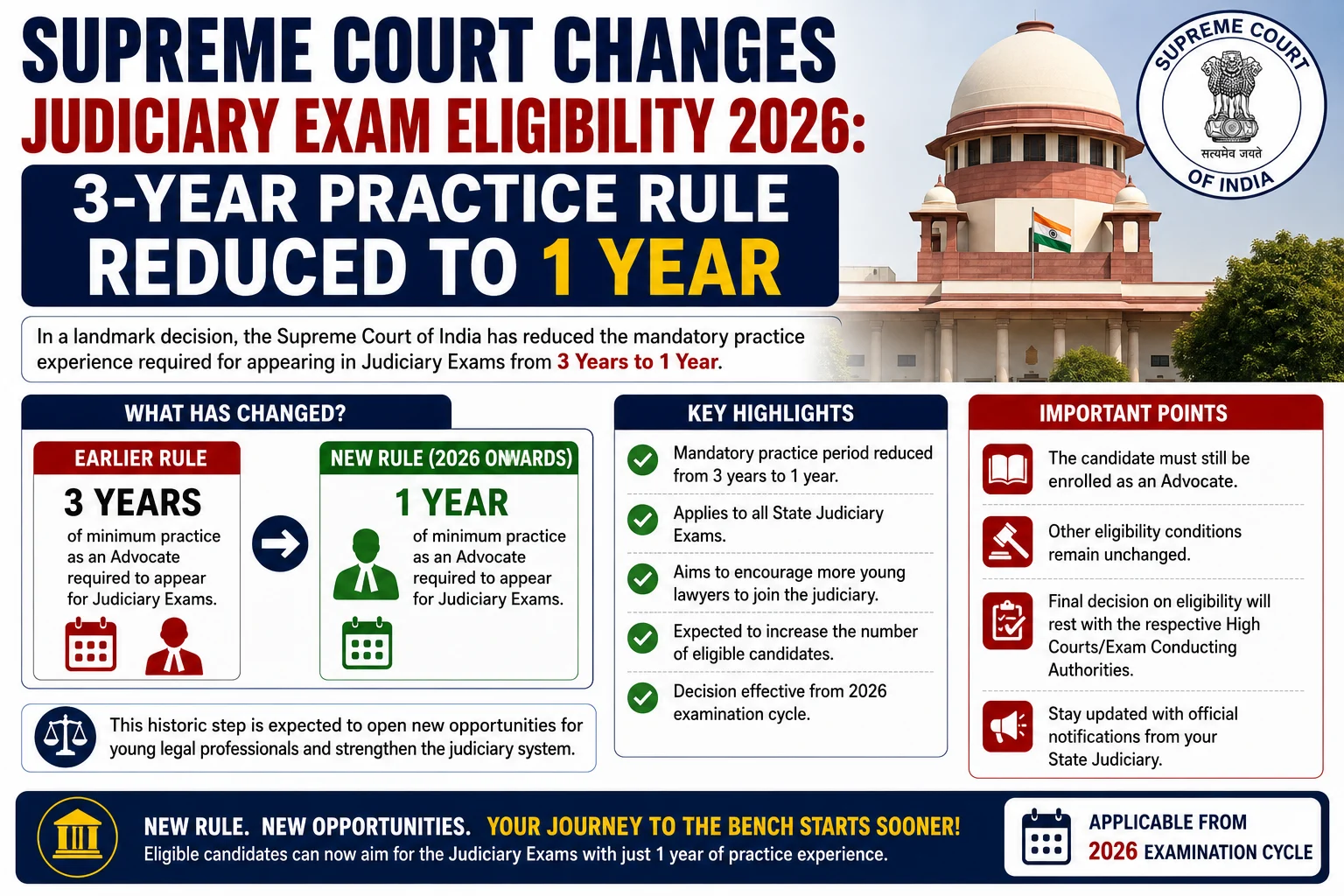
The Supreme Court has changed the eligibility rules for entry-level judicial service examinations in 2026, providing major relief to law graduates and young judiciary aspirants. The Court has modified its earlier requirement of three years of legal practice for recruitment to the post of Civil Judge (Junior Division).
In a significant judgment delivered on August 21, 2026, a three-judge Bench headed by Chief Justice Surya Kant changed the way the earlier three-year practice requirement will operate. The Court retained the principle that candidates should have practical exposure to the legal system but decided that the entire experience does not have to come from conventional practice at the Bar.
Under the new framework, candidates appearing in recruitments notified after April 1, 2027 will generally need one year of actual legal practice before appearing for the Civil Judge (Junior Division) examination. After selection, they will undergo one year of intensive judicial training and one year of structured law clerkship.
There is also a transitional arrangement. Candidates covered by judicial recruitment notifications issued from May 20, 2025, up to March 31, 2027, can apply without having completed the earlier three-year practice requirement.
The decision is particularly important for fresh law graduates who were affected by the Supreme Court’s 2025 decision restoring the three-year practice requirement.
What Has the Supreme Court Changed?
The Supreme Court has not completely removed the requirement for practical legal exposure.
Instead, it has restructured the pathway to entry-level judicial service.
The new framework broadly works as follows:
- Transitional candidates can apply without prior practice until March 31, 2027.
- For recruitments after April 1, 2027, candidates need one year of actual legal practice.
- Selected candidates will undergo one year of intensive training at a State Judicial Academy.
- They will then complete one year of structured law clerkship.
- The clerkship will provide supervised exposure to the functioning of courts.
- The framework is intended to remain in force for five years before being reviewed on the basis of empirical evidence.
Therefore, the headline “three years reduced to one year” is correct, but it does not mean that practical courtroom exposure has been eliminated.
Why Did the Supreme Court Change the 3-Year Practice Rule?
The Supreme Court had earlier restored the three-year practice requirement because it considered practical exposure important for people entering the lower judiciary.
A Civil Judge can deal with matters involving life, liberty, property and personal rights from the beginning of their judicial career. The Court therefore considered familiarity with courtroom procedure and the roles of the Bench and Bar important.
However, the Court also recognised concerns about the impact of suddenly imposing a three-year practice requirement on young law graduates.
The new framework attempts to balance both concerns:
Early access to judicial recruitment + structured practical training.
Instead of requiring all experience to be acquired through three years of independent Bar practice, the Court has created a combination of practice, judicial training and supervised clerkship.
What Was the Earlier 3-Year Practice Rule?
In May 2025, the Supreme Court had directed that candidates seeking direct recruitment to the post of Civil Judge (Junior Division) should have a minimum of three years of practice at the Bar.
The decision represented a significant change from the earlier recruitment model, under which fresh law graduates could generally appear for entry-level judicial service examinations subject to the applicable state rules.
The three-year requirement created concerns among law students and recent graduates because candidates had to spend additional years practising before becoming eligible for the examination.
The Supreme Court’s August 2026 judgment has now modified that approach.
What Is the New Eligibility Rule From April 2027?
For judicial recruitment notifications issued after April 1, 2027, the basic prior-practice requirement will be:
One Year of Actual Legal Practice
Candidates will need to demonstrate one year of actual practice before appearing for the Civil Judge (Junior Division) examination.
This is significantly shorter than the earlier three-year requirement.
However, candidates should understand that the one-year practice requirement is only one part of the new framework.
Selected candidates will subsequently undergo structured training and clerkship before becoming regular judicial officers.
What Is the Transitional Rule Until March 31, 2027?
The Court has created a special transitional arrangement to prevent hardship to candidates affected by the earlier 2025 judgment.
For recruitment notifications issued from May 20, 2025, through March 31, 2027, law graduates can apply without having completed three years of practice.
In this transitional period, candidates are treated as having completed the required practice for eligibility purposes.
However, candidates selected under this arrangement will not simply move directly into regular judicial duties. They will undergo structured training and clerkship as prescribed by the Court.
Who Will Benefit From the New Rule?
The change is particularly significant for:
- Fresh law graduates
- Recent LLB graduates
- Young advocates
- Judiciary aspirants who had paused their preparation
- Candidates affected by the 2025 three-year practice rule
- Law students planning a career in the subordinate judiciary
Candidates who were concerned that they would have to wait three years before becoming eligible now have a shorter practice requirement under the post-April 2027 framework.
The transitional arrangement provides even greater relief to candidates covered by recruitment notifications up to March 31, 2027.
Will Fresh Law Graduates Be Able to Appear Directly After LLB?
The answer depends on when the recruitment notification is issued.
For the transitional period ending March 31, 2027, eligible law graduates can apply without demonstrating prior practice under the Court’s special arrangement.
For recruitment notifications issued after April 1, 2027, candidates will generally need one year of actual legal practice before appearing for the examination.
So, the new permanent framework does not completely restore unrestricted direct entry immediately after graduation.
What Happens After Clearing the Judiciary Exam?
Clearing the examination will not immediately mean that the selected candidate starts functioning independently as a Civil Judge.
The Supreme Court has introduced a structured post-selection pathway.
The selected candidates will undergo:
- Judicial Academy training
- Structured law clerkship
- Assessment/reporting before regular judicial responsibility
This is intended to provide practical exposure before candidates begin handling cases independently.
One Year of Judicial Academy Training
Selected candidates will undergo one year of intensive training at the concerned State Judicial Academy.
This training is intended to familiarise trainee judicial officers with the practical and procedural aspects of judicial work.
Training can cover areas such as:
- Court procedure
- Case management
- Drafting
- Evidence-related processes
- Judicial ethics
- Court administration
- Legal research
- Judgment writing
- Practical functioning of trial courts
The exact training programme can be structured by the concerned State Judicial Academy in accordance with the applicable framework.
One Year of Structured Law Clerkship
After the judicial academy training, selected candidates will undergo one year of structured law clerkship.
The clerkship is intended to provide practical exposure under the supervision of serving judges.
The Court’s framework divides this period into:
- Six months under a District Judge or member of the higher judicial service
- Six months under a sitting High Court Judge
This gives candidates exposure to both trial-court functioning and the working of a higher court.
Why Has the Court Added Training and Clerkship?
The purpose is to ensure that reducing the Bar-practice requirement does not result in judges entering the courtroom without adequate practical exposure.
The Court has essentially shifted part of the practical-experience requirement from pre-selection practice to structured post-selection training.
This approach allows young candidates to enter the judicial recruitment process earlier while still requiring them to gain practical knowledge before taking on regular judicial responsibilities.
Does One Year of Practice Replace All Three Years?
Not exactly.
This is an important distinction.
The earlier model required three years of legal practice before eligibility.
The new permanent framework requires:
1 year of actual practice before the examination
plus
1 year of judicial academy training
plus
1 year of structured clerkship after selection.
Therefore, the Court has not simply reduced three years to one and removed the remaining experience requirement.
Instead, it has redesigned how practical experience is acquired.
New Judiciary Eligibility Rule: Old vs New
| Feature | Earlier 3-Year Rule | New Framework |
|---|---|---|
| Pre-exam practice | 3 years | 1 year |
| Judicial Academy Training | Not part of the same eligibility structure | 1 year after selection |
| Structured Clerkship | Not part of the same structure | 1 year after selection |
| Clerkship structure | — | 6 months District Judiciary + 6 months High Court |
| Transitional relaxation | No | Available up to March 31, 2027 |
| Review | — | Scheme to be reviewed after five years |
The new structure is therefore a combination of shorter pre-examination practice and longer structured post-selection exposure.
What Is the Difference Between Practice and Clerkship?
Legal practice generally means working as an advocate and gaining professional experience through legal work, including court appearances and related activities.
Law clerkship, on the other hand, is structured supervised work with judges.
The two provide different types of experience.
Practice exposes an advocate to the role of representing clients, preparing cases and interacting with the Bar and court.
Clerkship provides insight into the judicial side of proceedings, including how judges analyse cases, manage proceedings and prepare judicial decisions.
The Supreme Court’s new framework attempts to combine these forms of exposure.
Does the Rule Apply to Every Judiciary Exam in India?
The Supreme Court’s judgment concerns direct recruitment to the Civil Judge (Junior Division) level of the subordinate judiciary.
Candidates should not assume that every judicial recruitment examination in India has identical eligibility conditions.
State-specific recruitment rules and notifications will need to reflect the Supreme Court’s directions.
The Court has directed State Governments, in consultation with the respective High Courts, to amend and notify applicable rules within the prescribed period.
Therefore, candidates should always check the latest notification issued by their respective High Court or State Public Service Commission.
What Does This Mean for State Judiciary Exams?
The practical impact will be significant for state-level Civil Judge or Junior Division judicial service examinations.
Candidates preparing for exams such as state judicial service recruitment should monitor:
- High Court notifications
- State Public Service Commission notices
- Judicial service recruitment rules
- Eligibility cut-off dates
- Practice certificate requirements
- Application deadlines
The Supreme Court’s directions provide the framework, but candidates still need to follow the specific recruitment notification issued for their state.
What Is a Certificate of Practice?
For candidates who need to demonstrate actual legal practice, the relevant recruitment authority may require documentation proving that the candidate has practised for the prescribed period.
The exact documentation requirements will depend on the applicable rules and notification.
Candidates should therefore maintain proper records of their legal practice and check what certificate or proof their recruiting authority requires.
What Should Judiciary Aspirants Do Now?
Candidates should not immediately abandon their existing plans.
Instead, they should first determine which category they fall into.
If You Are a Fresh Law Graduate
Check whether you fall within the transitional period and whether your state’s recruitment notification is covered by the Court’s directions.
If You Are Already Practising
Continue your legal practice and maintain proper documentation.
If You Have Three Years of Practice
The new one-year minimum does not prevent you from applying if you satisfy other eligibility conditions. Your additional experience may still be useful for your professional development.
If You Were Waiting to Complete Three Years
The new framework may allow you to become eligible sooner, subject to the recruitment notification and applicable cut-off date.
How Will the New Rule Affect Judiciary Preparation?
For many candidates, the change may allow them to attempt the examination earlier.
However, that does not mean the examination itself will become easier.
Judiciary examinations continue to require strong preparation in:
- Constitutional Law
- Civil Law
- Criminal Law
- Procedural Laws
- Evidence
- Local laws
- Current legal developments
- Language and drafting
- General knowledge, where applicable
Candidates should therefore not reduce their preparation simply because the experience requirement has been shortened.
Does the Rule Make the Judiciary Exam Easier?
No.
The eligibility barrier has been changed, but the examination remains competitive.
A candidate still needs to clear the written examination, interview or other stages prescribed by the relevant state recruitment authority.
The new framework is about when a candidate becomes eligible, not about reducing the academic or competitive standards of the examination.
Why the Decision Is Important for Young Lawyers
The three-year practice requirement could delay the judicial aspirations of young law graduates.
The new framework provides a shorter route to eligibility while retaining structured practical exposure.
This can be particularly important for candidates who know early in their careers that they want to pursue judicial service.
Instead of spending three years solely to satisfy an eligibility condition, candidates under the new framework will need one year of actual practice and then gain further practical exposure through judicial training and clerkship after selection.
What Happens to Candidates Selected During the Transitional Period?
Candidates selected during the transitional period will be treated differently from candidates under the permanent post-April 2027 framework.
They can apply without the earlier three-year practice requirement.
After selection, they will undergo structured training and clerkship before assuming regular judicial responsibilities.
This arrangement is designed to prevent candidates who were affected by the sudden introduction of the three-year rule from being unfairly excluded.
How Long Will the New Scheme Remain in Force?
The Supreme Court has directed that the new scheme will remain in force for five years.
After that period, the Court can review its effectiveness using empirical information such as:
- Quality of recruitment
- Effectiveness of training
- Effectiveness of clerkship
- Performance of judicial officers
- Other relevant indicators
This means the new system is not necessarily permanent in its present form.
Its future can depend on how effectively it works in practice.
Will the Rule Be Reviewed Again?
Yes.
The Court has provided for a review after the scheme has operated for a reasonable period.
The purpose is to assess whether the combination of shorter Bar practice and structured judicial training actually produces suitably prepared judicial officers.
This evidence-based approach allows the Court to make further changes if necessary.
Why Practical Experience Is Still Important
The Supreme Court has not rejected the importance of practical experience.
Instead, it has recognised that meaningful exposure to the justice system can be obtained through more than one route.
A Civil Judge deals with matters that can directly affect people’s:
- Liberty
- Property
- Rights
- Family relationships
- Financial interests
- Criminal liability
Therefore, understanding how courts function is essential.
The new training and clerkship requirements are intended to ensure that candidates develop this understanding before taking on full judicial responsibility.
Judiciary Exam Eligibility 2026: Important Timeline
| Date/Period | Rule |
|---|---|
| May 20, 2025 | Supreme Court had restored 3-year practice requirement |
| May 20, 2025–March 31, 2027 | Transitional relaxation; candidates can apply without the earlier practice requirement |
| April 1, 2027 onward | One year of actual practice required before examination |
| After selection | One year judicial training + one year structured clerkship |
| After five years | Scheme subject to review |
The transitional dates and future framework come from the Supreme Court’s August 21, 2026 judgment.
What Candidates Should Check Before Applying
Before filling out a judiciary examination form, candidates should check:
- Date of the recruitment notification
- Applicable eligibility date
- Whether the transitional arrangement applies
- Required legal qualification
- Practice requirement
- Practice certificate requirements
- Age limit
- State-specific eligibility conditions
- Examination syllabus
- Written examination pattern
- Interview requirements
- Latest High Court/PSC notification
This is particularly important because the Supreme Court’s framework still has to be incorporated into state-level recruitment rules.
Common Misunderstandings About the New Rule
“Three Years of Practice Has Been Completely Removed”
Not exactly.
For recruitments after April 1, 2027, one year of actual practice remains necessary.
“Fresh Graduates Can Always Apply Immediately”
Not under the permanent framework.
The transitional arrangement allows applications without prior practice up to March 31, 2027. After that, one year of practice is required.
“Training Is Optional”
No.
The Court has prescribed structured training and clerkship after selection.
“One Year of Practice Means No Practical Experience Is Required After Selection”
Incorrect.
Selected candidates will undergo further judicial training and clerkship.
“The Rule Applies Identically to Every Judiciary Recruitment”
Candidates should still check the relevant state notification because recruitment procedures and rules need to be updated in accordance with the Supreme Court’s directions.
Final Thoughts
The Supreme Court’s 2026 change to judiciary exam eligibility is a major development for law graduates and Civil Judge (Junior Division) aspirants. The Court has modified its earlier three-year practice requirement and created a new system that combines one year of actual legal practice with structured judicial training and clerkship.
The most immediate relief is available to candidates covered by recruitment notifications issued between May 20, 2025 and March 31, 2027. These candidates can apply without having completed the earlier three-year practice requirement under the transitional arrangement.
For recruitments after April 1, 2027, candidates will generally need one year of actual legal practice before appearing for the examination. After selection, they will undergo one year of intensive training at a State Judicial Academy and one year of structured clerkship, split between the District Judiciary and a High Court judge.
The decision therefore should not be viewed simply as a reduction from three years to one year. It is better understood as a restructuring of the route into the subordinate judiciary. The Supreme Court has retained its view that future judges need meaningful exposure to the legal system while providing a more accessible entry route for young law graduates.
For judiciary aspirants, the next step should be to check the latest recruitment notification issued by the relevant High Court or State Public Service Commission. Eligibility dates, documentation and implementation details will be particularly important during the transition.