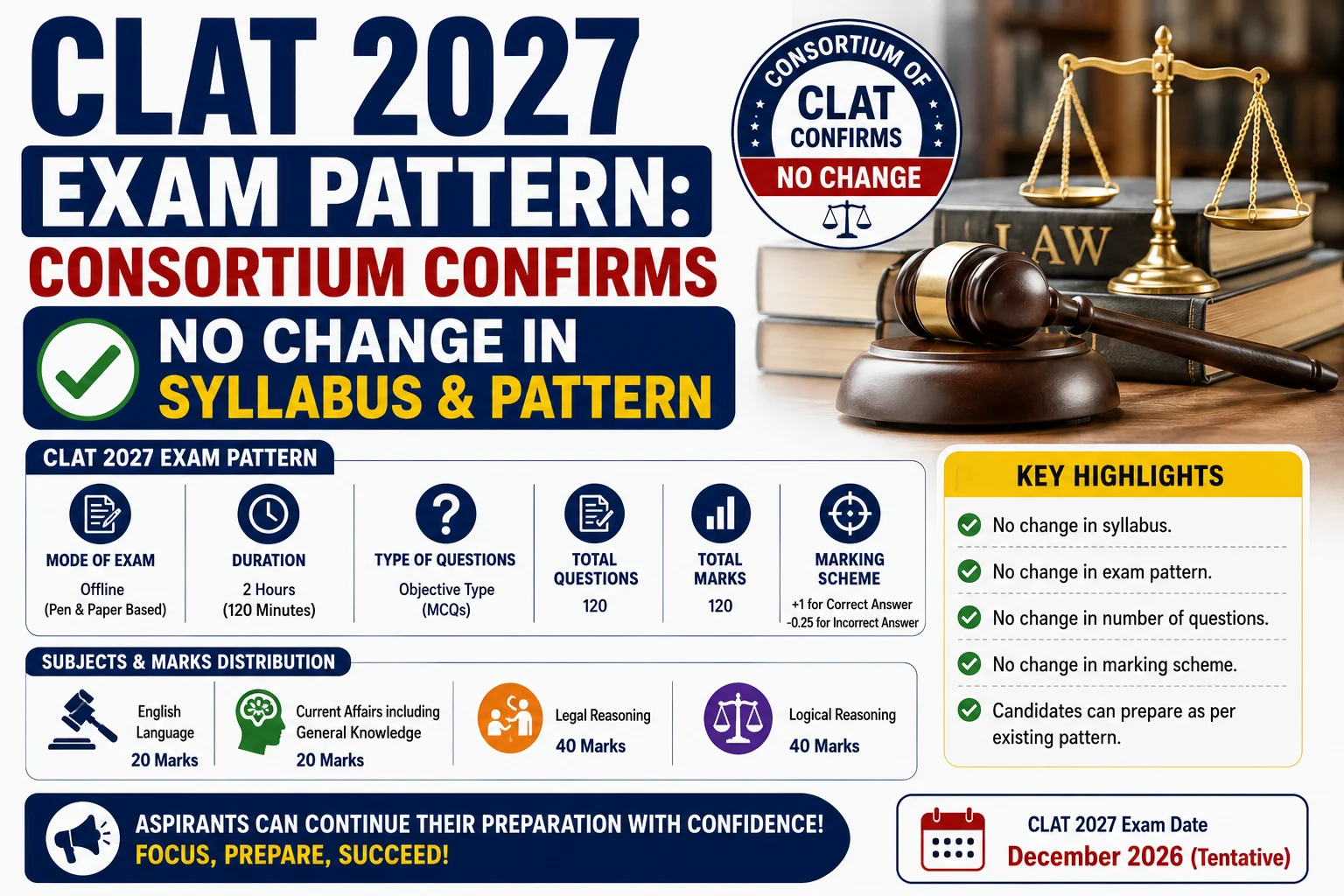
The Consortium of National Law Universities (NLUs) has confirmed that there will be no change in the CLAT 2027 syllabus or examination pattern. The announcement is important for law aspirants because candidates preparing for the Common Law Admission Test can continue following the existing preparation strategy instead of adjusting to a completely new paper structure.
The Consortium has announced that CLAT 2027 will be conducted on December 6, 2026, from 2:00 PM to 4:00 PM. The examination will be conducted in offline, pen-and-paper mode. Registration for CLAT 2027 opened on August 3, 2026, and the application deadline is October 31, 2026.
For UG candidates, the paper will continue to contain 120 multiple-choice questions carrying 120 marks, with a duration of two hours. There will also be negative marking of 0.25 marks for every incorrect answer.
This confirmation gives students greater clarity about what to expect from the upcoming examination.
CLAT 2027 Exam Pattern: No Major Change
The Consortium has confirmed that the CLAT 2027 syllabus and exam pattern remain unchanged.
For the Undergraduate examination, candidates will continue to face five sections:
- English Language
- Current Affairs, including General Knowledge
- Legal Reasoning
- Logical Reasoning
- Quantitative Techniques
The Consortium’s official CLAT 2027 syllabus states that the examination is designed mainly to test comprehension, reasoning and aptitude skills required for legal education rather than testing extensive prior knowledge of law.
This means candidates who have already started preparing according to the existing CLAT structure do not need to completely change their study strategy.
CLAT 2027 Exam Date and Timing
The Consortium has scheduled CLAT 2027 for Sunday, December 6, 2026.
The examination will be conducted from:
2:00 PM to 4:00 PM
The examination will be held in offline mode. The official instructions also state that eligible PwD candidates may receive additional time, with the notified examination duration extending to 4:40 PM for eligible candidates.
Candidates should carefully check their admit cards for the final reporting time and examination-centre instructions once the hall tickets are released.
CLAT 2027 UG Exam Pattern at a Glance
| Particular | CLAT 2027 UG |
|---|---|
| Exam mode | Offline |
| Duration | 2 hours |
| Total questions | 120 |
| Maximum marks | 120 |
| Question type | Multiple Choice Questions |
| Marks for correct answer | +1 |
| Negative marking | -0.25 |
| Total sections | 5 |
| Exam date | December 6, 2026 |
| Exam timing | 2:00 PM to 4:00 PM |
These details are based on the Consortium’s official CLAT 2027 question-paper format and examination instructions.
CLAT 2027 Section-Wise Weightage
Although the exact number of questions can vary within the prescribed range, the Consortium has provided an approximate distribution for each section.
| Section | Approx. Questions | Approx. Weightage |
|---|---|---|
| English Language | 22–26 | 20% |
| Current Affairs, including GK | 28–32 | 25% |
| Legal Reasoning | 28–32 | 25% |
| Logical Reasoning | 22–26 | 20% |
| Quantitative Techniques | 10–14 | 10% |
| Total | 120 | 100% |
The Consortium has officially listed these ranges for CLAT 2027.
English Language Section
The English Language section will continue to focus on reading comprehension and language skills.
Candidates can expect passages of around 450 words, followed by questions designed to test their understanding of the material.
The section can assess a candidate’s ability to:
- Identify the main point of a passage
- Understand arguments and viewpoints
- Draw inferences
- Summarise information
- Compare different arguments
- Understand words and phrases according to context
The Consortium states that the passages may come from contemporary or historically significant fiction and non-fiction.
How to Prepare for English
Candidates should develop a regular reading habit instead of relying only on grammar books.
Reading editorials, quality newspapers, essays and long-form articles can help improve comprehension speed.
Practice should focus on understanding the passage rather than reading every sentence repeatedly.
Current Affairs and General Knowledge
The Current Affairs and General Knowledge section carries approximately 25% of the CLAT UG paper, making it one of the largest sections.
Questions are based around passages related to current events, news, journalism and other non-fiction sources.
The Consortium says the section can cover:
- Significant events in India
- International affairs
- Arts and culture
- Historical events of continuing importance
- General awareness related to current developments
The questions can also include legal information discussed in a passage, but candidates are not expected to have specialised legal knowledge beyond what is provided in the passage.
How to Prepare for Current Affairs
Candidates should avoid trying to memorise every piece of news.
Instead, focus on important national and international developments and understand the background behind major events.
Maintaining monthly current-affairs notes can make revision easier as the examination approaches.
Legal Reasoning Section
Legal Reasoning remains one of the most important sections in CLAT 2027.
The Consortium has allocated approximately 28–32 questions, or around 25% of the paper, to this section.
The section uses passages involving:
- Legal matters
- Public policy
- Moral issues
- Fact situations
- General legal principles
Candidates are expected to identify principles from a passage and apply them to hypothetical situations.
Importantly, the Consortium states that candidates do not require prior knowledge of law to attempt the Legal Reasoning section. General awareness of contemporary legal and moral issues can nevertheless be helpful.
How to Prepare for Legal Reasoning
Focus on:
- Principle-based questions
- Application of rules
- Reading comprehension
- Legal current affairs
- Public policy issues
- Constitutional developments
Do not spend most of your preparation time memorising sections of laws unless your preparation material specifically requires it.
The ability to understand a principle and apply it correctly is more important.
Logical Reasoning Section
The Logical Reasoning section is expected to account for around 20% of the CLAT 2027 UG paper, with approximately 22–26 questions.
The section will contain short passages followed by questions testing reasoning and analytical abilities.
Candidates may need to:
- Identify arguments
- Find premises and conclusions
- Analyse reasoning
- Draw logical inferences
- Identify contradictions
- Recognise relationships
- Evaluate arguments
- Determine whether evidence strengthens or weakens a conclusion
The Consortium’s syllabus specifically focuses on the candidate’s ability to analyse arguments and understand how conclusions depend on assumptions, evidence and premises.
How to Prepare for Logical Reasoning
Regular practice is more useful than simply reading theory.
Candidates should solve different types of passage-based reasoning questions and analyse why an option is correct or incorrect.
Quantitative Techniques Section
Quantitative Techniques will remain the smallest section in terms of question count, accounting for approximately 10% of the paper.
Candidates can expect around 10–14 questions.
The section requires candidates to extract and manipulate numerical information provided in short sets of facts, propositions or textual representations.
The focus is not simply on solving complicated mathematical equations.
Candidates should be comfortable with:
- Percentages
- Ratios
- Averages
- Basic arithmetic
- Data interpretation
- Numerical comparisons
- Tables and numerical information
How to Prepare for Quantitative Techniques
Since this section has fewer questions, candidates should aim for accuracy rather than spending excessive time on one difficult problem.
Practising calculations regularly can improve both speed and confidence.
CLAT 2027 Negative Marking
The negative-marking system remains unchanged.
Candidates will receive:
- +1 mark for every correct answer
- -0.25 mark for every incorrect answer
- 0 marks for an unanswered question
The official CLAT 2027 question-paper format confirms the 0.25-mark penalty for each wrong answer.
This means candidates should make their attempts strategically.
Blind guessing across a large number of questions can reduce the overall score.
CLAT 2027 Will Be Conducted Offline
Another important point for candidates is that CLAT 2027 will be conducted in offline mode.
The Consortium’s official instructions clearly state that the examination will be conducted offline.
Candidates should therefore practise solving full-length papers on paper rather than preparing exclusively through computer-based mock tests.
This can help develop:
- Faster reading
- Quick marking
- Time management
- Passage annotation
- Efficient question selection
Why the No-Change Announcement Matters
The confirmation that there is no change in the syllabus or pattern is particularly useful for students who have already been preparing for CLAT.
Candidates do not need to:
- Learn a completely new section
- Change their entire preparation strategy
- Search for a new syllabus
- Worry about an unexpected paper structure
Instead, they can focus on strengthening their performance in the five existing sections.
The Consortium’s official syllabus and question-paper format confirm that the same five UG areas continue for CLAT 2027.
CLAT 2027 Registration Schedule
The CLAT 2027 application process opened on August 3, 2026.
The last date to submit the application and pay the applicable fee is October 31, 2026, at 11:59 PM.
Candidates should not wait until the final day to complete registration.
Before submitting the form, carefully check:
- Name
- Parent details
- Date of birth
- Category
- Programme preference
- Photograph
- Signature
- Test-city preferences
- Contact information
The Consortium’s instructions state that candidates must provide correct and authentic information and that discrepancies between application information and documents can affect admission.
Can Candidates Appearing for Class 12 Apply?
Yes.
Candidates who are appearing for their qualifying examination in 2027 can apply for CLAT 2027, subject to meeting the applicable eligibility requirements.
The Consortium’s FAQ states that candidates appearing for their qualifying examination in March/April 2027 can appear for CLAT 2027 but must provide proof of passing at the time of admission.
This makes CLAT 2027 relevant to students currently preparing for their Class 12 board examinations as well.
CLAT 2027 PG Exam Pattern Also Remains Structured
The no-change announcement is relevant to the CLAT PG examination as well.
For CLAT PG 2027, the official format provides:
- 120 questions
- 120 marks
- Two-hour duration
- Multiple-choice questions
- 0.25-mark negative marking
The syllabus includes Constitutional Law along with other areas of law such as Jurisprudence, Administrative Law, Contract, Torts, Family Law, Criminal Law, Property Law, Company Law, Public International Law, Tax Law, Environmental Law and Labour & Industrial Law.
Therefore, PG aspirants should also continue preparing according to the existing structure.
CLAT 2027 Preparation Strategy After the No-Change Announcement
The confirmation gives candidates an opportunity to focus more seriously on preparation.
Build a Strong Reading Habit
CLAT is heavily passage-based.
Reading regularly can improve comprehension speed across English, Current Affairs, Legal Reasoning and Logical Reasoning.
Practise Full-Length Papers
Do not wait until the final month to start solving complete papers.
Regular full-length practice can help identify:
- Weak sections
- Time-consuming question types
- Accuracy problems
- Poor question selection
- Time-management issues
Track Current Affairs
Current Affairs and General Knowledge represents around one-fourth of the UG paper.
Keep organised notes and revise them regularly.
Focus on Accuracy
Because of negative marking, attempting every question without considering the probability of getting it right may not be the best strategy.
Improve Time Management
You have 120 minutes for 120 questions.
This does not mean that every question deserves exactly one minute.
Some questions will take considerably less time, while difficult passages may require longer.
The goal should be to maximise your score within the two-hour window.
CLAT 2027: Suggested Section-Wise Strategy
| Section | Main Focus |
|---|---|
| English | Reading comprehension and vocabulary in context |
| Current Affairs & GK | Important national and international developments |
| Legal Reasoning | Applying principles to fact situations |
| Logical Reasoning | Arguments, inference and analytical reasoning |
| Quantitative Techniques | Basic mathematics and data interpretation |
This strategy aligns with the skills described in the Consortium’s official CLAT 2027 syllabus.
Common Mistakes CLAT 2027 Candidates Should Avoid
Even with no change in the pattern, candidates can make preparation mistakes.
Ignoring Current Affairs
Some candidates focus heavily on English and Legal Reasoning while neglecting Current Affairs.
That can be costly because Current Affairs and GK represents around 25% of the paper.
Spending Too Much Time on One Passage
A difficult question should not consume several minutes while easier questions remain unanswered.
Memorising Law Instead of Understanding Principles
Legal Reasoning is primarily designed to test application of principles provided in passages.
Avoiding Quantitative Techniques
Although it has the smallest weightage, leaving the section completely unprepared can result in lost marks.
Taking Too Few Mock Tests
Understanding the syllabus is different from performing well under a two-hour time limit.
CLAT 2027 Exam-Day Preparation
Candidates should also prepare for the practical aspects of the examination.
Before exam day:
- Download the admit card when available.
- Check the examination-centre address.
- Plan your travel.
- Carry the documents mentioned in the admit card.
- Reach the centre well before the reporting deadline.
- Follow all examination-centre instructions.
- Avoid carrying prohibited items.
Because CLAT 2027 is an offline examination, candidates should also make sure they are comfortable with pen-and-paper answering.
CLAT 2027: Important Dates
| Event | Date |
|---|---|
| CLAT 2027 Registration Begins | August 3, 2026 |
| Application Deadline | October 31, 2026 |
| CLAT 2027 Examination | December 6, 2026 |
| Examination Time | 2:00 PM–4:00 PM |
| Mode | Offline |
The schedule is based on the Consortium’s official CLAT 2027 instructions.
What Does “No Change in Pattern” Actually Mean?
The statement that there is no change should not be interpreted as meaning that candidates can ignore the official CLAT 2027 materials.
The Consortium has still published the current syllabus and question-paper format for CLAT 2027.
Candidates should use these official resources as their primary reference rather than relying on older coaching material.
The official UG format confirms 120 questions, five sections, a two-hour duration and 0.25 negative marking.
Final Thoughts
The confirmation that there is no change in the CLAT 2027 syllabus or exam pattern is welcome news for law aspirants. Students who have already started preparing can continue with their existing strategy while focusing on improving speed, accuracy and comprehension.
CLAT 2027 will be held on December 6, 2026, from 2:00 PM to 4:00 PM in offline mode. The UG paper will contain 120 multiple-choice questions across English Language, Current Affairs including General Knowledge, Legal Reasoning, Logical Reasoning and Quantitative Techniques. Each correct answer will carry one mark, while an incorrect answer will result in a 0.25-mark deduction.
The biggest advantage candidates have now is clarity. There is no need to spend valuable preparation time worrying about a completely different paper structure. Instead, aspirants can concentrate on reading regularly, practising passage-based questions, following current affairs, improving logical reasoning and taking timed mock tests.
Candidates should also remember that no change in syllabus does not mean no preparation is needed. Competition for seats at National Law Universities remains high, and a familiar pattern can still be challenging when thousands of candidates are competing for limited seats.
The best approach for CLAT 2027 is therefore simple: understand the official pattern, practise consistently, analyse your mistakes and build a preparation schedule that covers all five sections.
Read More: How to Reapply After Visa Refusal: Steps, Documents, Reasons & Tips for Approval