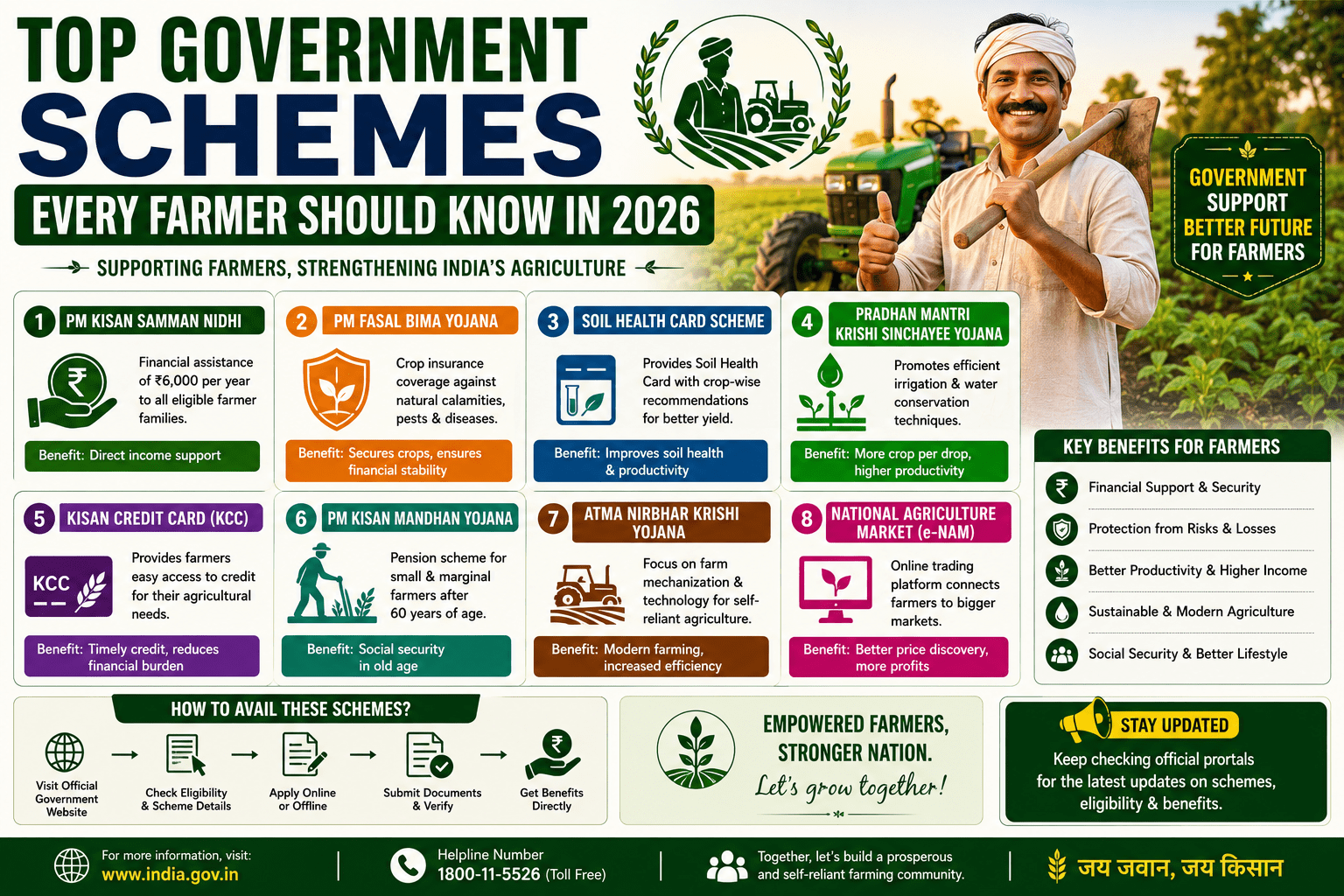
The Government of India has introduced several welfare schemes to improve farmers’ income, reduce farming risks, promote sustainable agriculture, and encourage the adoption of modern farming techniques. These schemes provide benefits such as direct financial assistance, crop insurance, affordable agricultural loans, irrigation support, soil testing, digital marketing platforms, subsidies for farm machinery, fisheries, and organic farming. Together, they aim to make Indian agriculture more productive and resilient.
In 2026, farmers should stay informed about the latest government schemes to maximize the benefits available to them. This guide highlights the top government schemes every farmer should know, along with their benefits, eligibility, and application process.
Why Government Schemes are Important for Farmers
Government schemes help farmers by:
- Providing direct financial assistance.
- Reducing crop-related risks.
- Offering affordable credit.
- Supporting modern agricultural practices.
- Increasing farm productivity.
- Improving market access.
- Promoting sustainable farming.
- Enhancing farmers’ income.
Top Government Schemes for Farmers in 2026
1. PM Kisan Samman Nidhi (PM-KISAN)
PM-KISAN provides ₹6,000 per year to eligible landholding farmer families through Direct Benefit Transfer (DBT) in three equal installments.
Key Benefits
- ₹2,000 per installment.
- Direct bank transfer.
- No middlemen.
- Nationwide coverage.
2. Pradhan Mantri Fasal Bima Yojana (PMFBY)
PMFBY provides crop insurance against losses caused by natural disasters, pests, and diseases.
Key Benefits
- Low insurance premium.
- Protection against crop loss.
- Financial assistance after crop damage.
- Online claim tracking.
3. Kisan Credit Card (KCC)
The Kisan Credit Card Scheme offers short-term agricultural loans at concessional interest rates for farming and allied activities.
Key Benefits
- Affordable crop loans.
- Flexible repayment.
- Interest subsidy.
- Easy credit access.
4. Soil Health Card Scheme
The Soil Health Card Scheme provides farmers with soil testing reports and fertilizer recommendations.
Key Benefits
- Free soil testing.
- Balanced fertilizer use.
- Improved crop productivity.
- Better soil fertility management.
5. National Agriculture Market (e-NAM)
e-NAM is an online agricultural trading platform connecting APMC mandis across India.
Key Benefits
- Online crop trading.
- Better price discovery.
- Transparent bidding.
- Digital payment facility.
6. Pradhan Mantri Krishi Sinchai Yojana (PMKSY)
PMKSY promotes efficient irrigation and water conservation through the slogan “Per Drop More Crop.”
Key Benefits
- Improved irrigation.
- Water conservation.
- Higher crop productivity.
- Better water-use efficiency.
7. Sub-Mission on Agricultural Mechanization (SMAM)
SMAM provides financial assistance for purchasing tractors and modern agricultural equipment.
Key Benefits
- Tractor subsidy.
- Farm machinery subsidy.
- Reduced farming costs.
- Improved mechanization.
8. Organic Farming Schemes (PKVY & MOVCDNER)
The Government supports organic farming through:
- Paramparagat Krishi Vikas Yojana (PKVY)
- Mission Organic Value Chain Development for North Eastern Region (MOVCDNER)
Key Benefits
- Organic farming subsidy.
- Certification support.
- Farmer training.
- Marketing assistance.
9. Pradhan Mantri Matsya Sampada Yojana (PMMSY)
PMMSY supports fish farming, aquaculture, fisheries infrastructure, and related businesses.
Key Benefits
- Fish farming subsidy.
- Pond construction assistance.
- Infrastructure support.
- Fisheries development.
10. Agriculture Infrastructure Fund (AIF)
The Agriculture Infrastructure Fund provides medium- and long-term financing for post-harvest infrastructure and community farming assets.
Key Benefits
- Warehouse development.
- Cold storage.
- Food processing infrastructure.
- Interest subvention on eligible loans.
Eligibility Criteria
Eligibility varies depending on the scheme, but generally applicants should:
- Be an Indian citizen.
- Be engaged in farming or allied agricultural activities.
- Possess agricultural land or meet the scheme-specific eligibility conditions.
- Have an Aadhaar-linked bank account.
- Complete any required registration or verification.
Documents Required
Most schemes require:
- Aadhaar Card
- Mobile Number
- Bank Passbook
- Land Records
- Passport-size Photograph
- Identity Proof
- Address Proof
- Farmer Registration (where applicable)
How to Apply for Government Schemes
Follow these general steps.
Step 1
Visit the official scheme portal or State Agriculture Department website.
Step 2
Register using your Aadhaar-linked mobile number.
Step 3
Fill in the application form.
Step 4
Upload the required documents.
Step 5
Submit the application.
Step 6
Track your application status online.
Benefits of Government Schemes
These schemes help farmers by:
- Increasing annual income.
- Reducing farming risks.
- Improving crop productivity.
- Promoting sustainable agriculture.
- Providing affordable credit.
- Supporting modern technology.
- Expanding market access.
- Improving overall rural development.
Important Tips
Before applying:
- Apply only through official government portals.
- Keep Aadhaar linked with your bank account.
- Complete eKYC where required.
- Submit accurate land details.
- Keep copies of all application receipts.
- Regularly check application and payment status.
Frequently Asked Questions (FAQs)
Which is the most popular government scheme for farmers?
PM Kisan Samman Nidhi (PM-KISAN) is one of the most widely used schemes, providing eligible farmers with ₹6,000 annually through DBT.
Which scheme provides crop insurance?
The Pradhan Mantri Fasal Bima Yojana (PMFBY) offers crop insurance against natural calamities, pests, and diseases.
Which scheme provides affordable agricultural loans?
The Kisan Credit Card (KCC) scheme offers low-interest agricultural loans for crop cultivation and allied farming activities.
Which scheme supports online agricultural marketing?
The National Agriculture Market (e-NAM) enables farmers to sell agricultural produce through a transparent online trading platform.
Which scheme supports organic farming?
The Government promotes organic farming through PKVY and MOVCDNER, which provide financial assistance, certification, training, and marketing support.
Conclusion
The Top Government Schemes Every Farmer Should Know in 2026 cover every major aspect of agriculture—from direct income support and crop insurance to affordable credit, soil health, irrigation, mechanization, organic farming, fisheries, and digital marketing. By understanding these schemes and applying through the appropriate official portals, farmers can reduce production costs, improve productivity, manage risks, and increase their income. Staying updated with the latest government initiatives is essential to making the most of the support available for India’s agricultural community.
Read More : Best Agriculture Loans in India for Farmers 2026: KCC, NABARD & Bank Loan Guide