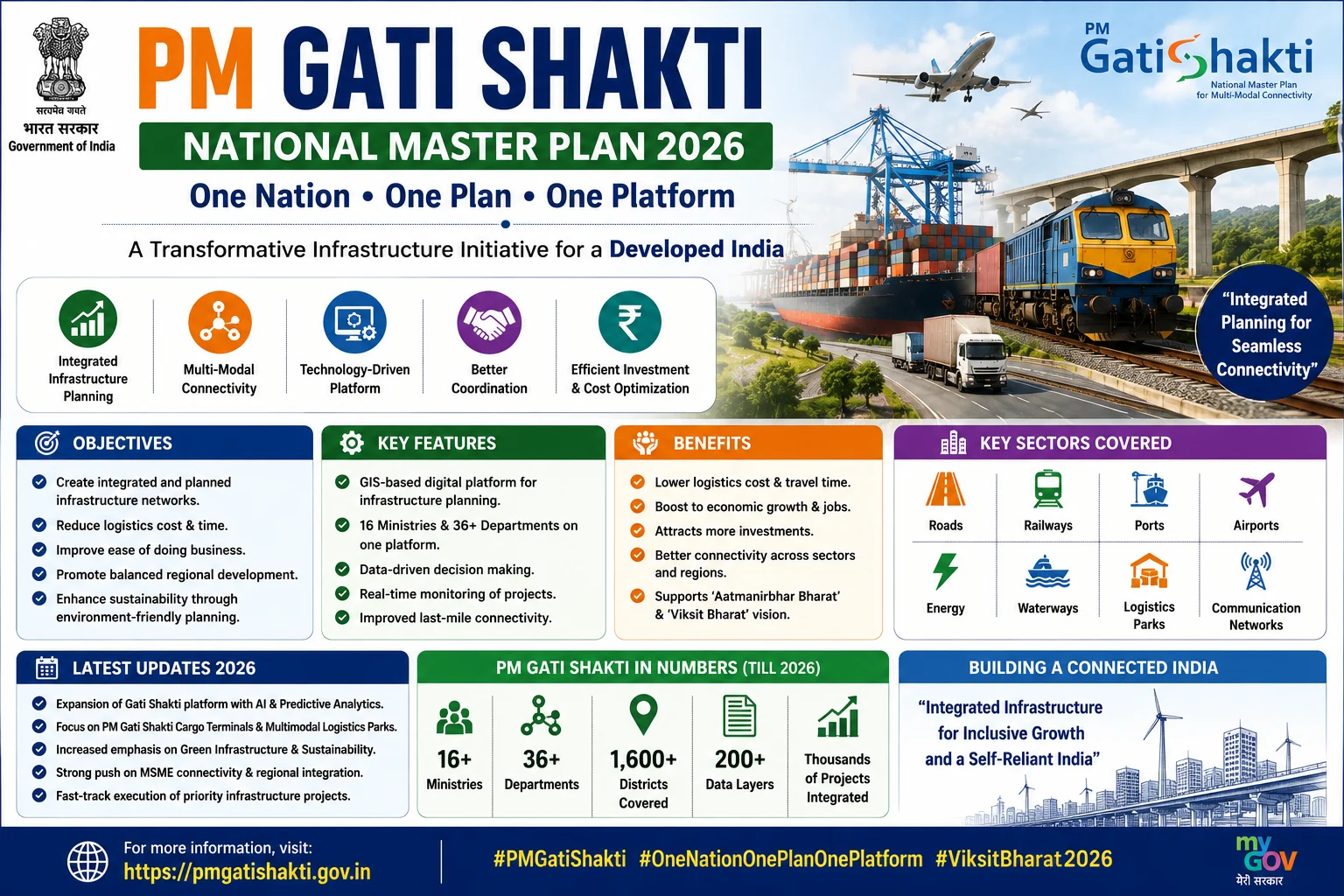
The PM Gati Shakti National Master Plan (PMGS-NMP) is one of India’s most ambitious infrastructure initiatives, launched by the Government of India to improve multi-modal connectivity and accelerate economic growth. Introduced in October 2021, the plan integrates infrastructure planning across various ministries through a GIS-based digital platform, enabling better coordination, faster project execution, reduced logistics costs, and seamless connectivity between roads, railways, ports, airports, waterways, and logistics infrastructure.
The National Master Plan is built on a whole-of-government approach, bringing together infrastructure data from multiple ministries on a single digital platform. It supports integrated planning of projects, minimizes delays caused by poor coordination, and improves last-mile connectivity for industries, farmers, businesses, and citizens. In 2026, the initiative continues to expand, with the Network Planning Group (NPG) having evaluated 352 infrastructure projects worth approximately ₹16.10 lakh crore, highlighting the government’s continued focus on integrated infrastructure development.
This comprehensive guide explains everything about the PM Gati Shakti National Master Plan 2026, including its objectives, features, benefits, implementation process, participating sectors, latest updates, and frequently asked questions.
Objectives of PM Gati Shakti National Master Plan
The scheme aims to:
- Develop world-class infrastructure.
- Improve multi-modal connectivity.
- Reduce logistics costs.
- Improve last-mile connectivity.
- Accelerate infrastructure project implementation.
- Enhance inter-ministerial coordination.
- Promote industrial development.
- Improve ease of doing business.
- Increase economic competitiveness.
- Support India’s vision of becoming a developed economy.
PM Gati Shakti National Master Plan 2026 Highlights
| Particular | Details |
|---|---|
| Scheme Name | PM Gati Shakti National Master Plan |
| Launched By | Government of India |
| Launch Year | 2021 |
| Nodal Ministry | Ministry of Commerce & Industry |
| Platform | GIS-Based Digital Master Planning Platform |
| Coverage | Pan India |
| Beneficiaries | Citizens, Industries, Farmers, Businesses, Logistics Sector |
| Objective | Integrated Infrastructure Development |
| Implementation | Multi-Ministerial Coordination |
What is PM Gati Shakti National Master Plan?
PM Gati Shakti is a GIS-enabled digital planning platform that integrates data from multiple Central Ministries and State Governments into a single system. Instead of planning projects independently, departments collaborate using shared data to ensure that roads, railways, ports, airports, power lines, pipelines, and logistics parks are planned together.
The platform enables authorities to identify infrastructure gaps, avoid duplication of work, reduce project delays, and improve connectivity across the country.
Six Pillars of PM Gati Shakti
The National Master Plan is based on six key pillars.
1. Comprehensiveness
The platform integrates existing and proposed infrastructure projects from multiple ministries into one centralized database.
2. Prioritization
Projects are prioritized based on national requirements, economic importance, and inter-departmental coordination.
3. Optimization
Authorities can identify the most efficient routes and infrastructure options, reducing travel time and logistics costs.
4. Synchronization
Different ministries work together instead of planning projects independently, minimizing duplication and delays.
5. Analytical Planning
The GIS platform provides advanced spatial analysis to identify infrastructure gaps and improve planning.
6. Dynamic Monitoring
Project progress is updated regularly, enabling real-time monitoring and timely decision-making.
Infrastructure Sectors Covered
The National Master Plan integrates major infrastructure sectors, including:
- National Highways
- Railways
- Airports
- Seaports
- Inland Waterways
- Logistics Parks
- Industrial Corridors
- Economic Zones
- Power Infrastructure
- Petroleum & Gas Pipelines
- Telecom Infrastructure
- Urban Transport
- Warehousing
- Freight Corridors
Benefits of PM Gati Shakti National Master Plan
Faster Infrastructure Development
Integrated planning reduces delays caused by poor coordination among departments.
Reduced Logistics Costs
Better connectivity between transportation modes lowers transportation expenses for businesses.
Improved Connectivity
The plan strengthens connections between production centres, industrial parks, ports, airports, and markets.
Better Project Coordination
Central and State Government departments can coordinate projects more efficiently through a common digital platform.
Increased Investment
Improved infrastructure encourages domestic and foreign investment in manufacturing and logistics.
Employment Generation
Large-scale infrastructure projects create direct and indirect employment opportunities across sectors.
Support for Manufacturing
Better logistics and transportation networks improve the competitiveness of Indian industries.
Digital Infrastructure Planning
The GIS-based platform provides real-time mapping, monitoring, and planning of infrastructure projects.
Major Components of the Plan
The National Master Plan supports:
- Economic Corridors
- Industrial Corridors
- Freight Corridors
- Multi-Modal Logistics Parks
- Border Connectivity
- Rural Connectivity
- Urban Infrastructure
- Port Connectivity
- Airport Connectivity
- Defence Infrastructure
Participating Ministries
The PM Gati Shakti platform brings together infrastructure planning from multiple ministries, including:
- Ministry of Road Transport & Highways
- Ministry of Railways
- Ministry of Civil Aviation
- Ministry of Ports, Shipping & Waterways
- Ministry of Commerce & Industry
- Ministry of Power
- Ministry of Petroleum & Natural Gas
- Ministry of Telecommunications
- Ministry of Housing & Urban Affairs
In total, 23 infrastructure-related ministries participate in the integrated planning process.
Latest Updates in 2026
The PM Gati Shakti initiative continues to expand across India.
Some key developments include:
- 352 infrastructure projects worth approximately ₹16.10 lakh crore have been evaluated through the Network Planning Group.
- States continue to receive support for integrated infrastructure development.
- The GIS platform is being used for better project planning and monitoring across sectors.
- Several railway, road, logistics, and industrial connectivity projects have been approved under the PM Gati Shakti framework.
Major Features of PM Gati Shakti
Some important features include:
- GIS-based planning platform.
- Multi-ministerial coordination.
- Real-time project monitoring.
- Digital infrastructure mapping.
- Integrated logistics planning.
- Last-mile connectivity improvement.
- Faster project approvals.
- Reduced infrastructure costs.
- Data-driven planning.
- National-level infrastructure integration.
Impact on Citizens
The initiative benefits citizens through:
- Better roads.
- Faster transportation.
- Improved railway connectivity.
- Better airport access.
- Reduced travel time.
- Improved logistics.
- Better public infrastructure.
- Increased employment opportunities.
- Faster delivery of goods.
- Improved economic development.
Challenges Addressed by the Scheme
PM Gati Shakti helps solve several long-standing infrastructure issues:
- Lack of coordination between departments.
- Delayed infrastructure projects.
- High logistics costs.
- Missing last-mile connectivity.
- Duplication of work.
- Inefficient planning.
- Slow project approvals.
- Poor data sharing.
- Fragmented infrastructure development.
Frequently Asked Questions (FAQs)
What is PM Gati Shakti National Master Plan?
It is a GIS-based national infrastructure planning platform that integrates projects from multiple ministries to improve multi-modal connectivity and accelerate infrastructure development.
When was PM Gati Shakti launched?
The National Master Plan was launched in October 2021 by the Government of India.
Which ministry implements PM Gati Shakti?
The initiative is coordinated by the Ministry of Commerce & Industry, with participation from multiple infrastructure ministries.
What is the main objective of PM Gati Shakti?
Its primary objective is to improve multi-modal infrastructure connectivity, reduce logistics costs, and accelerate infrastructure development across India.
How many ministries are part of PM Gati Shakti?
The initiative involves 23 infrastructure and user ministries working together through an integrated planning platform.
How many projects have been evaluated under the plan?
As of 2026, the Network Planning Group has evaluated 352 infrastructure projects with an estimated value of ₹16.10 lakh crore.
Who benefits from PM Gati Shakti?
Citizens, industries, farmers, transport operators, logistics companies, manufacturers, exporters, and state governments all benefit from improved infrastructure and connectivity.
Conclusion
The PM Gati Shakti National Master Plan 2026 is transforming India’s infrastructure planning through integrated, technology-driven, and data-based decision-making. By connecting roads, railways, ports, airports, logistics hubs, and industrial corridors on a single GIS platform, the initiative reduces project delays, improves coordination, lowers logistics costs, and strengthens economic growth. As the programme continues to expand with hundreds of major infrastructure projects under evaluation, PM Gati Shakti is expected to play a crucial role in building a faster, more efficient, and globally competitive infrastructure network for India.