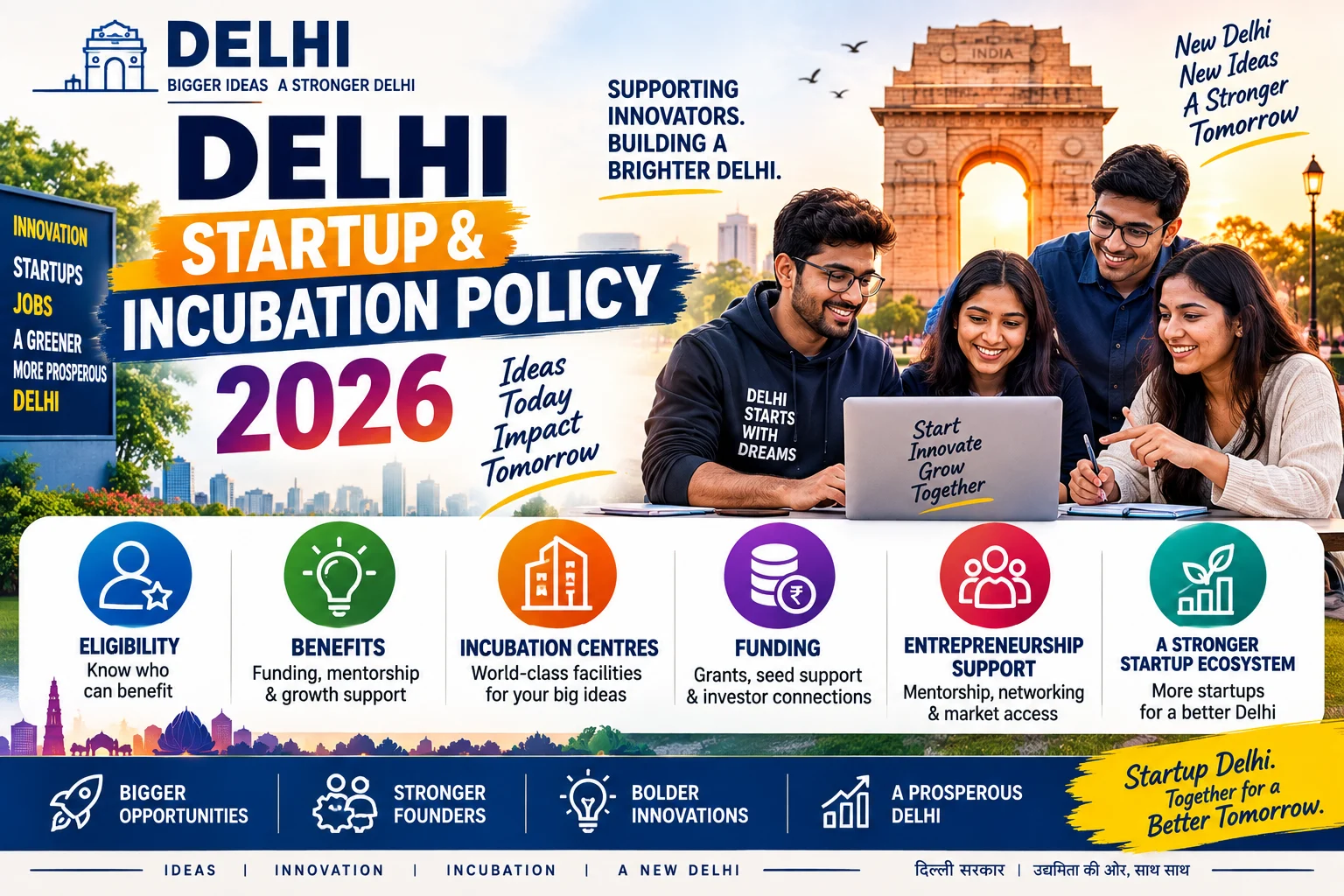
The Delhi Startup & Incubation Policy 2026 is a major initiative of the Government of NCT of Delhi aimed at strengthening the startup ecosystem, encouraging innovation, supporting young entrepreneurs, and creating new employment opportunities. The policy was initially discussed as a proposed framework, but the Delhi Cabinet approved the policy in July 2026, with an investment of more than ₹400 crore over five years.
The policy focuses particularly on building startup and incubation infrastructure in government-funded educational institutions. In its initial phase, the programme is expected to cover 11 state universities, 13 government-aided colleges, polytechnic institutions, Industrial Training Institutes (ITIs), and government schools. The objective is to give students and young innovators access to incubation, mentorship, financial support, networking opportunities, and an environment where innovative ideas can be converted into viable businesses.
The policy is an important step toward developing Delhi as a stronger centre for entrepreneurship and innovation. It also reflects a shift toward encouraging young people to become job creators rather than only job seekers.
What is Delhi Startup & Incubation Policy 2026?
The Delhi Startup & Incubation Policy 2026 is a government initiative designed to create a structured ecosystem for startups and entrepreneurs in Delhi.
The policy aims to connect:
- Students
- Young entrepreneurs
- Startups
- Educational institutions
- Incubators
- Investors
- Industry representatives
- Mentors
- Government agencies
Through incubation centres and institutional support, aspiring entrepreneurs can get opportunities to develop their business ideas, test products, receive guidance, connect with investors, and potentially obtain financial assistance.
The policy is particularly focused on using government-funded educational institutions as innovation and entrepreneurship hubs.
Delhi Startup & Incubation Policy 2026 Highlights
| Particular | Details |
|---|---|
| Policy Name | Delhi Startup & Incubation Policy 2026 |
| State | Delhi |
| Implementing Government | Government of NCT of Delhi |
| Policy Status | Approved by Delhi Cabinet in July 2026 |
| Proposed Investment | More than ₹400 crore |
| Implementation Period | Five years |
| Main Objective | Promote startups, innovation and entrepreneurship |
| Initial Institutions | 11 state universities, 13 government-aided colleges, ITIs, polytechnics and government schools |
| Major Support | Incubation, mentorship, institutional infrastructure and financial assistance |
| Target Group | Students, innovators, entrepreneurs and startups |
| Major Event | Annual Delhi Start-up Youth Festival |
The policy is intended to provide structured support rather than only one-time financial assistance.
Why Was the Delhi Startup Policy Introduced?
Delhi has a large student population, numerous higher-education institutions and a strong technology and services ecosystem. However, many innovative ideas do not develop into successful businesses because students and first-time entrepreneurs may lack:
- Funding
- Mentorship
- Business guidance
- Incubation facilities
- Industry connections
- Market access
- Professional infrastructure
The Startup & Incubation Policy seeks to address these gaps by creating startup-support infrastructure within government-funded institutions.
The government has stated that the policy is intended to promote innovation, research, self-employment and entrepreneurship and help young people turn their ideas into successful startups.
Main Objectives of Delhi Startup & Incubation Policy
The major objectives include:
- Promote entrepreneurship among young people.
- Encourage innovation and research.
- Establish incubation infrastructure.
- Support student entrepreneurs.
- Provide mentorship and business guidance.
- Improve access to funding.
- Encourage self-employment.
- Create new employment opportunities.
- Connect startups with investors and industry.
- Develop Delhi as an innovation hub.
- Encourage commercialization of innovative ideas.
- Strengthen the relationship between educational institutions and industry.
Incubation Centres Under the Policy
One of the most important components of the policy is the establishment and strengthening of incubation centres.
The first phase is expected to cover:
- 11 state universities
- 13 government-aided colleges
- Polytechnics
- Industrial Training Institutes
- Government schools
The government will provide financial support to eligible institutions for establishing or strengthening incubation centres.
These centres can provide entrepreneurs with an environment where they can develop their ideas before launching them into the market.
What is a Startup Incubation Centre?
A startup incubation centre is a facility that supports entrepreneurs during the early stages of building a business.
Depending on the institution and programme, an incubation centre can provide:
- Workspace
- Mentorship
- Business planning support
- Technical guidance
- Networking
- Training
- Product development support
- Investor connections
- Market-related guidance
- Entrepreneurship programmes
For students, these centres can provide an opportunity to work on business ideas while continuing their education.
Financial Support Under the Policy
The Delhi Government has allocated more than ₹400 crore over five years for implementing the Startup & Incubation Policy.
Financial support under the policy is not limited to simply giving a fixed amount of money to every startup. The framework is intended to support institutions and startups through different mechanisms, including:
- Funding for incubation infrastructure.
- Support for strengthening existing incubators.
- Financial assistance to eligible entrepreneurs or successful student innovators.
- Support linked to startup development and milestones.
- Institutional support for entrepreneurship activities.
The exact amount and eligibility for financial assistance can depend on the specific programme, institution and implementation guidelines.
Therefore, applicants should not assume that every startup will automatically receive a particular fixed grant.
Support for Students
Students are one of the major target groups of the policy.
The government wants students to receive opportunities to transform innovative ideas into practical businesses.
Students may benefit from:
- Entrepreneurship training.
- Incubation facilities.
- Mentorship.
- Innovation programmes.
- Networking opportunities.
- Startup competitions.
- Access to industry experts.
- Investor interaction.
- Financial support for eligible ideas.
- Exposure to the startup ecosystem.
The policy also extends opportunities to students of Delhi government schools through the participating institutional ecosystem.
Support for Young Entrepreneurs
Young entrepreneurs often have innovative ideas but lack experience in business management.
The policy can help address these challenges by connecting entrepreneurs with:
- Mentors
- Incubators
- Educational institutions
- Investors
- Industry experts
- Government agencies
This can help entrepreneurs understand areas such as business planning, product development, market research, financial management, marketing, technology and fundraising.
Delhi Start-up Youth Festival
Another important component of the policy is the proposed annual Delhi Start-up Youth Festival.
The festival is expected to bring together:
- Young innovators
- Startups
- Students
- Educational institutions
- Investors
- Industry representatives
- Policymakers
Such an event can provide a platform for entrepreneurs to showcase their ideas, find potential partners, receive feedback and build investor or industry connections.
Who Can Benefit From the Policy?
The policy is primarily focused on strengthening the startup ecosystem around government-supported educational institutions.
Potential beneficiaries include:
- Students
- Student entrepreneurs
- Young innovators
- Startup founders
- Faculty members
- Alumni
- Incubation centres
- Educational institutions
- Technology innovators
- Early-stage businesses
The exact eligibility for individual financial assistance or incubation support will depend on the detailed implementation guidelines issued by the relevant authorities.
Priority Areas for Startups
Delhi’s startup ecosystem has previously identified several sectors for innovation support, including:
- Artificial Intelligence
- Machine Learning
- Education Technology
- Healthcare Technology
- Fintech
- Tourism
- Electric Vehicles
- Green Technology
- Internet of Things
- Software and SaaS
- Robotics
- E-governance
- IT and IT-enabled services
- Bio-pharma
- Medical devices
- Waste management
The broader Delhi startup ecosystem has also highlighted these areas as priority sectors for entrepreneurship and innovation.
Eligibility for Startup Support
Since the policy is being implemented through institutions and different programmes, eligibility may vary.
Generally, applicants may need to meet conditions related to:
- Startup or business status.
- Association with an eligible educational institution, where applicable.
- Innovation or business idea.
- Stage of startup development.
- Institutional incubation requirements.
- Business viability.
- Indian entity or founder requirements, wherever applicable.
- Submission of required documents.
The detailed eligibility criteria for specific financial assistance should be checked once the concerned department or institution releases the relevant application guidelines.
Documents That May Be Required
Depending on the programme, applicants may need:
- Aadhaar Card
- PAN Card
- Address proof
- Student ID, where applicable
- College or university ID
- Startup incorporation documents
- Business registration documents
- Startup recognition certificate, if applicable
- Business plan
- Pitch deck
- Project report
- Details of founders
- Bank account details
- Financial information
- Proof of innovation or intellectual property, where applicable
Applicants should submit only the documents requested in the specific notification.
How to Avail Benefits Under Delhi Startup & Incubation Policy
The exact application process will depend on the individual programme and participating institution.
A general process may include:
Step 1: Identify an Eligible Institution
Check whether your university, college, ITI, polytechnic or other institution is participating in the incubation programme.
Step 2: Contact the Incubation Centre
Approach the designated incubation or entrepreneurship cell.
Step 3: Submit Your Startup Idea
Prepare a business plan, pitch deck or project proposal explaining your idea.
Step 4: Complete Screening
The institution or incubation centre may evaluate the idea based on innovation, feasibility, scalability and market potential.
Step 5: Participate in Mentorship
Selected applicants may receive business and technical guidance.
Step 6: Develop the Product or Service
Entrepreneurs can use incubation support to develop and test their product or service.
Step 7: Seek Funding
Eligible startups may be considered for financial support or investor connections under the applicable programme.
Step 8: Launch and Scale
After validation, entrepreneurs can work toward launching and expanding their businesses.
The exact process, application dates and financial support will depend on the official implementation guidelines.
Benefits for Delhi’s Startup Ecosystem
The policy can have wider benefits for Delhi’s economy.
More Entrepreneurship
Students and young professionals may be encouraged to start their own businesses.
Employment Generation
Successful startups can create direct and indirect employment.
Better Industry-Academia Collaboration
Educational institutions can work more closely with industry and entrepreneurs.
Innovation Infrastructure
Incubation centres can provide physical and professional infrastructure for new businesses.
Greater Investor Access
Startup events and institutional programmes can help founders connect with investors.
Commercialization of Ideas
Innovative research and student projects can potentially be transformed into commercial products and services.
Delhi Startup Policy and Startup India
The Delhi policy is a state-level initiative and should not be confused with the central government’s Startup India programme.
Startup India provides national-level recognition and support mechanisms for eligible startups. In February 2026, the central government also revised its startup recognition framework, including increasing the general turnover eligibility limit to ₹200 crore and introducing enhanced limits for qualifying deep-tech startups.
A Delhi-based startup may therefore potentially benefit from both state-level initiatives and applicable central government startup programmes, provided it meets the respective eligibility conditions.
Important Points for Entrepreneurs
Before applying for any benefit, entrepreneurs should:
- Check whether their institution is covered.
- Read the latest notification.
- Prepare a clear business plan.
- Explain the problem their startup solves.
- Demonstrate market potential.
- Maintain proper registration documents.
- Keep financial records ready.
- Verify the eligibility criteria for funding.
- Apply through official channels.
- Avoid relying on unofficial websites or agents.
Frequently Asked Questions (FAQs)
What is Delhi Startup & Incubation Policy 2026?
It is a Delhi Government initiative designed to promote startups, innovation, research and entrepreneurship by developing incubation infrastructure and providing institutional and financial support.
Has the Delhi Startup & Incubation Policy been approved?
Yes. The Delhi Cabinet approved the policy in July 2026. The government has announced an investment of more than ₹400 crore over five years.
How much money has been allocated for the policy?
More than ₹400 crore has been allocated for the policy over a five-year period.
Who can benefit from the policy?
Students, young entrepreneurs, innovators, startups and eligible institutions can benefit through the various programmes and incubation mechanisms created under the policy.
How many institutions are covered initially?
The first phase includes 11 state universities and 13 government-aided colleges, along with polytechnics, ITIs and government schools.
Will every startup receive government funding?
No. Financial support will depend on the applicable programme, eligibility requirements, evaluation and implementation guidelines.
What is the Delhi Start-up Youth Festival?
It is an annual event planned under the policy to bring together startups, students, innovators, investors, educational institutions, industry representatives and policymakers.
Can school students benefit from the policy?
The policy’s ecosystem includes government schools, and the government has indicated that students can access opportunities through participating institutions.
Is Delhi Startup & Incubation Policy the same as Startup India?
No. Delhi Startup & Incubation Policy is a Delhi Government policy, while Startup India is a Central Government initiative. Eligible startups may potentially benefit from both programmes separately.
Conclusion
The Delhi Startup & Incubation Policy 2026 is a significant initiative aimed at creating a stronger culture of entrepreneurship, innovation and self-employment in the capital. With an investment of more than ₹400 crore over five years, the policy will focus on incubation centres across state universities, government-aided colleges, polytechnics, ITIs and government schools.
By providing access to incubation infrastructure, mentorship, financial support, networking and entrepreneurship opportunities, the policy can help students and young innovators turn promising ideas into sustainable businesses. The planned Delhi Start-up Youth Festival can further connect entrepreneurs with investors, industry and policymakers.
For aspiring entrepreneurs, the policy represents an opportunity to access institutional support at an early stage. However, applicants should wait for and follow the specific implementation guidelines and official notifications applicable to their institution or startup before applying for financial assistance or incubation benefits.