Supreme Court Refuses Urgent Listing of Ram Temple Donation Plea
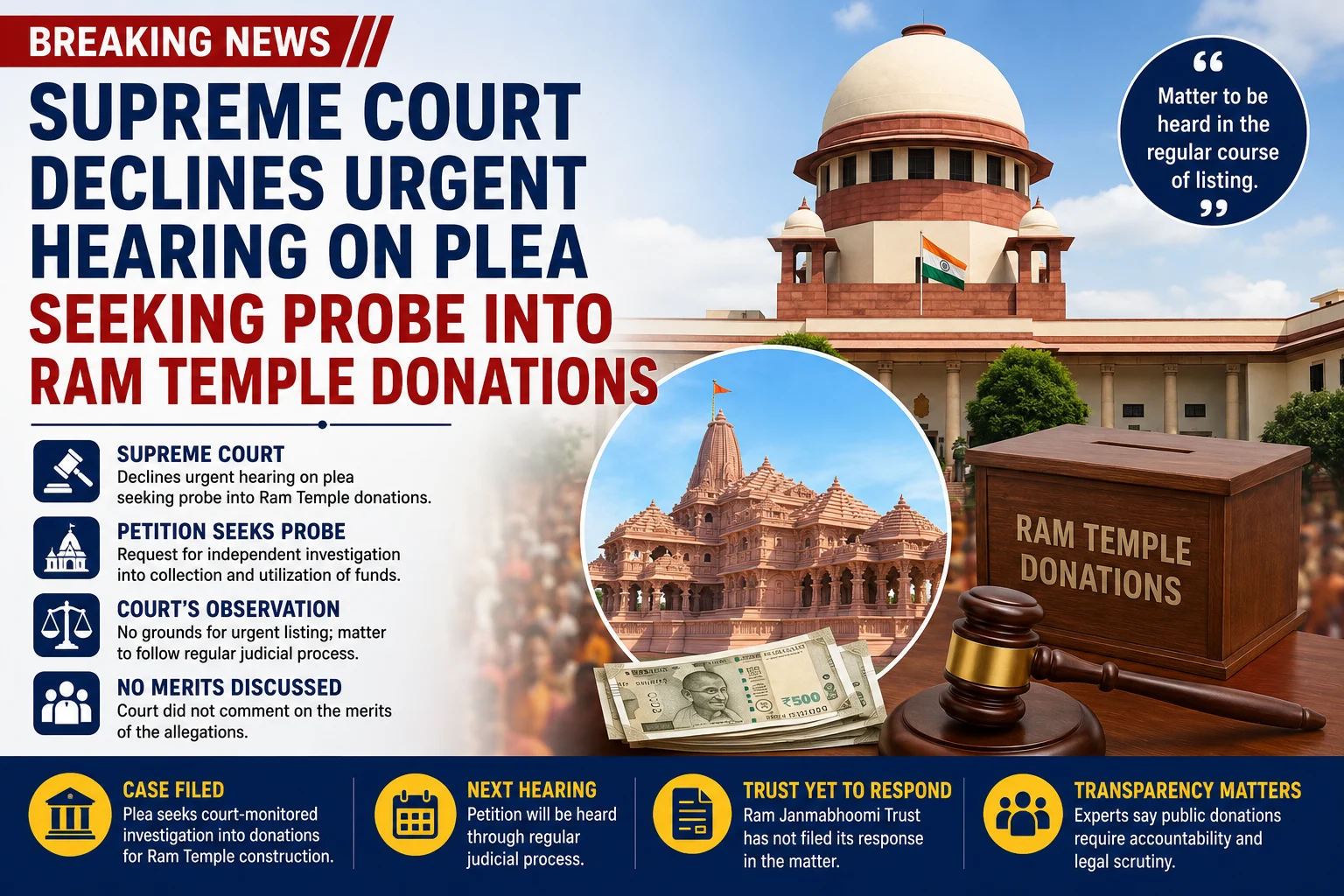
The Supreme Court of India has declined an urgent hearing on a petition seeking an independent investigation into donations received for the construction of the Ram Temple in Ayodhya. The petitioner had requested immediate intervention, alleging irregularities in the handling and utilization of donation funds.
However, the apex court did not find sufficient grounds for granting an urgent listing and directed that the matter follow the regular judicial process. As a result, the petition will be heard according to the court’s normal schedule.
What Was the Petition About?
The plea sought a court-monitored investigation into donations collected for the Ram Temple project. The petitioner requested an inquiry by an independent agency to examine the collection, management, and utilization of funds.
Furthermore, the petition raised concerns regarding transparency and accountability in the management of public donations. The petitioner argued that an impartial investigation would help address these concerns.
Supreme Court’s Response
During the mentioning of the matter, the Supreme Court declined the request for an urgent hearing. The bench observed that there was no immediate urgency requiring the court to bypass its regular listing procedure.
Moreover, the court did not make any observations on the merits of the allegations presented in the petition. Instead, it limited its decision to the request for urgent listing.
Therefore, the petition remains pending and may be taken up through the usual judicial process at a later date.
Ram Temple Trust Yet to Respond in Court
At this stage, the concerned authorities and the Shri Ram Janmabhoomi Teerth Kshetra Trust, which oversees the Ram Temple project, have not responded before the court regarding the allegations mentioned in the petition.
Additionally, since the matter has not yet been heard on merits, no judicial findings have been made regarding the claims raised by the petitioner.
Importance of Transparency in Public Donations
Legal experts note that public donations for religious and charitable institutions often involve questions of transparency and financial accountability. However, any allegations regarding fund management are subject to legal scrutiny and require evidence before conclusions can be drawn.
Furthermore, courts generally examine such petitions based on applicable laws, documentary records, and submissions from all concerned parties before passing any orders.
What Happens Next?
Since the Supreme Court has declined an urgent hearing, the petition is expected to proceed through the normal court listing process. The matter may be heard on a future date, during which all parties will have an opportunity to present their arguments.
Consequently, any further action or investigation, if considered necessary, will depend on the court’s decision after examining the case on its merits.
Conclusion
The Supreme Court’s decision to decline an urgent hearing on the plea seeking a probe into Ram Temple donations does not amount to a ruling on the allegations themselves. Instead, the court has decided that the matter should proceed through the regular judicial process. The case will now await listing in accordance with the Supreme Court’s standard procedures.
Read More :Skill India Registration 2026: Apply Online, Eligibility & Complete Registration Process