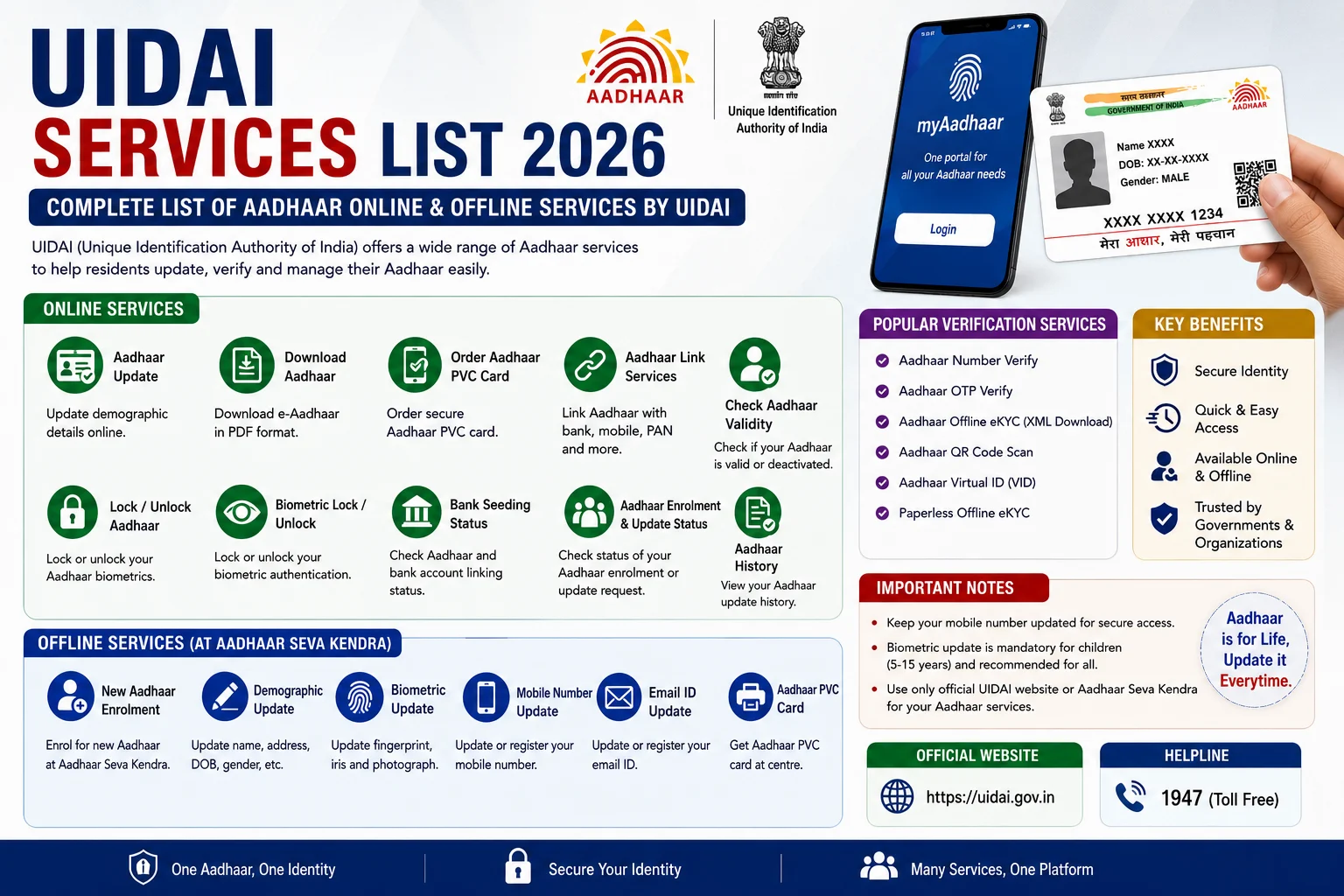
Many people in India use the terms UID and Aadhaar interchangeably. However, this often creates confusion about whether they are different or the same. In reality, UID (Unique Identification Number) is the 12-digit unique number issued by the Unique Identification Authority of India (UIDAI), while Aadhaar is the identity document or card that contains this UID along with the resident’s demographic and biometric information.
In 2026, Aadhaar continues to be one of the most widely accepted identity documents in India. It is used for identity verification, address proof, banking, government schemes, PAN linking, mobile SIM verification, passport applications, and many other public and private services. Understanding the difference between UID and Aadhaar helps citizens use the correct terminology and better understand how the Aadhaar ecosystem works.
This guide explains everything about Difference Between UID and Aadhaar 2026, including their meaning, features, uses, benefits, and frequently asked questions.
What is UID?
UID stands for Unique Identification Number. It is a 12-digit unique number generated and assigned by the Unique Identification Authority of India (UIDAI) to every eligible resident after successful Aadhaar enrolment.
The UID is unique for every individual and remains the same throughout the person’s lifetime.
What is Aadhaar?
Aadhaar is the official identity document issued by UIDAI that contains the resident’s:
- 12-digit UID Number
- Name
- Photograph
- Date of Birth or Year of Birth
- Gender
- Address
- QR Code
The Aadhaar card is available in multiple formats such as:
- Aadhaar Letter
- e-Aadhaar
- PVC Aadhaar Card
- mAadhaar (Digital Aadhaar)
Is UID Different from Aadhaar?
No.
The UID and Aadhaar Number are the same 12-digit unique identification number. The difference is only in the terminology.
- UID refers to the unique identification number.
- Aadhaar refers to the identity document that contains the UID.
Therefore, there is no separate UID number and Aadhaar number.
UID vs Aadhaar: Key Differences
| Feature | UID | Aadhaar |
|---|---|---|
| Full Form | Unique Identification Number | Aadhaar Identity Document |
| Meaning | 12-digit unique number | Identity document containing the UID |
| Issued By | UIDAI | UIDAI |
| Number | 12 digits | Contains the same 12-digit UID |
| Purpose | Unique identification | Identity and address proof |
| Physical Card | No | Yes |
| Digital Version | Used in digital records | Available as e-Aadhaar and mAadhaar |
| Validity | Lifetime | Lifetime |
Features of UID
The UID has several important features.
- Unique 12-digit number.
- Issued only once.
- Lifetime validity.
- Cannot be duplicated.
- Linked with biometric and demographic data.
- Used for identity authentication.
Features of Aadhaar
The Aadhaar document provides several features.
- Government-issued identity proof.
- Address proof.
- Digital QR Code.
- Available online.
- Accepted across India.
- Supports online authentication.
- Available in physical and digital formats.
Uses of UID and Aadhaar
The UID/Aadhaar is used for various services, including:
- Opening bank accounts.
- PAN linking.
- Income Tax filing.
- Passport application.
- LPG subsidy.
- PM Kisan Scheme.
- Scholarship applications.
- SIM card verification.
- EPFO services.
- DigiLocker.
- Government welfare schemes.
- Aadhaar authentication.
Benefits of Aadhaar
Aadhaar offers several benefits.
- Nationwide identity proof.
- Easy online verification.
- Direct Benefit Transfer (DBT).
- Secure digital authentication.
- Quick KYC process.
- Easy access to government schemes.
- Accepted by banks and financial institutions.
- Paperless verification through Offline e-KYC.
Types of Aadhaar
UIDAI currently issues Aadhaar in different formats.
Aadhaar Letter
Paper-based Aadhaar delivered by post.
e-Aadhaar
Digitally signed PDF version downloadable online.
Aadhaar PVC Card
Pocket-sized durable PVC Aadhaar card.
mAadhaar
Digital Aadhaar available through the official mAadhaar App.
All these versions contain the same UID number.
Can Two People Have the Same UID?
No.
Each resident receives a unique 12-digit UID. No two individuals can have the same Aadhaar number because UIDAI performs demographic and biometric de-duplication before issuing Aadhaar.
Common Misconceptions
Many people believe:
- UID and Aadhaar are different numbers.
- UID card is separate from Aadhaar.
- Aadhaar and UID require separate registration.
These are incorrect.
There is only one 12-digit unique identification number, and it is called both the UID and the Aadhaar Number.
Important Tips
Before using Aadhaar:
- Never share your OTP with anyone.
- Use only the official UIDAI website.
- Lock your biometrics when not required.
- Keep your Aadhaar updated.
- Download Aadhaar only from official UIDAI sources.
- Use Virtual ID (VID) wherever supported for enhanced privacy.
Frequently Asked Questions (FAQs)
Is UID and Aadhaar the same?
Yes. The UID is the same 12-digit number that appears on your Aadhaar card.
What does UID stand for?
UID stands for Unique Identification Number.
Is there a separate UID card?
No. There is no separate UID card. The Aadhaar card contains your UID number.
Who issues UID and Aadhaar?
Both the UID number and Aadhaar are issued by the Unique Identification Authority of India (UIDAI).
Can I use UID instead of Aadhaar?
Yes. Since the UID is your Aadhaar Number, both terms refer to the same unique identification number.
Conclusion
The Difference Between UID and Aadhaar 2026 is mainly a difference in terminology rather than functionality. The UID is the unique 12-digit identification number issued by UIDAI, while Aadhaar is the identity document that contains this number along with your personal details. In simple terms, every Aadhaar contains a UID, and the UID is your Aadhaar Number. Understanding this distinction helps eliminate confusion while using Aadhaar for banking, government schemes, identity verification, and other official services.
Read More: Aadhaar NPCI Mapping Status 2026: How to Check Aadhaar Bank Linking & NPCI Mapper Status Online