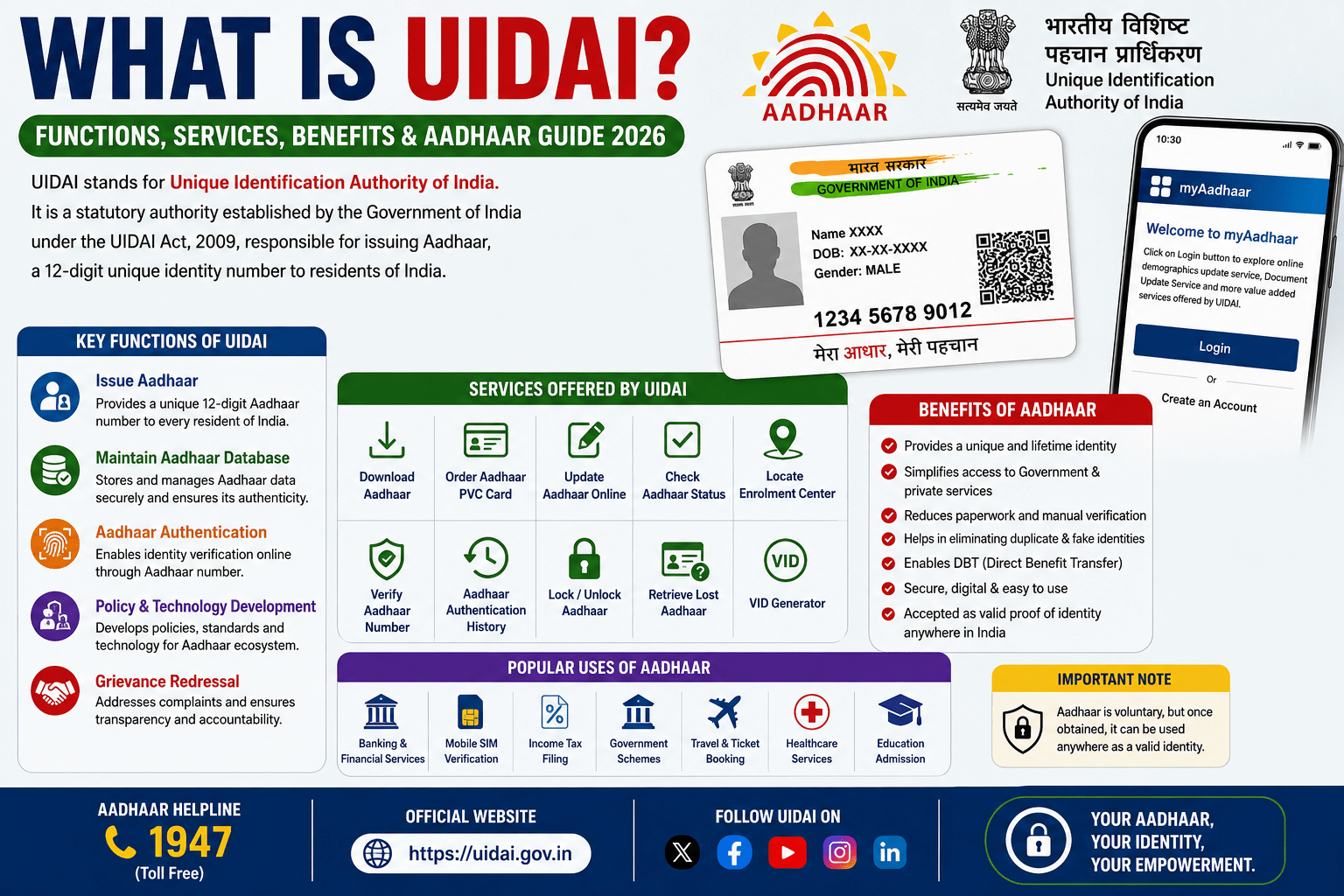
The Unique Identification Authority of India (UIDAI) is the government authority responsible for issuing and managing Aadhaar, India’s 12-digit unique identification number. Since its launch, Aadhaar has become one of the most widely used identity documents in the country, helping residents access government schemes, banking services, digital verification, tax-related services, and many other public and private sector facilities.
In 2026, UIDAI continues to improve Aadhaar services by offering secure online facilities such as Aadhaar updates, e-Aadhaar downloads, biometric locking, Virtual ID generation, Aadhaar authentication history, and much more. Through its official portal, residents can access most Aadhaar-related services from the comfort of their homes.
This article explains What is UIDAI, its functions, services, objectives, benefits, and why it plays an important role in India’s digital identity ecosystem.
What is UIDAI?
UIDAI (Unique Identification Authority of India) is a statutory authority established by the Government of India to issue Aadhaar numbers and maintain the Aadhaar database. It operates under the Ministry of Electronics and Information Technology (MeitY) and is responsible for ensuring that Aadhaar services remain secure, transparent, and accessible to all residents.
UIDAI was initially established on 28 January 2009 and later became a statutory authority under the Aadhaar (Targeted Delivery of Financial and Other Subsidies, Benefits and Services) Act, 2016.
Its primary objective is to provide every eligible resident with a unique identity number that can be verified digitally from anywhere in India.
Objectives of UIDAI
UIDAI was created to simplify identity verification and improve the delivery of government services. Its major objectives include:
- Issue a unique Aadhaar number to every eligible resident.
- Eliminate duplicate and fake identities.
- Provide secure digital identity verification.
- Improve the delivery of government subsidies and welfare schemes.
- Support Direct Benefit Transfer (DBT).
- Promote digital governance across India.
- Make Aadhaar authentication simple, secure, and reliable.
What is Aadhaar?
Aadhaar is a 12-digit unique identification number issued by UIDAI after verifying an individual’s demographic and biometric information. Each Aadhaar number is unique and remains valid throughout the lifetime of the resident.
The Aadhaar database stores information such as:
- Name
- Date of Birth
- Gender
- Address
- Photograph
- Fingerprints
- Iris Scan
This information is securely maintained by UIDAI and used for identity authentication whenever required.
Major Services Offered by UIDAI
UIDAI provides a wide range of online and offline services for Aadhaar holders.
Some of the most popular services include:
- Aadhaar Enrollment
- Aadhaar Card Correction
- Aadhaar Address Update
- Aadhaar Mobile Number Update
- Download e-Aadhaar
- Order Aadhaar PVC Card
- Check Aadhaar Update Status
- Aadhaar Authentication History
- Generate Virtual ID (VID)
- Lock and Unlock Biometrics
- Verify Aadhaar Number
- Locate Aadhaar Seva Kendra
These services are available through the official myAadhaar portal and Aadhaar Seva Kendras.
Why is Aadhaar Important?
Today, Aadhaar is accepted as one of the most widely recognized identity documents in India. It is used for several purposes, including:
- Opening bank accounts
- Filing Income Tax Returns
- PAN-Aadhaar linking
- Passport applications
- Government subsidy schemes
- PM Kisan Scheme
- Scholarship schemes
- Pension schemes
- LPG subsidy
- SIM card verification
- Digital KYC
- Direct Benefit Transfer (DBT)
Having updated Aadhaar information helps ensure smooth access to these services.
Benefits of UIDAI and Aadhaar
UIDAI has simplified identity verification for millions of residents. Some key benefits include:
- Unique identity for every resident.
- Faster verification process.
- Easy access to government welfare schemes.
- Secure online authentication.
- Reduced identity fraud.
- Paperless digital verification.
- Convenient online Aadhaar services.
- Nationwide acceptance of Aadhaar as identity proof.
Security Features Provided by UIDAI
UIDAI has introduced several security measures to protect Aadhaar data and prevent misuse.
These include:
- OTP-based authentication
- Biometric authentication
- Aadhaar Virtual ID (VID)
- Biometric Lock/Unlock facility
- Aadhaar Authentication History
- Masked Aadhaar Download
- Secure encryption of Aadhaar data
Residents are advised to regularly monitor their Aadhaar authentication history and keep their mobile number updated.
How to Access UIDAI Services Online?
Most Aadhaar-related services can be accessed through the official myAadhaar portal.
Users can:
- Update Aadhaar details.
- Download e-Aadhaar.
- Check Aadhaar status.
- Order Aadhaar PVC Card.
- Generate Virtual ID.
- Lock biometrics.
- Check authentication history.
- Locate Aadhaar Seva Kendras.
Many services require OTP verification using the mobile number registered with Aadhaar.
Common Reasons to Visit an Aadhaar Seva Kendra
Although many services are available online, you may need to visit an Aadhaar Seva Kendra for:
- Mobile number update
- Biometric update
- Photograph update
- Iris scan update
- Fingerprint update
- Name correction (where in-person verification is required)
- Date of Birth correction
- Gender update
Carry original supporting documents while visiting the centre.
Important Tips for Aadhaar Holders
To keep your Aadhaar secure:
- Never share your OTP with anyone.
- Download Aadhaar only from the official UIDAI website.
- Regularly check Aadhaar Authentication History.
- Lock your biometrics if not in regular use.
- Keep your mobile number updated.
- Verify Aadhaar details before using them for official purposes.
Frequently Asked Questions (FAQs)
What does UIDAI stand for?
UIDAI stands for Unique Identification Authority of India.
Who issues the Aadhaar Card?
The Aadhaar Card is issued by UIDAI on behalf of the Government of India.
Is Aadhaar mandatory for every citizen?
Aadhaar is widely used for many government and financial services. However, whether it is mandatory depends on the specific law, scheme, or service involved.
Can I update my Aadhaar online?
Yes. UIDAI allows eligible updates such as address and document updates online, while some updates require visiting an Aadhaar Seva Kendra.
Is UIDAI a government organization?
Yes. UIDAI is a statutory authority established by the Government of India under the Ministry of Electronics and Information Technology (MeitY).
Conclusion
The Unique Identification Authority of India (UIDAI) has transformed the way identity verification works in India. By issuing Aadhaar and providing secure digital authentication services, UIDAI has made government services, banking, taxation, and welfare schemes more accessible and transparent. Whether you need to update your Aadhaar, download an e-Aadhaar, or verify your identity online, UIDAI offers a reliable and secure platform for millions of residents across the country.
Read more: Vehicle RC Status Check Online 2026: How to Check Registration Certificate (RC) Status Online