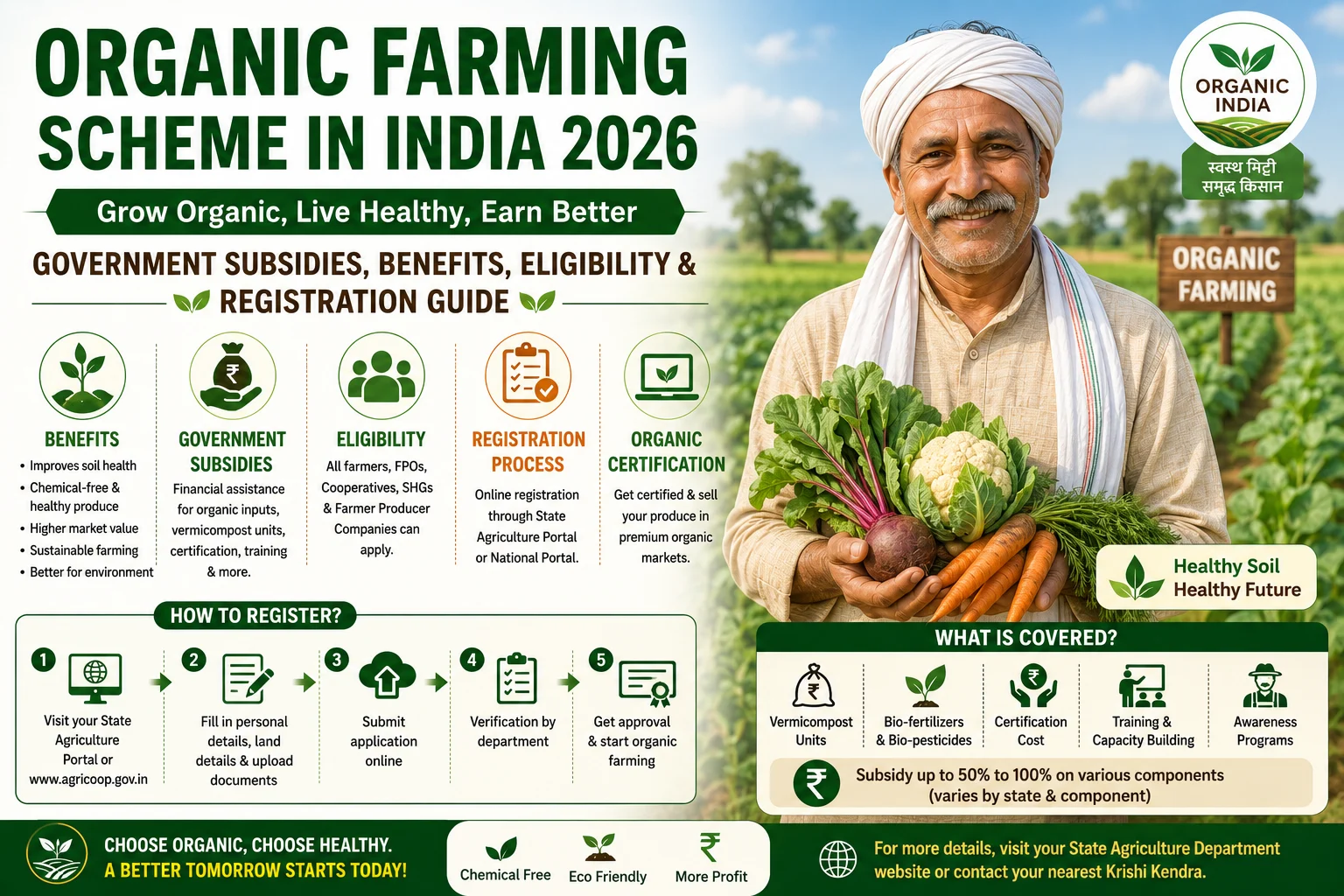
Organic farming is gaining popularity in India as farmers increasingly adopt sustainable agricultural practices that improve soil health, reduce chemical usage, and produce safe, chemical-free food. To encourage this transition, the Government of India provides financial assistance, training, certification support, and marketing assistance through various organic farming schemes. The two major schemes are the Paramparagat Krishi Vikas Yojana (PKVY) and the Mission Organic Value Chain Development for North Eastern Region (MOVCDNER). These schemes promote end-to-end support for organic farming, including production, certification, processing, and marketing.
In 2026, eligible farmers can receive government subsidies for adopting organic farming practices, forming organic clusters, purchasing organic inputs, obtaining certification, and improving market access. Applications are generally processed through the State Agriculture Department, Agriculture Offices, or implementing agencies under the respective schemes.
This guide explains everything about Organic Farming Scheme in India 2026, including government subsidies, eligibility, registration process, benefits, required documents, and frequently asked questions.
What is the Organic Farming Scheme?
The Organic Farming Scheme is a government initiative that encourages farmers to shift from chemical-based farming to environmentally friendly and sustainable organic farming practices.
The scheme focuses on:
- Reducing chemical fertilizer usage.
- Improving soil fertility.
- Promoting organic crop production.
- Increasing farmers’ income.
- Supporting certification and marketing.
- Encouraging sustainable agriculture.
Government Schemes for Organic Farming
The Government promotes organic farming mainly through:
Paramparagat Krishi Vikas Yojana (PKVY)
Implemented across all States and Union Territories except the North Eastern States, PKVY promotes organic farming through cluster-based farming and supports certification, training, organic inputs, value addition, and marketing.
Mission Organic Value Chain Development for North Eastern Region (MOVCDNER)
This scheme is implemented exclusively in the North Eastern States and provides assistance for organic farming, Farmer Producer Organizations (FPOs), certification, processing, and marketing.
Government Subsidy
Eligible farmers receive financial assistance under different schemes.
Under PKVY
- Financial assistance for organic farming over 3 years.
- Support for organic inputs.
- Training and capacity building.
- Organic certification.
- Marketing and value addition support.
Under MOVCDNER
- Financial assistance for organic farming.
- Support for quality planting material.
- Assistance for Farmer Producer Organizations (FPOs).
- Organic certification and marketing support.
Benefits of Organic Farming
Organic farming offers several advantages.
- Improves soil fertility.
- Reduces dependence on chemical fertilizers.
- Produces healthier crops.
- Protects the environment.
- Reduces production costs over time.
- Increases market value of organic produce.
- Improves long-term farm sustainability.
- Supports better farmer income.
Eligibility Criteria
Generally, applicants should:
- Be an Indian farmer.
- Own or cultivate agricultural land.
- Be willing to adopt organic farming practices.
- Join an approved organic farming cluster where required.
- Meet the eligibility conditions of the respective scheme.
Documents Required
Keep the following documents ready.
- Aadhaar Card
- Mobile Number
- Bank Passbook
- Land Records
- Passport-size Photograph
- Identity Proof
- Address Proof
- Farmer ID (if applicable)
How to Apply for Organic Farming Scheme 2026
Follow these simple steps.
Step 1
Visit the nearest Agriculture Department Office or Krishi Vigyan Kendra (KVK).
Step 2
Contact the implementing agency for the applicable organic farming scheme.
Step 3
Submit the application form.
Step 4
Provide land and personal details.
Step 5
Submit the required documents.
Step 6
Join an approved organic farming cluster if required.
Step 7
After verification, eligible farmers receive scheme benefits according to the applicable guidelines.
Organic Certification
Farmers adopting organic farming may receive assistance for certification under approved certification systems, making it easier to market organic produce.
Marketing Support
The schemes also support:
- Organic branding.
- Packaging.
- Value addition.
- Processing.
- Market linkages.
- Farmer Producer Organizations (FPOs).
Common Reasons for Application Rejection
Applications may be rejected because of:
- Incomplete documents.
- Incorrect land details.
- Ineligibility under the scheme.
- Failure to meet cluster requirements.
- Incorrect bank details.
Important Tips
Before applying:
- Use only official Agriculture Department channels.
- Submit accurate land records.
- Participate in training programs.
- Follow approved organic farming practices.
- Keep all application documents safely.
Frequently Asked Questions (FAQs)
What is the Organic Farming Scheme?
It is a government initiative that promotes sustainable and chemical-free farming through financial assistance, training, certification, and marketing support.
Which schemes support organic farming?
The major schemes are Paramparagat Krishi Vikas Yojana (PKVY) and Mission Organic Value Chain Development for North Eastern Region (MOVCDNER).
Who can apply?
Eligible farmers willing to adopt organic farming practices can apply according to the guidelines of the respective scheme.
Is financial assistance available?
Yes. The Government provides financial assistance for organic inputs, certification, training, processing, and marketing under various schemes.
Where can I apply?
You can apply through your State Agriculture Department, Agriculture Office, Krishi Vigyan Kendra (KVK), or other implementing agencies.
Conclusion
The Organic Farming Scheme in India 2026 provides an excellent opportunity for farmers to adopt sustainable farming practices while receiving government support for organic inputs, certification, training, and marketing. With increasing consumer demand for organic products and continued government assistance, organic farming can improve soil health, reduce production costs, and enhance long-term farm income. Farmers should contact their local Agriculture Department to learn about the schemes available in their state and begin the registration process.
Read More: HSRP Number Plate Apply Online 2026: How to Apply, Book Appointment, Fees, Documents & Status Check