Competitive examinations are becoming more closely monitored in 2026, and candidates who attempt to gain an unfair advantage can face consequences far more serious than simply losing their examination attempt.
The Public Examinations (Prevention of Unfair Means) Amendment Bill, 2026 has strengthened India’s existing anti-cheating framework. The amendment builds on the Public Examinations (Prevention of Unfair Means) Act, 2024, which covers examinations conducted by major bodies including UPSC, SSC, Railway Recruitment Boards, IBPS and NTA.
The 2026 amendment increases penalties for unfair means, strengthens action against organised examination fraud and introduces faster investigation and trial mechanisms. The legislation was introduced in July 2026 and passed by both Houses of Parliament.
For students and government-job aspirants, the message is straightforward: impersonation, cheating, leaked papers, unauthorized assistance and other unfair practices can have serious academic as well as legal consequences.
What Are Exam Cheating Rules in 2026?
Exam cheating rules are designed to protect the fairness and credibility of public examinations.
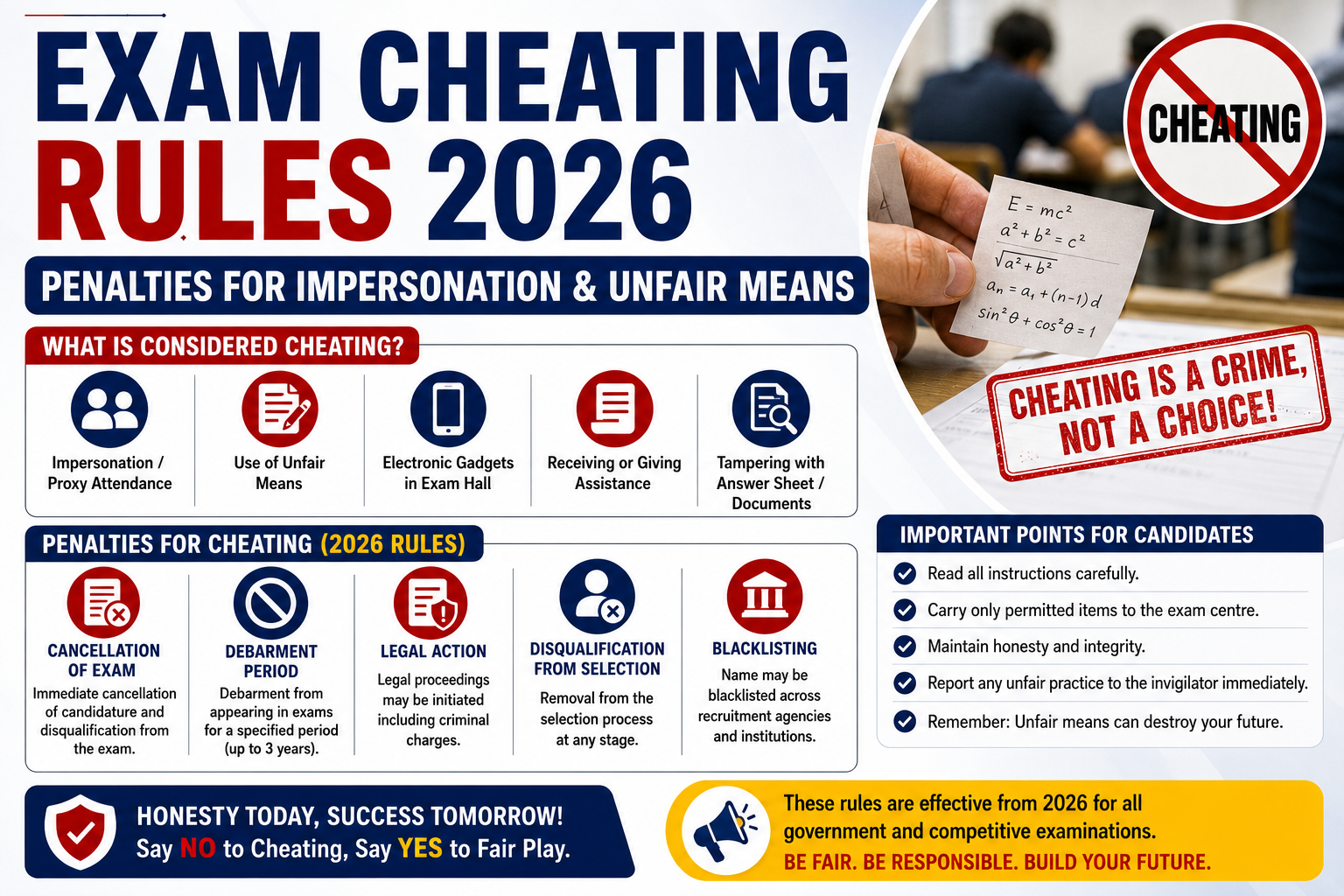
Depending on the examination and applicable law, unfair means can include:
- Impersonating another candidate
- Using unauthorized electronic devices
- Using leaked question papers
- Receiving unauthorized assistance
- Sharing examination material illegally
- Manipulating examination systems
- Arranging someone else to take an examination
- Participating in organised cheating networks
- Tampering with examination records
- Helping another person commit examination fraud
The exact offence and punishment depend on the examination, the circumstances and the law applicable to the case.
What Is Impersonation in an Examination?
Impersonation means pretending to be another person or arranging for another person to appear in an examination on your behalf.
For example, if Candidate A is registered for an examination but Candidate B enters the examination centre and attempts the paper using Candidate A’s identity, it can constitute impersonation.
The practice is particularly serious because it directly defeats the identity-verification system used by examination authorities.
Modern examinations may use photographs, identity documents, biometric verification and other security measures to identify candidates.
Can a Candidate Be Punished for Using Unfair Means?
Yes.
The central anti-unfair-means law covers the use of unfair means in specified public examinations. The 2024 Act made offences under the law cognizable, non-bailable and non-compoundable, with provisions for imprisonment, fines and other consequences.
The 2026 amendment makes the punishment for a person resorting to unfair means substantially stricter.
The proposed/amended penalty is five to 10 years of imprisonment and a fine of up to ₹50 lakh, compared with three to five years and a maximum fine of ₹10 lakh under the earlier framework.
This demonstrates how seriously examination fraud is now being treated.
What Is the Penalty for Impersonation?
Impersonation can result in serious consequences under the applicable examination rules and anti-cheating laws.
A candidate involved in impersonation may face:
- Cancellation of candidature
- Cancellation of examination results
- Debarment from future examinations
- Disciplinary action
- Criminal investigation
- Imprisonment and financial penalties where the conduct falls under the applicable anti-unfair-means law
The exact punishment is not necessarily identical for every examination because examination authorities can have their own rules in addition to the central law.
Candidates should therefore never allow another person to appear on their behalf or attempt to appear using someone else’s identity.
What Happens If Someone Helps With Impersonation?
The consequences are not limited to the candidate whose identity is being used.
A person who knowingly assists an impersonation arrangement can potentially face legal action depending on their role and the applicable provisions.
This can include people who:
- Arrange a substitute candidate
- Provide false documents
- Facilitate entry into an examination centre
- Help create fraudulent identity credentials
- Organise a solver arrangement
- Participate in an examination fraud network
The seriousness increases when the conduct is part of an organised operation.
What Is a Solver Gang?
A “solver” arrangement generally involves another person appearing for an examination on behalf of the actual candidate.
These arrangements can be organised through intermediaries or networks that recruit people to impersonate candidates.
Such activity is fundamentally different from an ordinary examination-rule violation because it can involve planning, identity fraud and multiple participants.
The central 2026 amendment specifically strengthens the broader legal framework against organised examination malpractices.
State laws may also prescribe particularly severe penalties for solver gangs and impersonation. For example, Uttar Pradesh’s 2024 public examination law contains specific provisions addressing solver gangs and related offences.
Tougher Penalty for Organised Examination Crime
The 2026 amendment increases punishment for organised examination crime.
Under the earlier central framework, organised crime attracted imprisonment of five to 10 years and a fine of at least ₹1 crore.
The amended framework increases the minimum imprisonment to seven years and the minimum fine to ₹10 crore.
This is aimed at organised networks rather than ordinary candidates who make an isolated examination mistake.
The distinction is important because organised examination fraud can involve several people working together to leak papers, arrange impersonation or manipulate examination systems.
What Is Considered Unfair Means?
Unfair means can cover much more than copying answers from another candidate.
Depending on the applicable examination rules, prohibited conduct may include:
Using Electronic Devices
Carrying or using unauthorized mobile phones, smartwatches, Bluetooth devices, communication equipment or other electronic gadgets can result in cancellation and other penalties.
Using Unauthorized Material
Notes, written material, books or other prohibited material can lead to disciplinary action.
Communicating With Other Candidates
Candidates generally cannot communicate with other examinees during the examination unless specifically permitted.
Receiving Outside Assistance
Getting answers or instructions from someone outside the examination room can constitute unfair means.
Impersonation
Using another person to appear for an examination or appearing as someone else is a serious offence.
Tampering With the Examination System
Manipulating computers, examination software, records or other examination infrastructure can attract severe consequences.
Can Using a Leaked Question Paper Be a Crime?
Potentially, yes.
A candidate who knowingly participates in a paper-leak arrangement or uses illegally obtained examination material can face serious consequences depending on the circumstances and applicable law.
The 2026 amendments were introduced specifically against examination malpractices including question-paper leaks and organised cheating.
Candidates should therefore avoid Telegram channels, WhatsApp groups or individuals claiming to have a “100% original leaked paper.”
Apart from the possibility of being a scam, participating in such an arrangement can expose a candidate to serious legal and examination-related consequences.
What If Someone Sends You a Fake or Alleged Leaked Paper?
Not every paper circulating online is genuine.
Some people deliberately circulate fake question papers to collect money from candidates.
If you receive such material, do not:
- Pay for it
- Forward it
- Attempt to sell it
- Use it during the examination
- Encourage others to purchase it
If you believe the material represents a genuine examination-security breach, use the appropriate official reporting mechanism or contact the relevant authorities.
Are Mobile Phones Allowed in Exam Centres?
In most major competitive examinations, mobile phones are either prohibited inside the examination hall or subject to strict restrictions.
The exact rule depends on the examination.
Candidates should not assume that keeping a phone switched off makes it acceptable.
The safest option is to leave prohibited electronic devices at home whenever the examination instructions do not permit them.
Are Smartwatches Allowed?
Candidates should generally avoid carrying smartwatches unless the examination authority explicitly permits them.
Smartwatches can potentially provide communication, internet access or stored information and are therefore commonly treated as prohibited devices.
A normal watch may also be restricted in some computer-based examinations.
Always check the examination-specific instructions before wearing any watch.
What Happens If a Candidate Is Caught Cheating?
The immediate response depends on the examination authority and the nature of the violation.
Possible consequences can include:
- The candidate may be stopped from continuing the examination.
- The candidate’s candidature may be cancelled.
- The examination result may be withheld or cancelled.
- The candidate may be debarred from future examinations.
- The incident may be reported to the appropriate authority.
- Criminal proceedings may follow where the conduct constitutes an offence under applicable law.
For serious cases, examination action and criminal proceedings can operate separately.
Can a Candidate Be Banned From Future Exams?
Yes.
Examination authorities can impose debarment for violations of their rules.
The length of a ban can depend on the examination, the nature of the misconduct and the applicable regulations.
In serious cases involving the central anti-unfair-means law, criminal proceedings can also arise in addition to examination-related disqualification.
Candidates should therefore not assume that cancellation of one examination is the only possible consequence.
What Are the New Penalties Under the 2026 Rules?
The central 2026 amendment significantly increases the penalties under the existing framework.
| Offence | Earlier Framework | 2026 Amended Framework |
|---|---|---|
| Use of unfair means | 3–5 years + fine up to ₹10 lakh | 5–10 years + fine up to ₹50 lakh |
| Service provider involved in unfair means | Fine up to ₹1 crore | Fine up to ₹5 crore |
| Service provider debarment | 4 years | 8 years |
| Responsible management personnel | 3–10 years + ₹1 crore fine | 5–10 years + ₹5 crore fine |
| Organised examination crime | 5–10 years + minimum ₹1 crore fine | 7–10 years + minimum ₹10 crore fine |
The figures above relate to the central public-examinations framework and should not be confused with penalties under individual state anti-cheating laws or examination-specific regulations.
New Action Against Examination Service Providers
The 2026 changes also target companies and organisations involved in conducting examinations.
A service provider found involved in unfair means can face a maximum fine of ₹5 crore, compared with ₹1 crore under the earlier framework.
The period of debarment from conducting public examinations is also proposed to increase from four years to eight years.
This is important because modern competitive examinations often depend on technology companies and other private service providers.
Management Personnel Can Also Face Punishment
The law also strengthens accountability for management personnel of service providers.
Under the amended framework, responsible management personnel can face five to 10 years of imprisonment and a fine of up to ₹5 crore where the relevant provisions apply.
The purpose is to prevent organisations from treating examination security as merely an administrative responsibility.
Special Task Force for Examination Fraud
Another important 2026 development is the proposed use of Special Task Forces for investigating offences under the central law.
The amendment empowers the Central Government to constitute a Special Task Force for investigation.
This can be particularly useful in complex cases involving:
- Multiple states
- Digital evidence
- Large cheating networks
- Examination centres
- Service providers
- Financial transactions
- Multiple accused persons
Investigation Timeline of Two Months
The amended framework introduces a two-month timeline for investigation of offences under the Act.
The objective is to prevent examination-fraud investigations from continuing indefinitely.
However, candidates should understand that a statutory timeline does not necessarily mean every case will practically be resolved within exactly two months.
The investigation can still involve substantial evidence, multiple accused people and technical material.
Special Fast Track Courts
The 2026 amendment also provides for Special Fast Track Courts.
Each state and Union Territory is required to designate a Court of Session as a Special Fast Track Court for trying offences under the Act.
The purpose is to ensure that examination-related criminal cases receive faster judicial attention.
Trial Timeline
The amended framework provides for a three-month timeline for trial after the filing of the chargesheet, subject to the judicial process and applicable circumstances.
This is intended to provide faster resolution of cases involving examination fraud.
The law also provides for a specialised prosecution mechanism through Special Public Prosecutors.
Which Exams Are Covered by the Central Law?
The Public Examinations Act applies to specified public examinations conducted by major central bodies.
These include:
- UPSC
- SSC
- Railway Recruitment Boards
- IBPS
- NTA
- Central Government ministries and departments
- Attached and subordinate offices
- Other authorities notified by the Central Government
The central framework was brought into force in 2024 and is now being strengthened through the 2026 amendment.
What About State Government Exams?
Candidates should understand that the central law does not automatically replace every state-level anti-cheating law.
States can have their own laws dealing with:
- Paper leaks
- Impersonation
- Solver gangs
- Organised cheating
- Electronic devices
- Examination malpractice
For example, Uttar Pradesh has its own Public Examination (Prevention of Unfair Means) Act, 2024, which contains specific provisions concerning examinees, impersonation-related conduct and solver gangs.
Therefore, candidates preparing for state-level examinations should also check the applicable state law and examination notification.
Why Are Exam Cheating Rules Becoming Stricter?
The main reason is the growing scale and complexity of examination fraud.
A modern competitive examination can involve millions of candidates, computer systems, private service providers and examination centres spread across multiple locations.
A single leak or organised cheating operation can therefore affect an enormous number of candidates.
The government has stated that stronger penalties are intended to protect deserving candidates and restore confidence in public examinations.
How Do These Rules Protect Honest Candidates?
Strict anti-cheating rules are ultimately intended to protect candidates who prepare honestly.
Imagine spending two years preparing for a government examination only to discover that a group obtained the paper illegally before the test.
A fair examination system requires every candidate to receive the same opportunity.
Stronger penalties can discourage organised groups from treating examination fraud as a profitable business.
What Should Candidates Do If They See Someone Cheating?
Candidates should not get involved in confrontation or attempt to handle the situation themselves.
Instead, follow the instructions provided by the examination authority.
Depending on the examination, a candidate may report suspicious activity to the invigilator or examination-centre authorities.
Do not photograph, record or circulate examination material unless the examination authority specifically permits it.
What Should You Do If Your Own Identity Is Misused?
If you discover that someone has attempted to use your identity for an examination, contact the relevant examination authority and, where appropriate, law-enforcement authorities immediately.
Keep copies of:
- Application details
- Admit card
- Identity documents
- Registration information
- Relevant communications
- Any evidence showing that you did not participate in the examination
Prompt reporting can be important in preventing further misuse.
Common Mistakes Candidates Should Avoid
Many examination violations can be avoided simply by reading the instructions.
Candidates should never:
- Carry a prohibited phone into the examination hall.
- Use a smartwatch to check information.
- Carry unauthorized notes.
- Communicate with another candidate.
- Allow someone else to take the examination.
- Attempt to enter using another person’s identity.
- Buy alleged leaked papers.
- Share examination questions illegally.
- Attempt to manipulate computer systems.
- Use unauthorized assistance.
- Submit false documents.
Even if a candidate believes an action is harmless, it is better to follow the official instructions exactly.
Exam Cheating vs Paper Leak
These terms are sometimes used interchangeably, but they are not exactly the same.
Exam cheating generally refers to obtaining or attempting to obtain an unfair advantage during an examination.
Paper leakage refers to unauthorized access, disclosure or distribution of examination questions before the examination.
Impersonation involves someone appearing in place of the actual candidate.
Organised examination crime involves coordinated activities by multiple people to manipulate or exploit the examination system.
The legal consequences can differ depending on the offence.
Exam Cheating Rules 2026: Quick Checklist
Before entering an examination centre, candidates should ask:
- Do I have my valid admit card?
- Do I have the required original ID?
- Does my name and date of birth match my documents?
- Have I checked the prohibited-items list?
- Have I left my mobile phone and smartwatch at home?
- Am I carrying only permitted stationery?
- Do I know the reporting time?
- Do I know the exact examination-centre address?
- Have I read the latest exam instructions?
- Do I understand the rules concerning rough work?
- Do I know the procedure for identity or biometric verification?
A few minutes of preparation can prevent serious problems.
Key Takeaways
The most important Exam Cheating Rules 2026 are:
- India’s central anti-unfair-means framework was created through the Public Examinations Act, 2024.
- The 2026 amendment strengthens the existing framework.
- The law covers specified examinations conducted by UPSC, SSC, RRBs, IBPS, NTA and other notified central authorities.
- Penalties for individuals using unfair means have been increased to five to 10 years’ imprisonment and a fine of up to ₹50 lakh.
- Organised examination crime can attract seven to 10 years’ imprisonment and a minimum fine of ₹10 crore under the amended framework.
- Service providers can face fines of up to ₹5 crore and longer debarment.
- Special Task Forces can be constituted for investigations.
- Special Fast Track Courts are being provided for examination-related offences.
- Investigation is subject to a two-month timeline under the amended framework.
- State examinations may also be governed by separate state anti-cheating laws.
- Candidates should never participate in impersonation, solver arrangements, paper leaks or unauthorized assistance.
Final Thoughts
The Exam Cheating Rules 2026 show how seriously India is treating examination fraud. The updated central framework goes beyond ordinary disciplinary action by introducing substantially tougher penalties for unfair means and organised examination crime, along with specialised investigation and trial mechanisms.
For candidates, the safest approach is simple: prepare honestly, follow the examination instructions and stay away from anyone offering leaked papers or shortcuts.
Impersonation and organised cheating are particularly serious because they can involve criminal consequences in addition to cancellation or debarment from examinations. The same applies to people who knowingly facilitate examination fraud.
Candidates should also remember that the exact rules can differ between central and state examinations. Always read the latest notification, admit card instructions and applicable examination rules before appearing.
A competitive examination should ultimately measure a candidate’s preparation and ability—not access to leaked material, outside assistance or fraudulent identity. The stricter 2026 framework is intended to protect that principle and give genuine candidates a fairer chance.
Read More: SSC Exam New Rules 2026: Major Changes Candidates Should Know