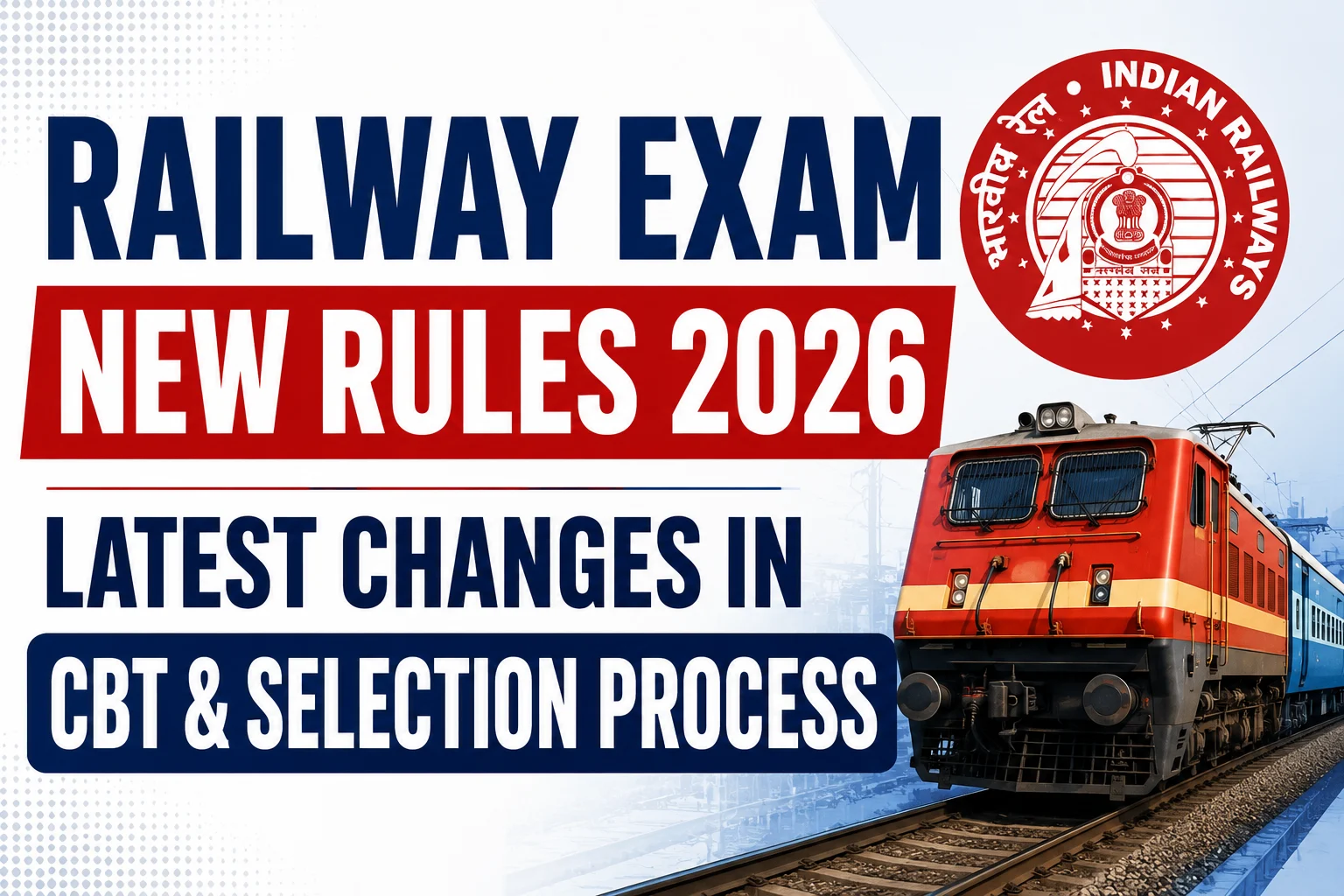
Railway recruitment exams are among the most popular government job examinations in India, attracting lakhs of candidates for posts such as Group D, NTPC, Assistant Loco Pilot (ALP), Technician, Junior Engineer (JE), Paramedical Staff and other railway positions. In 2026, the Railway Recruitment Boards (RRBs) are continuing to modernize the recruitment process with greater use of technology, Computer-Based Tests (CBT), digital verification and improved transparency.
One important point candidates should understand is that there is no single new rule that applies identically to every Railway exam. The selection process depends on the post and the Centralised Employment Notice (CEN) under which recruitment is being conducted. However, recent RRB recruitment cycles and official announcements show several important developments that candidates should know before applying or appearing for an exam.
The Railway Ministry has also emphasized a more transparent, accurate and technology-driven recruitment system. In June 2026, the Ministry said that all departmental examinations are now being conducted through CBT and that Indian Railways plans to expand tablet-based testing.
For candidates preparing for Railway exams in 2026, understanding these changes can be just as important as studying the syllabus.
What Are the Major Railway Exam Changes in 2026?
The latest Railway recruitment process places greater emphasis on:
- Computer-Based Testing
- Technology-based examination management
- Digital access to questions and recorded responses
- Online objection facilities
- Candidate identity verification
- Computer-based mock tests
- City intimation and e-call letters
- Post-specific selection stages
- Document and medical verification
- Faster and more structured recruitment cycles
The exact rules still depend on the individual CEN. Candidates should therefore read the notification for the specific post instead of assuming that the process for Group D will be identical to NTPC, ALP or JE.
Railway Exams Are Moving Further Toward CBT
One of the biggest changes candidates will notice is the continued expansion of Computer-Based Testing.
Instead of traditional pen-and-paper examinations, RRB recruitment increasingly uses computer-based examinations for different stages.
The Railway Ministry said in June 2026 that all departmental examinations are being conducted through CBT and that the Railways is also planning to expand tablet-based testing. The Ministry described the broader recruitment process as technology-driven and focused on transparency and accuracy.
For candidates, this means that basic computer familiarity is increasingly important.
You should be comfortable with:
- Reading questions on a computer screen
- Selecting answers using a mouse
- Moving between questions
- Reviewing marked questions
- Managing time during a digital test
- Submitting answers correctly
Regular computer-based mock tests can help candidates become comfortable with the examination interface.
CBT Is Not the Same for Every Railway Recruitment
Candidates should avoid preparing for every Railway exam as though the selection process is identical.
For example, an examination for Level 1 posts can have a different selection structure from an ALP, Technician, NTPC or JE recruitment.
Recent recruitment notices demonstrate this difference. For example, RRB recruitment for JE/DMS/CMA posts under CEN 05/2025 included CBT 1 followed by CBT 2, with candidates shortlisted from the first stage for the next stage.
Similarly, ALP recruitment includes additional stages after the CBTs, including the Computer-Based Aptitude Test for candidates who meet the applicable requirements. Recent 2026 reporting on the ALP recruitment cycle also confirms the multi-stage process involving CBT 1, CBT 2, CBAT and subsequent verification.
Therefore, candidates should always check the selection process mentioned in their particular CEN.
Latest Railway Selection Process: How It Works
The selection process generally follows a sequence based on the post.
Depending on the recruitment, candidates may have to go through:
- CBT 1
- CBT 2
- Computer-Based Aptitude Test, where applicable
- Physical Efficiency Test, where applicable
- Skill Test or Typing Test, where applicable
- Document Verification
- Medical Examination
- Final appointment
Not every candidate will have to take every stage.
For example, a candidate applying for a post with a typing requirement may face a skill or typing test, while an ALP candidate may have to qualify the relevant aptitude test. Group D or Level 1 recruitment can involve a Physical Efficiency Test after CBT.
The exact sequence should always be checked in the official recruitment notification.
New Focus on Transparency in CBT
The Railway recruitment system is also becoming more transparent after the examination.
Recent RRB notices have provided candidates with facilities to view and download their CBT questions and recorded responses and raise objections against questions or answer keys. RRB Bhubaneswar, for example, issued such notices for CEN 08/2025 in July 2026.
A similar facility was provided for CEN 05/2025, including access to CBT questions, responses, answer keys and the objection tracker.
This is useful because candidates can review what they actually answered rather than depending only on their memory after the examination.
Candidates Can Raise Objections Against Answer Keys
Another important part of the digital examination process is the online objection facility.
After certain CBTs, RRB provides candidates with an opportunity to view the questions, their recorded responses and the provisional answer key.
If a candidate believes that an answer is incorrect or a question has an issue, they can raise an objection through the official objection tracker within the specified deadline.
Candidates should remember that:
- Objections must be submitted within the notified period.
- The prescribed procedure must be followed.
- Supporting evidence may be required.
- A fee may apply depending on the examination.
- Objections submitted after the deadline may not be considered.
The exact rules are given in the relevant RRB notice.
City Intimation Slips Are Issued Before the Admit Card
RRB recruitment also uses city intimation slips before the examination.
The city intimation slip generally helps candidates know the city where their examination centre will be located before the detailed e-call letter or admit card becomes available.
Recent Level 1 recruitment notices show separate releases for the city intimation slip and e-call letter. RRB Bhubaneswar, for example, listed the city intimation link before the e-call letter for CEN 09/2025 Level 1 recruitment.
Candidates should not confuse the city intimation slip with the admit card.
The city slip provides examination-related information, while the e-call letter contains the instructions and details needed for appearing at the examination centre.
E-Call Letters Are Becoming the Standard
Railway recruitment has increasingly shifted toward digital communication with candidates.
Instead of depending on physical communication, candidates generally download their e-call letter/admit card from the relevant RRB portal.
Recent Level 1 recruitment notices show online availability of e-call letters ahead of the CBT.
Candidates should regularly check official RRB websites and their registered communication channels rather than waiting for a physical letter.
Mock Tests Are Available for CBT Preparation
RRBs are also providing computer-based mock tests for candidates in several recruitment cycles.
For example, RRB Bhubaneswar listed a mock test for the Level 1 CBT in July 2026.
Mock tests are useful because they allow candidates to understand the examination interface before the actual test.
Candidates should use them to practice:
- Question navigation
- Time management
- Reviewing answers
- Marking questions for later review
- Submitting the test
- Using the computer interface comfortably
This is especially helpful for candidates who are more accustomed to studying from books than taking online tests.
Identity Verification Is Becoming More Important
As Railway recruitment becomes increasingly digital, candidate identity verification is also receiving greater attention.
Candidates should ensure that the information provided during registration matches their official identity and educational documents.
Depending on the recruitment notice, candidates may be required to present original identification and other documents at different stages.
Candidates should therefore keep their documents organized well before the examination.
Aadhaar and Identity Details Should Be Checked Carefully
Candidates should pay close attention to the identity-related instructions in their specific RRB notification.
A mismatch in personal information can create problems later, particularly during document verification.
Before submitting an application, check:
- Name spelling
- Date of birth
- Father’s or mother’s name where required
- Address
- Category
- Educational qualification
- Photograph
- Signature
- Identity document details
Do not enter information casually just because the online form appears straightforward.
Document Verification Remains an Important Stage
Passing the CBT does not automatically mean that a candidate will receive a Railway job.
Candidates shortlisted for further stages must generally prove that they meet the eligibility requirements.
Document verification may involve checking:
- Educational certificates
- Date of birth
- Category certificate
- EWS certificate
- OBC certificate
- Disability certificate, where applicable
- Experience certificates, where required
- Identity documents
- Other post-specific documents
Recent RRB results show candidates being shortlisted for document verification and medical examination after completing the relevant examination stages.
Candidates should therefore keep their original certificates safe.
Medical Examination Is Still Part of Selection
For many Railway posts, medical fitness is an important part of the recruitment process.
The required medical standard can vary depending on the post.
A candidate should not assume that qualifying the written examination guarantees appointment.
The Railway recruitment process can include medical verification after the examination and document stages. Recent RRB notices for various categories show candidates being shortlisted for both document verification and medical examination.
Candidates applying for technically demanding or safety-related positions should pay particular attention to the medical standards mentioned in the relevant CEN.
Physical Efficiency Test for Applicable Posts
Certain Railway recruitments may include a Physical Efficiency Test (PET) after the CBT.
This is particularly relevant for Level 1 or other posts where physical standards form part of the recruitment process.
Candidates should check the official notification for:
- PET requirements
- Qualifying standards
- Gender-specific requirements
- Exemptions, where applicable
- Documents required
- Instructions for the test
The PET is generally a qualifying stage, but candidates must satisfy the prescribed requirements to continue in the recruitment process.
ALP Recruitment Has Additional Selection Stages
Candidates applying for Assistant Loco Pilot posts should pay particular attention to the multi-stage process.
The ALP recruitment process can involve:
- CBT 1
- CBT 2
- Computer-Based Aptitude Test
- Document Verification
- Medical Examination
Recent 2026 ALP recruitment updates show candidates moving through CBT 2 and the subsequent stages of selection.
This means ALP aspirants should not prepare only for the first CBT. They should understand the complete selection structure before beginning preparation.
NTPC Selection Process Depends on the Post
The NTPC recruitment process can also include multiple examination stages.
The exact process depends on whether the recruitment is for graduate-level or undergraduate-level posts and whether the particular post includes a typing requirement.
Candidates should carefully check whether their selected post requires:
- CBT 1
- CBT 2
- Computer-Based Typing Skill Test
- Document Verification
- Medical Examination
Recent RRB updates show continued use of CBT-based selection for NTPC recruitment.
Railway Recruitment Is Becoming More Structured
The Railway Ministry has highlighted efforts to accelerate recruitment while maintaining transparency and accuracy.
According to the Ministry’s June 2026 review, Indian Railways recruited 43,781 candidates during FY 2025-26 through completed recruitment cycles covering 47,084 vacancies across six major categories.
The figures indicate that recruitment is being managed through more structured cycles rather than relying only on irregular vacancy announcements.
The Ministry has also emphasized annual recruitment calendars, which can help candidates plan their preparation more effectively.
What Does the Annual Recruitment Calendar Mean for Candidates?
A more structured recruitment calendar can make Railway job preparation easier to plan.
Instead of waiting indefinitely for notifications, candidates can monitor expected recruitment cycles and begin preparation in advance.
However, an indicative or annual calendar should not be treated as a guarantee that an examination will occur on a particular date.
The final dates, vacancies, eligibility requirements and selection process are determined through the official CEN and subsequent notices.
Candidates Should Follow the CEN, Not Social Media Posts
One of the biggest mistakes candidates make is relying on old information.
Railway recruitment rules can vary by CEN, and official notices can later be updated through corrigenda.
For example, the Level 1 CEN 09/2025 recruitment page contains multiple updates, including corrigenda, revised schedules and important candidate instructions.
Therefore, candidates should always check:
- Official RRB website
- Current CEN
- Corrigenda
- Examination notices
- City intimation notice
- E-call letter instructions
- Answer-key notices
- Result notices
A YouTube video or social media post may contain outdated information even if it appears convincing.
Is There Negative Marking in Railway CBT?
Negative marking can apply to Railway CBT examinations, but candidates should check the specific CEN rather than assuming that every Railway examination uses exactly the same marking scheme.
The number of questions, duration, subjects, marks and negative-marking rules can vary between recruitment categories and examination stages.
This is particularly important because guessing too many answers can reduce the final score when negative marking applies.
Always check the examination pattern in the official notification for your post.
How Should Candidates Prepare for Railway Exams in 2026?
The changing examination environment means candidates should prepare in two ways: academically and technically.
Focus on the Official Syllabus
Start with the syllabus provided for your specific recruitment.
Do not spend too much time studying unrelated topics.
Practice Computer-Based Tests
Take regular online mock tests instead of relying only on paper-based practice.
Improve Speed and Accuracy
Railway CBTs are time-bound, so candidates need to balance speed with accuracy.
Read Current Affairs
General awareness can be important in several Railway examinations. Keep your preparation updated rather than studying only old current-affairs material.
Practice Previous-Year Questions
Previous-year papers can help you understand question types, difficulty levels and recurring topics.
Track Official Notices
Make it a habit to check the relevant RRB website for updates.
Railway Exam 2026: Candidate Checklist
Before appearing for a Railway examination, candidates should check:
Read the complete CEN for your post.
Confirm eligibility requirements.
Check the CBT pattern.
Confirm whether negative marking applies.
Check whether CBT 2 is required.
Check whether PET, CBAT or a skill test applies.
Download the city intimation slip.
Download the e-call letter.
Check the reporting time.
Carry the required identity documents.
Follow examination-centre instructions.
Check the answer key when released.
Use the objection window before the deadline if required.
Keep original documents ready for verification.
Check the medical requirements for your post.
Key Changes Candidates Should Remember
The most important Railway exam developments in 2026 are not simply about changing the question paper.
The bigger change is the overall digitalization and restructuring of recruitment.
Candidates should be prepared for:
- More CBT-based testing
- Digital mock tests
- Online city information
- E-call letters
- Digital access to questions and responses
- Online answer-key objections
- Stronger identity verification
- Structured selection stages
- Document verification
- Medical examination
- Greater use of technology in recruitment
The Railway Ministry has specifically said that the recruitment process is being made more transparent, accurate and technology-driven.
Final Thoughts
The Railway Exam New Rules 2026 reflect a broader move toward a more digital, transparent and structured recruitment system. Computer-Based Tests remain central to the selection process, while RRBs are also providing digital mock tests, city intimation slips, e-call letters and online access to questions and recorded responses in applicable examinations.
However, candidates should remember that there is no single selection process for every Railway job. Group D, NTPC, ALP, Technician, JE and other recruitments can have different stages and eligibility requirements.
The safest strategy is to read the latest CEN carefully and keep checking official RRB updates for corrigenda, exam schedules, answer keys and results.
For candidates preparing for Railway jobs in 2026, exam preparation should therefore include more than books and notes. Regular CBT practice, careful application management, document preparation and timely checking of official notices can help avoid last-minute problems.
With Railway recruitment becoming increasingly technology-driven, candidates who understand both the exam pattern and the recruitment process will be better prepared to handle every stage of the selection journey.
Read More:Visa Refusal vs Visa Rejection: Key Differences, Reasons & What to Do Next