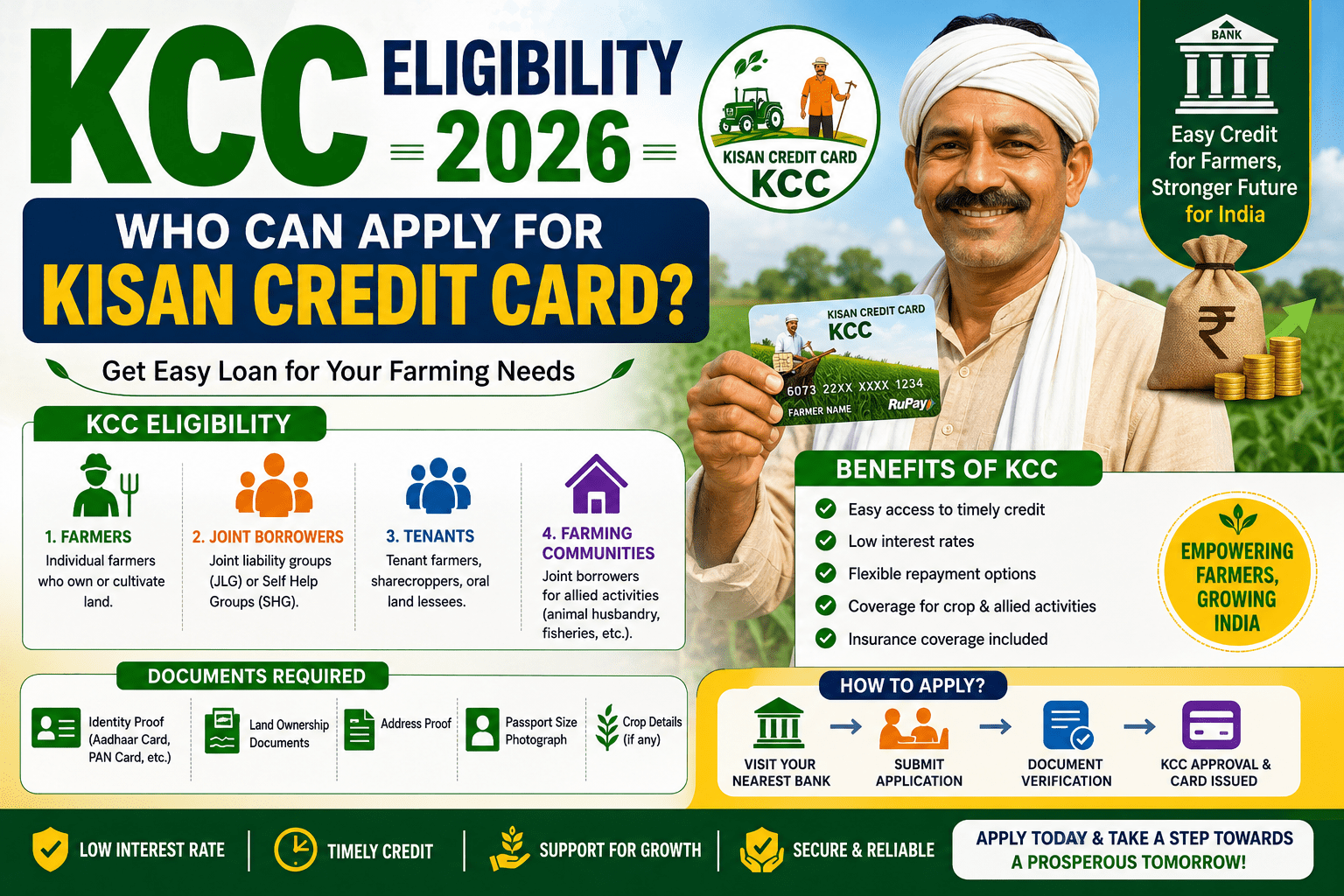
The Kisan Credit Card (KCC) Scheme is a Government of India initiative that provides farmers with timely and affordable credit for agriculture and allied activities such as crop cultivation, dairy, animal husbandry, fisheries, poultry, beekeeping, and sericulture. The scheme is implemented through commercial banks, regional rural banks, cooperative banks, and other eligible financial institutions.
The KCC scheme aims to provide flexible working capital for farming needs, reduce dependence on informal lenders, and ensure easy access to institutional credit.
This guide explains the KCC Eligibility 2026, eligible applicants, required documents, application process, and FAQs.
What is a Kisan Credit Card (KCC)?
A Kisan Credit Card (KCC) is a revolving credit facility that enables eligible farmers to obtain short-term loans for crop production, post-harvest expenses, farm maintenance, and allied agricultural activities through a simplified process.
KCC Eligibility 2026 Highlights
| Particular | Details |
|---|---|
| Scheme Name | Kisan Credit Card (KCC) |
| Implementing Authority | Department of Agriculture & Farmers Welfare |
| Beneficiaries | Farmers, Dairy, Animal Husbandry & Fisheries Farmers |
| Application Mode | Online & Offline |
| Loan Purpose | Crop Cultivation & Allied Activities |
| Participating Institutions | Commercial Banks, RRBs, Cooperative Banks, Small Finance Banks |
| Official Portal | https://fasalrin.gov.in |
Who is Eligible for KCC?
The following applicants are eligible for a Kisan Credit Card:
1. Owner Cultivator Farmers
Individual or joint farmers who own agricultural land and cultivate crops are eligible to apply.
2. Tenant Farmers
Farmers cultivating land on lease can also apply, subject to the bank’s requirements.
3. Oral Lessees
Farmers cultivating land through oral lease arrangements are eligible under the scheme.
4. Sharecroppers
Sharecroppers engaged in agricultural cultivation can apply for KCC loans.
5. Self Help Groups (SHGs)
Farmer SHGs involved in agriculture and allied activities are eligible.
6. Joint Liability Groups (JLGs)
Joint Liability Groups of farmers, including tenant farmers and sharecroppers, can also avail KCC benefits.
7. Dairy Farmers
Farmers engaged in dairy farming are eligible for working capital requirements through the KCC scheme.
8. Animal Husbandry Farmers
Farmers involved in activities such as:
- Cattle Rearing
- Goat Farming
- Sheep Farming
- Pig Farming
- Poultry Farming
- Rabbit Farming
can apply for KCC.
9. Fisheries Farmers
Eligible fisheries activities include:
- Inland Fisheries
- Marine Fisheries
- Shrimp Farming
- Fish Seed Rearing
- Aquaculture
Farmers engaged in these activities can apply for KCC.
Purpose of KCC Loan
The KCC loan can be used for:
- Crop cultivation expenses
- Purchase of seeds and fertilizers
- Pesticides and irrigation
- Farm machinery maintenance
- Post-harvest expenses
- Produce marketing
- Dairy farming
- Fisheries
- Poultry
- Beekeeping
- Sericulture
- Household consumption related to farming
- Working capital for allied agricultural activities
Documents Required
Applicants generally need:
- Aadhaar Card
- PAN Card (if applicable)
- Passport-size Photograph
- Address Proof
- Identity Proof
- Land Records or Cultivation Proof
- Bank Account Details
- Mobile Number
- Details of crops or allied activities
Banks may request additional documents depending on the loan amount and applicant profile.
How to Apply for KCC
Step 1
Visit the nearest participating bank or apply through the bank’s online portal where available.
Step 2
Fill out the Kisan Credit Card application form.
Step 3
Submit the required documents.
Step 4
The bank verifies your eligibility, land or activity details, and documents.
Step 5
Upon approval, the KCC loan limit is sanctioned and the Kisan Credit Card is issued.
Loan Repayment
- Repayment is generally linked to the crop harvesting and marketing cycle.
- Each short-term withdrawal is typically repayable within 12 months.
- Timely repayment may make borrowers eligible for applicable interest benefits as notified by the Government.
Benefits of KCC
- Easy access to agricultural credit.
- Flexible revolving credit facility.
- Financial support for crop and allied activities.
- Reduced dependence on informal moneylenders.
- Simplified loan application process.
- Interest benefits for eligible borrowers making timely repayments, as per government guidelines.
Frequently Asked Questions (FAQs)
Who can apply for a Kisan Credit Card?
Owner cultivators, tenant farmers, oral lessees, sharecroppers, SHGs, JLGs, dairy farmers, animal husbandry farmers, and fisheries farmers are eligible under the scheme.
Can dairy and fisheries farmers get a KCC?
Yes. The KCC scheme covers eligible dairy, animal husbandry, and fisheries farmers for their working capital requirements.
Is land ownership mandatory?
No. Besides land-owning farmers, tenant farmers, oral lessees, and sharecroppers are also eligible, subject to the lending institution’s requirements.
Which banks issue KCC?
Kisan Credit Cards are issued by Public Sector Banks, Private Sector Scheduled Commercial Banks, Regional Rural Banks (RRBs), Cooperative Banks, Small Finance Banks, and other participating institutions.
Can I apply online?
Yes. Many participating banks provide online KCC application facilities, and applications can also be submitted offline at bank branches.
Conclusion
The KCC Eligibility 2026 guidelines ensure that a wide range of farmers—including owner cultivators, tenant farmers, sharecroppers, dairy farmers, animal husbandry farmers, and fisheries farmers—can access affordable institutional credit. The scheme provides timely financial assistance for crop cultivation and allied agricultural activities, helping improve productivity and reduce reliance on high-cost borrowing. Eligible applicants should keep their documents ready and apply through a participating bank to avail the benefits of the Kisan Credit Card Scheme.