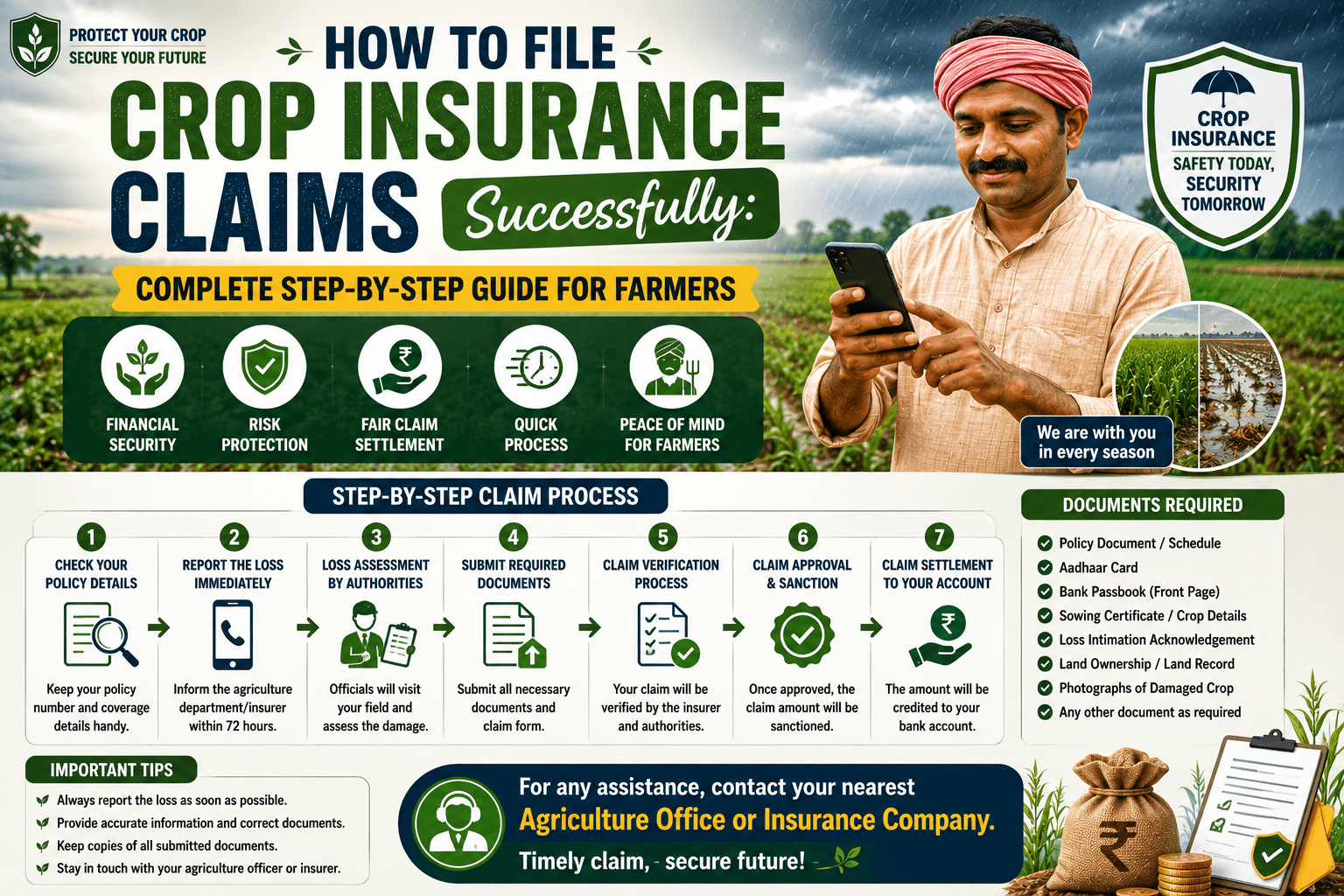
Crop insurance protects farmers from financial losses caused by natural calamities, adverse weather conditions, pests, diseases, and other unforeseen events that damage crops. In India, the Pradhan Mantri Fasal Bima Yojana (PMFBY) is one of the largest crop insurance schemes, providing affordable insurance coverage to farmers across the country.
However, obtaining compensation depends on filing the insurance claim correctly and within the prescribed timeline. Many claims are delayed or rejected because of incomplete documentation, delayed reporting, or failure to follow the official procedure.
This guide explains how to file crop insurance claims successfully, the documents required, eligibility, claim process, common mistakes to avoid, and useful tips to ensure faster settlement.
Crop Insurance Claim Overview
| Particular | Details |
|---|---|
| Scheme | Pradhan Mantri Fasal Bima Yojana (PMFBY) & Other Crop Insurance Schemes |
| Beneficiaries | Farmers |
| Coverage | Crop loss due to natural calamities, pests, diseases, localized disasters, and post-harvest losses (where applicable) |
| Claim Mode | Online / Offline |
| Reporting Authority | Insurance Company / Agriculture Department / Bank / CSC |
| Claim Settlement | Direct Benefit Transfer (DBT) to the farmer’s bank account |
What is a Crop Insurance Claim?
A crop insurance claim is a request submitted by a farmer to receive compensation for crop losses covered under an insurance policy. If the insured crop suffers damage due to eligible risks such as drought, floods, cyclones, hailstorms, pests, or diseases, the farmer can report the loss and apply for compensation.
The claim is processed after verification by the concerned authorities and the insurance company. Once approved, the claim amount is transferred directly to the farmer’s registered bank account.
Why Crop Insurance is Important
Crop insurance offers several benefits, including:
- Financial protection against crop losses.
- Reduced risk from natural disasters.
- Support for small and marginal farmers.
- Improved financial stability.
- Encouragement to adopt modern farming practices.
- Reduced dependence on emergency borrowing after crop failure.
When Can You File a Crop Insurance Claim?
Farmers can file a claim in situations such as:
- Drought
- Floods
- Cyclones
- Heavy Rainfall
- Hailstorms
- Landslides
- Cloudbursts
- Pest Attack
- Plant Diseases
- Localized Natural Calamities
- Post-Harvest Crop Damage (where covered under the policy)
- Prevented Sowing or Planting due to adverse weather
Claims should be reported immediately after the loss and within the timeline specified by the insurance scheme or insurer.
Eligibility for Filing a Claim
To file a crop insurance claim, a farmer should generally:
- Be enrolled under the crop insurance scheme.
- Have insured the affected crop for the relevant season.
- Cultivate land eligible under the scheme.
- Report crop damage within the prescribed time limit.
- Provide accurate land and crop details.
- Cooperate during field inspections and verification.
Documents Required
Keep the following documents ready:
- Aadhaar Card
- Crop Insurance Policy Details
- Farmer Registration Number (if applicable)
- Land Ownership or Tenancy Documents
- Bank Passbook
- Sowing Certificate (if required)
- Mobile Number
- Identity Proof
- Recent Passport-size Photograph
- Photographs or videos of the damaged crop (if requested)
- Claim Form
Step-by-Step Process to File a Crop Insurance Claim
Step 1: Report the Crop Loss
As soon as crop damage occurs, inform the insurance company, local Agriculture Department, bank, Common Service Centre (CSC), or the designated crop insurance helpline within the prescribed reporting period.
Step 2: Register the Claim
Submit your claim online through the designated portal or visit the nearest Agriculture Office, bank, or CSC to register your claim.
Step 3: Submit Required Documents
Provide all necessary documents, including your policy details, Aadhaar, bank account information, land records, and any supporting evidence of crop damage.
Step 4: Field Verification
Officials from the Agriculture Department or the insurance company may inspect the affected field to verify the extent and cause of crop loss.
Step 5: Assessment of Loss
The crop damage is assessed using field inspections, crop-cutting experiments, weather data, satellite imagery, or other approved methods, depending on the type of claim.
Step 6: Claim Approval
If the claim satisfies the scheme guidelines and verification process, it is approved by the insurance company.
Step 7: Receive Compensation
After approval, the claim amount is transferred directly to the farmer’s registered bank account through Direct Benefit Transfer (DBT).
Types of Crop Insurance Claims
Prevented Sowing Claims
Applicable when farmers are unable to sow crops due to adverse seasonal conditions such as inadequate rainfall or floods.
Standing Crop Claims
Available when crops are damaged during the growing season due to covered risks.
Localized Calamity Claims
Applicable for localized events such as hailstorms, landslides, cloudbursts, or inundation affecting individual farms.
Post-Harvest Claims
Compensation for crops damaged after harvesting but before storage, where such coverage is included under the scheme.
Claim Settlement Process
The typical process includes:
- Crop loss reported by the farmer.
- Claim registration.
- Verification by officials.
- Loss assessment.
- Approval by the insurance company.
- Direct transfer of compensation to the farmer’s bank account.
The processing time may vary depending on the scheme, the completeness of the application, and verification requirements.
Common Reasons for Claim Rejection
Claims may be rejected due to:
- Late reporting of crop loss.
- Incorrect or incomplete application forms.
- Missing documents.
- Incorrect bank account details.
- Crop not insured under the policy.
- Non-payment of insurance premium (where applicable).
- Crop loss not covered under the policy.
- Mismatch between declared and actual crop details.
Tips for Successful Crop Insurance Claims
- Report crop damage immediately.
- Maintain accurate records of sowing and cultivation.
- Purchase insurance before the deadline.
- Keep copies of all submitted documents.
- Ensure Aadhaar and bank account details are correctly linked.
- Take clear photographs of damaged crops if required.
- Cooperate with field inspection teams.
- Track the status of your claim regularly.
Frequently Asked Questions (FAQs)
Q1. Who can file a crop insurance claim?
Any eligible farmer enrolled under a crop insurance scheme with an insured crop can file a claim, subject to the scheme’s conditions.
Q2. How soon should crop damage be reported?
Crop damage should be reported as soon as possible and within the reporting period specified by the insurance scheme or insurer.
Q3. Can tenant farmers apply?
Depending on the scheme and state guidelines, eligible tenant farmers and sharecroppers may also be covered if they meet the required conditions.
Q4. How is crop loss verified?
Crop loss may be verified through field inspections, crop-cutting experiments, weather data, satellite imagery, or other approved assessment methods.
Q5. How is the claim amount paid?
Approved claims are generally transferred directly to the farmer’s registered bank account through Direct Benefit Transfer (DBT).
Q6. Can claims be filed online?
Many crop insurance schemes provide online claim registration, while offline assistance is also available through banks, Agriculture Offices, and Common Service Centres.
Q7. What happens if the claim is rejected?
If a claim is rejected, farmers should check the reason, rectify any deficiencies if possible, and contact the insurance company or the concerned Agriculture Department for guidance.
Conclusion
Filing a crop insurance claim correctly and on time is essential for receiving compensation after crop losses. Farmers should report damage promptly, submit complete documentation, and cooperate with the verification process to improve the chances of successful claim settlement. Understanding the claim procedure and following the scheme guidelines can help ensure timely financial assistance and reduce the impact of agricultural losses.