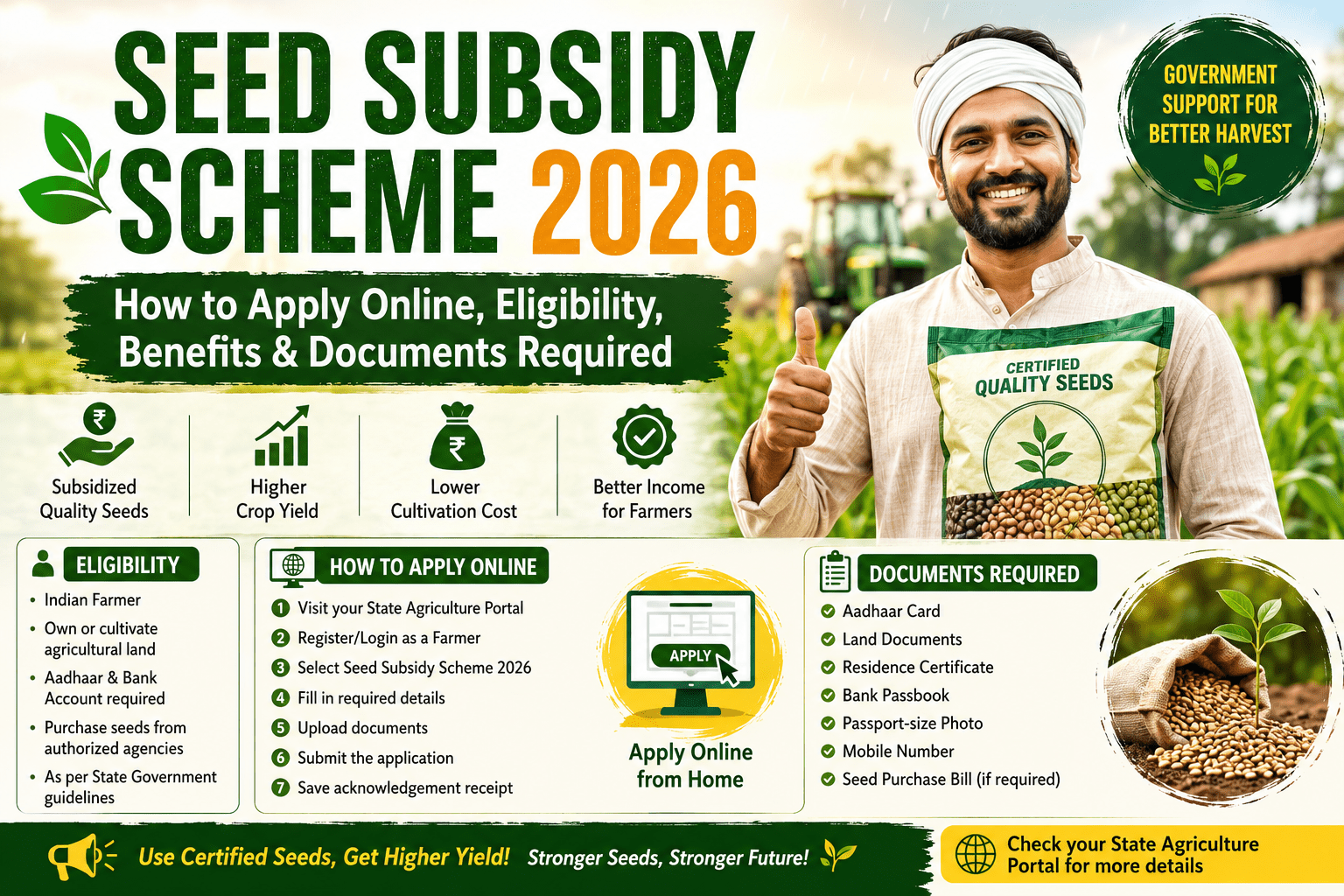
The Seed Subsidy Scheme 2026 is an agricultural assistance initiative implemented by the Central and State Governments to help farmers purchase certified and quality seeds at subsidized prices. The scheme aims to improve crop productivity, encourage the use of high-yielding and certified seed varieties, and increase farmers’ income by reducing the cost of cultivation.
Financial assistance for seed distribution is provided under various government programmes such as the National Food Security & Nutrition Mission (NFSNM), National Mission on Edible Oils – Oilseeds (NMEO-Oilseeds), Rashtriya Krishi Vikas Yojana (RKVY), and state-level seed subsidy programmes. Depending on the crop and state, farmers may receive up to 50% subsidy on the cost of certified or foundation seeds.
This guide explains everything about the Seed Subsidy Scheme 2026, including eligibility, benefits, subsidy amount, documents required, and the application process.
Seed Subsidy Scheme 2026 Overview
| Particular | Details |
|---|---|
| Scheme Name | Seed Subsidy Scheme 2026 |
| Launched By | Central & State Governments |
| Implementing Department | Department of Agriculture / State Agriculture Departments |
| Beneficiaries | Farmers |
| Objective | Promote use of certified quality seeds |
| Benefit | Subsidy on certified/foundation/hybrid seeds |
| Subsidy | Up to 50% (varies by scheme and state) |
| Application Mode | Online / Offline (State-wise) |
What is the Seed Subsidy Scheme?
The Seed Subsidy Scheme provides financial assistance to farmers for purchasing quality-certified seeds of various crops. The objective is to increase agricultural productivity by encouraging farmers to replace traditional or farm-saved seeds with certified, disease-free, and high-yielding varieties.
The subsidy is generally credited through the concerned agriculture department or provided as a reduced purchase price through government-authorized seed distribution centres. The exact implementation varies from state to state.
Objectives of the Scheme
The major objectives include:
- Promote the use of certified quality seeds.
- Increase agricultural productivity.
- Improve seed replacement rates.
- Reduce the cost of cultivation.
- Support small and marginal farmers.
- Encourage adoption of improved crop varieties.
- Enhance food security.
- Increase farmers’ income through better yields.
Benefits of Seed Subsidy Scheme
Farmers can avail several benefits under the scheme:
- Subsidy on certified seeds.
- Lower cost of purchasing quality seeds.
- Better germination and crop yield.
- Disease-resistant seed varieties.
- Access to newly developed high-yielding varieties.
- Improved farm productivity.
- Support for oilseeds, pulses, cereals, and other notified crops.
Eligible Crops and Seeds
The list of eligible seeds differs by state and season, but commonly includes:
- Paddy (Rice)
- Wheat
- Maize
- Bajra
- Jowar
- Pulses
- Gram
- Lentil
- Mustard
- Groundnut
- Soybean
- Sunflower
- Sesame
- Cotton
- Vegetable Seeds
- Certified Hybrid Seeds
- Foundation Seeds
Availability depends on the cropping season and state agriculture department.
Eligibility Criteria
Applicants generally should:
- Be an Indian farmer.
- Own or legally cultivate agricultural land (subject to state guidelines).
- Be registered with the State Agriculture Department, where required.
- Have a valid Aadhaar-linked bank account.
- Purchase eligible certified seeds from authorized agencies.
Additional conditions may vary by state and crop.
Subsidy Amount
The subsidy amount is determined by the respective Central or State Government scheme.
Generally:
- Up to 50% subsidy on the cost of certified, foundation, or hybrid seeds.
- Subsidy rates may differ depending on:
- Crop type
- Farmer category
- State Government policy
- Season (Kharif/Rabi)
Farmers should check the latest subsidy rates with their district agriculture office before purchasing seeds.
Documents Required
Applicants generally need:
- Aadhaar Card
- Land Ownership or Cultivation Documents
- Farmer Registration Number (if applicable)
- Bank Passbook
- Mobile Number
- Passport-size Photograph
- Identity Proof
- Seed Purchase Invoice (where reimbursement is applicable)
How to Apply for Seed Subsidy Scheme 2026
The application process varies by state, but generally follows these steps:
Step 1
Visit the official State Agriculture Department portal or contact your nearest Agriculture Office.
Step 2
Register using your Aadhaar number and mobile number (if registration is required).
Step 3
Select the Seed Subsidy Scheme or the relevant seasonal seed distribution programme.
Step 4
Fill in personal, land, crop, and bank details.
Step 5
Upload or submit the required documents.
Step 6
Submit the application.
Step 7
After verification, purchase eligible seeds from an authorized dealer or government seed distribution centre.
Step 8
The subsidy is either adjusted at the time of purchase or transferred to the beneficiary according to the state’s implementation process.
Seed Distribution Process
Depending on the state, seeds may be distributed through:
- Government Seed Stores
- State Seed Corporations
- Agriculture Department Offices
- Cooperative Societies
- Authorized Seed Dealers
Some states use Direct Benefit Transfer (DBT), while others provide subsidized prices directly at the point of sale.
Important Guidelines
- Purchase only certified seeds from authorized sellers.
- Keep the purchase invoice safely.
- Verify crop-wise subsidy availability before buying.
- Ensure Aadhaar and bank account details are updated.
- Apply within the prescribed Kharif or Rabi season deadlines.
- Follow state-specific eligibility conditions.
Frequently Asked Questions (FAQs)
Q1. What is the Seed Subsidy Scheme?
It is a government initiative that provides financial assistance to farmers for purchasing certified and quality seeds at subsidized rates.
Q2. Who can apply?
Eligible Indian farmers who meet the conditions prescribed by their respective State Agriculture Department.
Q3. How much subsidy is available?
Many seed subsidy programmes provide up to 50% subsidy, although the exact amount depends on the crop, scheme, and state.
Q4. Which seeds are covered?
Certified seeds of crops such as paddy, wheat, maize, pulses, oilseeds, cotton, vegetables, and other notified crops.
Q5. Is the application process online?
Many states offer online applications, while others accept applications through district agriculture offices.
Q6. Where can I buy subsidized seeds?
Eligible seeds are available through government seed stores, state seed corporations, cooperative societies, and authorized dealers.
Q7. Is Aadhaar mandatory?
Most states require Aadhaar-linked identification and bank account details for verification and subsidy transfer.
Conclusion
The Seed Subsidy Scheme 2026 plays an important role in improving agricultural productivity by making certified and high-quality seeds affordable for farmers. Through subsidies offered under Central and State Government programmes, farmers can reduce cultivation costs, adopt improved seed varieties, and increase crop yields. Interested farmers should contact their State Agriculture Department or visit the official agriculture portal of their state to check current crop-wise subsidies, application dates, and eligibility requirements.