A home loan can help make homeownership more affordable, but it can also provide certain income-tax benefits to eligible borrowers. In India, home-loan tax benefits are mainly associated with the principal repayment under Section 80C and interest paid under Section 24(b), subject to the applicable tax regime and conditions.
For 2026, borrowers should pay particular attention to the difference between the old tax regime and the new tax regime. The Income Tax Department’s current guidance states that Section 24(b) provides a deduction for eligible housing-loan interest under the old regime, while the treatment under the new regime differs depending on whether the property is self-occupied or let out.
This guide explains Home Loan Tax Benefits 2026, including Section 80C, Section 24(b), old vs new tax regime, self-occupied and let-out properties, joint home loans, pre-construction interest, required documents and common mistakes.
What Are Home Loan Tax Benefits?
Home-loan tax benefits allow eligible taxpayers to claim deductions for certain housing-loan payments while calculating taxable income.
The two important provisions traditionally associated with home loans are:
- Section 80C – principal repayment
- Section 24(b) – interest paid on housing loan
However, these benefits are subject to conditions and are not automatically available simply because a person has a home loan.
The tax regime selected by the taxpayer is also important.
Home Loan Tax Benefits 2026 at a Glance
| Tax Benefit | What It Covers | Maximum/Tax Treatment |
|---|---|---|
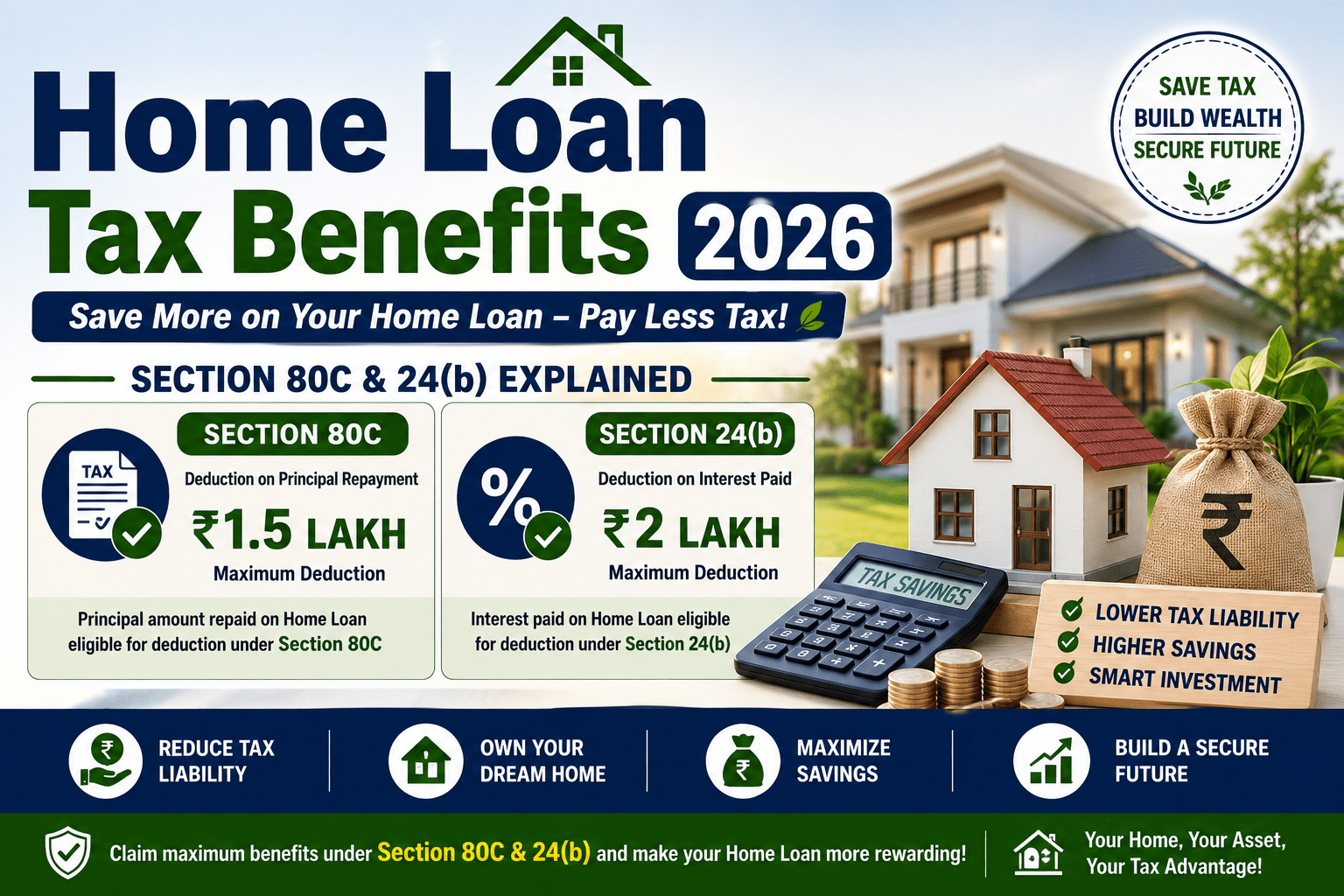
| Section 80C | Eligible principal repayment | Up to ₹1.5 lakh within the overall Section 80C limit under the old regime |
| Section 24(b) | Interest on eligible housing loan | Up to ₹2 lakh for qualifying self-occupied property under the old regime |
| Section 24(b) for Let-Out Property | Interest on housing loan | Actual eligible interest, subject to applicable house-property rules |
| New Tax Regime | Section 80C | Generally not available |
| New Tax Regime – Self-Occupied Property | Section 24(b) | Deduction generally not available |
| New Tax Regime – Let-Out Property | Section 24(b) | Eligible interest can be considered subject to applicable rules |
The Income Tax Department confirms that Section 80C deductions form part of the deductions available under the old regime, while the new regime substantially restricts deductions. Its current guidance specifically provides Section 24(b) treatment for eligible let-out property under the new regime.
Section 80C Home Loan Benefit 2026
Section 80C allows eligible taxpayers under the applicable tax regime to claim a deduction for certain investments and payments.
For home-loan borrowers, the important component is the principal portion of the housing-loan repayment.
Under the old tax regime, eligible principal repayment can be included within the overall Section 80C deduction limit of ₹1.5 lakh in a financial year.
This ₹1.5 lakh limit is not exclusively for home-loan principal repayment.
Other eligible Section 80C investments and payments can also use the same overall limit.
For example, if a taxpayer already has eligible investments under Section 80C, the remaining available limit for home-loan principal repayment may be lower.
What Is Covered Under Section 80C?
For home-loan purposes, Section 80C can cover eligible repayment of the principal component of a housing loan.
Depending on the circumstances and applicable provisions, certain expenses connected with purchase or construction may also qualify.
However, taxpayers should distinguish between:
- Principal repayment
- Interest repayment
- Registration charges
- Stamp duty
- Other property expenses
These do not all receive the same tax treatment.
Section 24(b) Home Loan Interest Deduction 2026
Section 24(b) deals with interest paid on borrowed capital for eligible house property.
Under the old tax regime, interest on a qualifying housing loan for a self-occupied property can generally be claimed up to ₹2 lakh per financial year, subject to the applicable conditions.
The Income Tax Department’s current guidance specifies the ₹2 lakh maximum for eligible self-occupied property where the loan is used for purchase or construction and the applicable conditions are satisfied.
The deduction is for interest, not the principal component.
Therefore:
- Principal repayment → Section 80C
- Interest payment → Section 24(b)
Section 80C vs Section 24(b)
Understanding the difference between these two provisions is important.
| Particular | Section 80C | Section 24(b) |
|---|---|---|
| Main benefit | Principal repayment | Home-loan interest |
| Old tax regime | Available subject to conditions | Available subject to conditions |
| Self-occupied property | Eligible principal can qualify | Interest deduction subject to applicable limit |
| Maximum for self-occupied property | Within overall ₹1.5 lakh Section 80C limit | Generally up to ₹2 lakh |
| New tax regime | Generally unavailable | Different treatment depending on property type |
| Nature of deduction | Chapter VI-A deduction | Deduction under income from house property |
The two sections are separate, but their availability depends on the applicable tax regime and property circumstances.
Home Loan Tax Benefits Under Old Tax Regime
The old tax regime continues to allow several deductions that are restricted or unavailable under the new regime.
For eligible home-loan borrowers, the major benefits can include:
Section 80C
Eligible principal repayment can be claimed within the overall ₹1.5 lakh Section 80C limit.
Section 24(b)
Eligible interest paid on a qualifying self-occupied property can generally be claimed up to ₹2 lakh, subject to the applicable conditions.
Let-Out Property
Different rules apply when the property is let out.
The taxpayer calculates income from house property after considering eligible interest and other applicable provisions.
Home Loan Tax Benefits Under New Tax Regime
The new tax regime provides lower or simplified tax rates in exchange for giving up many deductions and exemptions available under the old regime.
For home-loan borrowers, this distinction is particularly important.
Section 80C Under New Tax Regime
The regular Section 80C deduction is generally not available under the new tax regime.
Therefore, eligible home-loan principal repayment cannot generally be claimed under Section 80C when the taxpayer is taxed under the new regime.
Section 24(b) for Self-Occupied Property
For a self-occupied house, the Section 24(b) interest deduction available under the old regime is generally not available under the new regime.
Section 24(b) for Let-Out Property
The Income Tax Department’s current guidance provides for deduction of actual eligible housing-loan interest for a let-out property under the new regime, subject to the applicable house-property rules. However, a house-property loss cannot be set off against other heads of income or carried forward in the manner available under the old regime.
Therefore, taxpayers with rental properties should examine the new-regime rules carefully rather than assuming that all home-loan deductions disappear.
Self-Occupied Property and Tax Benefits
A self-occupied property is generally a home used by the owner for their own residential purposes.
Under the old tax regime, eligible borrowers can generally claim:
- Principal repayment under Section 80C, within the overall limit
- Interest deduction under Section 24(b), subject to the applicable conditions and ₹2 lakh limit
The Income Tax Department’s current guidance specifies the ₹2 lakh Section 24(b) limit for qualifying self-occupied property.
Tax Benefits for Let-Out Property
If a house is rented out, the tax treatment is different.
The taxpayer calculates income from house property after considering applicable deductions.
Eligible interest on borrowed capital can be considered under Section 24(b).
Under the old regime, house-property losses may be subject to set-off and carry-forward rules. Under the new regime, the Income Tax Department states that a loss under the house-property head cannot be set off against other heads of income or carried forward when the relevant Section 24(b) deduction is claimed for a let-out property.
Because rental-property taxation can become more complicated, taxpayers with multiple properties should carefully review the applicable provisions before filing their return.
Home Loan Tax Benefits for Joint Borrowers
A home loan can be taken jointly by eligible applicants, such as spouses.
Where the conditions are satisfied, each co-borrower may potentially claim eligible deductions according to their respective ownership, repayment and tax circumstances.
However, simply being named as a co-applicant does not automatically guarantee a tax deduction.
The borrower should generally have the required ownership and repayment relationship with the property and loan.
Joint borrowers should maintain proper records of:
- Ownership share
- Loan contribution
- EMI payments
- Principal repayment
- Interest paid
- Loan certificate
Home Loan Tax Benefits for First-Time Homebuyers
First-time homebuyers may also need to check whether any additional tax provision is applicable to their specific loan and property circumstances.
However, taxpayers should not assume that every homebuyer receives an additional deduction simply because they are purchasing their first house.
Certain additional home-loan provisions introduced in earlier years have specific eligibility and loan-sanction conditions.
For 2026 tax planning, borrowers should verify whether any additional provision applies to their particular loan before claiming it.
Tax Benefit on Home Loan Principal Repayment
The principal component of the EMI can qualify for Section 80C deduction under the old regime, subject to the overall Section 80C limit.
The taxpayer should obtain the annual home-loan statement from the lender showing:
- Principal repaid
- Interest paid
- Outstanding loan
- Loan account number
- Other relevant details
This helps in correctly reporting the deduction while filing the income-tax return.
Tax Benefit on Home Loan Interest
The interest component of the EMI is considered separately from principal repayment.
For a qualifying self-occupied property under the old tax regime, Section 24(b) generally allows a deduction up to ₹2 lakh per year, subject to the conditions.
The Income Tax Department’s ITR guidance also requires taxpayers to provide housing-loan information such as lender name, loan account number, sanction date, total loan amount, outstanding amount and interest on borrowed capital.
Pre-Construction Interest Tax Benefit
Interest paid during the period before construction or acquisition is completed can have a different treatment from regular post-completion interest.
Eligible pre-construction interest can generally be claimed in instalments after the property is acquired or construction is completed, subject to the applicable tax rules and conditions.
Taxpayers should keep records of interest paid before completion and consult the applicable provisions when filing the return.
Home Loan Tax Benefits for Under-Construction Property
For an under-construction property, the tax treatment of interest can depend on the date of completion and other applicable conditions.
Borrowers should maintain:
- Loan sanction letter
- Loan statement
- Interest certificate
- Construction documents
- Possession/completion documents
The timing of the property purchase or construction completion can affect when eligible deductions can be claimed.
Documents Required to Claim Home Loan Tax Benefits
Taxpayers should keep the following documents ready:
Home Loan Interest Certificate
This is one of the most important documents.
It generally shows:
- Principal repaid
- Interest paid
- Outstanding loan
- Loan account number
- Financial-year details
Loan Statement
The annual loan statement provides a detailed record of repayments.
Sale Agreement
This can establish property purchase details.
Sale Deed
The registered sale deed can establish ownership.
Possession Certificate
This may be relevant for determining property possession and completion.
Bank Statements
Bank statements can help establish that EMI payments were made.
Property Documents
Keep relevant title and registration documents safely.
Rent-Related Documents
For a let-out property, keep rental income and related property records.
How to Claim Home Loan Tax Benefits
Taxpayers generally claim eligible deductions while filing their income-tax return.
The basic process is:
Step 1: Obtain the Annual Loan Statement
Request the annual interest and principal certificate from your bank or housing finance company.
Step 2: Check Principal Repayment
Identify the eligible principal amount for the relevant financial year.
Step 3: Check Interest Paid
Review the interest amount shown on the lender’s certificate.
Step 4: Determine Your Tax Regime
Check whether you are filing under the old or new tax regime.
Step 5: Check Property Status
Determine whether the property is:
- Self-occupied
- Let out
- Deemed to be let out, where applicable
Step 6: Check Eligibility
Confirm that the applicable conditions for the deduction have been satisfied.
Step 7: Report the Deduction
Enter the eligible amounts in the appropriate sections while filing the income-tax return.
The Income Tax Department’s current ITR guidance includes a dedicated Section 24(b) schedule requiring details of the housing loan and interest.
Can You Claim Both Section 80C and Section 24(b)?
Yes, an eligible taxpayer under the old tax regime can generally claim both benefits when the relevant conditions are satisfied.
The two deductions cover different components:
Section 80C → Principal repayment
Section 24(b) → Interest payment
However, taxpayers must observe the respective limits and conditions.
Section 80C has an overall annual limit of ₹1.5 lakh, while the Section 24(b) limit for qualifying self-occupied property is generally ₹2 lakh.
Important Conditions for Home Loan Tax Benefits
Taxpayers should keep the following points in mind:
- The tax regime matters.
- Section 80C has an overall limit.
- Section 24(b) has different rules for self-occupied and let-out properties.
- Ownership can matter for claiming deductions.
- The loan should be used for an eligible housing purpose.
- Interest and principal should be supported by lender records.
- Pre-construction interest has separate treatment.
- Joint borrowers need to satisfy applicable ownership and repayment conditions.
- Property-related documents should be preserved.
Home Loan Tax Benefit and Tax Regime: Quick Comparison
| Particular | Old Tax Regime | New Tax Regime |
|---|---|---|
| Section 80C principal repayment | Available subject to conditions | Generally not available |
| Self-occupied property interest under Section 24(b) | Up to ₹2 lakh subject to conditions | Generally not available |
| Let-out property interest | Eligible under applicable rules | Actual eligible interest, subject to applicable restrictions |
| Section 80C overall limit | ₹1.5 lakh | Not available |
| Need to compare tax regimes | Yes | Yes |
The Income Tax Department’s current guidance confirms the difference in Section 24(b) treatment between self-occupied and let-out properties under the new regime.
Common Mistakes While Claiming Home Loan Tax Benefits
Claiming Section 80C Without Checking the Overall Limit
The ₹1.5 lakh Section 80C limit includes several eligible investments and payments, not only home-loan principal.
Claiming Section 24(b) in the Wrong Tax Regime
Taxpayers should check whether the deduction is available under their selected regime.
Confusing Principal and Interest
Principal and interest are reported under different provisions.
Ignoring Property Status
Self-occupied and let-out properties can have different tax treatment.
Claiming a Deduction Without Ownership
Being a co-applicant without the required ownership or repayment conditions may not be enough.
Not Keeping the Interest Certificate
Always retain the lender’s annual certificate.
Claiming the Entire EMI Under Section 80C
The entire EMI cannot be claimed under Section 80C. Only the eligible principal component is relevant.
Home Loan Tax Benefits 2026 Checklist
Before filing your income-tax return, check:
- Home-loan interest certificate
- Annual loan statement
- Principal repayment amount
- Interest paid during the financial year
- Loan account number
- Loan sanction date
- Property ownership documents
- Property possession/completion details
- Property status
- Tax regime selected
- Existing Section 80C investments
- Eligible Section 24(b) amount
- Joint-owner details, where applicable
- Rental income records, if applicable
Frequently Asked Questions (FAQs)
What is Section 80C home loan benefit?
Section 80C can allow eligible taxpayers under the old tax regime to claim a deduction for qualifying home-loan principal repayment within the overall ₹1.5 lakh annual Section 80C limit.
What is Section 24(b)?
Section 24(b) provides a deduction for eligible interest paid on borrowed capital used for qualifying house property.
How much home-loan interest can I claim under Section 24(b)?
For a qualifying self-occupied property under the old tax regime, the maximum deduction is generally ₹2 lakh per year, subject to applicable conditions.
Can I claim Section 80C and Section 24(b) together?
Yes, eligible taxpayers under the old tax regime can generally claim both, because Section 80C covers eligible principal repayment while Section 24(b) covers eligible interest.
Is Section 80C available under the new tax regime?
The regular Section 80C deduction is generally not available under the new tax regime.
Can I claim home-loan interest under the new tax regime?
The treatment depends on the property. The Income Tax Department provides Section 24(b) treatment for eligible interest on let-out property under the new regime, subject to applicable restrictions. The self-occupied-property interest deduction available under the old regime is generally not available under the new regime.
Can I claim tax benefits on a joint home loan?
Eligible co-borrowers may be able to claim deductions separately if the applicable ownership, repayment and tax conditions are satisfied.
Can I claim tax benefits on a home loan for an under-construction property?
Tax treatment can depend on when the property is completed and the nature of the interest paid. Pre-construction interest has specific rules.
What documents are required to claim home-loan deductions?
The most important document is generally the lender’s annual home-loan certificate showing principal and interest. Property and payment records should also be retained.
Can I claim the entire EMI as a tax deduction?
No. The EMI contains both principal and interest. Different tax provisions apply to the two components.
What happens if I already use Section 80C for other investments?
The overall Section 80C limit is shared among eligible investments and payments. If the limit has already been used, additional eligible principal repayment cannot be claimed beyond that overall limit.
Is home-loan tax benefit automatically available?
No. The taxpayer must satisfy the applicable conditions and correctly report eligible deductions while filing the income-tax return.
Conclusion
Home Loan Tax Benefits 2026 can reduce the taxable income of eligible borrowers, but the benefit depends heavily on the tax regime, property type, loan purpose, ownership and applicable conditions.
Under the old tax regime, eligible borrowers can generally claim home-loan principal repayment under Section 80C, within the overall ₹1.5 lakh annual limit, and interest deduction under Section 24(b) for a qualifying self-occupied property, generally up to ₹2 lakh.
The new tax regime works differently. The regular Section 80C deduction is generally unavailable, while Section 24(b) has specific treatment for let-out properties and restrictions concerning house-property losses.
Borrowers should therefore compare the tax impact of both regimes rather than automatically choosing one based only on the home-loan deduction.
Before filing the return, keep the annual home-loan interest certificate, loan statement, property documents and repayment records ready. The Income Tax Department’s ITR guidance also requires relevant loan details when reporting Section 24(b) interest.
Most importantly, taxpayers should not claim deductions simply because they are paying a home-loan EMI. The exact tax benefit depends on the applicable provisions and the taxpayer’s circumstances. For complicated cases involving multiple properties, joint ownership, rental income or pre-construction interest, professional tax advice can help ensure the return is filed correctly.