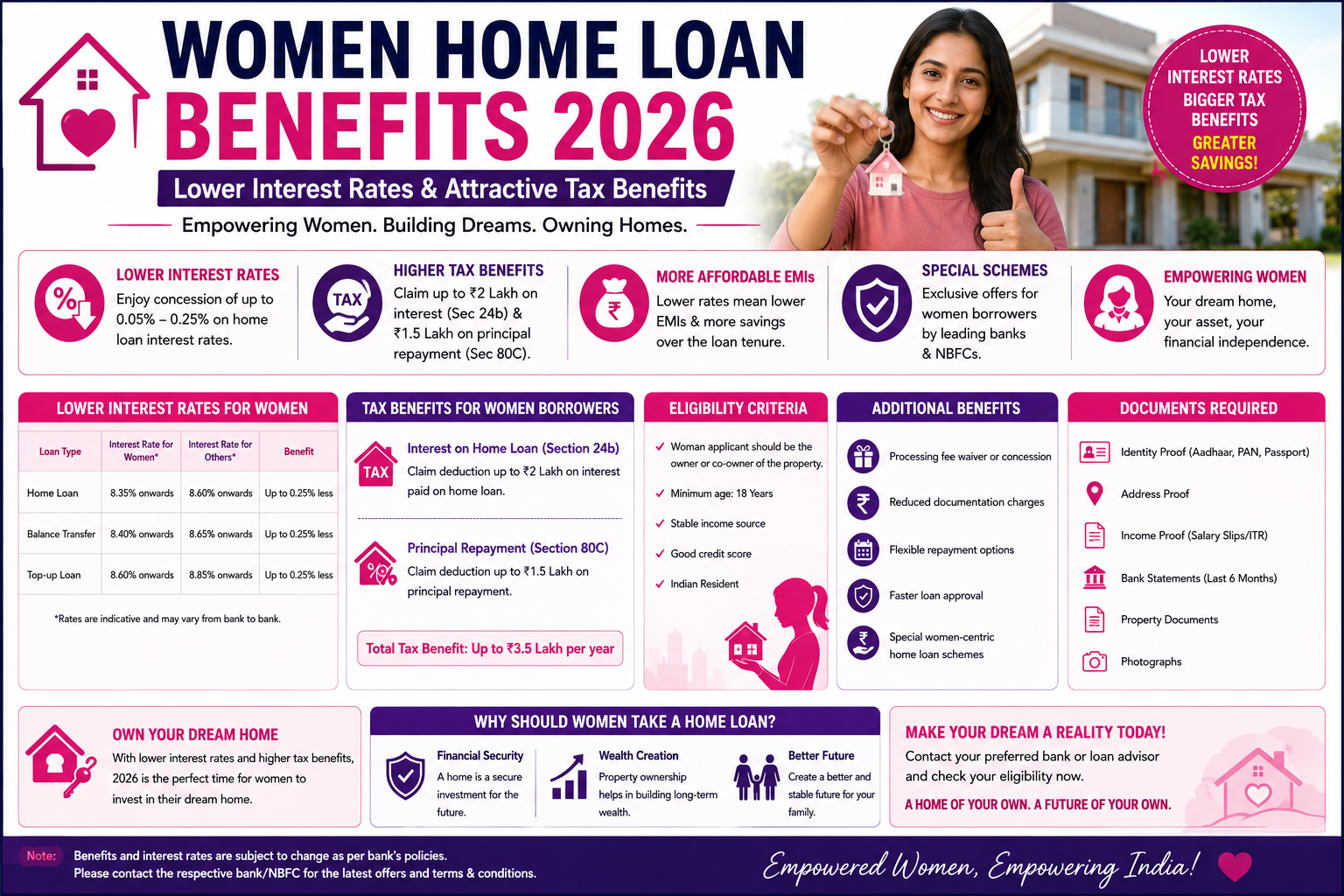
Women homebuyers in India may receive several advantages when applying for a home loan or purchasing a property in their own name. In 2026, these benefits can include preferential home-loan interest rates from some lenders, state-specific stamp-duty concessions, joint-home-loan advantages and tax deductions available to eligible homeowners.
However, it is important to understand that not every benefit is exclusively available to women. For example, income-tax deductions on home loans are generally based on the taxpayer’s eligibility, ownership, loan and property conditions rather than gender. The main advantage for women often comes from lender-specific interest-rate concessions and state-level property registration benefits. (hdfc.bank.in)
Several banks and housing finance companies offer preferential pricing to women borrowers. HDFC Bank states that women may receive home-loan interest-rate concessions of around 0.05% to 0.10%, depending on the applicable product and conditions. (hdfc.bank.in)
This guide explains Women Home Loan Benefits 2026, including lower interest rates, tax benefits, stamp-duty concessions, joint home loans, eligibility, documents, application process and important conditions.
What Is a Home Loan for Women?
A home loan for women is a housing loan offered to a female applicant under the lender’s applicable home-loan product.
A woman may apply as:
- Sole borrower
- Primary applicant
- Joint borrower
- Co-applicant
- Property owner or co-owner
The exact benefits depend on the lender and the ownership structure.
Women can use home loans for eligible purposes such as:
- Buying a house
- Buying a flat
- Purchasing a resale property
- Buying an under-construction property
- Constructing a house
- Renovating an existing home
- Extending or repairing a property
Women Home Loan Benefits 2026 at a Glance
| Benefit | Details |
|---|---|
| Lower Interest Rate | Some lenders offer preferential rates to women borrowers |
| Stamp Duty Concession | Several states offer lower stamp duty when property is registered in a woman’s name |
| Tax Benefits | Eligible women can claim applicable home-loan deductions under the tax rules |
| Joint Home Loan | Joint ownership and borrowing can provide separate tax benefits when conditions are satisfied |
| Government Housing Schemes | Eligible women may benefit from applicable affordable-housing schemes |
| Property Ownership | Buying property in a woman’s name can support independent asset ownership |
| Credit Profile | Regular repayment can help establish a stronger credit history |
The availability and amount of each benefit depend on the lender, state, property, ownership structure and applicable tax rules.
Lower Home Loan Interest Rates for Women
One of the most commonly promoted benefits for women borrowers is a preferential interest rate.
Some banks and housing finance companies offer a small concession compared with their standard home-loan rates.
For example, HDFC Bank states that women borrowers can receive an interest-rate concession generally ranging from 0.05% to 0.10%, subject to the lender’s terms. (hdfc.bank.in)
Kotak Mahindra Bank also states that its home-loan products for women can have reduced interest rates. (kotak.bank.in)
However, the concession is not automatically available to every woman. The lender may require the woman to be:
- Primary applicant
- Sole applicant
- First applicant
- Property owner
- Co-owner
The exact requirement varies by lender.
Why Lower Interest Rates Matter
Even a small difference in the interest rate can affect the overall cost of a long-term home loan.
A lower rate can potentially result in:
- Lower interest burden
- Lower EMI
- Reduced total repayment cost
- Better affordability
However, borrowers should compare the complete loan terms instead of choosing a lender solely because it advertises a women-specific rate.
Check:
- Interest rate
- Processing fee
- Legal charges
- Valuation charges
- Prepayment conditions
- Loan tenure
- Other applicable fees
Stamp Duty Concession for Women Homebuyers
Another important benefit available in several parts of India is a stamp-duty concession for women property buyers.
Stamp duty is a state-level charge associated with property transactions. Several states provide lower stamp-duty rates when a property is registered in a woman’s name.
The exact concession varies by state and can also depend on:
- Property value
- Property location
- Individual or joint ownership
- Type of property
- State rules
For example, Delhi provides a lower stamp-duty rate for women compared with men in certain property transactions. Recent 2026 reporting also highlights state-specific concessions available to women homebuyers. (outlookmoney.com)
Therefore, women should check the current stamp-duty rules of the state where the property is being purchased.
Is Stamp Duty a Home Loan Benefit?
Stamp duty is not a home-loan benefit provided by the bank.
It is a property transaction charge governed by the relevant state or Union Territory.
However, when a woman receives a stamp-duty concession because the property is registered in her name, it can reduce the overall cost of buying the property.
This is why stamp-duty savings are commonly discussed along with women home-loan benefits.
Home Loan Tax Benefits for Women
Women borrowers can claim applicable tax benefits on home loans, but it is important to understand that these deductions are generally not exclusive to women.
Tax benefits depend on factors such as:
- Property ownership
- Loan ownership
- Repayment of the loan
- Property type
- Tax regime
- Purpose of the loan
- Applicable income-tax provisions
Under the old tax regime, eligible taxpayers can generally claim:
- Principal repayment under Section 80C, subject to the overall limit
- Interest deduction under Section 24(b), subject to applicable conditions
The Income Tax Department states that eligible interest on borrowed capital for a qualifying self-occupied house can generally be deducted up to ₹2 lakh, subject to the prescribed conditions. (incometaxindia.gov.in)
Section 80C Benefit for Women Homebuyers
Under the old tax regime, eligible principal repayment of a home loan can qualify for deduction under Section 80C.
The overall Section 80C limit is ₹1.5 lakh per financial year.
This limit is shared with other eligible investments and payments under Section 80C.
Therefore, if a woman is already using Section 80C for other eligible investments, the amount available for home-loan principal repayment may be lower.
It is important to remember that the entire EMI cannot be claimed under Section 80C.
Only the eligible principal component is relevant for this deduction.
Section 24(b) Benefit for Women Home Loan Borrowers
Section 24(b) deals with eligible interest paid on borrowed capital for house property.
For a qualifying self-occupied property under the old tax regime, eligible home-loan interest can generally be claimed up to ₹2 lakh per year, subject to the applicable conditions. (incometaxindia.gov.in)
This benefit is available based on tax eligibility and is not a women-only deduction.
Therefore, a male or female taxpayer can potentially claim the deduction if the applicable requirements are satisfied.
Home Loan Tax Benefits Under the New Tax Regime
Women borrowers should carefully compare the old and new tax regimes before assuming that a home loan will automatically provide tax savings.
The new tax regime does not generally provide the regular Section 80C deduction.
Similarly, the Section 24(b) treatment for a self-occupied property is different from the old regime.
For a let-out property, eligible interest can receive different treatment under the new regime, subject to applicable house-property rules.
The Income Tax Department’s current guidance should be checked before filing the return because tax provisions can change through Finance Acts. (incometax.gov.in)
Women Home Loan: Old Tax Regime vs New Tax Regime
| Tax Benefit | Old Tax Regime | New Tax Regime |
|---|---|---|
| Section 80C | Available subject to conditions | Generally not available |
| Home-loan principal deduction | Possible through Section 80C | Generally unavailable |
| Self-occupied home-loan interest | Section 24(b) benefit subject to conditions | Generally unavailable |
| Let-out property interest | Subject to house-property rules | Different treatment and restrictions apply |
| Tax benefit based on gender | No | No |
The important point is that being a woman does not by itself create a separate income-tax deduction. The tax benefit depends on the applicable tax provisions and the taxpayer’s circumstances.
Joint Home Loan Benefits for Women
A woman can also take a home loan jointly with her spouse or another eligible family member.
Joint borrowing may provide advantages when both borrowers satisfy the applicable ownership and repayment conditions.
Potential benefits include:
- Combined income consideration
- Potentially higher loan eligibility
- Separate tax deductions for eligible co-borrowers
- Shared property ownership
However, simply adding a woman’s name as a co-applicant does not automatically provide a separate tax benefit.
The woman should generally have the required ownership interest and loan/repayment responsibility to claim the applicable deduction.
Can Both Husband and Wife Claim Home Loan Tax Benefits?
Yes, eligible co-owners and co-borrowers may be able to claim deductions separately, provided the applicable conditions are satisfied.
For example, where:
- Both are owners of the property
- Both are borrowers
- Both contribute toward repayment
- The property and loan meet the tax requirements
each eligible taxpayer may claim their respective share of the applicable deduction.
The exact amount depends on the ownership and repayment structure.
Benefits of Registering Property in a Woman’s Name
Registering a property in a woman’s name can provide several potential advantages depending on the state and transaction.
These may include:
- Lower stamp duty
- Eligibility for women-specific lender pricing
- Independent property ownership
- Potential joint-home-loan benefits
- Access to applicable government housing schemes
However, ownership should be structured carefully because it can have legal, financial and tax implications.
Women and Government Housing Schemes
Women may also receive preference or specific ownership-related benefits under certain government housing programmes.
Under PMAY-U 2.0, scheme guidelines include provisions concerning female ownership or joint ownership for certain categories and beneficiary households, subject to the applicable scheme rules. The official PMAY-U 2.0 FAQ states that ownership requirements depend on the relevant scheme guidelines. (pmaymis.gov.in)
The exact eligibility depends on:
- Income category
- Family status
- Property ownership
- Location
- Existing house ownership
- Scheme component
- Other eligibility conditions
Women should therefore check the official PMAY-U 2.0 guidelines rather than assuming that every woman homebuyer automatically qualifies for a subsidy.
Home Loan Benefits for Single Women
Single women can apply for home loans if they meet the lender’s eligibility requirements.
A lender may consider:
- Income
- Employment
- Credit history
- Existing liabilities
- Age
- Property value
- Repayment capacity
Some lenders specifically market housing-loan products to women and may offer preferential terms.
However, approval is still based on the lender’s credit and income assessment.
Home Loan Benefits for Working Women
Working women with stable salaries may find it easier to demonstrate repayment capacity.
Documents may include:
- Salary slips
- Bank statements
- Form 16
- Employment proof
- Income-tax documents, where applicable
Stable income can help the lender evaluate the borrower’s ability to repay the loan.
Home Loan Benefits for Self-Employed Women
Self-employed women can also apply for home loans.
The lender may assess:
- Business income
- Business continuity
- Income-tax returns
- Financial statements
- Bank transactions
- Existing liabilities
- Credit history
Documents can include:
- ITRs
- Profit and loss statements
- Balance sheets
- Business registration documents
- GST documents, where applicable
- Bank statements
The exact requirements vary between lenders.
Women Home Loan Eligibility 2026
Women applicants generally need to meet the lender’s standard home-loan eligibility criteria.
Common factors include:
- Age
- Income
- Employment status
- Work experience
- Credit history
- Existing EMIs
- Repayment capacity
- Property value
- Loan amount
- Loan tenure
Some lenders may have specific requirements for women-specific home-loan products.
Applicants should check the lender’s current eligibility conditions before applying.
Documents Required for Women Home Loan 2026
The document requirements can vary between lenders.
Common documents include:
Identity Proof
- Aadhaar
- Passport
- Driving licence
- Voter ID
- Other accepted KYC documents
PAN Card
PAN or applicable alternative documentation may be required.
Address Proof
- Aadhaar
- Passport
- Driving licence
- Voter ID
- Other lender-approved documents
Income Proof
For salaried women:
- Salary slips
- Form 16
- Bank statements
- Employment details
For self-employed women:
- Income-tax returns
- Financial statements
- Business documents
- Bank statements
Property Documents
Depending on the property:
- Sale agreement
- Sale deed
- Title documents
- Approved building plan
- Property tax documents
- Possession documents
- Builder documents
- Other lender-required records
How to Apply for a Women Home Loan in 2026
The application process is generally similar to a regular home loan, although the applicant may need to satisfy specific conditions to receive women-specific pricing.
Step 1: Check Eligibility
Review your income, age, credit profile and existing liabilities.
Step 2: Compare Lenders
Check whether the lender offers a special interest rate for women.
Step 3: Check Property Ownership Requirements
Some lenders may require the woman to be the sole owner, first applicant or co-owner.
Step 4: Check State Stamp Duty
Verify whether your state provides a concession for women property owners.
Step 5: Prepare Documents
Keep identity, income, bank and property documents ready.
Step 6: Submit the Application
Complete the application online or through the lender’s branch.
Step 7: Complete Verification
The lender may verify:
- Income
- Employment
- Credit history
- Bank statements
- Property documents
Step 8: Property Verification
The lender may conduct legal and technical checks.
Step 9: Loan Sanction
If the application satisfies the lender’s criteria, a sanction letter may be issued.
Step 10: Complete Documentation and Disbursement
After completing the required documentation and property formalities, the loan can be disbursed according to the lender’s terms.
How to Get the Best Home Loan Deal as a Woman
Women borrowers should compare the complete cost of the loan, not just the women-specific interest-rate concession.
Check:
- Interest rate
- Benchmark
- Processing fee
- Legal charges
- Valuation fee
- Loan tenure
- Prepayment conditions
- Penal charges
- Insurance requirements
- Other applicable costs
A slightly lower interest rate may not necessarily result in the lowest overall cost if the loan has higher fees or other charges.
Credit Score and Women Home Loans
A good credit history can strengthen a home-loan application.
Before applying, women borrowers should:
- Pay existing EMIs on time
- Pay credit-card bills on time
- Avoid unnecessary loan applications
- Keep outstanding debt under control
- Check their credit report
- Correct errors where necessary
Women-specific interest rates do not generally mean that credit assessment is ignored.
Lenders can still evaluate the applicant’s credit history and repayment capacity.
Common Mistakes Women Homebuyers Should Avoid
Assuming Every Bank Offers a Women Discount
Not every lender provides the same concession.
Assuming the Discount Is Automatic
The lender may require the woman to be the primary applicant or property owner.
Confusing Tax Benefits With Women-Specific Benefits
Section 80C and Section 24(b) are not exclusive to women.
Ignoring State Stamp-Duty Rules
Stamp-duty concessions vary between states.
Adding a Woman as a Nominal Co-Applicant
Simply adding a woman’s name to the loan does not automatically create a tax benefit.
Choosing a Loan Only for the Lowest Rate
Check all charges and conditions.
Not Checking Property Ownership
Ownership structure can affect both tax and legal rights.
Women Home Loan Benefits 2026 Checklist
Before applying, check:
- Women-specific interest rate
- Primary applicant requirement
- Property ownership requirement
- State stamp-duty concession
- Credit score
- Income eligibility
- Existing liabilities
- Loan tenure
- Processing fee
- Prepayment conditions
- Property documents
- Income documents
- Home-loan interest certificate
- Tax regime
- Section 80C eligibility
- Section 24(b) eligibility
- Government housing-scheme eligibility, if applicable
Frequently Asked Questions (FAQs)
Do women get lower home-loan interest rates in 2026?
Some banks and housing finance companies offer preferential interest rates to women borrowers. HDFC Bank states that women can receive concessions generally ranging from 0.05% to 0.10%, subject to applicable conditions. (hdfc.bank.in)
Is a lower interest rate guaranteed for every woman?
No. The concession depends on the lender, loan product and applicable eligibility conditions.
Does a woman have to be the property owner to get a women-specific rate?
The requirement varies by lender. Some lenders may require the woman to be the primary applicant, first applicant, sole owner or co-owner.
Do women get special income-tax deductions on home loans?
There is generally no separate home-loan tax deduction exclusively for women. Eligible women can claim the same applicable tax deductions as other taxpayers, subject to the tax regime and relevant conditions.
Can women claim Section 80C on home-loan principal?
Eligible taxpayers under the old tax regime can claim qualifying principal repayment under Section 80C within the overall ₹1.5 lakh limit, subject to applicable conditions.
Can women claim Section 24(b) on home-loan interest?
Yes, eligible women can claim Section 24(b) benefits under the applicable tax regime and property conditions. For a qualifying self-occupied property under the old regime, the interest deduction can generally be up to ₹2 lakh, subject to conditions. (incometaxindia.gov.in)
Can both husband and wife claim home-loan tax benefits?
Yes, eligible co-owners and co-borrowers can potentially claim deductions separately if the applicable ownership, loan and repayment conditions are satisfied.
Do women get a stamp-duty concession?
Several states provide stamp-duty concessions to women property buyers, but the amount and conditions vary by state.
Is stamp-duty concession available if the property is jointly owned?
The rules vary by state. Buyers should check the current state registration and stamp-duty provisions before registering the property.
Can a single woman get a home loan?
Yes. A single woman can apply for a home loan if she meets the lender’s eligibility requirements.
Can self-employed women apply for a home loan?
Yes. Self-employed women can apply subject to the lender’s income, business, credit and documentation requirements.
Can women apply for a joint home loan?
Yes. Women can apply jointly with an eligible spouse or family member, subject to the lender’s conditions.
Does being a woman guarantee home-loan approval?
No. Lenders still evaluate credit history, income, employment, existing liabilities, property value and repayment capacity.
Can women get government home-loan subsidies?
Eligible women may benefit from applicable government housing schemes, but eligibility depends on the scheme’s rules. PMAY-U 2.0, for example, has specific ownership and beneficiary conditions that vary according to the scheme component. (pmaymis.gov.in)
Conclusion
Women Home Loan Benefits 2026 can make property ownership more affordable for eligible women, particularly through preferential interest rates, state-specific stamp-duty concessions and the ability to structure eligible joint home loans.
Several lenders offer lower interest rates to women borrowers. HDFC Bank, for example, states that its women borrowers can receive a concession of around 0.05% to 0.10%, subject to the applicable product and eligibility conditions. (hdfc.bank.in)
Tax benefits are slightly different. Women do not receive a separate home-loan tax deduction simply because they are women. Instead, eligible women can claim applicable deductions under provisions such as Section 80C and Section 24(b) when the required conditions are satisfied. Under the old tax regime, qualifying principal repayment can fall within the Section 80C limit, while eligible interest on a qualifying self-occupied property can generally receive a Section 24(b) deduction of up to ₹2 lakh. (incometaxindia.gov.in)
Women homebuyers should also check state-specific stamp-duty concessions, because these can reduce the upfront cost of property registration. The benefit varies significantly across states.
Before taking a home loan, compare the complete loan terms rather than focusing only on a women-specific discount. Check the interest rate, processing charges, tenure, prepayment rules and other applicable costs.
Women should also carefully consider the ownership structure when taking a joint home loan. If both spouses are co-owners and co-borrowers and satisfy the applicable tax requirements, each may be able to claim eligible deductions according to their respective share.
Finally, government housing programmes such as PMAY-U 2.0 may provide benefits to eligible households, with specific rules concerning female ownership or joint ownership depending on the scheme component. (pmaymis.gov.in)
Therefore, women planning to purchase a home in 2026 should compare lender benefits, tax rules, state stamp-duty concessions and government housing schemes before finalising their home loan.
Read More: Home Loan Tax Benefits 2026: Section 80C & 24(b) Explained