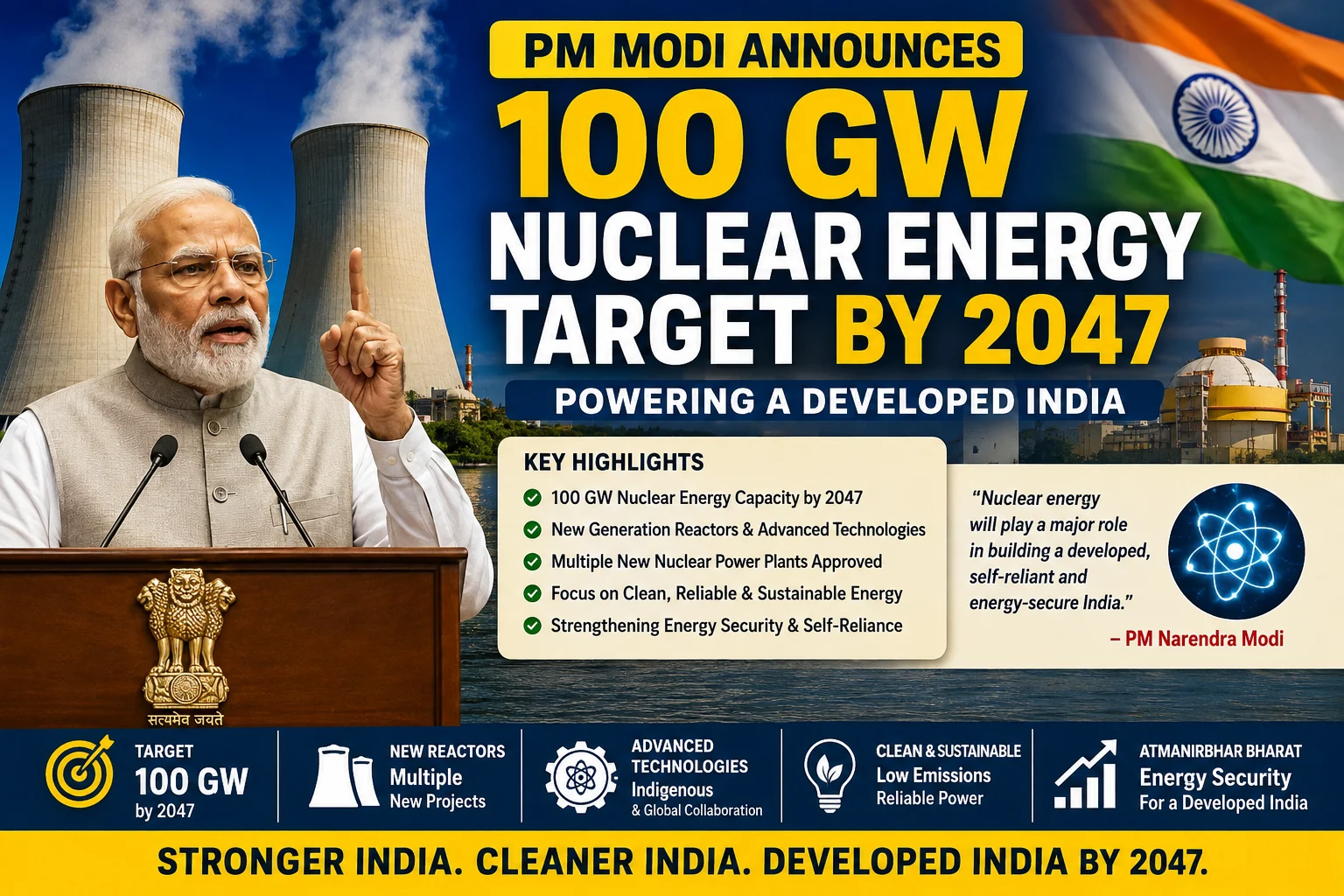
Prime Minister Narendra Modi announced a major expansion of India’s nuclear power programme during his Independence Day address on 15 August 2026, setting a target of achieving 100 GW of nuclear power capacity by 2047. He also announced that five new nuclear reactors are targeted to become operational within the next six to seven years.
The announcement places nuclear energy at the centre of India’s long-term energy security and Viksit Bharat 2047 strategy. PM Modi linked the growing electricity requirements of technologies such as artificial intelligence, semiconductor manufacturing and data centres with the need for reliable energy supplies.
The 100 GW target is also part of the government’s broader Nuclear Energy Mission, which was announced in the Union Budget 2025-26. The mission aims to substantially increase India’s nuclear power capacity while supporting the country’s longer-term clean-energy and energy-security objectives.
What Did PM Modi Announce About Nuclear Energy?
During his 2026 Independence Day speech, PM Modi said India was moving forward with a target of 100 GW of nuclear power capacity by 2047.
He also said the government aims to have five new nuclear reactors operational within six to seven years. The announcement comes as India seeks to expand nuclear generation to meet rising electricity demand.
The major targets include:
- 100 GW nuclear power capacity by 2047
- Five new reactors within the next six to seven years
- Greater energy security
- Expansion of indigenous nuclear technology
- Support for India’s growing technology and industrial sectors
- Greater self-reliance in nuclear fuel and energy
Why Is India Targeting 100 GW of Nuclear Power?
India’s electricity demand is expected to increase as the economy expands and energy-intensive industries grow.
Modern technologies such as:
- Artificial intelligence
- Data centres
- Semiconductor manufacturing
- Electric mobility
- Advanced manufacturing
- Digital infrastructure
require reliable electricity.
PM Modi specifically highlighted the rising energy requirements of chips, AI and data centres while discussing the importance of nuclear power and energy security.
Nuclear power can provide electricity continuously and therefore has a different role from variable renewable sources such as solar and wind.
What Is India’s Current Nuclear Power Capacity?
India’s nuclear power capacity is currently far below the 100 GW target.
Recent government information indicates that India is working toward substantially increasing nuclear capacity under the Nuclear Energy Mission. The government has also prepared a roadmap for reaching 100 GW by 2047.
This means achieving the target will require a very large expansion of India’s existing nuclear fleet, including new reactors, supporting infrastructure, fuel availability, technology development and investment.
Five New Nuclear Reactors in the Next Six to Seven Years
One of the immediate targets announced by PM Modi is to operationalise five new nuclear reactors within six to seven years.
These reactors are expected to contribute to India’s growing nuclear generation capacity and help establish a stronger foundation for the longer-term 100 GW target.
The expansion will require:
- Reactor construction
- Nuclear fuel availability
- Safety systems
- Skilled workforce
- Grid infrastructure
- Regulatory approvals
- Supporting manufacturing capacity
Nuclear Energy and India’s Energy Security
Energy security was a major reason highlighted by PM Modi for expanding nuclear power.
A country with growing electricity requirements needs a reliable and diversified energy mix.
Nuclear power can contribute to energy security by providing a steady source of electricity while reducing dependence on fossil fuels for part of the power mix.
The government has described nuclear energy as an important component of India’s energy-security strategy.
Nuclear Energy and Viksit Bharat 2047
The 100 GW target is closely connected with the government’s Viksit Bharat 2047 vision.
India aims to become a developed nation by 2047, when the country completes 100 years of independence.
Achieving this objective will require substantial growth in:
- Manufacturing
- Infrastructure
- Digital technology
- Transport
- Healthcare
- Industry
- Agriculture
- Defence
- Energy
A dependable electricity supply is essential for all these sectors.
The nuclear expansion is therefore being positioned as a long-term foundation for India’s economic development.
Nuclear Energy and Artificial Intelligence
The connection between nuclear energy and AI is becoming increasingly important.
AI systems require large computing infrastructure, while data centres can consume substantial amounts of electricity.
PM Modi specifically linked the growing energy needs of AI, chips and data centres with India’s need for greater energy security.
As India expands its AI ecosystem, reliable electricity will become increasingly important for:
- Data centres
- Cloud computing
- AI training
- High-performance computing
- Semiconductor manufacturing
- Digital infrastructure
Nuclear Energy and Semiconductor Manufacturing
India is simultaneously trying to build a domestic semiconductor ecosystem.
Semiconductor manufacturing requires highly reliable electricity and supporting infrastructure.
The nuclear-energy expansion could therefore complement India’s efforts to strengthen advanced manufacturing.
The broader 2026 Independence Day vision placed nuclear power, semiconductors, AI and technology within the same larger framework of technological and economic self-reliance.
Nuclear Energy Mission 2026
The 100 GW target is not entirely a new policy introduced in August 2026.
The government had already announced the Nuclear Energy Mission in the Union Budget 2025-26 with the objective of reaching 100 GW of nuclear power capacity by 2047.
The 2026 Independence Day announcement therefore reinforces and elevates an existing long-term government objective.
The mission involves measures aimed at:
- Expanding nuclear capacity
- Supporting domestic reactor technology
- Developing small modular reactors
- Encouraging investment
- Strengthening the nuclear manufacturing ecosystem
- Improving regulatory frameworks
Role of Small Modular Reactors
Small Modular Reactors, or SMRs, are an important part of India’s future nuclear-energy strategy.
The government has been working on indigenous SMR technologies as part of the wider Nuclear Energy Mission.
Government information indicates that ₹20,000 crore has been provided under the Nuclear Energy Mission for the development and deployment of small modular reactors and related technologies.
SMRs could potentially be useful for:
- Industrial applications
- Captive power
- Smaller grids
- Remote locations
- Flexible deployment
- Low-carbon electricity generation
The technology is still under development and deployment at scale will depend on regulatory, technical and economic considerations.
India’s Indigenous Nuclear Technology
India has been developing its own nuclear technologies for decades.
The country’s nuclear programme includes a long-term three-stage strategy involving:
- Pressurised Heavy Water Reactors
- Fast Breeder Reactors
- Advanced systems using India’s thorium resources
India recently reached a significant milestone with the 500 MWe Prototype Fast Breeder Reactor (PFBR) achieving first criticality. The government has described this as an important step in the country’s nuclear-energy journey.
The expansion announced in 2026 is therefore connected with India’s broader effort to strengthen indigenous nuclear capabilities.
Nuclear Fuel Self-Reliance
PM Modi also highlighted India’s progress toward greater self-reliance in critical nuclear fuel.
During his Independence Day address, he said India had taken a major step toward becoming self-reliant in crucial nuclear fuel.
Reliable fuel availability is essential if India is to operate a significantly larger nuclear fleet in the coming decades.
Nuclear Energy and Net-Zero Target
India has also committed to achieving net-zero emissions by 2070.
Nuclear power can contribute to this objective because it produces electricity with very low direct carbon emissions during operation.
The government’s Nuclear Energy Mission has therefore been linked with both:
- Energy security
- India’s long-term climate objectives
The 100 GW target is expected to complement India’s renewable-energy expansion rather than replace solar, wind and other clean-energy sources.
Is Nuclear Energy a Renewable Source?
No.
Nuclear energy is generally classified as a low-carbon energy source, but it is not technically a renewable energy source like solar, wind or hydropower.
Nuclear reactors use fuels such as uranium, which are finite resources.
However, nuclear power can provide large amounts of low-carbon electricity and operate continuously, making it an important component of many countries’ energy strategies.
Benefits of India’s 100 GW Nuclear Target
Greater Energy Security
More domestic nuclear generation can diversify India’s energy mix.
Reliable Electricity
Nuclear plants can provide continuous power generation.
Support for Industry
Reliable electricity can support manufacturing and energy-intensive industries.
AI and Data Centres
Growing digital infrastructure will require substantial quantities of dependable electricity.
Semiconductor Manufacturing
Advanced chip manufacturing requires high-quality and reliable power.
Lower Carbon Electricity
Nuclear power can provide low-carbon electricity during operation.
Technology Development
The programme can support India’s nuclear engineering, manufacturing and research capabilities.
Skilled Employment
Expansion of the nuclear sector can create opportunities for engineers, scientists, technicians and specialised workers.
Employment Opportunities From Nuclear Expansion
The 100 GW target could create employment across several areas.
Potential sectors include:
- Nuclear engineering
- Mechanical engineering
- Electrical engineering
- Civil engineering
- Electronics
- Instrumentation
- Nuclear science
- Safety
- Construction
- Manufacturing
- Maintenance
- Research and development
However, the target should not be interpreted as a guarantee of a particular number of government jobs.
Employment opportunities will depend on the projects, organisations and recruitment programmes launched over time.
Impact on India’s Power Sector
The nuclear expansion could significantly change India’s electricity mix over the next two decades.
India is simultaneously developing:
- Solar power
- Wind power
- Hydropower
- Green hydrogen
- Nuclear power
- Energy storage
The objective is to create a diversified energy system capable of meeting rising electricity demand while supporting India’s climate commitments.
The 100 GW nuclear target therefore represents one part of a much larger energy transition.
Nuclear Power Target: Key Facts
| Particular | Details |
|---|---|
| Target | 100 GW nuclear power capacity |
| Target Year | 2047 |
| Announcement | Independence Day 2026 |
| Immediate Reactor Target | 5 new reactors |
| Timeline for New Reactors | 6–7 years |
| Major Objective | Energy security |
| Related Mission | Nuclear Energy Mission |
| Long-Term Vision | Viksit Bharat 2047 |
| Climate Link | Net-zero emissions target for 2070 |
| Emerging Technology | Small Modular Reactors |
What Challenges Could India Face?
Achieving 100 GW of nuclear capacity will be a major undertaking.
Some important challenges include:
High Capital Requirements
Nuclear projects require significant investment and long construction periods.
Construction Timelines
Large nuclear projects can take years to complete because of their technical complexity and regulatory requirements.
Nuclear Safety
Strict safety standards are essential throughout the life cycle of a nuclear facility.
Fuel Supply
A larger reactor fleet requires a secure and reliable fuel supply chain.
Skilled Workforce
India will need more nuclear scientists, engineers, technicians and specialised professionals.
Public Confidence
Effective communication and strong safety standards are important for public acceptance.
Regulatory Requirements
New reactors require extensive regulatory assessment and approvals.
How Will the 100 GW Target Affect Common Citizens?
For ordinary consumers, the impact will be long term.
A larger and more diversified power supply could potentially contribute to:
- Greater electricity availability
- Improved energy security
- Support for industrial growth
- New employment opportunities
- Growth of technology sectors
- Reduced dependence on certain imported energy sources
However, the actual impact on electricity prices and household power bills will depend on the overall energy mix, generation costs, transmission infrastructure and other market factors.
What Does the Target Mean for Students?
The expansion of India’s nuclear-energy sector could create opportunities for students pursuing:
- Nuclear engineering
- Mechanical engineering
- Electrical engineering
- Electronics
- Civil engineering
- Chemical engineering
- Physics
- Chemistry
- Materials science
- Computer science
- Instrumentation
Students interested in nuclear technology can monitor recruitment and education opportunities from organisations such as NPCIL, BARC and other government institutions.
Frequently Asked Questions (FAQs)
What is India’s nuclear energy target for 2047?
India has set a target of achieving 100 GW of nuclear power capacity by 2047.
When did PM Modi announce the 100 GW nuclear target?
PM Modi highlighted the target during his Independence Day address from the Red Fort on 15 August 2026.
How many new reactors are planned?
The Prime Minister said India aims to start five new nuclear reactors within the next six to seven years.
Why is India expanding nuclear power?
The expansion is intended to strengthen energy security and meet rising electricity requirements, including the growing demand associated with AI, semiconductor manufacturing and data centres.
Is the 100 GW target a new scheme?
No. The 100 GW objective was already part of the Nuclear Energy Mission announced in the Union Budget 2025-26. The 2026 Independence Day address reinforced the target and highlighted the planned expansion.
Is nuclear energy renewable?
No. Nuclear energy is not classified as renewable energy, although nuclear power is a low-carbon source of electricity.
Will nuclear expansion create jobs?
It can create employment across engineering, construction, manufacturing, research, operations, maintenance and other specialised sectors, although the exact number of jobs will depend on individual projects and recruitment programmes.
What is the role of SMRs?
Small Modular Reactors are being developed as part of India’s broader nuclear-energy strategy and could provide additional options for deploying nuclear power in the future.
Does nuclear power help India’s net-zero target?
Nuclear power produces very low direct carbon emissions during electricity generation and is being considered as part of India’s broader clean-energy strategy alongside renewable energy.
What is the current Nuclear Energy Mission?
The Nuclear Energy Mission is the government’s long-term programme to expand India’s nuclear capacity, with the stated objective of reaching 100 GW by 2047.
Conclusion
The 100 GW Nuclear Energy Target by 2047 announced by Prime Minister Narendra Modi represents a major long-term expansion of India’s nuclear power programme. During his Independence Day address on 15 August 2026, PM Modi said India is moving toward 100 GW of nuclear capacity by 2047 and aims to bring five new reactors into operation within six to seven years.
The target is particularly significant because India’s electricity requirements are expected to grow alongside manufacturing, artificial intelligence, semiconductor production and digital infrastructure. Nuclear power is being positioned as an important source of reliable electricity and a key part of India’s energy-security strategy.
The 100 GW goal is also connected with the Nuclear Energy Mission announced in the Union Budget 2025-26. The mission seeks to accelerate nuclear capacity expansion, develop new technologies including small modular reactors and strengthen India’s domestic nuclear ecosystem.
For India to achieve the target, substantial investment, technological development, skilled manpower, fuel security, infrastructure and strict safety standards will be required. The expansion will also need to work alongside India’s growing renewable-energy capacity.
For students and professionals, the nuclear expansion could create opportunities in engineering, science, construction, manufacturing, research and specialised technical fields. For the wider economy, reliable low-carbon electricity could support India’s long-term industrial and technological ambitions.
Overall, the 100 GW nuclear target is not an isolated announcement but part of India’s larger Viksit Bharat 2047 and energy-security vision. Its success will depend on how effectively India converts the long-term target into reactors, infrastructure, technology and safe operating capacity over the coming decades.
Read More: PM Modi Announces Sports Talent Hunt for 50 Lakh Children