The CLAT 2027 new rules are important for students planning to pursue undergraduate or postgraduate law programmes at participating National Law Universities (NLUs). The Consortium of National Law Universities has released the official CLAT 2027 syllabus, eligibility criteria, question-paper format and examination instructions, giving aspirants a clearer picture of what to expect.
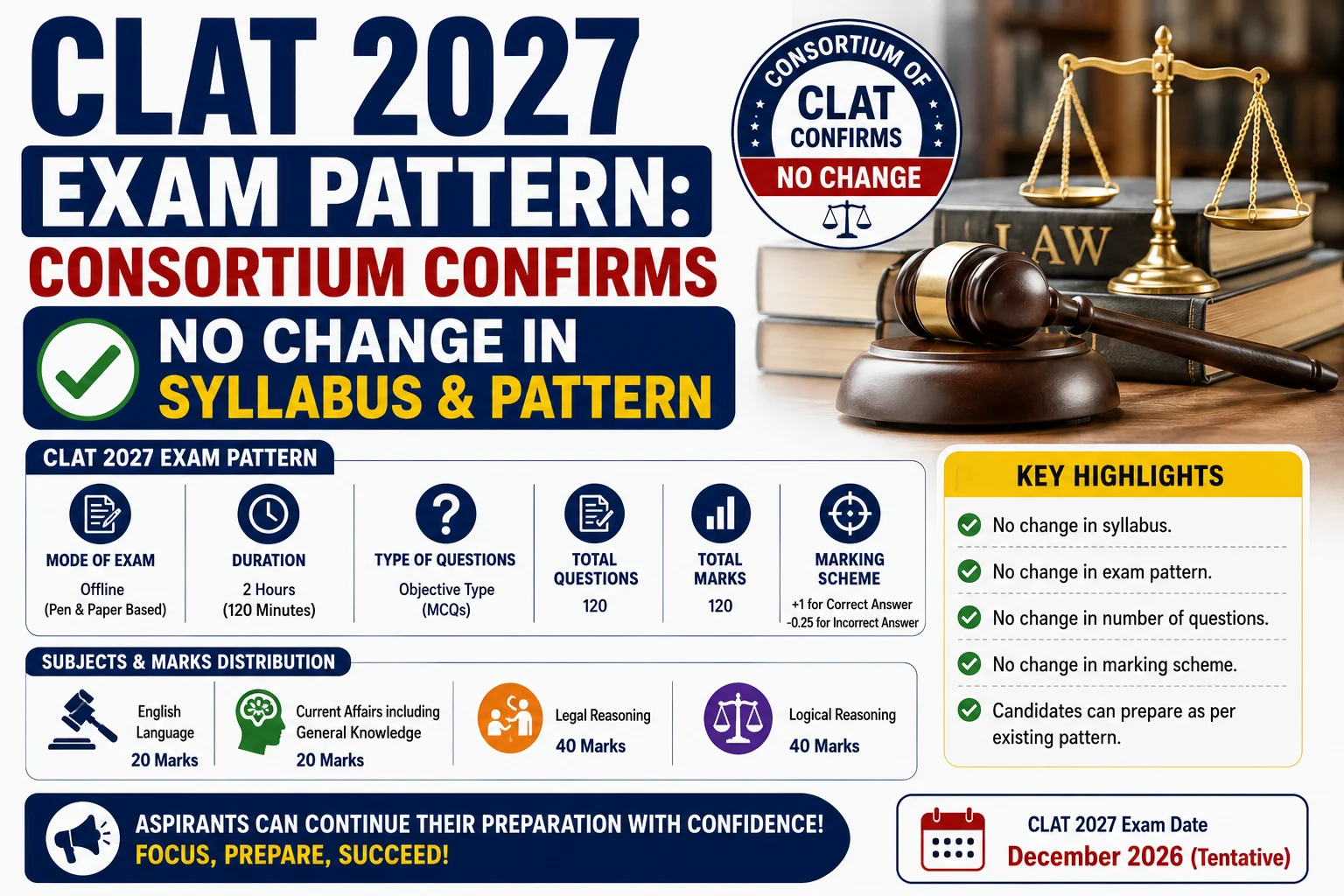
CLAT 2027 will continue to be conducted for admission to five-year integrated undergraduate law programmes and postgraduate LL.M. programmes offered by participating universities. The examination is scheduled to be conducted in offline mode on December 6, 2026, from 2 PM to 4 PM. Eligible PwD candidates will receive additional time as specified by the Consortium.
For UG candidates, the CLAT 2027 paper will continue to have 120 multiple-choice questions for 120 marks, with a duration of two hours and negative marking of 0.25 marks for every incorrect answer. The five sections are English Language, Current Affairs including General Knowledge, Legal Reasoning, Logical Reasoning and Quantitative Techniques.
The eligibility rules have also been clearly specified. There is no upper age limit for either the UG or PG CLAT 2027 examination. UG candidates need to have passed Class 12 or an equivalent examination with at least 45% marks, while the minimum requirement is 40% for candidates belonging to SC, ST and PwD categories.
Therefore, candidates preparing for CLAT 2027 should focus on the official pattern instead of relying on social-media claims about major changes.
CLAT 2027 Exam Pattern at a Glance
The CLAT 2027 examination will be conducted in offline mode.
For the UG examination:
| Particular | CLAT UG 2027 |
|---|---|
| Exam Mode | Offline |
| Duration | 2 hours |
| Total Questions | 120 |
| Total Marks | 120 |
| Question Type | Multiple Choice Questions |
| Marks per Correct Answer | 1 |
| Negative Marking | 0.25 mark |
| Number of Sections | 5 |
| Exam Date | December 6, 2026 |
The official Consortium syllabus confirms the two-hour duration, 120 questions and 0.25-mark negative marking.
CLAT 2027 UG Exam Pattern
The undergraduate CLAT paper consists of five sections:
- English Language
- Current Affairs including General Knowledge
- Legal Reasoning
- Logical Reasoning
- Quantitative Techniques
The Consortium provides approximate weightage rather than an absolutely fixed number of questions for every section.
| Section | Approx. Questions | Approx. Weightage |
|---|---|---|
| English Language | 22–26 | 20% |
| Current Affairs including GK | 28–32 | 25% |
| Legal Reasoning | 28–32 | 25% |
| Logical Reasoning | 22–26 | 20% |
| Quantitative Techniques | 10–14 | 10% |
| Total | 120 | 100% |
This distribution means that Current Affairs and Legal Reasoning together account for roughly half of the paper, making them particularly important areas for UG aspirants.
Is There a Major Change in the CLAT 2027 Pattern?
Candidates should be careful with the word “change.”
The Consortium’s official CLAT 2027 material confirms a 120-question, two-hour paper with five sections. It does not indicate a dramatic reduction in the number of sections or a complete restructuring of the UG paper.
The more important point is that candidates should prepare according to the CLAT 2027-specific syllabus and question format, especially because the Consortium has provided detailed guidance on the nature of passages and skills being tested.
In other words, the examination remains aptitude- and comprehension-focused rather than becoming a test of memorised legal knowledge.
CLAT 2027 English Language Section
The English Language section will use passages of approximately 450 words.
The passages may come from contemporary or historically significant fiction and non-fiction.
Questions will test whether candidates can:
- Understand the main idea
- Identify arguments and viewpoints
- Draw conclusions
- Make inferences
- Summarise information
- Compare different arguments
- Understand words and phrases in context
The Consortium specifically describes CLAT as a test of comprehension and reasoning skills rather than a test that depends primarily on prior knowledge.
How to Prepare for English
Candidates should develop the habit of reading regularly.
Useful preparation can include:
- Newspaper editorials
- Long-form articles
- Quality essays
- Opinion pieces
- Fiction and non-fiction passages
The objective should not be to memorise vocabulary lists alone.
Instead, candidates should practise understanding how arguments are structured and how ideas connect within a passage.
CLAT 2027 Current Affairs and General Knowledge
Current Affairs including General Knowledge is expected to account for approximately 28 to 32 questions, or around 25% of the UG paper.
The section will use passages of up to approximately 450 words based on news, journalistic sources and other non-fiction writing.
Topics may include:
- Important national events
- International developments
- Arts and culture
- Major global affairs
- Significant historical events
- Contemporary issues
Questions may sometimes involve legal information connected with a passage, but the Consortium states that candidates will not be expected to possess additional legal knowledge beyond what is provided in the passage for such questions.
How to Prepare for Current Affairs
Candidates should follow current events consistently instead of trying to cover everything in the final few weeks.
Maintain short notes on:
- Important appointments
- Government policies
- International developments
- Major court judgments
- Awards
- Sports events
- Economic developments
- Science and technology
- National and international organisations
Regular revision is more important than collecting huge amounts of information.
CLAT 2027 Legal Reasoning Section
Legal Reasoning is one of the most important parts of CLAT UG.
The Consortium expects approximately 28 to 32 questions, representing around 25% of the paper.
The section contains passages that may involve:
- Legal matters
- Public policy
- Moral questions
- Fact situations
- Legal principles
Candidates are expected to identify the principles contained in a passage and apply them to new situations.
Importantly, the official syllabus states that prior knowledge of law is not required to attempt the Legal Reasoning section.
This is a key point for school students.
A student does not need to study an entire law degree syllabus before appearing for CLAT.
How to Prepare for Legal Reasoning
Focus on:
- Reading carefully
- Identifying rules
- Separating facts from principles
- Applying a principle to a new situation
- Understanding the difference between similar options
Practice is particularly important because two answer choices can sometimes appear reasonable until the passage is examined closely.
CLAT 2027 Logical Reasoning
Logical Reasoning accounts for approximately 22 to 26 questions, or around 20% of the UG paper.
Questions are based on short passages and test reasoning ability.
Candidates may be asked to:
- Identify arguments
- Find premises and conclusions
- Draw inferences
- Identify assumptions
- Strengthen an argument
- Weaken an argument
- Identify contradictions
- Compare relationships
- Evaluate reasoning
The focus is therefore not simply on solving traditional puzzle questions.
Candidates need to understand how an argument works.
CLAT 2027 Quantitative Techniques
Quantitative Techniques has the smallest approximate share of the UG paper, with around 10 to 14 questions, or approximately 10%.
The questions are based on numerical information presented through short sets of facts, propositions or other representations.
Candidates may need to:
- Extract numerical information
- Interpret data
- Perform mathematical operations
- Compare quantities
- Draw conclusions from numerical information
Strong fundamentals are more useful than advanced mathematics.
Candidates should focus on speed and accuracy.
CLAT 2027 Negative Marking
The negative-marking rule remains important.
For every incorrect answer, 0.25 marks will be deducted.
Therefore:
- Correct answer = +1 mark
- Incorrect answer = -0.25 mark
- Unattempted question = 0 mark
Candidates should avoid random guessing.
However, intelligent elimination can still be useful when a candidate can confidently remove one or more incorrect options.
CLAT 2027 Eligibility for UG Candidates
The official UG eligibility rules state that there is no upper age limit for CLAT 2027.
Candidates must have passed Class 12 or an equivalent examination with:
- 45% marks for the general eligibility category
- 40% marks for candidates belonging to SC/ST/PwD categories
Students who are appearing for their qualifying examination in March/April 2027 can also apply. However, they must provide proof of passing the qualifying examination at the time of admission.
This is particularly useful for students currently studying in Class 12.
Can Class 12 Students Apply for CLAT 2027?
Yes.
Students appearing for their Class 12 qualifying examination in March or April 2027 can apply for CLAT 2027.
Their admission remains subject to successfully passing the qualifying examination with the required marks.
Therefore, students do not need to wait for their Class 12 results before appearing for the entrance examination.
Is There Any Age Limit for CLAT 2027?
No.
There is no upper age limit for the UG CLAT 2027 examination.
The same applies to the PG examination, which also has no upper age limit.
Candidates should still check the admission requirements of the particular NLU they wish to join because individual institutions can have additional programme-specific conditions.
CLAT 2027 PG Eligibility
CLAT PG 2027 is meant for candidates seeking admission to postgraduate LL.M. programmes through participating NLUs.
There is no upper age limit.
Candidates must have completed an LL.B. degree or an equivalent qualification with:
- 50% marks or equivalent grade
- 45% marks for SC/ST/PwD candidates
Candidates appearing for their qualifying examination in 2027 are also eligible to apply, but they must provide proof of successfully completing the qualification at admission.
CLAT PG 2027 Exam Pattern
The PG examination is also a two-hour objective test.
It contains:
- 120 questions
- 120 marks
- 0.25-mark negative marking for each incorrect answer
The paper focuses on mandatory subjects taught in an undergraduate law programme.
Major areas include:
- Constitutional Law
- Jurisprudence
- Administrative Law
- Contract Law
- Torts
- Family Law
- Criminal Law
- Property Law
- Company Law
- Public International Law
- Tax Law
- Environmental Law
- Labour and Industrial Law
CLAT PG 2027: Comprehension-Based Questions
The PG paper places significant emphasis on comprehension.
Candidates will receive extracts from primary legal materials, including important judicial decisions, statutes and regulations.
Questions will test whether candidates can:
- Understand legal issues
- Identify arguments
- Summarise passages
- Understand relevant legal facts
- Apply legal knowledge
- Analyse the issues discussed in judgments or statutes
This makes reading and understanding legal material particularly important for PG candidates.
CLAT 2027 Exam Date
According to the official instructions, CLAT 2027 is scheduled for Sunday, December 6, 2026.
The examination is scheduled from 2 PM to 4 PM for the standard duration. Eligible PwD candidates will receive additional time according to the prescribed provisions.
Candidates should remember that the Consortium describes the date as subject to revision if necessary.
Therefore, the official CLAT website should be checked regularly for updates.
CLAT 2027 Application Dates
The official instructions state that online enrolment for CLAT 2027 will open on:
August 3, 2026
The last date to submit the completed application is:
October 31, 2026, by 11:59 PM.
Candidates should not wait until the last day.
Application forms can take time to complete, especially when documents and category certificates need to be uploaded.
CLAT 2027 Application Process
Candidates need to register online using their mobile number and email address.
An OTP is used to validate the registered mobile number.
After registration, candidates can log in and complete the application.
The Consortium advises candidates to enter their names and other details exactly as they appear on their official certificates, marksheets and identity documents.
Once the application has been submitted and paid, certain fields such as the programme and category cannot be changed.
This makes it important to review the form carefully before final submission.
Documents Required for CLAT 2027
Candidates should keep the required documents ready.
The official instructions mention documents such as:
- Recent passport-size photograph
- Candidate’s signature
- Category certificate, where applicable
- PwD certificate, where applicable
- BPL certificate, where applicable
The documents must be uploaded according to the prescribed format.
Candidates should check the latest instructions before uploading documents because requirements can be updated.
CLAT 2027 Application Fee
According to the official instructions, the application fee is:
| Category | Application Fee |
|---|---|
| General/OBC/NRI | ₹4,000 |
| SC/ST/BPL/PwD | ₹3,500 |
The previous-year question papers are available separately for a stated cost of ₹500.
Candidates should remember that the application fee is non-refundable and non-adjustable according to the official instructions.
CLAT 2027 Exam Mode
CLAT 2027 will be conducted in offline mode.
This means candidates will answer the examination on a physical question paper/answer sheet rather than taking the test entirely through a computer interface.
Candidates should therefore practise using offline mock papers as well as online practice tests.
Offline practice can help with:
- Reading long passages on paper
- Managing the answer sheet
- Maintaining speed
- Avoiding marking mistakes
- Developing examination stamina
CLAT 2027 Tie-Breaking Rule
The Consortium has also specified a tie-breaking procedure for candidates who obtain equal marks.
For UG candidates, the order is:
- Higher marks in the Legal Aptitude component
- Higher age
- Computerised draw of lots
Candidates should be aware of this rule, although it is relevant only when candidates have equal scores.
Are Foreign Nationals Eligible for CLAT 2027?
The official instructions state that Indian Nationals and NRIs seeking admission to the UG programmes can appear for CLAT 2027, while foreign nationals are not eligible to appear for CLAT. NRI/NRI-sponsored admissions are handled according to the respective NLU’s rules.
Candidates interested in NRI or NRI-sponsored seats should therefore check the individual NLU’s admission rules instead of assuming that the standard CLAT counselling process applies to every such seat.
CLAT 2027 Preparation Strategy
The revised official syllabus makes one thing clear: CLAT is largely a reading, comprehension and reasoning examination.
Students should therefore spend less time trying to memorise isolated information and more time developing the ability to understand passages quickly.
A useful preparation strategy is:
Read Every Day
Read newspapers, editorials and good-quality non-fiction.
Practise Passages
Solve timed comprehension passages regularly.
Build Current Affairs Notes
Maintain concise notes instead of collecting hundreds of pages.
Strengthen Legal Reasoning
Practise applying principles to new situations.
Improve Logical Reasoning
Learn to identify assumptions, conclusions and supporting evidence.
Revise Basic Mathematics
Focus on the topics relevant to Quantitative Techniques.
How to Manage CLAT 2027 Time
Two hours may appear sufficient for 120 questions, but the long passages make time management important.
Candidates should practise dividing their available time across sections.
There is no official fixed time limit for each individual UG section. The Consortium’s FAQ specifically states that there is no specific time frame for the Current Affairs including General Knowledge section.
Therefore, candidates can develop their own section-wise strategy.
For example, a candidate who is particularly strong in English may finish that section faster and devote more time to Legal Reasoning or Quantitative Techniques.
The exact strategy should depend on individual strengths.
Common Mistakes CLAT 2027 Candidates Should Avoid
Relying Only on Legal Knowledge
CLAT UG does not require candidates to already know extensive law.
The Legal Reasoning section is designed around passages and principles provided in the question.
Ignoring Current Affairs
Current Affairs including GK accounts for roughly 25% of the UG paper.
Avoiding Quantitative Techniques
Although it has the smallest weightage, candidates should not completely ignore it.
Reading Without Practising
Good reading habits are important, but timed question practice is equally necessary.
Guessing Randomly
Negative marking can reduce the score.
Waiting Until the Last Month
CLAT rewards consistent preparation, especially because reading speed and comprehension improve gradually.
CLAT 2027: Important Checklist
Candidates should keep the following points in mind:
Check the official CLAT 2027 syllabus
Confirm UG or PG eligibility
Check the 45%/40% UG marks requirement
Check the 50%/45% PG marks requirement
Note the December 6, 2026 exam date
Complete the application before October 31, 2026
Prepare for the offline examination
Practise all five UG sections
Revise current affairs regularly
Practise legal and logical reasoning
Improve reading speed
Revise quantitative basics
Understand negative marking
Keep required documents ready
Final Thoughts
The CLAT 2027 new rules do not represent a complete overhaul of the examination. The official Consortium information confirms that the UG examination will continue with 120 multiple-choice questions, five sections, two hours of duration and 0.25-mark negative marking.
What candidates should pay particular attention to is the detailed nature of the syllabus. The CLAT UG examination is designed to test comprehension, reasoning and aptitude rather than simply checking whether a student has memorised large amounts of legal information. This is especially clear in Legal Reasoning, where prior knowledge of law is not required to answer the questions.
The eligibility rules are also straightforward. There is no upper age limit for CLAT 2027 UG candidates. Students need at least 45% in Class 12, with a 40% requirement for SC/ST/PwD candidates. Students appearing for their qualifying examination in March/April 2027 can also apply, subject to producing proof of successful completion at admission.
For PG candidates, the minimum qualification is an LL.B. or equivalent degree with 50% marks, or 45% for SC/ST/PwD candidates. There is no upper age limit here either.
Another important update for aspirants is the official schedule. CLAT 2027 is currently scheduled for December 6, 2026, while online applications are scheduled to remain open from August 3 to October 31, 2026.
Candidates should therefore avoid depending on old CLAT preparation material alone. The most reliable approach is to use the official 2027 syllabus, understand the passage-based nature of the examination and practise under the two-hour, 120-question format.
For students targeting National Law Universities, preparation should begin with reading and comprehension, followed by regular practice in Legal Reasoning, Logical Reasoning, Current Affairs and Quantitative Techniques. With consistent preparation and a clear understanding of the official rules, candidates can approach CLAT 2027 with much greater confidence.