Getting your passport application rejected can be disappointing, especially if you have urgent travel plans for work, education, business, or a family emergency. However, a passport rejection does not necessarily mean you can never obtain a passport. In many cases, applications are rejected due to incomplete documents, incorrect information, failed police verification, or other issues that can be corrected.
The Ministry of External Affairs (MEA) issues Indian passports through the Passport Seva Programme. If your application is refused, the Passport Office generally provides the reason for rejection. Once the issue is resolved, you may apply again following the prescribed process.
In this detailed guide, you’ll learn the common reasons why passport applications are rejected, how to avoid rejection, how to reapply successfully, required documents, processing time, and frequently asked questions.
What Does Passport Rejection Mean?
Passport rejection means that the Passport Authority has not approved your passport application after examining your documents, verification reports, and eligibility under the Passports Act and applicable rules.
A rejection is different from an application being kept on hold or pending for additional documents. In many situations, applicants can correct the issues and submit a fresh application.
Passport Rejection 2026 Highlights
| Particular | Details |
|---|---|
| Service | Passport Application |
| Issuing Authority | Ministry of External Affairs (MEA) |
| Official Portal | Passport Seva Portal |
| Application Mode | Online |
| Reapplication Allowed | Yes, after resolving the reason for rejection (subject to applicable rules) |
| Police Verification | May be required depending on the case |
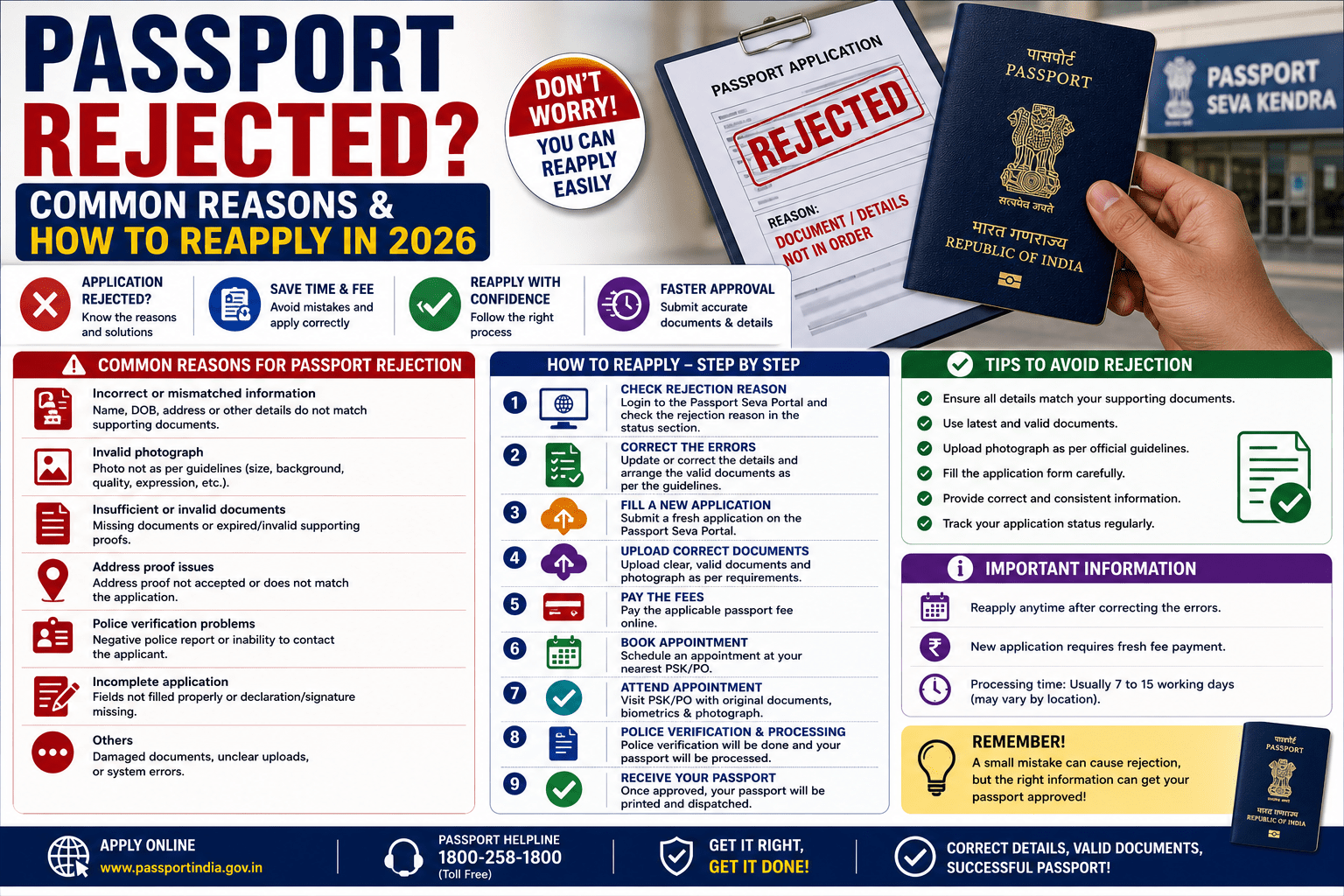
Top Reasons Why Passport Applications Are Rejected
1. Incorrect Personal Information
One of the most common reasons for rejection is providing incorrect information in the application form.
Examples include:
- Wrong name spelling
- Incorrect date of birth
- Incorrect parent’s details
- Incorrect marital status
- Incorrect place of birth
Always ensure that the details match your official documents exactly.
2. Incomplete Application Form
Leaving mandatory fields blank or entering incomplete information can result in rejection.
Common mistakes include:
- Missing address details
- Incomplete employment information
- Missing previous passport details
- Incorrect emergency contact information
Double-check every section before submitting the application.
3. Invalid or Incomplete Documents
The Passport Office verifies all supporting documents.
Applications may be rejected if:
- Documents are expired.
- Address proof is invalid.
- Identity proof is incomplete.
- Documents are unclear or unreadable.
- Required documents are missing.
Always carry original documents during your Passport Seva Kendra (PSK) appointment.
4. Failed Police Verification
Police verification is an important step in passport processing.
Your application may face rejection if:
- You are unavailable during verification.
- Your address cannot be verified.
- The police report is adverse.
- Documents submitted during verification do not match the application.
Ensure that you are available and provide accurate information during the verification process.
5. Address Mismatch
If the address entered in your passport application differs from the address shown in your supporting documents, the application may be rejected.
Before applying, update your address proof if required.
6. Criminal Proceedings or Legal Restrictions
The Passport Authority may refuse or delay passport issuance in cases involving certain legal restrictions or pending criminal proceedings, subject to the provisions of the Passports Act, 1967.
Applicants should provide complete and truthful information if asked to disclose court cases or legal matters.
7. Duplicate Passport Application
Submitting multiple passport applications simultaneously can create confusion and may result in rejection or cancellation of one of the applications.
Submit only one application unless specifically advised by the Passport Office.
8. Previous Passport Issues
Applications may require additional scrutiny if:
- A previous passport was lost multiple times.
- A damaged passport explanation is unsatisfactory.
- There are inconsistencies in earlier passport records.
Provide all relevant documents and explanations whenever required.
9. Signature or Photograph Issues
Applications may also be rejected due to:
- Poor-quality photographs.
- Signature mismatch.
- Missing signatures.
- Improper biometric capture.
Follow the photo and signature guidelines carefully.
10. Suppression of Information
Providing false information or hiding important facts can lead to rejection and may have legal consequences.
Examples include:
- Concealing previous passports.
- Hiding criminal cases where disclosure is required.
- Submitting forged documents.
- Giving false identity information.
Always provide truthful and complete information.
How to Know Why Your Passport Was Rejected
If your passport application is rejected, you can usually determine the reason by:
- Checking your application status on the Passport Seva Portal.
- Reviewing the communication received from the Passport Office.
- Contacting the Regional Passport Office if further clarification is required.
Understanding the exact reason will help you avoid repeating the same mistake.
Can You Reapply After Passport Rejection?
Yes.
In most cases, applicants can submit a fresh passport application after resolving the issue that caused the rejection.
Examples include:
- Correcting personal information.
- Updating documents.
- Completing police verification.
- Providing additional supporting documents.
- Rectifying address discrepancies.
However, cases involving legal restrictions or fraud may require additional action before reapplying.
Step-by-Step Process to Reapply
Step 1: Identify the Reason
Read the rejection communication carefully and understand the specific reason.
Step 2: Correct the Issue
Depending on the rejection reason:
- Update documents.
- Correct personal details.
- Obtain missing certificates.
- Resolve address issues.
- Complete pending legal formalities, if applicable.
Step 3: Prepare Fresh Documents
Collect all updated documents.
Ensure every document is:
- Valid
- Original
- Consistent with the application
Step 4: Submit a New Application
Log in to the Passport Seva Portal.
Choose:
Apply for Fresh Passport/Reissue Passport
Fill the application carefully.
Step 5: Pay the Fee
Pay the applicable passport fee.
Previous application fees are generally not refundable, so a fresh application fee is required.
Step 6: Book a New Appointment
Schedule a new appointment at:
- Passport Seva Kendra (PSK)
- Post Office Passport Seva Kendra (POPSK)
Step 7: Attend Verification
Carry all original documents and cooperate fully during document and police verification.
Documents Required for Reapplication
Depending on your case, you may need:
- Aadhaar Card
- PAN Card
- Voter ID
- Birth Certificate
- Address Proof
- Passport-size photographs (if required)
- Previous passport details (if applicable)
- Police documents (if applicable)
- Additional documents requested by the Passport Office
How Long Does Reapplication Take?
Processing time depends on:
- Document verification.
- Police verification.
- Passport Office workload.
- Type of application (Normal or Tatkal).
If all documents are complete and verification is successful, processing is generally smoother than a reapplication with unresolved issues.
Tips to Avoid Passport Rejection
Follow these best practices:
- Fill the application carefully.
- Ensure all documents are valid.
- Keep Aadhaar details updated.
- Match every document with the application.
- Carry original documents.
- Reach the PSK before your appointment time.
- Cooperate during police verification.
- Avoid submitting multiple applications.
- Never submit forged documents.
- Track your application regularly.
Common Myths About Passport Rejection
Myth 1: Passport rejection means permanent disqualification.
Fact: Most applicants can reapply after correcting the issues that led to the rejection.
Myth 2: Police verification failure always results in a lifetime ban.
Fact: Not necessarily. The outcome depends on the nature of the adverse report and the applicable passport rules.
Myth 3: A rejected application fee is refunded.
Fact: Passport application fees are generally non-refundable.
Myth 4: Tatkal applications can never be rejected.
Fact: Tatkal applications are also subject to document verification, eligibility checks, and applicable rules.
Frequently Asked Questions (FAQs)
Can I apply again after passport rejection?
Yes. In most cases, you can submit a fresh application after resolving the reason for rejection.
Do I need to pay the fee again?
Yes. A fresh application generally requires payment of the applicable passport fee, as previously paid fees are typically non-refundable.
Can I use Tatkal while reapplying?
Yes, if you meet the eligibility criteria for the Tatkal scheme and your application is otherwise eligible.
Will police verification happen again?
It depends on your case. The Passport Office decides whether police verification is required based on the fresh application and applicable rules.
How do I avoid rejection?
Submit accurate information, provide valid supporting documents, attend appointments on time, and cooperate fully during verification.
Conclusion
A passport rejection can be frustrating, but it is often the result of issues that can be corrected. By understanding the reason for rejection, updating your documents, providing accurate information, and following the official Passport Seva process, you can improve your chances of approval when you reapply. Always use the official Passport Seva Portal for applications, status tracking, and the latest guidelines.