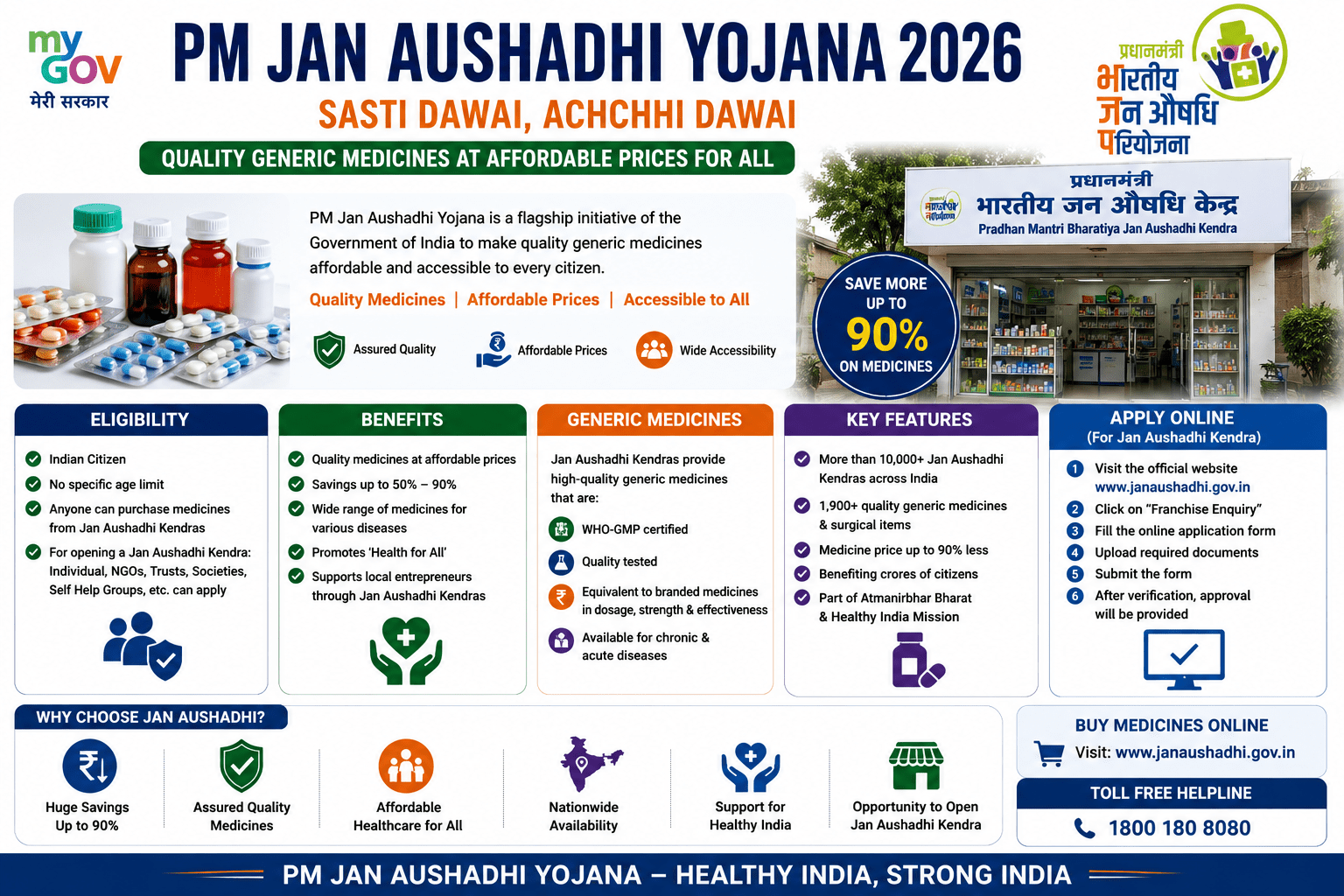
The Pradhan Mantri Bhartiya Janaushadhi Pariyojana (PMBJP), popularly known as the PM Jan Aushadhi Yojana, is a flagship initiative of the Department of Pharmaceuticals, Ministry of Chemicals and Fertilizers, Government of India. The scheme aims to make quality generic medicines available at affordable prices through a nationwide network of Pradhan Mantri Bhartiya Janaushadhi Kendras (PMBJKs). These medicines are typically priced 50% to 80% lower than branded medicines while meeting the prescribed quality standards.
The scheme not only reduces healthcare expenses for patients but also creates entrepreneurship opportunities by allowing eligible individuals, pharmacists, NGOs, hospitals, and charitable organizations to open Jan Aushadhi Kendras. As of February 2026, more than 18,646 Jan Aushadhi Kendras are operational across India, with the Government targeting 25,000 Kendras by March 2027.
This comprehensive guide explains everything about the PM Jan Aushadhi Yojana 2026, including eligibility, benefits, medicines available, incentives, documents required, how to open a Jan Aushadhi Kendra, and frequently asked questions.
Objectives of PM Jan Aushadhi Yojana
The scheme has been introduced with the following objectives:
- Make quality generic medicines affordable.
- Reduce household healthcare expenses.
- Improve access to essential medicines.
- Promote the use of generic medicines.
- Increase awareness about affordable healthcare.
- Expand Jan Aushadhi Kendras across India.
- Generate self-employment opportunities.
- Improve medicine availability in rural and urban areas.
- Support financially weaker sections.
- Strengthen India’s public healthcare system.
PM Jan Aushadhi Yojana 2026 Highlights
| Particular | Details |
|---|---|
| Scheme Name | Pradhan Mantri Bhartiya Janaushadhi Pariyojana (PMBJP) |
| Popular Name | PM Jan Aushadhi Yojana |
| Ministry | Ministry of Chemicals and Fertilizers |
| Department | Department of Pharmaceuticals |
| Implementing Agency | Pharmaceuticals & Medical Devices Bureau of India (PMBI) |
| Beneficiaries | All Indian Citizens |
| Major Benefit | Affordable Generic Medicines |
| Application Mode | Online & Offline (For Kendra Opening) |
| Official Platform | PMBJP Portal |
What is PM Jan Aushadhi Yojana?
PM Jan Aushadhi Yojana is a government initiative that supplies quality-assured generic medicines through dedicated Jan Aushadhi Kendras located across the country.
These medicines contain the same active ingredients, dosage, strength, quality, and therapeutic effectiveness as branded medicines but are available at significantly lower prices, making healthcare more affordable for citizens.
Benefits of PM Jan Aushadhi Yojana
Affordable Generic Medicines
Medicines available at Jan Aushadhi Kendras are generally 50% to 80% cheaper than equivalent branded medicines, helping families reduce healthcare expenses.
Quality-Assured Medicines
All medicines supplied under PMBJP are procured and tested according to prescribed quality standards before distribution.
Reduced Medical Expenses
Patients suffering from chronic illnesses such as diabetes, hypertension, cardiac diseases, and asthma can save substantially on long-term medication costs.
Nationwide Availability
Thousands of Jan Aushadhi Kendras operate across India, making affordable medicines easily accessible.
Digital Support
Citizens can use the Jan Aushadhi Sugam App to:
- Locate nearby Kendras.
- Search medicine availability.
- Compare medicine prices.
- Check product details.
Medicines Available at Jan Aushadhi Kendras
The Kendras offer a wide range of healthcare products, including:
- Generic Medicines
- Surgical Products
- Medical Consumables
- Nutraceutical Products
- Ayurvedic Products (selected categories)
- Sanitary Napkins
- Health Supplements
- Medical Devices
Medicines are available for conditions such as:
- Diabetes
- Blood Pressure
- Heart Diseases
- Thyroid Disorders
- Fever
- Infections
- Pain Management
- Asthma
- Gastric Disorders
- Skin Diseases
Jan Aushadhi Suvidha Sanitary Napkins
Under PMBJP, Jan Aushadhi Suvidha Oxo-Biodegradable Sanitary Napkins are made available at ₹1 per pad, promoting menstrual hygiene and affordable healthcare for women.
Who Can Open a Jan Aushadhi Kendra?
Eligible applicants include:
- Individual Entrepreneurs
- Registered Pharmacists
- Doctors
- NGOs
- Charitable Trusts
- Hospitals
- Self-Help Groups
- Government Agencies
The applicant must generally have:
- Retail space as prescribed.
- A qualified pharmacist.
- Drug licence (or eligibility to obtain one).
- GST registration where applicable.
Incentives for Jan Aushadhi Kendra Owners
The Government provides financial support to Kendra owners.
Monthly Incentive
Owners receive an incentive equal to 10% of monthly purchases from PMBI, subject to a maximum of ₹10,000 per month. Additionally, incentives are available for maintaining stock of selected high-demand medicines.
Special One-Time Incentive
A one-time incentive of up to ₹2 lakh is available for eligible Kendras established in:
- North-Eastern States
- Himalayan Regions
- Island Territories
- Aspirational Districts
The incentive is also available for eligible entrepreneurs belonging to categories such as:
- Women
- SC
- ST
- Divyangjan
- Ex-Servicemen
subject to PMBI guidelines.
Eligibility Criteria
Applicants wishing to open a Jan Aushadhi Kendra should generally satisfy the following conditions:
- Must be an Indian citizen.
- Should have a suitable retail premises.
- Must employ or be a qualified pharmacist.
- Should comply with applicable drug licence requirements.
- Must meet PMBI eligibility guidelines.
Documents Required
Applicants should generally keep the following documents ready:
- Aadhaar Card
- PAN Card
- Identity Proof
- Address Proof
- Pharmacist Registration Certificate
- Drug Licence
- GST Registration (if applicable)
- Shop Ownership/Rent Agreement
- Passport-size Photograph
- Bank Account Details
- Mobile Number
- Email ID
Additional documents may be required during verification.
How to Apply for a Jan Aushadhi Kendra
Eligible applicants can apply online by following these steps:
Step 1
Visit the official PM Jan Aushadhi Portal.
Step 2
Click on Apply for Kendra.
Step 3
Complete online registration.
Step 4
Fill in personal and business details.
Step 5
Upload all required documents.
Step 6
Submit the online application.
Step 7
PMBI verifies the documents.
Step 8
After approval, the applicant can establish the Jan Aushadhi Kendra and begin operations.
How to Locate a Jan Aushadhi Kendra
Citizens can locate nearby Kendras by:
- Visiting the official PMBJP website.
- Using the Jan Aushadhi Sugam mobile application.
- Searching by State, District, or PIN Code.
Latest Updates in 2026
The PM Jan Aushadhi Scheme continues to expand nationwide.
Key updates include:
- 18,646 Jan Aushadhi Kendras operational as of 28 February 2026.
- Government target to establish 25,000 Kendras by March 2027.
- Medicines available at 50–80% lower prices than branded alternatives.
- Continued incentives for Kendra owners and stock maintenance of high-demand medicines.
Major Features of PM Jan Aushadhi Yojana
Some important features include:
- Affordable generic medicines.
- Nationwide network of Kendras.
- Quality-tested medicines.
- Online Kendra application.
- Entrepreneurship opportunities.
- Financial incentives for Kendra owners.
- Jan Aushadhi Sugam App.
- Women’s hygiene products.
- Healthcare cost reduction.
- Government-backed medicine distribution.
Common Reasons for Kendra Application Rejection
Applications may be rejected because of:
- Incomplete documents.
- Invalid pharmacist registration.
- Missing drug licence.
- Incorrect application details.
- Ineligible premises.
- Failure to satisfy PMBI guidelines.
Tips for Successful Approval
To improve your chances of approval:
- Ensure all documents are complete.
- Keep pharmacist registration valid.
- Verify premises details.
- Submit accurate information.
- Upload clear scanned copies of documents.
- Track your application regularly.
Why Should Citizens Use Jan Aushadhi Medicines?
Jan Aushadhi medicines offer the same therapeutic benefits as branded medicines while significantly reducing treatment costs. This is especially beneficial for patients requiring long-term treatment for chronic conditions. The scheme has become an important pillar of affordable healthcare by improving access to quality medicines and reducing out-of-pocket medical expenditure for millions of families.
Frequently Asked Questions (FAQs)
What is PM Jan Aushadhi Yojana?
PM Jan Aushadhi Yojana is a Government of India initiative that provides quality generic medicines at affordable prices through Jan Aushadhi Kendras.
How much cheaper are Jan Aushadhi medicines?
Generic medicines are generally 50% to 80% less expensive than branded medicines.
Who can open a Jan Aushadhi Kendra?
Eligible individuals, pharmacists, NGOs, hospitals, trusts, women entrepreneurs, SC/ST entrepreneurs, Divyangjan, and other eligible applicants can apply according to PMBI guidelines.
Is financial assistance available for Kendra owners?
Yes. Eligible Kendra owners receive monthly incentives, and certain eligible categories can receive a one-time incentive of up to ₹2 lakh.
How can I locate my nearest Jan Aushadhi Kendra?
You can locate the nearest Kendra through the official PMBJP website or the Jan Aushadhi Sugam mobile app.
Are Jan Aushadhi medicines safe?
Yes. Medicines supplied under PMBJP are quality-tested and comply with prescribed regulatory standards before distribution.
Is the scheme active in 2026?
Yes. The scheme continues to expand, with over 18,646 operational Kendras and a target of 25,000 Kendras by March 2027.
Conclusion
The PM Jan Aushadhi Yojana 2026 is transforming healthcare in India by making quality generic medicines affordable and easily accessible to millions of citizens. Through an expanding network of Jan Aushadhi Kendras, the scheme helps reduce healthcare costs, promotes the use of quality-assured generic medicines, and creates entrepreneurship opportunities across the country. With thousands of Kendras already operational and continued government support for expansion, PMBJP remains one of India’s most impactful healthcare initiatives for improving access to affordable medicines.