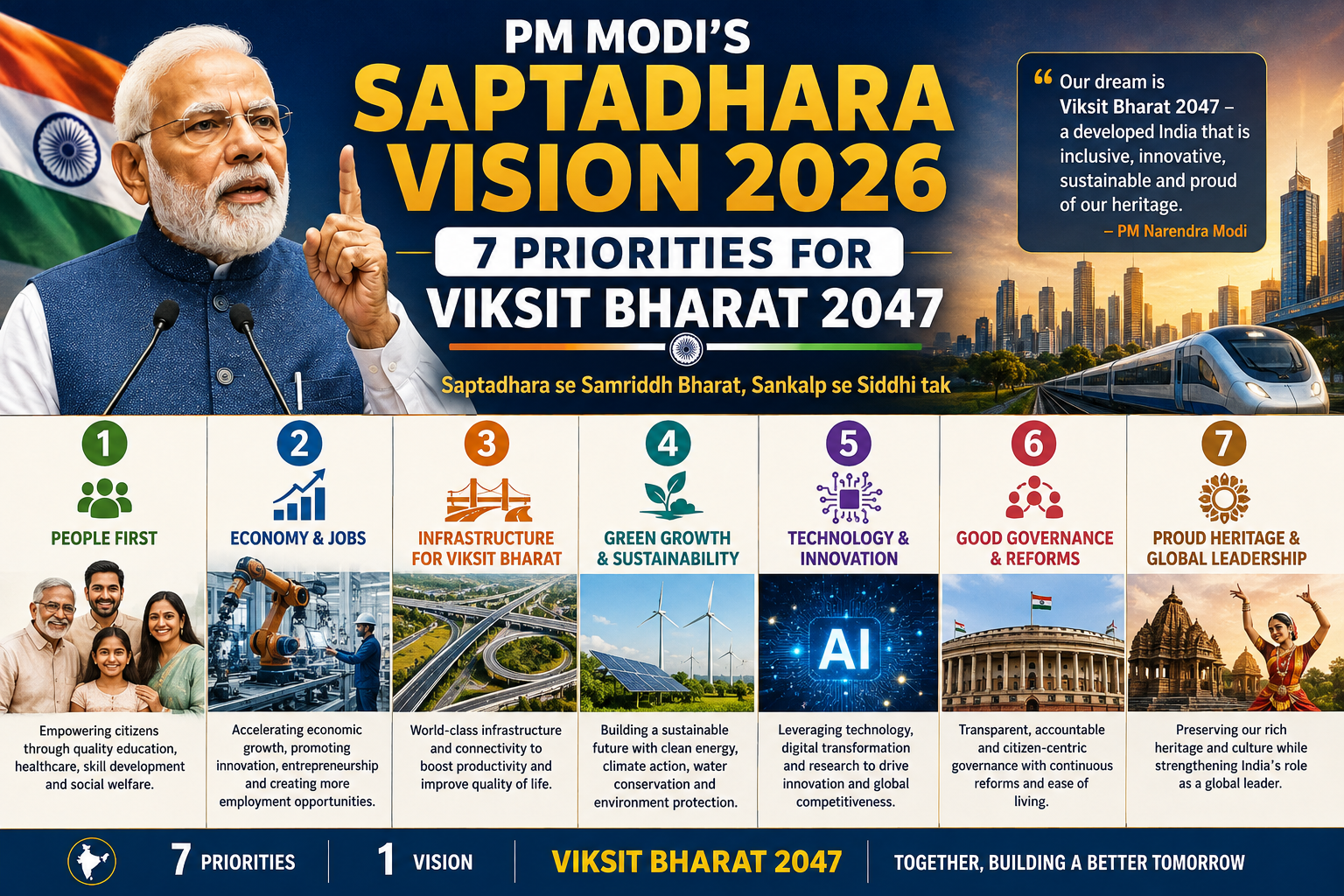
Prime Minister Narendra Modi introduced the “Sapta Dhara” (seven streams of strength) during his Independence Day address from the Red Fort on 15 August 2026, presenting it as a broad development framework to help India achieve the goal of Viksit Bharat by 2047.
The vision focuses on seven major areas: manufacturing, agriculture and food production, technology and innovation, Gati Shakti, defence power, the green and blue economy, and India’s soft power. PM Modi said these seven strengths should help India accelerate development and achieve in the next 5–7 years what could not be accomplished over several previous decades.
The Saptadhara framework is not a single government scheme through which citizens can register for benefits. Instead, it is a long-term development vision connecting different sectors with India’s 2047 goal.
What Is PM Modi’s Saptadhara Vision?
“Sapta Dhara” literally refers to seven streams or flows of strength.
In his 2026 Independence Day speech, PM Modi said India needs a clear direction to achieve the Viksit Bharat goal and presented these seven areas as important sources of national strength. He also emphasised that youth power would be integrated into nation-building.
The seven priorities are:
- Manufacturing Power
- Agriculture and Food Production
- Technology and Innovation
- Gati Shakti
- Raksha Shakti
- Green and Blue Economy
- India’s Soft Power
Together, these areas cover India’s economy, agriculture, technology, infrastructure, national security, sustainability and global cultural influence.
1. Manufacturing Power
The first pillar of Saptadhara is manufacturing.
PM Modi called for a significant expansion of India’s manufacturing capabilities, with the objective of developing the complete value chain within the country. This means India should not focus only on assembling final products but also develop the components, intermediate goods, design capabilities and technologies required to manufacture them.
The vision includes:
- Manufacturing small and large components
- Developing complete products
- Building domestic supply chains
- Strengthening design and engineering
- Improving manufacturing quality
- Increasing production scale
- Meeting global standards
- Expanding exports
PM Modi also emphasised the importance of cost, quality and scale for Indian manufacturers.
Focus on Zero-Defect Manufacturing
The Prime Minister stressed that Indian products should be competitive globally and that quality should become a major part of India’s global brand identity.
This could be particularly important for:
- MSMEs
- Startups
- Electronics manufacturers
- Automobile companies
- Textile businesses
- Machinery manufacturers
- Defence companies
- Consumer-product manufacturers
The broader goal is to make India a trusted manufacturing hub in global supply chains.
2. Agriculture and Food Production
The second Saptadhara priority is agriculture and food production.
PM Modi highlighted the need to move beyond traditional farming and give greater importance to food processing, exports and global markets.
The vision is to connect Indian farmers more directly with international consumers.
Areas highlighted include:
- Food processing
- Agricultural exports
- Millets
- Spices
- Fruits
- Flowers
- Traditional foods
- Chemical-free farming
- Global food brands
From Farm to Global Market
One of the key ideas is to move from “farm to export market.”
India has access to international markets through Free Trade Agreements, and the Saptadhara vision calls for farmers and food businesses to make greater use of these opportunities.
Indian agricultural products that meet global quality and safety standards could have greater export potential.
This can create opportunities not only for farmers but also for:
- Food-processing companies
- Agricultural startups
- Exporters
- Cold-chain businesses
- Packaging companies
- Logistics providers
- Rural entrepreneurs
3. Technology and Innovation
The third pillar is technology and innovation, reflecting the growing importance of advanced technologies in India’s economy.
PM Modi highlighted areas such as:
- Artificial intelligence
- Quantum technology
- Space technology
- Robotics
- Data centres
- Digital public infrastructure
- Next-generation communication
He said India should not simply become a market for technologies developed elsewhere but should aim to become a global innovation hub.
India’s AI Push
AI is expected to play an increasingly important role in India’s development.
During the same Independence Day address, PM Modi announced a target to train 1 crore young people in AI skills over the next year.
This connects directly with the technology pillar of Saptadhara.
Made-in-India 6G
Another major technology ambition is the development and global adoption of Made-in-India 6G technology.
The objective is to strengthen India’s position in next-generation communication technologies and potentially make Indian digital technologies available globally.
4. Gati Shakti
The fourth pillar is Gati Shakti, focusing on fast, seamless and integrated connectivity.
The vision includes improving:
- High-speed rail
- Highways
- Airports
- Inland waterways
- Ports
- Multimodal logistics
- Urban connectivity
- Freight movement
PM Modi stressed that India’s infrastructure should not operate as disconnected individual projects. Instead, transportation networks should work together as an integrated system.
Port-Led Development
Ports are also expected to become important engines of economic growth.
The vision is to move beyond viewing ports simply as locations for loading and unloading goods and develop them into centres of port-led economic activity.
This could support:
- Trade
- Manufacturing
- Logistics
- Coastal industries
- Exports
- Maritime services
5. Raksha Shakti – Defence Power
The fifth pillar is Raksha Shakti, or defence power.
PM Modi emphasised that India needs to become more self-reliant in defence and develop advanced defence technologies domestically.
The focus areas include:
- Defence manufacturing
- Drones
- Counter-drone systems
- Hypersonic technologies
- Cybersecurity
- Advanced military technologies
- Defence exports
From Defence Buyer to Global Supplier
The long-term objective is not simply to manufacture defence equipment for India’s own requirements.
India also wants to become a global supplier of next-generation defence technologies.
This could create opportunities for:
- Defence startups
- Engineering companies
- MSMEs
- Electronics manufacturers
- Aerospace companies
- Drone companies
- Cybersecurity firms
- Research institutions
6. Green Economy and Blue Economy
The sixth pillar combines the green economy and blue economy.
PM Modi described this area as an opportunity not only for environmental protection but also for creating green jobs and new economic opportunities.
Green Economy
The green-economy focus includes:
- Green hydrogen
- Renewable energy
- Energy storage
- Green mobility
- Green manufacturing
- Clean technologies
India’s transition toward cleaner energy and sustainable production could create new industries and employment opportunities.
Blue Economy
India’s long coastline provides significant opportunities in the blue economy.
Areas highlighted include:
- Fisheries
- Coastal tourism
- Ocean technology
- Marine industries
- Maritime activities
The blue economy can therefore contribute to both economic growth and employment in coastal regions.
7. India’s Soft Power
The seventh and final Saptadhara pillar is India’s soft power.
This pillar focuses on using India’s culture, traditions, knowledge systems and creative industries to strengthen its influence around the world.
Areas highlighted include:
- Yoga
- Ayurveda
- Holistic healthcare
- Handicrafts
- Indian culture
- Films
- Animation
- VFX
- Gaming
- Digital content
- Tourism
- Sports
- Entertainment
- Creative industries
Yoga and Ayurveda
India’s traditional knowledge systems already have an international audience.
The Saptadhara vision seeks to strengthen this global reach through areas such as:
- Yoga
- Ayurveda
- Wellness
- Holistic healthcare
- Medical tourism
The Heal in India concept was also mentioned as an opportunity to take India’s healthcare capabilities to international audiences.
India’s Creative Economy
India’s creative industries can also become a source of global influence.
Potential growth areas include:
- Bollywood and regional cinema
- VFX
- Animation
- Gaming
- Music
- Digital content
- Handicrafts
- Fashion
- Design
PM Modi also highlighted the potential of India’s World Audio Visual and Entertainment Summit (WAVES) as a platform for showcasing the country’s creative ecosystem globally.
Saptadhara Vision 2026 at a Glance
| No. | Saptadhara Priority | Main Focus |
|---|---|---|
| 1 | Manufacturing Power | Production, quality, global supply chains |
| 2 | Agriculture & Food Production | Food processing, exports, global markets |
| 3 | Technology & Innovation | AI, quantum, space, robotics, 6G |
| 4 | Gati Shakti | High-speed connectivity and multimodal infrastructure |
| 5 | Raksha Shakti | Defence self-reliance and advanced technologies |
| 6 | Green & Blue Economy | Green jobs, renewable energy, fisheries, ocean economy |
| 7 | Soft Power | Yoga, culture, tourism, healthcare and creative industries |
How Saptadhara Supports Viksit Bharat 2047
The central objective behind Saptadhara is India’s goal of becoming a Viksit Bharat by 2047, when the country completes 100 years of independence.
PM Modi said that the next 5–7 years would be particularly important and called for faster reforms, changes in work culture and greater participation from citizens, industry, farmers, workers and governments.
The seven pillars provide a broad framework:
Manufacturing → Economic strength
Agriculture → Rural prosperity
Technology → Innovation and productivity
Gati Shakti → Infrastructure and connectivity
Defence → National security
Green & Blue Economy → Sustainable growth
Soft Power → Global influence
Role of Youth in the Saptadhara Vision
Youth are a major part of the Viksit Bharat strategy.
PM Modi described the country’s young population as both a major force behind development and one of the biggest beneficiaries of a developed India.
The government has also highlighted several youth-focused initiatives, including:
- AI skilling
- Startup opportunities
- Innovation funding
- Skill development
- Sports development
- Technology education
- Research opportunities
During the 2026 Independence Day speech, PM Modi announced that 1 crore youth would be trained in AI skills over the next year.
Role of MSMEs in Saptadhara
MSMEs are particularly important to the manufacturing and export objectives.
PM Modi urged MSMEs to make use of India’s Free Trade Agreements and reach international markets with competitive products.
For MSMEs, the Saptadhara vision could create opportunities in:
- Manufacturing
- Exporting
- Food processing
- Defence production
- Electronics
- Technology
- Green manufacturing
- Creative industries
However, businesses will need to focus strongly on quality, cost competitiveness and global standards.
Saptadhara and Atmanirbhar Bharat
Saptadhara is closely connected with the broader idea of Atmanirbhar Bharat.
The Prime Minister emphasised that India needs to strengthen its own capabilities rather than remain excessively dependent on other countries for critical products and technologies.
This is particularly visible in areas such as:
- Semiconductors
- Critical minerals
- Nuclear energy
- Defence
- Technology
- Manufacturing
- Energy
The objective is not simply to produce more within India but also to build capabilities that can compete globally.
Global Companies and India’s 2047 Ambition
PM Modi also presented several broader ambitions alongside Saptadhara.
He said India should aim to have 50 Indian companies among the Fortune 500 within the next decade. He also called for an Indian bank to be among the world’s top five banks and Indian pharmaceutical companies to achieve a place among the global top five.
These ambitions demonstrate that Saptadhara is not limited to government infrastructure or welfare programmes.
The vision also aims to create globally competitive Indian businesses and brands.
Is Saptadhara a Government Scheme?
No.
Saptadhara is a seven-point development vision, not a conventional government scheme with an application form, eligibility criteria or direct financial benefit.
Citizens cannot apply for “Saptadhara” in the same way they apply for a scholarship, pension or subsidy.
Instead, individual government policies and programmes may be developed or aligned with the priorities outlined under the framework.
What Could Saptadhara Mean for Common Citizens?
The impact will depend on how the seven priorities are implemented.
Potential long-term effects could include:
- More manufacturing jobs
- Better transport infrastructure
- Greater agricultural-export opportunities
- New technology careers
- More defence-sector employment
- Growth of green industries
- Expansion of tourism
- Growth of creative industries
- Greater global demand for Indian products and services
The framework is therefore designed to influence multiple parts of the economy rather than a single sector.
What Could Saptadhara Mean for Farmers?
The agriculture pillar focuses on moving Indian agriculture toward greater processing, branding and exports.
Farmers could potentially benefit from stronger:
- Food-processing infrastructure
- Export networks
- Cold chains
- Agricultural supply chains
- Branding
- Global market access
The emphasis on chemical-free farming could also create opportunities as global demand for such products increases.
What Could Saptadhara Mean for Students?
Students may benefit from the technology, innovation, defence, manufacturing, green economy and creative-economy priorities.
Potential career areas include:
- AI
- Robotics
- Space technology
- Semiconductor technology
- Engineering
- Defence technology
- Cybersecurity
- Renewable energy
- Green hydrogen
- Biotechnology
- Animation
- Gaming
- VFX
- Digital content
The government’s parallel announcement to train 1 crore youth in AI also highlights the growing importance of technology skills.
Saptadhara and India’s Global Position
The framework also has an international dimension.
India wants to move beyond being a large consumer market and become a:
- Global manufacturing hub
- Technology and innovation centre
- Defence supplier
- Agricultural exporter
- Green-technology leader
- Creative-economy hub
- Cultural and tourism destination
PM Modi’s emphasis on global brands, exports, technology and soft power reflects this broader ambition.
Challenges in Achieving the Saptadhara Vision
Turning a broad vision into measurable results will require sustained implementation.
Some important challenges include:
Infrastructure
Large-scale infrastructure projects require significant investment and coordination.
Global Competition
Indian manufacturers and exporters must compete on quality, price and reliability.
Skill Development
Emerging industries will require workers with specialised technical and digital skills.
Technology Development
India will need continued investment in research and innovation.
Agricultural Modernisation
Farm-to-market and export systems require strong logistics, storage and processing infrastructure.
Defence Technology
Developing advanced defence systems requires long-term research and development.
Green Transition
Green technologies require investment, infrastructure and commercially viable solutions.
Global Branding
India’s cultural and creative industries need strong international distribution and branding.
Frequently Asked Questions (FAQs)
What is PM Modi’s Saptadhara Vision 2026?
Saptadhara is a seven-part development framework announced by PM Modi during his 2026 Independence Day speech to strengthen India’s capabilities and support the goal of becoming a Viksit Bharat by 2047.
What are the seven pillars of Saptadhara?
The seven pillars are manufacturing, agriculture and food production, technology and innovation, Gati Shakti, Raksha Shakti, green and blue economy, and India’s soft power.
When was Saptadhara announced?
PM Modi presented the Saptadhara framework during his 80th Independence Day address on 15 August 2026.
Is Saptadhara a government scheme?
No. It is a broad development framework rather than a scheme with direct applications or financial benefits.
What is the goal of Saptadhara?
The broader objective is to strengthen India’s capabilities and accelerate progress toward Viksit Bharat by 2047.
What is the first pillar of Saptadhara?
The first pillar is manufacturing power, with an emphasis on developing complete domestic value chains and making India a trusted global manufacturing hub.
What is the technology pillar about?
It focuses on AI, quantum technology, space, robotics, data centres, digital public infrastructure and next-generation communication technologies such as 6G.
What is Raksha Shakti?
Raksha Shakti means defence power. It focuses on defence self-reliance, advanced technologies, drones, counter-drone systems, hypersonic technologies and cybersecurity.
What does the green and blue economy pillar cover?
The green economy includes renewable energy, green hydrogen, energy storage, green mobility and green manufacturing. The blue economy includes fisheries, coastal tourism and ocean technology.
What is India’s soft power under Saptadhara?
It includes India’s cultural and creative strengths such as yoga, Ayurveda, tourism, handicrafts, films, VFX, animation, gaming and digital content.
How does Saptadhara relate to Viksit Bharat 2047?
Saptadhara provides seven broad areas through which India aims to strengthen its economy, infrastructure, technology, security, sustainability and global influence as it works toward the Viksit Bharat 2047 goal.
Conclusion
PM Modi’s Saptadhara Vision 2026 presents a broad seven-point framework for strengthening India’s capabilities and supporting the country’s ambition to become a Viksit Bharat by 2047.
The seven priorities—manufacturing, agriculture and food production, technology and innovation, Gati Shakti, Raksha Shakti, green and blue economy, and soft power—cover some of the most important areas of India’s future economic and strategic development.
The manufacturing pillar aims to make India a globally trusted production hub, while the agriculture pillar focuses on connecting farmers and food products with international markets. Technology and innovation place AI, quantum technology, robotics, space and 6G at the centre of India’s future growth.
Gati Shakti focuses on faster and better-connected infrastructure, while Raksha Shakti emphasises defence self-reliance and advanced military technologies. The green and blue economy pillars look at sustainable growth, renewable energy, green jobs, fisheries and ocean-based opportunities.
The final pillar—India’s soft power—highlights the country’s potential in yoga, Ayurveda, tourism, culture and creative industries such as films, animation, VFX and gaming.
Importantly, Saptadhara is not a single government scheme. It is a long-term development vision that seeks to bring different sectors together under the larger Viksit Bharat 2047 objective.
The success of this vision will ultimately depend on implementation, reforms, investment, skill development and participation from government, industry, farmers, workers, entrepreneurs and citizens. PM Modi also placed India’s youth at the centre of the Viksit Bharat journey, making skill development, innovation and entrepreneurship particularly important for the coming years.
If implemented effectively, the seven priorities could help India strengthen domestic capabilities while also becoming more competitive in global markets. The Saptadhara framework therefore represents a long-term attempt to connect economic growth, technology, infrastructure, national security, sustainability and India’s global influence with the goal of building a developed India by 2047.
Read More: PM Modi Independence Day Speech 2026: 10 Major Announcements