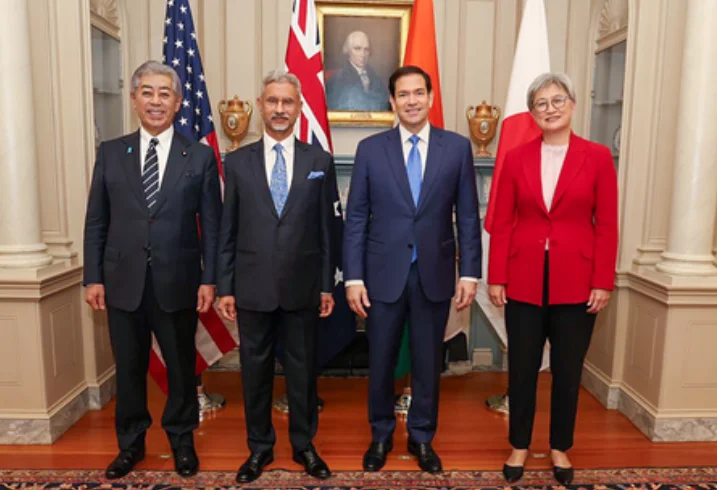
The Quad Foreign Ministers’ Meeting will be held in New Delhi tomorrow, bringing together top diplomats from India, the United States, Japan, and Australia for high-level discussions on regional security, Indo-Pacific cooperation, strategic partnerships, and global geopolitical challenges.
The meeting comes at a crucial time as global attention remains focused on:
- Indo-Pacific security concerns
- China’s growing regional influence
- Supply chain resilience
- Maritime security
- Critical minerals and technology cooperation
- Ongoing tensions in West Asia
The Quad grouping, comprising India, the US, Japan, and Australia, has increasingly emerged as an important strategic platform for cooperation in the Indo-Pacific region.
Foreign Ministers Arriving in India
According to India’s Ministry of External Affairs, External Affairs Minister S. Jaishankar will host:
- Marco Rubio
- Penny Wong
- Toshimitsu Motegi
for the Quad ministerial discussions in New Delhi on May 26, 2026.
US Secretary of State Marco Rubio is currently on a four-day visit to India and has already held bilateral engagements with Indian leaders ahead of the Quad meeting.
Key Issues Likely to Dominate Talks
Officials and analysts expect the Quad ministers to discuss:
- Indo-Pacific stability
- Maritime security and freedom of navigation
- Supply chain diversification
- Critical minerals cooperation
- Artificial intelligence and emerging technologies
- Regional security developments involving China
- West Asia tensions and the Strait of Hormuz crisis
Reports suggest the recent geopolitical tensions in the Gulf region and disruptions affecting global energy routes may also feature prominently during discussions.
Focus on China and Indo-Pacific Strategy
The Quad has increasingly focused on ensuring a “Free and Open Indo-Pacific” amid growing concerns regarding China’s military and strategic activities in the region.
Strategic experts believe the meeting will reinforce cooperation among the four countries on:
- Naval coordination
- Regional connectivity
- Technology partnerships
- Cybersecurity
- Defense collaboration
Analysts also expect discussions on strengthening coordination with regional partners such as the Philippines and Pacific nations.
India-US Strategic Engagement
The Quad meeting also reflects strengthening India-US strategic ties. During his India visit, Marco Rubio reportedly discussed:
- Critical minerals cooperation
- Nuclear energy collaboration
- Artificial intelligence partnerships
- Defense and technology ties
- Indo-Pacific security cooperation
with Indian officials.
The meeting is being viewed as an important diplomatic engagement amid shifting global alignments and increasing geopolitical competition.
Australia and Japan’s Participation
Australian Foreign Minister Penny Wong and Japanese Foreign Minister Toshimitsu Motegi are also expected to hold bilateral meetings with Indian leaders during their visit.
Australia and Japan continue to play major roles within the Quad framework, particularly regarding:
- Regional security cooperation
- Supply chain resilience
- Semiconductor and technology collaboration
- Maritime partnerships
Significance of the Quad Meeting
The Quad meeting is considered important because it demonstrates continued diplomatic coordination among four major Indo-Pacific democracies at a time of growing regional uncertainty.
Experts say the grouping has evolved beyond security cooperation into areas including:
- Infrastructure development
- Climate initiatives
- Vaccine cooperation
- Technology and innovation
- Economic security
The ministerial meeting is expected to review progress on ongoing Quad initiatives and future cooperation mechanisms.
Conclusion
The Quad Foreign Ministers’ Meeting in New Delhi tomorrow is expected to focus heavily on Indo-Pacific security, strategic cooperation, supply chains, and emerging global geopolitical challenges.
With rising tensions in multiple regions and increasing competition in the Indo-Pacific, the meeting is likely to play a significant role in shaping future strategic coordination among India, the United States, Japan, and Australia.