One of the most important factors in a successful visa application is proving that you have sufficient financial resources to support your trip. Almost every country requires applicants to demonstrate that they can cover expenses such as accommodation, food, transportation, tuition (for student visas), and other living costs without becoming a financial burden.
There is no universal minimum bank balance that guarantees visa approval. The required amount depends on factors such as the destination country, visa category, duration of stay, travel purpose, and the applicant’s overall financial profile. Immigration authorities assess your finances along with other supporting documents like income, employment, travel history, and ties to your home country.
This guide explains the estimated bank balance requirements for different country visas in 2026, required financial documents, and tips to strengthen your application.
Why Do Embassies Check Your Bank Balance?
Embassies verify your financial capacity to ensure that you can:
- Pay for your travel expenses.
- Cover accommodation and daily living costs.
- Return to your home country after your visit.
- Support yourself without working illegally.
- Meet the financial requirements of the visa category.
Bank balance is only one part of the financial assessment.
Bank Balance Requirements 2026 Highlights
| Particular | Details |
|---|---|
| Purpose | Financial Proof for Visa Application |
| Required By | Most Embassies & Immigration Authorities |
| Accepted Proof | Bank Statements, Fixed Deposits, Salary Slips, Income Tax Returns, Sponsorship Letter (if applicable) |
| Statement Period | Usually 3–6 months (varies by country) |
| Guarantee of Approval | No |
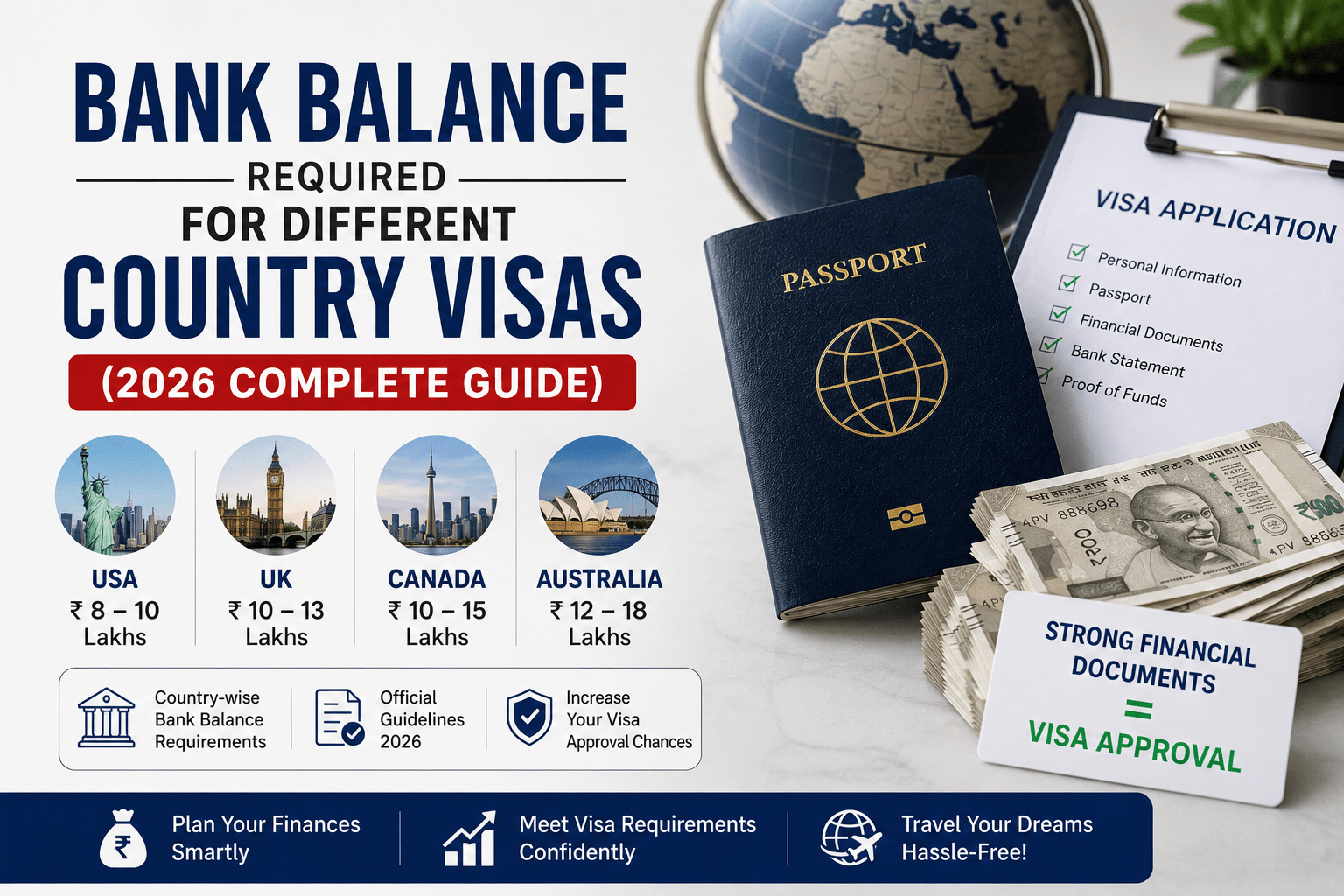
Estimated Bank Balance for Popular Country Visas
Note: The amounts below are general estimates based on common travel scenarios. Official immigration authorities usually assess your overall financial ability rather than prescribing a fixed minimum balance. Always verify the latest requirements with the respective embassy or immigration authority.
| Country | Estimated Recommended Balance (Tourist Visa) |
|---|---|
| Canada | ₹4–8 Lakhs |
| United States | ₹5–10 Lakhs |
| United Kingdom | ₹3–7 Lakhs |
| Schengen Countries | ₹2–5 Lakhs |
| Australia | ₹4–8 Lakhs |
| New Zealand | ₹4–8 Lakhs |
| Japan | ₹2–5 Lakhs |
| Singapore | ₹1.5–3 Lakhs |
| UAE (Dubai) | ₹1–3 Lakhs |
| Thailand | ₹1–2 Lakhs |
These figures may vary depending on:
- Length of stay
- Number of travelers
- Hotel category
- Travel itinerary
- Sponsor availability
- Personal income
Country-wise Financial Requirements
Canada Tourist Visa
Applicants should demonstrate enough funds to cover:
- Airfare
- Accommodation
- Daily expenses
- Return travel
While there is no fixed minimum amount for a visitor visa, stronger financial documentation generally improves the application.
USA Tourist Visa
The U.S. does not specify a minimum bank balance.
Visa officers evaluate:
- Employment
- Income
- Savings
- Travel purpose
- Financial stability
- Home country ties
A consistent financial history is usually more important than a large one-time deposit.
United Kingdom Visitor Visa
Applicants should show they can pay for:
- Travel
- Accommodation
- Living expenses
UK Visas and Immigration (UKVI) reviews whether the funds are genuine, available, and consistent with the applicant’s income.
Schengen Visa
Schengen countries require applicants to demonstrate sufficient financial means for the entire stay.
The required amount varies by country because each Schengen member state sets its own daily financial requirement.
Australia Tourist Visa
Applicants generally need to demonstrate adequate funds for:
- Travel expenses
- Accommodation
- Living costs
- Return journey
Financial documents should clearly support the planned itinerary.
Financial Documents Required
Most embassies may request:
- Bank statements (last 3–6 months)
- Salary slips
- Income Tax Returns (ITR)
- Employment letter
- Business registration documents (for self-employed applicants)
- Fixed Deposit certificates
- Investment statements
- Property documents (optional)
- Sponsorship letter (if someone else is funding your trip)
- Education loan or scholarship documents (for student visas)
What Makes a Strong Bank Statement?
A strong bank statement generally shows:
- Regular income deposits.
- Stable account balance.
- Genuine financial activity.
- No unexplained large cash deposits immediately before applying.
- Sufficient funds maintained over several months.
Immigration officers often look for financial consistency rather than a sudden increase in your account balance.
Can a Sponsor Cover Your Expenses?
Yes.
Many countries allow financial sponsorship from:
- Parents
- Spouse
- Close family members
- Employer
- Educational institution
- Inviting host (where permitted)
The sponsor may need to provide:
- Sponsorship letter
- Bank statements
- Income proof
- Identity documents
- Relationship proof (if applicable)
Common Financial Mistakes That Lead to Visa Refusal
Avoid these mistakes:
- Large unexplained deposits.
- Fake bank statements.
- Insufficient available funds.
- Inconsistent financial documents.
- Missing income proof.
- Submitting outdated statements.
- Providing incomplete sponsorship documents.
- Bank balance not matching the travel budget.
Tips to Improve Your Financial Profile
- Maintain a healthy bank balance for several months before applying.
- Keep regular salary or business transactions visible.
- Submit genuine financial documents.
- Include a detailed travel itinerary.
- Explain any unusually large deposits with supporting evidence.
- Ensure your declared income matches your financial documents.
- Provide sponsorship documents if someone else is funding your trip.
Frequently Asked Questions (FAQs)
Is there a fixed minimum bank balance for every visa?
No. Most countries do not prescribe a universal minimum balance. Immigration authorities assess your overall financial situation, travel plans, and supporting documents.
How many months of bank statements are required?
Many embassies ask for 3 to 6 months of recent bank statements, although the exact requirement depends on the country and visa type.
Can Fixed Deposits be shown as financial proof?
Yes. Fixed Deposits, investments, and other financial assets may be submitted as supporting evidence, but applicants should also show access to liquid funds for travel expenses.
Will a large bank balance guarantee visa approval?
No. A high account balance alone does not guarantee approval. Immigration officers also consider your employment, travel history, purpose of visit, and ties to your home country.
Can I use my parents’ bank statement?
Yes, if your parents are sponsoring your trip. You may need to submit a sponsorship letter, relationship proof, and their financial documents as required by the destination country.
Is cash deposit before applying a good idea?
Frequent or large unexplained cash deposits shortly before applying may raise questions. If you have a legitimate reason for such deposits, include supporting documentation.
Conclusion
Showing adequate financial resources is an essential part of most visa applications, but bank balance is only one aspect of the decision-making process. Immigration authorities evaluate your complete financial profile, employment, travel purpose, supporting documents, and intention to return home. Maintaining transparent financial records, submitting genuine documents, and planning your application well in advance can significantly improve your chances of obtaining a visa.
Read More: Passport Seva Kendra (PSK) 2026: Services & Appointment Guide