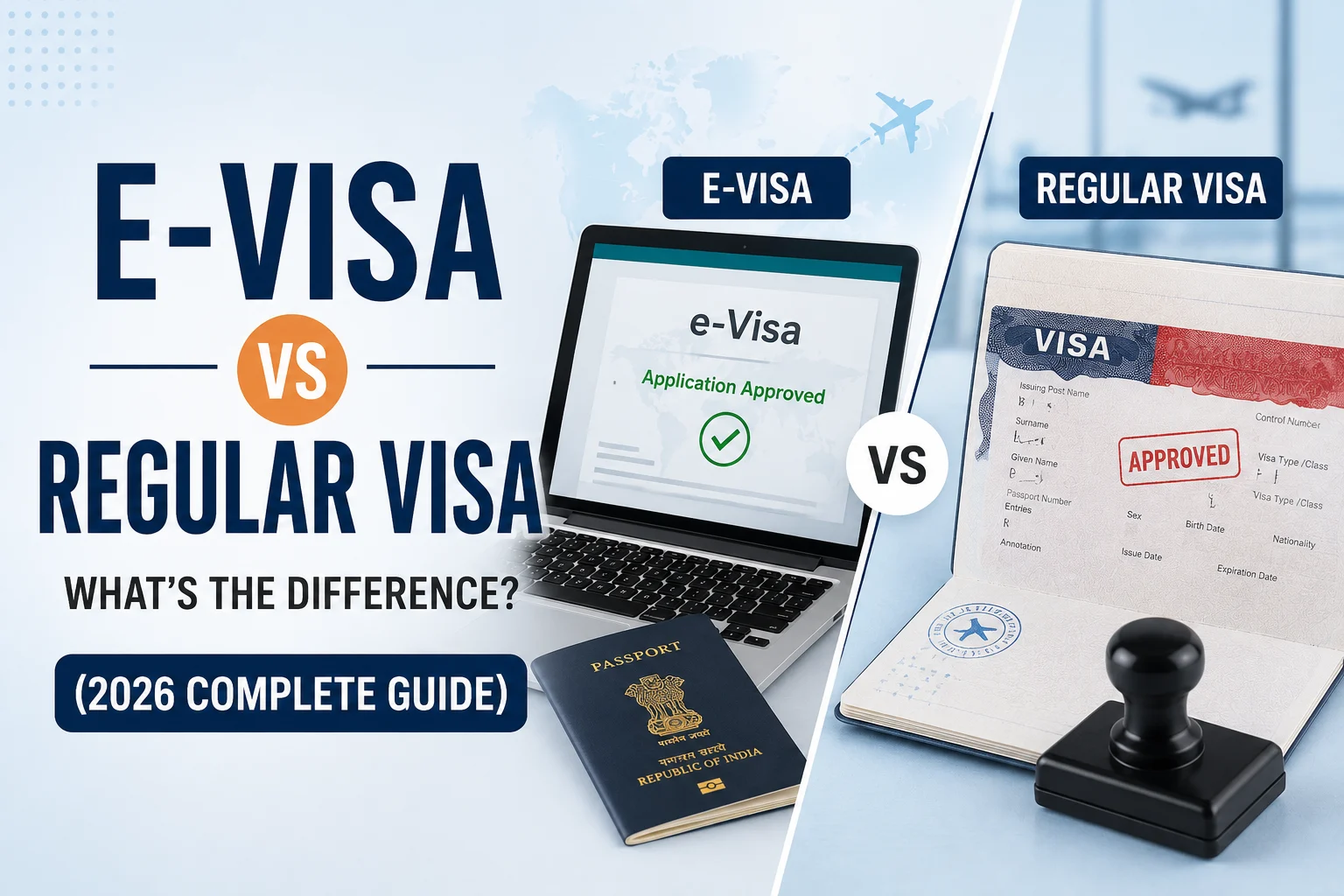
If you’re planning an international trip, one of the first things you’ll need is a visa. Today, many countries offer both Electronic Visas (E-Visas) and Regular (Sticker) Visas, making it easier for travelers to choose the option that best suits their travel purpose.
While both visa types allow you to enter a foreign country legally, they differ in terms of application process, documentation, processing time, cost, validity, and travel requirements. Understanding these differences can help you choose the right visa and avoid unnecessary delays.
In this comprehensive guide, we’ll explain the difference between an E-Visa and a Regular Visa, their advantages, disadvantages, eligibility, application process, and when each option is the best choice.
What is an E-Visa?
An E-Visa (Electronic Visa) is a digital travel authorization that applicants can apply for online without visiting an embassy or consulate in most cases. Once approved, the visa is issued electronically and is usually linked to your passport or sent via email.
Many countries now offer E-Visas for:
- Tourism
- Business
- Short-term medical treatment
- Conferences
- Transit (in some countries)
Applicants generally need to print or digitally carry the approved E-Visa while travelling.
What is a Regular Visa?
A Regular Visa, also known as a Sticker Visa, is a visa issued by an embassy or consulate. In most cases, the visa is printed or stamped inside your passport after document verification and, where applicable, an interview.
Regular visas are commonly issued for:
- Tourism
- Student visas
- Work visas
- Family visas
- Long-term residence
- Employment
- Immigration
E-Visa vs Regular Visa: Quick Comparison
| Feature | E-Visa | Regular Visa |
|---|---|---|
| Application Mode | Online | Embassy/Consulate or Authorized Visa Centre |
| Passport Submission | Usually Not Required Before Approval | Usually Required |
| Embassy Visit | Usually Not Required | Often Required |
| Processing Time | Generally Faster | May Take Longer |
| Interview | Usually Not Required | May Be Required |
| Visa Format | Electronic Approval | Visa Sticker/Stamp |
| Best For | Short-Term Travel | Long-Term or Complex Visa Categories |
Advantages of an E-Visa
1. Online Application
Applicants can complete the entire application online from home.
2. Faster Processing
Many E-Visas are processed within a few working days, depending on the destination country.
3. Less Paperwork
Most E-Visa applications require only scanned copies of:
- Passport
- Photograph
- Supporting documents
4. No Embassy Visit (in most cases)
Applicants usually do not need to visit an embassy or consulate.
5. Easy Status Tracking
Many countries allow applicants to track their E-Visa application online.
Advantages of a Regular Visa
1. Suitable for Long-Term Stay
Regular visas are generally required for:
- Employment
- Higher Education
- Permanent Residence
- Family Reunification
2. Wider Visa Categories
Regular visas are available for almost every travel purpose.
3. Higher Validity
Some Regular Visas offer longer validity and multiple-entry options.
4. Additional Verification
Embassy interviews and document verification may increase confidence in complex applications.
Disadvantages of an E-Visa
- Not available for every country.
- Limited to specific travel purposes.
- Shorter validity in many cases.
- Some countries restrict extension or conversion.
- Entry is subject to immigration approval on arrival.
Disadvantages of a Regular Visa
- Longer processing time.
- More documentation.
- Embassy appointment may be required.
- Passport submission is usually necessary.
- Higher processing effort for applicants.
Which Countries Offer E-Visas?
Many countries now provide E-Visa facilities for eligible travelers, including:
- India
- Turkey
- Vietnam
- Kenya
- Azerbaijan
- Egypt
- Oman
- Uzbekistan
- Qatar
- Sri Lanka (for eligible travel authorization schemes)
Availability depends on the applicant’s nationality and the visa category. Always verify the latest rules on the official immigration website of the destination country.
When Should You Choose an E-Visa?
An E-Visa is usually the better option if you are:
- Going on vacation.
- Attending a business meeting.
- Visiting for a short medical treatment.
- Participating in a conference.
- Making a short-term visit.
When Should You Choose a Regular Visa?
A Regular Visa is generally required if you are:
- Studying abroad.
- Accepting a job overseas.
- Moving permanently.
- Joining family members.
- Applying for long-term residency.
- Applying under immigration programs.
Documents Required
For an E-Visa
Commonly required documents include:
- Valid Passport
- Passport-size Photograph
- Email Address
- Travel Itinerary
- Hotel Booking
- Return Ticket (if applicable)
- Financial Proof
- Additional documents based on visa type
For a Regular Visa
Applicants may need:
- Passport
- Visa Application Form
- Passport Photographs
- Financial Documents
- Employment Letter
- Invitation Letter
- Admission Letter (Student Visa)
- Travel Insurance
- Medical Certificate (if applicable)
- Police Clearance Certificate (if required)
Processing Time
E-Visa
Processing typically ranges from 24 hours to several working days, depending on the country and application volume.
Regular Visa
Processing can take from a few days to several weeks, depending on:
- Visa category
- Country
- Interview requirements
- Additional background checks
Common Reasons for Visa Rejection
Whether applying for an E-Visa or a Regular Visa, applications may be refused due to:
- Incomplete application.
- Incorrect information.
- Insufficient financial proof.
- Invalid passport.
- Poor-quality documents.
- Failure to meet eligibility criteria.
- Previous immigration violations.
- False or misleading information.
Tips for a Successful Visa Application
- Apply well before your travel date.
- Ensure your passport has sufficient validity.
- Provide accurate information.
- Upload clear and readable documents.
- Double-check all application details.
- Keep copies of your application and payment receipts.
- Track your application status regularly.
- Follow the official guidelines of the destination country’s immigration authority.
Frequently Asked Questions (FAQs)
Is an E-Visa the same as a Regular Visa?
No. An E-Visa is issued electronically after an online application, while a Regular Visa is typically issued as a sticker or stamp in your passport by an embassy or consulate.
Which visa is processed faster?
In many cases, E-Visas are processed faster than Regular Visas, although processing times vary by country.
Can I work with an E-Visa?
Generally, no. Most E-Visas are issued for tourism, business visits, or short-term purposes. Employment usually requires an appropriate work visa.
Do I need to visit the embassy for an E-Visa?
Usually not. Most E-Visa applications are completed entirely online, though some countries may request additional verification if necessary.
Which visa is better?
Neither is universally better. The right choice depends on your travel purpose, destination country, length of stay, and visa eligibility.
Conclusion
Both E-Visas and Regular Visas serve the same purpose of granting legal entry into a foreign country, but they differ significantly in application procedures, documentation, processing time, and eligibility. If you’re planning a short vacation or business trip, an E-Visa is often the faster and more convenient option. However, for long-term travel such as work, study, or immigration, a Regular Visa is usually required. Before applying, always review the latest visa requirements on the official immigration or embassy website of your destination country to ensure a smooth and successful application.