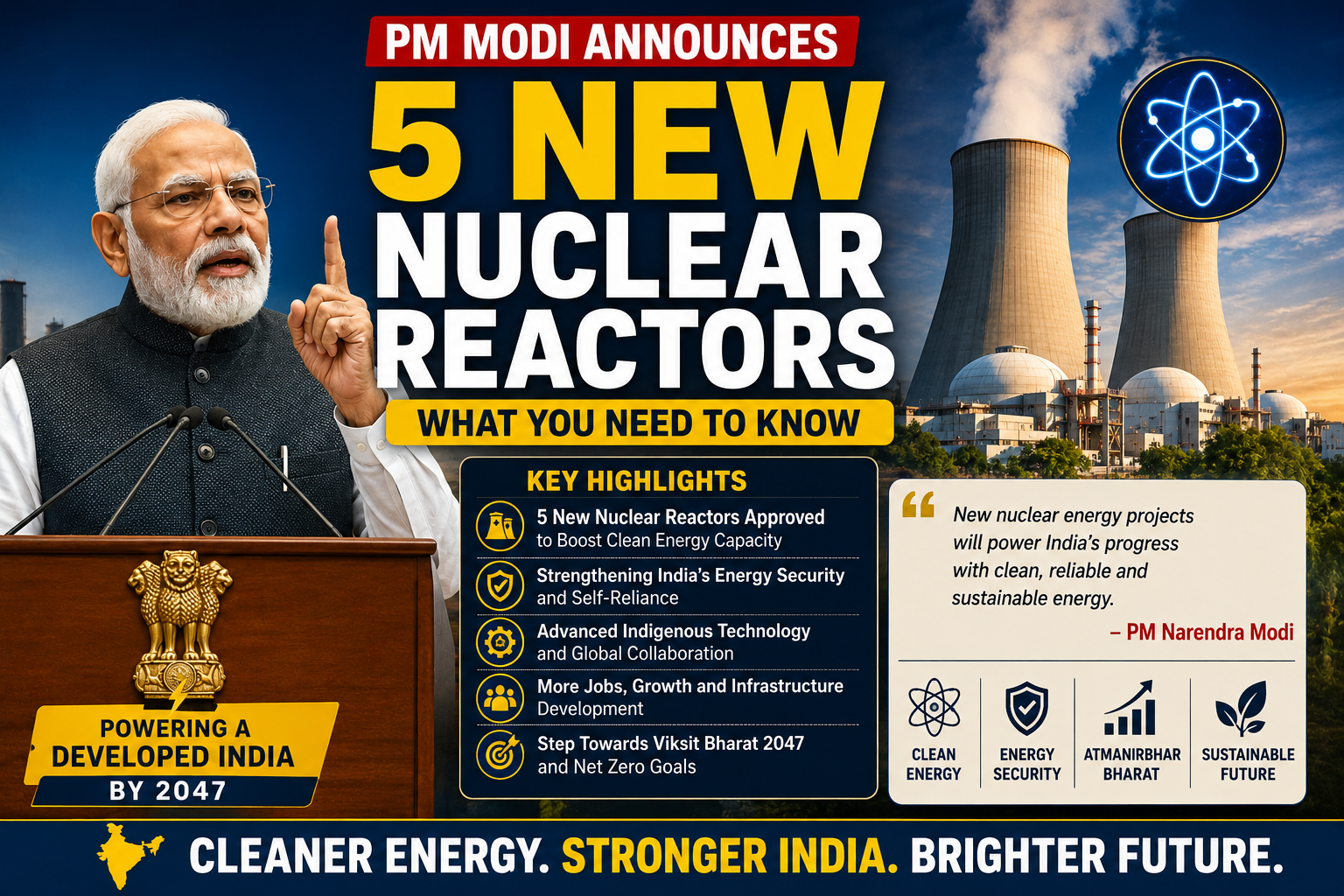
Prime Minister Narendra Modi announced a major expansion of India’s nuclear energy programme during his Independence Day address on 15 August 2026. The government plans to bring five new nuclear reactors into operation within this decade, as part of the larger target of achieving 100 GW of nuclear power capacity by 2047.
The announcement is significant because India is looking to increase its reliable electricity supply while supporting growing demand from industries such as artificial intelligence, semiconductor manufacturing, data centres and advanced manufacturing. The expansion is also linked to India’s long-term energy-security and clean-energy goals.
What Did PM Modi Announce?
During his Independence Day speech, PM Modi said India has set a target of 100 GW of nuclear power capacity by 2047 and that five new nuclear reactors are planned within this decade.
The announcement forms part of a much larger nuclear expansion programme that includes:
- Five new reactors within this decade
- 100 GW nuclear capacity by 2047
- Greater energy self-reliance
- Development of indigenous nuclear technology
- Expansion of nuclear fuel capabilities
- Support for India’s growing electricity demand
- Greater participation in the nuclear-energy ecosystem
Why Are Five New Nuclear Reactors Important?
India’s present installed nuclear power capacity is around 8.78 GW, with 24 nuclear power plants contributing about 3.1% of the country’s installed power capacity, according to recent government information.
Five additional reactors will therefore be an important step toward increasing India’s nuclear capacity.
However, the five reactors announced by PM Modi should be understood as an initial step toward the much larger 100 GW target, rather than enough on their own to achieve that goal.
India’s 100 GW Nuclear Energy Target
The five-reactor announcement is directly connected with India’s longer-term goal of reaching 100 GW of nuclear power capacity by 2047.
This target was already included in the government’s Nuclear Energy Mission, announced in the Union Budget 2025-26. The mission aims to make nuclear power a more important component of India’s energy mix.
The government has described nuclear energy as important for both energy security and India’s clean-energy transition.
Is the Five-Reactor Target a New Scheme?
No.
The five-reactor announcement is a national infrastructure and energy-development target, not a public welfare scheme through which citizens can directly apply for benefits.
It is part of India’s broader nuclear expansion programme.
The Nuclear Energy Mission was announced earlier, with a ₹20,000 crore allocation for research and development of Small Modular Reactors (SMRs) and a separate target of at least five indigenous SMRs operational by 2033.
Therefore, the five new reactors announced in the 2026 Independence Day speech should not automatically be equated with the five indigenous SMRs targeted for 2033.
What Are Small Modular Reactors?
Small Modular Reactors are smaller nuclear reactor designs intended to offer greater flexibility in deployment compared with traditional large reactors.
India’s Nuclear Energy Mission has allocated ₹20,000 crore toward the research, development and deployment of SMRs. The government has targeted at least five indigenously developed SMRs by 2033.
Potential applications include:
- Industrial power
- Captive power generation
- Repurposing suitable retired fossil-fuel plant sites
- Remote or smaller-grid applications
- Low-carbon electricity generation
India is also developing indigenous designs such as the Bharat Small Modular Reactor (BSMR-200) and other small-reactor technologies.
Why Does India Need More Nuclear Power?
India’s electricity demand is expected to increase as the economy grows.
Several emerging sectors require large amounts of reliable electricity, including:
- Artificial intelligence
- Data centres
- Semiconductor manufacturing
- Electric mobility
- Advanced manufacturing
- Digital infrastructure
- Industrial production
The government has highlighted nuclear power as a reliable source capable of supplying electricity around the clock.
Nuclear Energy and Artificial Intelligence
The rapid expansion of AI is increasing the importance of reliable electricity.
AI systems require large data centres and computing infrastructure. These facilities can consume substantial amounts of electricity.
During the 2026 Independence Day address, PM Modi linked India’s growing requirements for AI, chips and data centres with the need for greater energy security.
A stronger nuclear-energy base could therefore support India’s ambitions in:
- AI
- Cloud computing
- Data centres
- High-performance computing
- Semiconductor manufacturing
Nuclear Energy and Semiconductor Manufacturing
India is simultaneously building its semiconductor manufacturing ecosystem.
Chip manufacturing requires highly reliable electricity and sophisticated supporting infrastructure. The government has also announced plans to expand semiconductor production capacity.
The combination of nuclear expansion and semiconductor development is therefore part of a wider strategy to strengthen India’s technology and industrial self-reliance.
Nuclear Power and Energy Security
One of the major objectives behind the nuclear expansion is energy security.
A diversified energy mix can reduce India’s dependence on any single source of electricity.
India is developing multiple sources, including:
- Solar power
- Wind power
- Hydropower
- Nuclear power
- Green hydrogen
- Energy storage
Nuclear power can provide a stable source of electricity alongside variable renewable sources.
Nuclear Energy and India’s Net-Zero Goal
India has a long-term goal of achieving net-zero emissions by 2070.
Nuclear power produces very low direct carbon emissions during electricity generation and can therefore contribute to India’s low-carbon electricity strategy.
Government documents have linked the Nuclear Energy Mission with both the 100 GW nuclear target by 2047 and India’s broader clean-energy objectives.
Nuclear power is therefore being positioned as a complement to renewable energy rather than a replacement for solar and wind.
India’s Nuclear Technology Milestone
India has also made progress in indigenous nuclear technology.
In 2026, the country’s 500 MWe Prototype Fast Breeder Reactor (PFBR) at Kalpakkam achieved first criticality, marking an important milestone in India’s three-stage nuclear programme.
Fast breeder technology is particularly important to India’s long-term nuclear strategy because it is linked with more efficient utilisation of nuclear fuel resources and the eventual use of India’s large thorium resources.
India’s Three-Stage Nuclear Programme
India’s nuclear programme has traditionally followed a three-stage approach:
Stage 1: Pressurised Heavy Water Reactors
These reactors use natural uranium and form the foundation of India’s existing nuclear fleet.
Stage 2: Fast Breeder Reactors
Fast breeder technology is intended to produce more nuclear fuel while generating electricity.
The PFBR milestone at Kalpakkam represents an important step in this stage.
Stage 3: Thorium-Based Systems
The long-term programme aims to make greater use of India’s significant thorium resources.
This three-stage approach is an important part of India’s strategy for long-term nuclear-energy self-reliance.
What Will the Five New Reactors Do?
The five new reactors are expected to contribute to India’s expanding nuclear-generation capacity.
Their broader objectives include:
- Increasing electricity generation
- Strengthening energy security
- Supporting industrial growth
- Reducing dependence on fossil fuels
- Supporting low-carbon electricity
- Building nuclear-sector expertise
- Creating demand for specialised manufacturing
The exact reactor locations, capacities and commissioning schedules for the five reactors announced in the Independence Day speech should be confirmed through subsequent official project announcements.
Will the New Reactors Create Jobs?
Nuclear expansion can create employment opportunities across multiple sectors.
Potential areas include:
- Nuclear engineering
- Mechanical engineering
- Electrical engineering
- Civil engineering
- Electronics
- Instrumentation
- Physics
- Chemistry
- Construction
- Manufacturing
- Safety
- Maintenance
- Research and development
However, the announcement itself does not guarantee a specific number of government jobs.
Recruitment will depend on individual projects and organisations involved in construction and operation.
What Does This Mean for Engineering Students?
The expansion could create long-term opportunities for students pursuing technical and scientific disciplines.
Relevant fields include:
- Mechanical Engineering
- Electrical Engineering
- Electronics Engineering
- Civil Engineering
- Chemical Engineering
- Nuclear Engineering
- Instrumentation Engineering
- Materials Science
- Physics
- Chemistry
- Computer Science
Students interested in nuclear-sector careers can monitor recruitment and training opportunities announced by relevant government organisations and nuclear-sector institutions.
What Does This Mean for India’s Industries?
Reliable electricity is essential for industrial development.
The nuclear expansion could support sectors such as:
- Steel
- Chemicals
- Manufacturing
- Electronics
- Semiconductors
- Data centres
- Artificial intelligence
- Electric vehicles
A larger nuclear fleet could provide an additional source of dependable electricity as India’s industrial base expands.
Challenges in Building Five New Nuclear Reactors
Although the announcement is ambitious, nuclear projects require careful planning and execution.
High Investment
Nuclear power plants require substantial capital investment.
Long Construction Periods
Large nuclear projects involve complex engineering, construction and regulatory processes.
Nuclear Safety
Strict safety standards are essential throughout design, construction and operation.
Skilled Workforce
India will need a large pool of specialised engineers, scientists and technicians.
Fuel Availability
A larger nuclear fleet requires a dependable supply of nuclear fuel.
Regulatory Approvals
Nuclear projects must meet extensive regulatory and safety requirements.
Supporting Infrastructure
Transmission networks, cooling systems, transport infrastructure and other facilities are required around nuclear projects.
Nuclear Reactors vs Renewable Energy
Nuclear power and renewable energy serve different but complementary roles.
| Feature | Nuclear Power | Solar/Wind |
|---|---|---|
| Electricity Generation | Continuous generation possible | Variable |
| Carbon Emissions During Operation | Very low | Very low |
| Fuel | Nuclear fuel | No fuel required |
| Land Requirement | Relatively concentrated | Can require larger areas |
| Storage Requirement | Generally not required for continuous output | Often benefits from storage/grid balancing |
| Construction | Complex and capital intensive | Generally faster to deploy |
| Role | Reliable low-carbon power | Renewable electricity generation |
India’s long-term energy strategy is expected to involve a combination of nuclear power, renewables, storage and other technologies.
Key Facts About the Five New Nuclear Reactors
| Particular | Details |
|---|---|
| Announcement | 15 August 2026 |
| Announced by | Prime Minister Narendra Modi |
| New Reactor Target | 5 |
| Timeline | Within this decade |
| Long-Term Nuclear Target | 100 GW by 2047 |
| Related Programme | Nuclear Energy Mission |
| SMR Mission | ₹20,000 crore |
| SMR Target | At least 5 indigenous SMRs by 2033 |
| Current Nuclear Capacity | About 8.78 GW |
| Long-Term Climate Goal | Net zero by 2070 |
The current installed capacity figure of 8.78 GW comes from recent government information.
How Is This Different From the Five SMRs by 2033?
This is an important distinction.
The five new nuclear reactors announced by PM Modi in August 2026 are part of the broader expansion of nuclear power and are planned within this decade.
Separately, the Nuclear Energy Mission has a target of at least five indigenous Small Modular Reactors becoming operational by 2033.
Therefore, these are two different targets and should not be presented as the same five reactors.
Will Nuclear Power Make Electricity Cheaper?
Not necessarily.
Nuclear power can provide reliable electricity, but nuclear plants require substantial upfront investment and have complex construction and operating costs.
The impact on electricity prices will depend on:
- Construction costs
- Financing
- Operating costs
- Fuel costs
- Grid costs
- Power-purchase arrangements
- The overall electricity mix
Therefore, the five-reactor announcement should not be interpreted as a guarantee of cheaper electricity bills for households.
How Will Citizens Benefit?
The benefits are expected to be primarily long-term and economy-wide.
Potential benefits include:
- Greater energy security
- More reliable electricity
- Industrial growth
- Technology development
- Skilled employment
- Support for AI and data centres
- Support for semiconductor manufacturing
- Lower-carbon electricity generation
- Greater domestic nuclear capability
The actual impact will depend on how quickly the projects are implemented and integrated into the national electricity grid.
Frequently Asked Questions (FAQs)
How many nuclear reactors did PM Modi announce in 2026?
PM Modi announced plans for five new nuclear reactors within this decade during his Independence Day address on 15 August 2026.
What is India’s nuclear energy target for 2047?
India aims to achieve 100 GW of nuclear power capacity by 2047.
Are the five new reactors the same as five SMRs?
No. The five reactors announced during the 2026 Independence Day speech are part of the broader nuclear expansion plan. Separately, the Nuclear Energy Mission targets at least five indigenous SMRs by 2033.
What is the Nuclear Energy Mission?
The Nuclear Energy Mission is India’s long-term programme to expand nuclear power, support indigenous nuclear technologies and contribute toward the 100 GW nuclear-capacity target by 2047.
How much money has been allocated for India’s SMR programme?
The government has allocated ₹20,000 crore for the Nuclear Energy Mission focused on research and development of Small Modular Reactors.
What is India’s current nuclear capacity?
Recent government information puts India’s installed nuclear power capacity at approximately 8.78 GW, from 24 nuclear power plants.
Will the five reactors create government jobs?
They could create employment opportunities in engineering, construction, manufacturing, operations, research and other technical fields. However, the announcement does not provide a specific government-job number.
Why is India increasing nuclear power?
The expansion is intended to strengthen energy security and provide reliable electricity as demand rises from industries, AI, data centres, semiconductor manufacturing and other technologies.
Is nuclear energy renewable?
No. Nuclear energy is not classified as renewable, although nuclear power is considered a low-carbon source of electricity.
When will the five new reactors be operational?
PM Modi said the five new reactors are planned within this decade. Individual project commissioning dates will depend on project-specific development and official announcements.
Conclusion
The PM Modi announcement of five new nuclear reactors in 2026 marks another major step in India’s long-term nuclear-energy expansion. During his Independence Day address, the Prime Minister announced plans to bring five new reactors into operation within this decade while setting the much larger target of 100 GW of nuclear power capacity by 2047.
The announcement is important because India’s electricity demand is expected to grow alongside AI, data centres, semiconductor manufacturing, advanced industries and digital infrastructure. Nuclear power can provide reliable, low-carbon electricity and therefore has an important role in India’s future energy mix.
At the same time, the five-reactor announcement is only one part of the broader Nuclear Energy Mission. The government has already allocated ₹20,000 crore for Small Modular Reactor development and has separately targeted at least five indigenous SMRs by 2033.
India is also making progress in indigenous nuclear technology, including the 2026 first criticality milestone of the 500 MWe Prototype Fast Breeder Reactor at Kalpakkam.
For citizens, the expansion could eventually support greater energy security, industrial development and employment in specialised sectors. For students, it could create long-term opportunities in engineering, nuclear science, manufacturing, research and technology.
However, nuclear projects are complex and require significant investment, strict safety standards, skilled manpower and long construction periods. The success of the five-reactor plan will therefore depend on effective implementation over the coming years.
Overall, the announcement should be viewed as an important milestone in India’s wider 100 GW nuclear-energy vision for 2047, rather than as a standalone project. It reflects the government’s intention to make nuclear power a more significant part of India’s energy system while supporting the broader Viksit Bharat 2047 vision.
Read More: PM Modi Announces AI Skilling Programme 2026: Who Can Benefit?