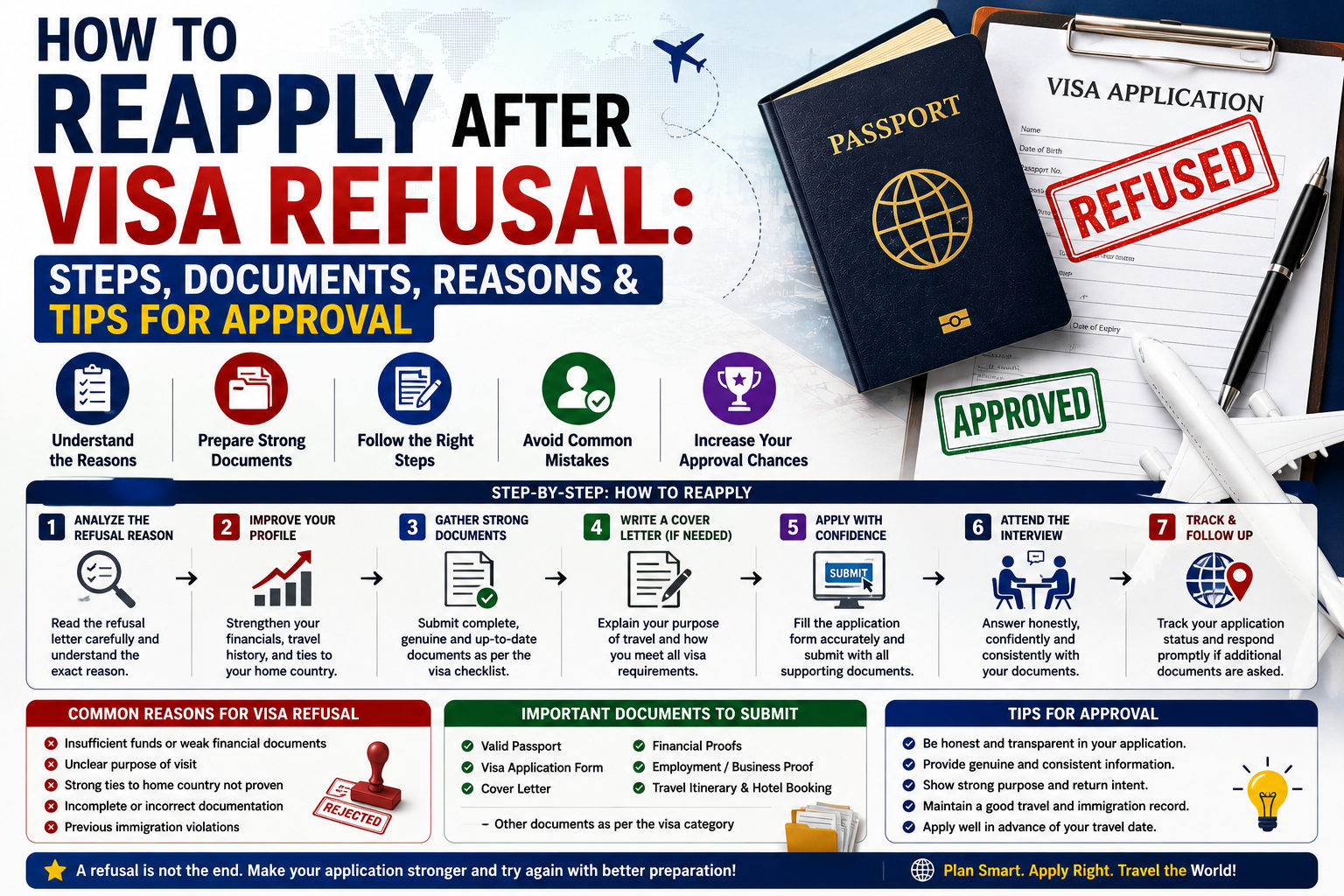
Having a visa application refused can be frustrating, especially when you have already spent time collecting documents, completing forms, paying fees, and preparing for your trip. However, a visa refusal does not always mean that you can never obtain a visa in the future. In many countries and visa categories, applicants can submit a fresh application after a refusal, provided they meet the applicable requirements and properly address the concerns that led to the earlier decision.
The most important thing to remember is that reapplying with exactly the same information may not solve the problem. Immigration authorities generally expect a new application to demonstrate that the applicant now meets the requirements or has provided information or evidence that addresses the earlier concerns. Canada’s immigration authority, for example, advises applicants to understand the reason for refusal before applying again and warns that submitting the same information is unlikely to change the outcome.
Similarly, the European Commission’s Schengen visa guidance says applicants are free to reapply after a refusal but recommends considering the reasons for the earlier refusal and making appropriate amendments before submitting a new application.
This guide explains how to reapply after visa refusal, what to check before submitting a new application, which documents may strengthen your case, common mistakes to avoid, and how to prepare a more convincing application.
What Does Visa Refusal Mean?
A visa refusal means that the relevant visa authority has decided not to grant the requested visa based on the information, documents, eligibility requirements, or other factors considered during the application process.
The exact meaning and legal consequences of a refusal vary between countries and visa categories.
For example, the U.S. Department of State explains that a visa application can be refused when an applicant is not eligible for the requested visa category or when the consular officer does not have enough information to establish eligibility.
A refusal letter or decision notice is therefore extremely important. It can tell you what went wrong and, depending on the country, whether you can appeal, request a review, submit additional information, or make a new application.
Can You Reapply After a Visa Refusal?
In many cases, yes.
There is no single worldwide rule requiring every applicant to wait a specific number of months before applying again. The rules depend on the country, visa type, refusal reason, and applicable immigration procedures.
For example, Canada’s official guidance says that applicants may apply again after a refusal unless the decision letter says otherwise, but recommends doing so only when they have new information or evidence that addresses the previous concerns.
The U.S. Department of State also states that applicants may reapply after being found ineligible, although a new application and another fee may be required in many circumstances.
Therefore, before reapplying, read your refusal letter carefully and check the official rules for the specific visa you are seeking.
Step 1: Read the Visa Refusal Letter Carefully
The first step after a visa refusal should be understanding why the application was refused.
Do not immediately submit another application without reviewing the decision.
Look for information about:
- The reason for refusal
- The immigration rule or legal provision involved
- Missing documents
- Financial concerns
- Concerns about your travel purpose
- Concerns about your intention to leave
- Previous immigration history
- Ineligibility or inadmissibility
- Additional information requested
- Appeal or review rights
- Reapplication instructions
For some applications, the refusal letter may contain very specific instructions. For example, U.S. applicants refused under INA 221(g) may be asked to provide additional documents or information rather than immediately starting a completely new application.
Step 2: Identify the Real Reason for the Refusal
A successful reapplication begins with identifying the actual weakness in the previous application.
Some common reasons include:
Insufficient Financial Evidence
The visa officer may not have been satisfied that you have enough funds to support your proposed trip.
Weak Evidence of Ties
For some temporary visas, the officer may have concerns about whether you will leave the destination country after your authorized stay.
Incomplete Documents
Important documents may have been missing, outdated, unclear, or inconsistent.
Unclear Purpose of Travel
Your travel plans may not have been sufficiently explained or may not have matched the visa category.
Inconsistent Information
Information in the application may have differed from your supporting documents or interview answers.
Previous Immigration Problems
A history of overstaying, unauthorized employment, previous removal, or other immigration violations can affect an application.
Failure to Meet Eligibility Requirements
You may simply not have met one or more requirements for the visa category.
The solution depends on the specific reason. There is no universal document or strategy that guarantees approval.
Step 3: Decide Whether You Should Reapply or Appeal
Reapplying is not always the only option.
Depending on the country and visa category, you may have the option to:
- Submit a fresh application
- Appeal the decision
- Request administrative review
- Request reconsideration
- Submit additional documents
- Apply for a waiver, where permitted
These options are not available for every visa.
For example, the UK states that there is no right of appeal against a refused visitor visa, while other immigration routes can have different review or appeal arrangements.
Some Schengen visa refusals can be appealed according to the procedure and deadline stated in the refusal notification.
This is why applicants should read the refusal notice rather than assuming that they have a particular legal remedy.
Step 4: Check Whether Your Circumstances Have Changed
Before reapplying, ask yourself whether anything meaningful has changed since the previous application.
A stronger second application could be possible if, for example:
- Your financial position has improved.
- You have started a stable job.
- Your employment has become more established.
- Your travel purpose is now clearer.
- You have received additional supporting documents.
- Your educational circumstances have changed.
- Your sponsor’s circumstances have changed.
- You have corrected an earlier documentation problem.
- You have developed stronger evidence supporting your application.
Canada’s immigration authority specifically notes that changes in employment, financial circumstances, travel purpose, or other relevant circumstances may provide new information for a future application.
However, a change does not guarantee approval. The new application still needs to satisfy the applicable immigration requirements.
Step 5: Improve Your Financial Documents
Financial evidence is important for many temporary travel, study and other visa categories.
Instead of submitting random bank statements, provide documents that clearly demonstrate your financial circumstances.
Depending on the visa type, relevant evidence may include:
- Recent bank statements
- Salary slips
- Employment confirmation
- Income tax records
- Business documents
- Savings evidence
- Sponsorship documents
- Scholarship documents
- Education funding documents
- Proof of regular income
The documents should tell a consistent financial story.
For example, if your application states that you earn a particular monthly salary, your employment documents and banking records should generally be consistent with that information.
Avoid unexplained large deposits shortly before applying. If there is a legitimate reason for a significant transaction, keep appropriate documentation explaining its source.
Step 6: Strengthen Your Proof of Travel Purpose
Your application should clearly explain why you want to travel.
Depending on the visa category, supporting evidence may include:
- Detailed travel itinerary
- Hotel or accommodation information
- Invitation letter
- Conference registration
- Business correspondence
- University admission letter
- Employment-related documents
- Family visit evidence
- Event tickets or registration
- Sponsorship documents
Do not provide unnecessary documents simply to make the application look larger.
The goal is to provide relevant, genuine and consistent evidence.
Step 7: Address Previous Refusal Concerns Directly
One of the biggest mistakes applicants make is pretending that the previous refusal never happened.
If the new application asks about previous visa refusals, answer honestly.
Then address the earlier concern through your new application and supporting evidence.
For example:
Previous concern: Insufficient financial evidence.
New evidence: Updated bank statements, salary records, employment confirmation and supporting financial documentation.
Or:
Previous concern: Unclear purpose of travel.
New evidence: A clearer itinerary, confirmed event registration, accommodation details and an explanation of the purpose of the trip.
The exact evidence depends on the refusal reason.
Step 8: Check Every Document for Consistency
Before submitting your new application, compare the information across all documents.
Check:
- Name spelling
- Date of birth
- Passport number
- Employment dates
- Salary information
- Travel dates
- Accommodation
- Sponsor information
- Family details
- Previous travel history
- Educational information
Even an accidental discrepancy can lead to questions.
If something has genuinely changed since the previous application, explain the change rather than trying to hide it.
Step 9: Complete a Fresh Application Carefully
If you are submitting a new application, make sure you use the correct current application form and follow the latest instructions.
Do not simply copy the previous application without reviewing it.
Pay particular attention to:
- Personal information
- Travel purpose
- Travel dates
- Employment history
- Financial information
- Previous visa refusals
- Previous international travel
- Immigration history
- Sponsor information
For U.S. visa applications, the Department of State states that applicants reapplying after an ineligibility generally need a new application and fee, subject to exceptions such as certain 221(g) cases.
Step 10: Prepare for a Second Visa Interview
If your visa category requires an interview, prepare carefully.
The officer may ask questions about:
- Why you want to travel
- How long you plan to stay
- Who is paying for the trip
- Where you will stay
- Your employment
- Your family
- Your previous travel
- Your previous visa refusal
- What has changed since the earlier application
Answer honestly and directly.
You do not need to memorize long speeches.
A clear answer supported by genuine documents is generally more useful than a rehearsed response that does not sound natural.
What Should You Say About Your Previous Visa Refusal?
If the officer asks about your previous refusal, do not become defensive.
Explain:
- That you previously applied.
- What reason was given for the refusal.
- What has changed, if anything.
- What additional evidence you are now providing.
For example:
“My previous application was refused because the officer was not satisfied with my financial documentation. Since then, my employment and income have changed, and I have provided updated financial and employment documents.”
Only use an explanation that is truthful and supported by your circumstances.
How Long Should You Wait Before Reapplying?
There is no universal waiting period after a visa refusal.
Some countries allow applicants to reapply relatively quickly, while specific visa categories or legal circumstances may impose different requirements.
The more important question is whether you can now address the reason for the refusal.
Reapplying immediately with identical circumstances may simply lead to another refusal.
Canada’s official guidance says applicants can apply again unless their decision says otherwise, but should generally do so when they can provide new information relevant to the previous refusal.
For Schengen applications, official guidance similarly allows reapplication but recommends making appropriate amendments after considering the previous refusal.
Do You Have to Pay the Visa Fee Again?
Often, yes.
A fresh visa application generally involves another application fee, although exact rules vary by country and visa category.
For example, the U.S. Department of State states that the visa application processing fee is non-refundable and that applicants generally need to submit a new application and pay the fee again when reapplying after an ineligibility.
Schengen visa fees are also generally not refunded simply because an application is refused.
Always check the current official fee before submitting a new application.
Can You Reapply With the Same Documents?
You may need to submit some of the same documents because they remain relevant.
However, simply submitting the exact same application package without addressing the refusal reason is unlikely to improve your chances.
Canada’s immigration authority specifically warns that applying again with the same information is unlikely to change the decision.
Instead, identify which evidence was weak and provide relevant, updated or additional documentation where appropriate.
Can a Visa Agent Guarantee Approval After Refusal?
No legitimate agent can guarantee that a visa will be approved.
Immigration authorities make their own decisions based on the applicable laws, evidence and circumstances.
Canada’s government specifically warns that hiring an immigration representative does not guarantee approval or change a previous immigration decision.
Be especially cautious if someone promises:
- Guaranteed visa approval
- Special access to embassy officials
- Fake documents
- Guaranteed appointment slots
- Guaranteed interview answers
- A “100% success” package
Providing false information or fraudulent documents can create much more serious immigration problems.
Common Mistakes When Reapplying After Visa Refusal
Reapplying Too Quickly Without Changes
Submitting a new application immediately may not help if nothing relevant has changed.
Ignoring the Refusal Reason
The refusal letter should be the starting point for preparing the new application.
Providing Fake Documents
Never manufacture financial records, employment letters, invitation letters or other evidence.
Hiding the Previous Refusal
If the new application asks about previous refusals, provide accurate information.
Giving Contradictory Answers
Your interview answers should match the information in your application and supporting documents.
Overloading the Application
More documents do not automatically mean a stronger application. Focus on relevant evidence.
Depending Completely on an Agent
You are responsible for the information submitted in your application, even if someone helps prepare it.
Visa Reapplication Checklist
Before submitting your new application, review the following:
Read the previous refusal letter.
Identify the exact refusal reason.
Check whether an appeal or review is available.
Determine whether a fresh application is appropriate.
Review the current visa requirements.
Update your financial documents.
Update employment or education evidence.
Prepare relevant travel documents.
Address every major concern from the previous refusal.
Check all information for consistency.
Disclose previous refusals when required.
Complete the latest application form.
Pay the applicable fee.
Prepare for the interview, if required.
Submit only genuine and verifiable documents.
What If Your Visa Is Refused Again?
A second refusal does not necessarily mean that you can never obtain a visa.
However, repeated refusals should be taken seriously.
Review the new decision carefully and determine whether:
- The same concern remains.
- A new concern has been identified.
- Your circumstances have changed.
- You have an appeal or review option.
- You need qualified legal or immigration advice.
If the case involves complicated immigration history, previous misrepresentation, inadmissibility, deportation, or another serious legal issue, consider obtaining advice from an appropriately qualified immigration professional.
Final Thoughts
A visa refusal is not always the end of your travel plans. In many situations, applicants can submit a new application, but the key is to understand why the first application failed and make meaningful improvements before applying again.
Start by reading the refusal letter. Determine whether the issue involved documentation, finances, travel purpose, eligibility, immigration history, or another concern. Then gather relevant evidence that directly addresses the problem.
Do not assume that simply waiting a few months will automatically improve your chances. In many cases, what matters more is whether your circumstances or evidence have genuinely changed.
Most importantly, never submit false information or documents. A refusal can often be addressed through a stronger and more accurate application, but providing misleading information can create much more serious immigration consequences.
Visa rules vary significantly between countries and visa categories. Always check the latest official instructions of the destination country’s immigration authority, embassy or consulate before submitting a fresh application.
Read More: Visa Refusal vs Visa Rejection: Key Differences, Reasons & What to Do Next