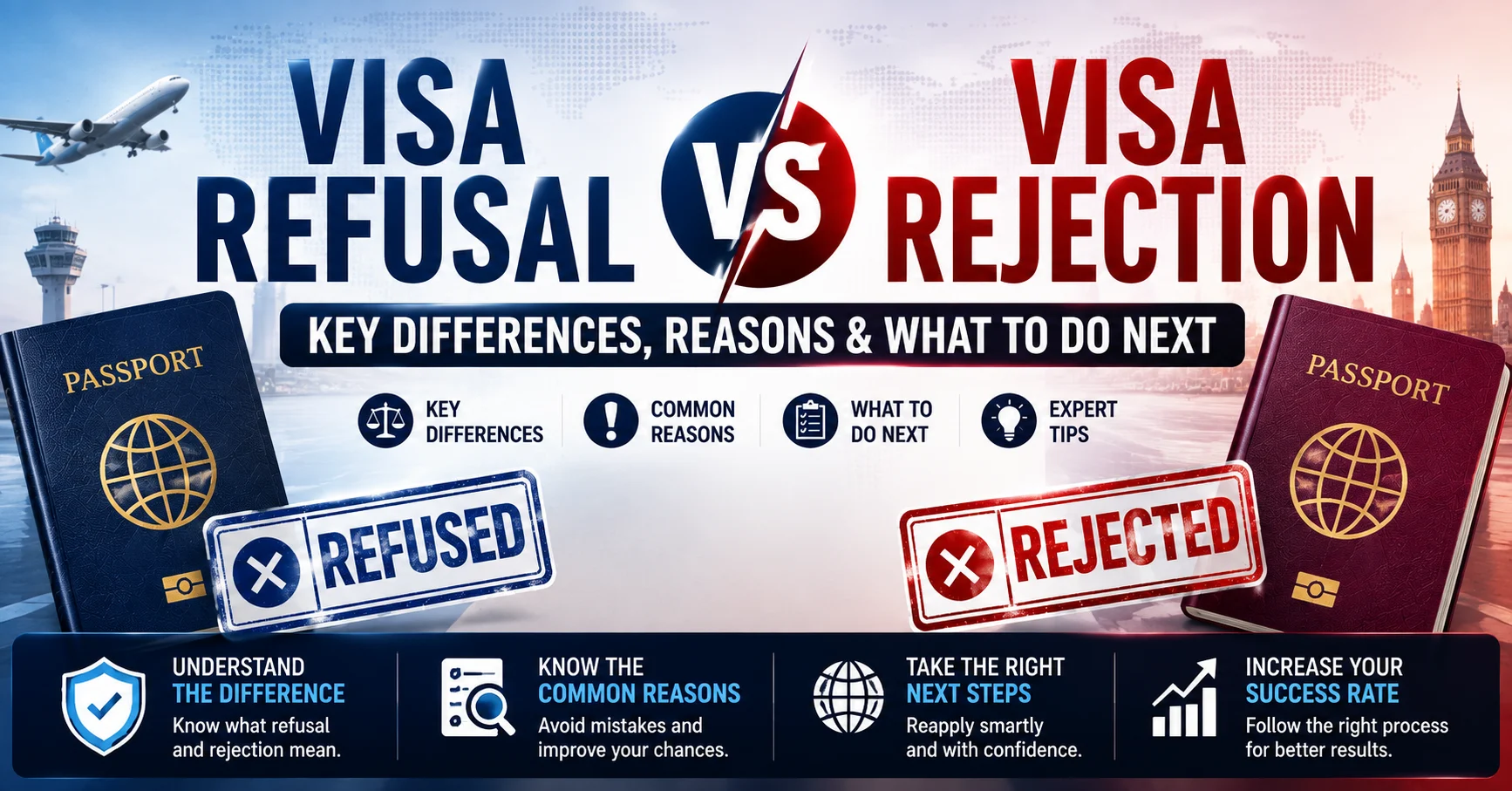
Applying for a visa can be an important step toward studying, working, visiting family, attending a business event, or traveling abroad. After submitting an application, however, not every applicant receives the decision they hoped for. Sometimes an application is described as refused, while in other situations people use the word rejected.
These two terms are often used interchangeably in everyday conversation, but their exact meaning can depend on the immigration system and the authority handling the application. In many cases, visa refusal refers to a formal decision by a visa authority that the applicant has not met the requirements for the visa. Visa rejection is often used more generally to describe an unsuccessful application, although some immigration systems may use “rejection” for a specific procedural reason.
Understanding the difference can help applicants interpret their decision letter correctly and determine what they should do next.
What Is Visa Refusal?
A visa refusal generally means that the relevant immigration or visa authority has assessed an application and decided not to grant the requested visa.
A refusal can happen for many reasons. The applicant may not have provided enough evidence, may not have satisfied the eligibility requirements, may have failed to demonstrate the purpose of travel, or may have raised concerns about whether they intend to follow the conditions of the visa.
The refusal letter or decision notice is particularly important because it may explain the reason for the decision and whether the applicant has any right to appeal, request administrative review, or submit a fresh application.
What Is Visa Rejection?
The word visa rejection is commonly used to describe an unsuccessful visa application.
However, “rejection” does not have one universal legal meaning across all countries. Some authorities may use the term in official correspondence, while others use “refusal” for a formal negative visa decision.
In everyday language, applicants often say that their visa was rejected when they mean that their application was not approved.
For this reason, applicants should focus less on the word itself and more on the official decision notice. The reason for the decision and the options available afterward are usually more important than whether the document says “refused” or “rejected.”
Visa Refusal vs Visa Rejection: Is There a Real Difference?
The difference can be summarized simply:
| Point | Visa Refusal | Visa Rejection |
|---|---|---|
| General meaning | Visa application is formally not approved | Common term for an unsuccessful application |
| Legal meaning | Can have a specific meaning under a country’s immigration law | Meaning varies by immigration system |
| Reason | Usually connected to eligibility or immigration requirements | Could refer to a procedural or substantive issue |
| Decision letter | Often provides a reason or legal basis | Depends on the authority |
| Next step | May include appeal, review or reapplication | Depends on the reason and applicable rules |
The most important point is that there is no worldwide legal distinction between the two terms.
An applicant should always read the official decision letter rather than relying on the terminology used by friends, agents or online discussions.
Common Reasons for Visa Refusal or Rejection
Visa applications can be unsuccessful for many different reasons. Some are related to eligibility, while others concern documentation or credibility.
1. Incomplete Documentation
One of the most common problems is failing to submit required documents.
Depending on the visa category, applicants may need to provide documents such as:
- Passport
- Financial records
- Employment documents
- Invitation letters
- Accommodation details
- Travel itinerary
- Educational records
- Admission letters
- Sponsorship documents
- Proof of relationship
- Insurance documents
- Previous immigration records
Missing or inconsistent documents can create doubts about whether the applicant meets the requirements.
2. Insufficient Financial Evidence
For many visa categories, applicants must demonstrate that they can financially support themselves during their stay.
Simply providing a bank statement may not always be enough. Immigration authorities may consider the source of funds, account history, income, employment and overall financial circumstances.
Large unexplained deposits can sometimes raise questions about the authenticity of the financial evidence.
3. Unclear Purpose of Travel
The purpose of the trip should be consistent with the visa being requested.
For example, someone applying for a tourist visa should be able to explain their travel plans in a credible and consistent manner.
If the information in the application, interview and supporting documents does not match, the application may face additional scrutiny.
4. Concerns About Returning Home
For certain temporary visas, immigration authorities may assess whether the applicant is likely to leave the country at the end of the authorized stay.
Applicants may be asked to demonstrate ties to their home country through employment, education, family responsibilities, property, business interests or other circumstances.
The exact assessment depends on the country’s immigration law and visa category.
5. Inconsistent Information
Providing information that conflicts with previous applications, supporting documents or interview answers can create concerns.
For example, differences in employment history, travel purpose, income, family information or previous travel may require clarification.
Applicants should carefully review their forms before submission.
6. Previous Immigration Violations
A history of immigration violations can affect a future visa application.
Examples may include:
- Previous visa overstay
- Unauthorized employment
- Working without the required permission
- Previous removal or deportation
- Misrepresentation in an earlier application
- Breach of visa conditions
The effect depends on the country, the nature of the violation and the specific visa category.
7. Previous Visa Refusal
Having a visa refused in the past does not automatically mean that every future application will be refused.
However, applicants may need to disclose previous refusals if the application asks about them.
A new application should address the reason for the previous refusal rather than simply submitting the same information again.
8. Failure to Meet Eligibility Requirements
Every visa category has specific eligibility requirements.
An applicant may be refused because they do not meet one or more of those requirements.
For example, a student visa applicant may need admission to an eligible institution, while a work visa applicant may require a qualifying job offer or sponsorship.
9. Problems With the Passport
A passport may need to meet certain validity requirements depending on the destination and visa category.
Issues such as insufficient validity, damaged travel documents or missing pages may cause problems.
Applicants should check passport requirements before submitting a visa application.
10. Misrepresentation or False Information
Providing false information is one of the most serious problems an applicant can create.
Misrepresentation can include intentionally providing incorrect information or submitting fraudulent documents.
The consequences can be much more serious than a simple visa refusal and may affect future immigration applications.
What Happens After a Visa Is Refused?
The next step depends on the country and the reason for refusal.
A decision letter may explain whether you can:
- Appeal the decision
- Request an administrative review
- Ask for reconsideration
- Submit additional evidence
- Correct a procedural problem
- Submit a new visa application
Not every visa refusal carries a right of appeal.
Therefore, applicants should carefully read the official decision notice and check the deadline for any available review or appeal.
Can You Apply Again After a Visa Refusal?
In many cases, yes.
However, simply submitting the same application again may not solve the problem.
Before reapplying, identify:
- Why the previous application was refused.
- Which documents or evidence were missing.
- Whether your circumstances have changed.
- Whether you now meet the visa requirements.
- Whether you need professional immigration advice.
A stronger application should address the actual reason for the previous decision.
Is Reapplying the Same as Appealing?
No.
An appeal or administrative review generally asks the relevant authority to reconsider a decision under the procedure available in that immigration system.
A new application starts a new visa application process.
Whether either option is available depends on the visa category and country.
Applicants should not assume that they can appeal simply because their visa was refused.
How Long Should You Wait Before Reapplying?
There is no universal waiting period after a visa refusal.
In some situations, an applicant may be able to submit a new application relatively quickly. However, reapplying immediately without addressing the reason for refusal may not improve the outcome.
For example, if an applicant was unable to demonstrate sufficient funds and submits the same financial evidence a few days later, the underlying concern may remain.
The better approach is to improve the application first.
Does Visa Refusal Affect Future Applications?
A previous refusal can become part of an applicant’s immigration history.
However, one refusal does not automatically mean that future applications will fail.
What matters is the reason for the refusal and whether the applicant can now demonstrate that they meet the requirements.
For example, a previous refusal caused by incomplete documentation may be easier to address than a refusal involving serious immigration concerns.
Applicants should always answer questions about previous refusals truthfully when required.
Can a Visa Refusal Be Removed From Your Record?
Generally, applicants should not assume that a previous refusal simply disappears.
Immigration authorities may retain records of applications and decisions according to their laws and policies.
If a future application asks about previous refusals, provide accurate information.
Trying to hide a previous refusal can create additional credibility or misrepresentation concerns.
Visa Refusal Because of Missing Documents
A refusal caused by insufficient or missing documentation does not necessarily mean that an applicant is permanently ineligible.
However, the applicant should first determine exactly what evidence was considered insufficient.
Before submitting another application, check:
- Financial documents
- Employment proof
- Travel history
- Accommodation evidence
- Invitation or sponsorship documents
- Educational documents
- Identity documents
- Proof of relationship
- Supporting letters
- Any country-specific forms
The documents should also be consistent with the information entered in the visa application.
Visa Refusal After an Interview
Some visa categories require an interview.
During an interview, applicants may be asked questions about:
- Purpose of travel
- Employment
- Education
- Financial circumstances
- Family
- Previous travel
- Accommodation
- Sponsorship
- Intended length of stay
An applicant should answer honestly and clearly.
Memorizing complicated answers or providing information that does not match the application can create credibility concerns.
What Is the Difference Between Visa Refusal and Visa Denial?
“Visa denial” is another phrase commonly used to describe an unsuccessful visa application.
Depending on the country, denial, refusal and rejection may be used differently or may simply be informal alternatives.
There is no single international definition that applies to every immigration system.
Therefore, applicants should identify the exact legal terminology used by the authority that made the decision.
Can a Visa Refusal Be Challenged?
Possibly, but the available options vary.
Some immigration systems provide appeal or review procedures for specific visa categories. Other decisions may have limited review options.
If an appeal or review is available, there may be a strict deadline.
Applicants should read the decision letter carefully and follow the official instructions rather than relying on general online advice.
Should You Use a Visa Consultant After Refusal?
Not every refused applicant needs professional assistance.
If the refusal resulted from a straightforward documentation issue, an applicant may be able to correct the problem independently.
However, professional immigration advice may be useful when the case involves:
- Previous immigration violations
- Multiple visa refusals
- Deportation or removal
- Alleged misrepresentation
- Complex family circumstances
- Serious financial concerns
- Complicated immigration history
- A legal appeal or review
Anyone considering professional help should verify the qualifications and authorization of the person providing immigration advice.
How to Improve Your Visa Application After Refusal
A successful reapplication should be based on the reason for the previous decision.
Read the Decision Carefully
Do not focus only on the word “refused” or “rejected.” Identify the specific reason.
Correct Errors
If information was entered incorrectly, make sure the new application contains accurate information.
Provide Better Evidence
Where the decision identifies insufficient evidence, provide relevant and credible supporting documents.
Explain Changes
If your circumstances have changed since the previous application, clearly explain the change and provide supporting evidence.
Maintain Consistency
Information across the application, supporting documents and interview should be accurate and consistent.
Avoid Fake Documents
Never use forged bank statements, employment letters, invitation letters or other fraudulent documents.
A document problem can become a much more serious immigration issue.
Important Mistakes to Avoid After Visa Refusal
Applicants should avoid making decisions based on frustration or assumptions.
Do not:
- Submit the same application without addressing the refusal reason.
- Hide a previous visa refusal.
- Submit false documents.
- Provide contradictory information.
- Depend entirely on unofficial advice.
- Ignore an appeal deadline.
- Assume that one country’s visa rules apply to another country.
- Book expensive non-refundable travel before obtaining the required visa.
Final Thoughts
The terms visa refusal and visa rejection are often used as if they mean exactly the same thing. In everyday conversation, both generally describe an unsuccessful visa application. However, their precise legal meaning can vary depending on the country and immigration system.
For applicants, the most important thing is not the terminology but the official decision and the reason behind it.
If your visa application has been refused or rejected, carefully read the decision notice, understand the reason, and determine whether you have an option to appeal, request a review, provide additional information or submit a fresh application.
A previous visa refusal does not automatically mean that you will never receive a visa. A stronger application, accurate information and appropriate supporting evidence can make a significant difference when the relevant immigration rules allow a new application.
Always check the official immigration or embassy guidance for the country concerned because visa requirements, appeal rights and application procedures can change.
Read more: UP Post-Matric/Dashmottar Scholarship Rules 2026: Eligibility, Income Limit & Application Process