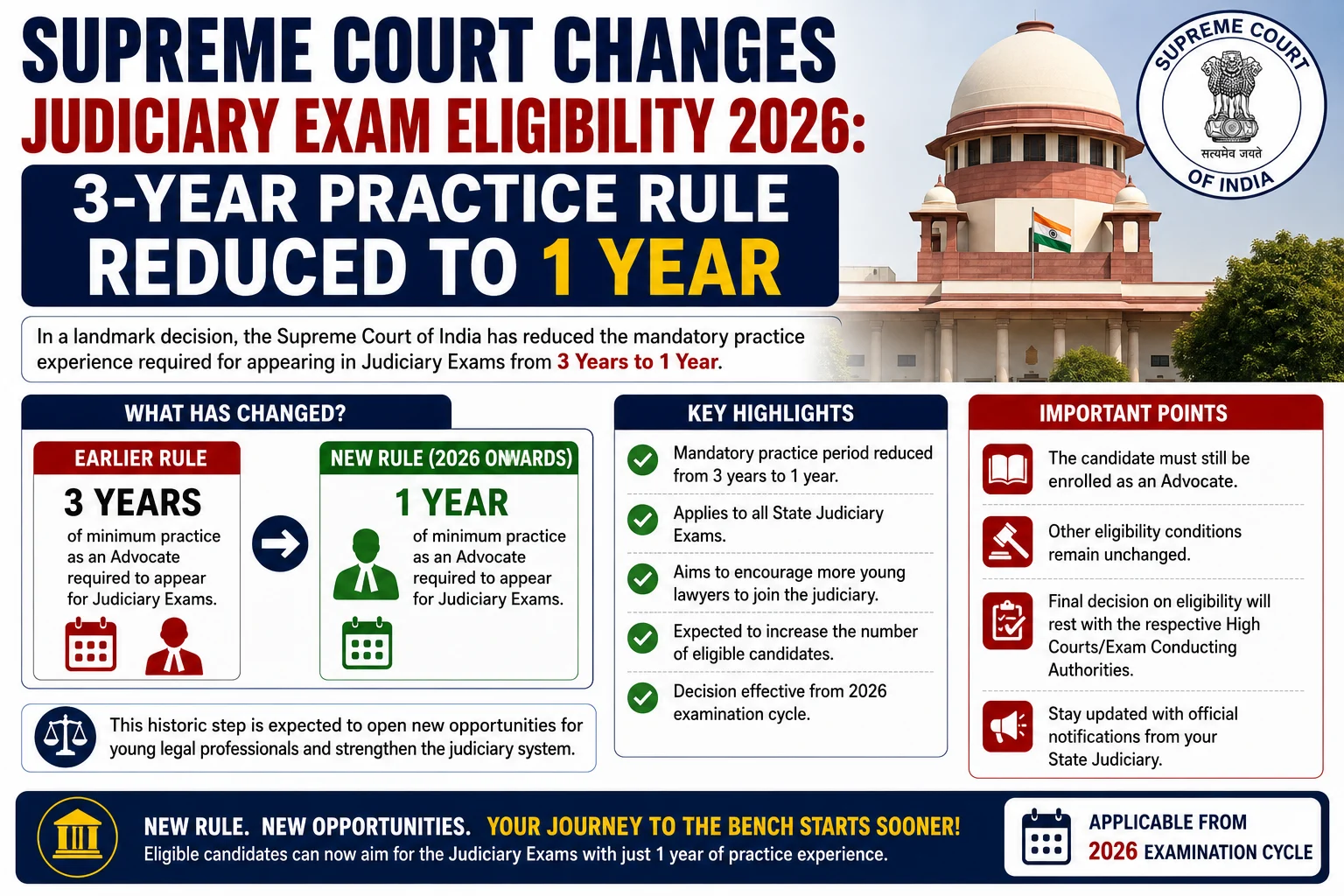
The Supreme Court of India has delivered a significant decision for law graduates and judicial service aspirants, reducing the mandatory legal practice requirement for entry-level judicial service examinations from three years to one year.
The decision modifies the Court’s May 2025 ruling, which had made three years of practice at the Bar a mandatory eligibility condition for candidates seeking direct recruitment as Civil Judges (Junior Division). The latest decision retains the principle that practical legal experience should be part of the entry route but reduces the period of prior practice required before candidates can appear for the examination.
The Supreme Court Bench comprising Chief Justice of India Surya Kant and Justices A.G. Masih and K. Vinod Chandran delivered the decision by a 2:1 majority while dismissing the review petitions challenging the earlier practice requirement. Justice K. Vinod Chandran dissented.
The revised framework is particularly important for young law graduates who were concerned that the three-year practice rule would delay their entry into judicial services. At the same time, the Court has introduced structured training and clerkship requirements to ensure that candidates gain practical courtroom exposure.
What Has the Supreme Court Changed?
Under the earlier May 2025 ruling, candidates seeking entry-level judicial service through direct recruitment were required to have at least three years of legal practice before appearing for the examination.
The Supreme Court has now reduced this requirement to one year of legal practice.
However, the change does not mean that selected candidates can immediately become regular judges after clearing the examination.
The revised system introduces additional practical training after selection. Candidates will undergo intensive training at a State Judicial Academy followed by structured clerkship under experienced judicial officers and judges.
This effectively replaces part of the earlier three-year practical experience requirement with supervised professional training after selection.
New One-Year Practice Rule for Judicial Service Exams
The most important change is the reduction of the mandatory practice period from three years to one year.
This means that eligible law graduates who complete the required one year of practice may be able to appear for entry-level judicial service examinations, subject to the recruitment rules and notification applicable to their state.
The decision is significant because the lower judiciary is largely recruited through state-level judicial service examinations. The exact recruitment process, eligibility conditions, examination pattern and application requirements can differ from one state to another.
Therefore, candidates should always check the latest notification issued by the relevant High Court, State Public Service Commission or judicial recruitment authority before applying.
Why Did the Supreme Court Reduce the Three-Year Requirement?
The Court’s latest decision follows review petitions challenging the three-year practice requirement introduced by its May 2025 judgment.
The earlier rule had generated considerable discussion among law students, young advocates and judicial service aspirants.
One of the concerns was that requiring three years of practice could create difficulties for fresh law graduates who wanted to pursue judicial service soon after completing their legal education.
The Court has now retained its view that practical legal exposure is important but has modified how that experience will be acquired.
Instead of requiring the entire three-year period before the examination, the new arrangement combines one year of practice before the examination with structured training and clerkship after selection.
What Was the Earlier Three-Year Rule?
In May 2025, the Supreme Court restored a requirement that candidates appearing for entry-level judicial service examinations should have a minimum of three years of legal practice.
The objective was to ensure that future judges had practical exposure to court proceedings before entering the judiciary.
The requirement represented a significant change for law graduates because candidates who previously expected to appear for judicial examinations soon after completing their law degree now had to spend additional years practicing law.
The issue subsequently became the subject of review petitions and further proceedings.
The Supreme Court has now modified that framework rather than completely removing the requirement for practical experience.
Who Will Benefit From the New Rule?
The decision is particularly relevant to young law graduates and early-career advocates who want to enter the lower judiciary.
Candidates who previously faced a three-year waiting period may now have a shorter route to eligibility, provided they meet the one-year practice requirement and other conditions prescribed for the examination.
The change may also help candidates who were concerned about the financial and professional challenges associated with maintaining several years of legal practice before entering judicial service.
However, candidates should understand that the new rule does not eliminate the need for practical experience altogether.
The Supreme Court has emphasized the importance of courtroom exposure by introducing structured post-selection training and clerkship.
What Happens After Clearing the Judicial Service Exam?
Clearing the examination will not necessarily result in an immediate regular judicial appointment under the revised framework.
Selected candidates will have to undergo a structured training process.
According to reports on the Supreme Court’s decision, the framework includes:
- One year of intensive training at the State Judicial Academy.
- One year of structured clerkship.
- Six months of clerkship under a District Judge or member of the Higher Judicial Service.
- Six months of clerkship under a sitting High Court judge.
This arrangement is designed to provide selected candidates with practical judicial experience before they take on regular responsibilities.
Why Is Judicial Academy Training Important?
Judicial academy training is intended to help newly selected candidates understand the responsibilities associated with judicial office.
A law degree provides academic knowledge of statutes, legal principles and case law, but judicial work requires additional practical skills.
Training can help candidates develop an understanding of:
- Court administration
- Case management
- Judicial ethics
- Courtroom procedure
- Evidence evaluation
- Drafting judicial orders
- Legal research
- Hearing management
- Interaction with litigants and lawyers
The structured training model therefore seeks to bridge the gap between legal education and actual judicial responsibilities.
What Is the Purpose of the Clerkship?
The clerkship component is another important part of the revised framework.
Selected candidates will receive practical exposure by working under experienced judges.
The reported structure divides the clerkship into two six-month periods: one under a District Judge or Higher Judicial Service officer and another under a sitting High Court judge.
This can expose candidates to different levels of judicial work.
A District Judge can provide insight into trial-level proceedings and case management, while a High Court clerkship can expose candidates to appellate proceedings, legal research and higher-level judicial decision-making.
Transitional Relief for Candidates
The Supreme Court has also provided a transitional arrangement for candidates affected by the earlier three-year rule.
Candidates appearing in judicial service examinations notified between May 20, 2025 and March 31, 2027 are eligible to participate regardless of prior practice experience under the transitional arrangement.
This is particularly important for candidates who may have been excluded or affected by the sudden introduction of the three-year practice requirement.
The Court’s transitional approach is intended to reduce hardship caused by the change in eligibility rules.
What Happens to Candidates During the Transition?
Candidates covered by the transitional arrangement can appear for the relevant judicial service examinations even if they do not have the earlier three-year practice experience.
However, selected candidates will be subject to the training and clerkship framework specified by the Court.
Reports indicate that such candidates will initially be treated as trainee judicial officers and will undergo the prescribed training and clerkship before completing the required process.
This allows the Court to address the immediate difficulties created by the earlier rule while still ensuring that selected candidates receive practical exposure.
Why Practical Legal Experience Matters for Judges
The Supreme Court’s decision shows that practical legal experience remains an important consideration in judicial recruitment.
Judges deal with real disputes involving individuals, businesses, governments and institutions. Their decisions can have significant consequences for people’s rights and interests.
Practical exposure to courts can help future judges understand how legal principles operate in real cases.
Experience at the Bar can provide familiarity with:
- Filing procedures
- Court arguments
- Evidence
- Legal drafting
- Client representation
- Procedural law
- Court etiquette
- Litigation strategy
- Case preparation
The revised system attempts to preserve these benefits while reducing the amount of experience candidates must obtain before appearing for the examination.
What Does This Mean for Fresh Law Graduates?
For fresh law graduates, the decision could make judicial service a more accessible career option.
Under the earlier three-year requirement, a law graduate would generally need to spend several years in legal practice before becoming eligible for the entry-level examination.
The new one-year requirement shortens that pre-examination period.
However, students should not interpret the change as meaning that judicial service can be entered without practical experience.
The revised framework still requires candidates to obtain courtroom exposure through practice, training and clerkship.
Does the New Rule Apply to Every Judicial Exam?
Candidates should be careful about assuming that the Supreme Court’s decision automatically changes every recruitment condition in every state.
The lower judiciary is governed by constitutional provisions and state-level recruitment frameworks. The Department of Justice has noted that respective State Governments, in consultation with the High Courts, frame rules and regulations concerning recruitment and appointment of judicial officers in the lower judiciary.
Therefore, candidates should check the specific notification for the examination they intend to take.
The state recruitment authority may provide additional eligibility requirements relating to age, educational qualifications, language, domicile, enrollment with a State Bar Council and other conditions.
What Should Judicial Aspirants Do Now?
Law graduates preparing for judicial service examinations should monitor official recruitment notifications carefully.
Candidates should:
- Check the latest eligibility rules.
- Confirm the required period of legal practice.
- Verify the relevant cut-off date.
- Check the examination notification issued by the concerned authority.
- Keep enrollment and practice-related documents ready.
- Monitor application deadlines.
- Continue preparing for the judicial service examination.
- Understand the training requirements after selection.
The Supreme Court’s decision changes an important eligibility condition, but candidates still need to satisfy all other requirements.
How Will the Decision Affect Judicial Recruitment?
The revised rule could influence the pool of candidates appearing for judicial service examinations.
Reducing the pre-examination practice requirement may allow more young lawyers to participate.
At the same time, the structured training and clerkship system may help judicial institutions ensure that successful candidates receive practical exposure before taking on full judicial responsibilities.
The approach therefore attempts to balance two objectives:
Earlier access to judicial recruitment and adequate practical preparation for judicial office.
Why Was the Three-Year Rule Controversial?
The three-year practice requirement was intended to strengthen the practical experience of candidates entering the judiciary, but it also raised concerns about accessibility.
Young graduates may face financial challenges during the early years of legal practice, particularly when they are working as junior advocates.
The additional waiting period could therefore discourage some talented graduates from pursuing judicial service.
The Supreme Court’s latest decision appears to recognize the need to balance practical experience with the difficulties faced by young legal professionals.
Supreme Court Decision Was Not Unanimous
The decision was delivered by a 2:1 majority.
Chief Justice Surya Kant and Justice A.G. Masih supported the modified framework, while Justice K. Vinod Chandran dissented.
The split decision demonstrates that the question of practical experience for entry-level judges remains an important issue within the judiciary.
The majority opted for a modified system combining limited pre-selection practice with structured post-selection training and clerkship.
Will the New System Be Reviewed?
Reports indicate that the revised arrangement can be reviewed after a period of implementation to assess how effectively the training and clerkship model works.
This means the framework may evolve based on practical experience and feedback from the judiciary, candidates and other stakeholders.
For judicial aspirants, this makes it particularly important to follow official updates rather than relying on older information about the three-year rule.
Three-Year Rule vs New One-Year Rule
| Feature | Earlier Requirement | Revised Framework |
|---|---|---|
| Prior legal practice | 3 years | 1 year |
| Judicial examination | After required practice | After required practice |
| Practical training | Primarily through Bar practice | Judicial academy + structured clerkship |
| Academy training | Not a substitute for the full practice requirement | 1 year intensive training |
| Clerkship | Not part of the earlier three-year requirement | 1 year structured clerkship |
| Transition arrangement | Not applicable | Relief for specified examinations up to March 31, 2027 |
The new framework therefore does not simply remove two years of experience. Instead, it changes when and how practical exposure is obtained.
What This Means for Civil Judge Aspirants
Candidates preparing for Civil Judge (Junior Division) recruitment should pay close attention to the new requirements.
The revised rule is likely to be especially relevant for law graduates who are planning their career path between legal practice and judicial service preparation.
Instead of assuming that three full years of practice are necessary before applying, eligible candidates should check whether their examination falls under the revised or transitional framework.
The exact implementation will depend on the applicable recruitment notification.
Key Takeaways
The Supreme Court’s latest decision on judicial service recruitment can be summarized as follows:
- The mandatory legal practice requirement has been reduced from three years to one year for entry-level judicial service examinations.
- The decision modifies the Supreme Court’s May 2025 ruling.
- The Court retained the principle that practical legal experience is important for entry into judicial service.
- The decision was delivered by a 2:1 majority.
- Selected candidates will undergo structured training after selection.
- The framework includes one year of intensive judicial academy training.
- Candidates will also undergo a one-year structured clerkship.
- The clerkship is reported to include six months under a District Judge/Higher Judicial Service officer and six months under a sitting High Court judge.
- A transitional arrangement applies to certain examinations notified up to March 31, 2027.
- Candidates should continue checking state-specific judicial recruitment notifications for detailed eligibility requirements.
Final Thoughts
The Supreme Court’s decision to reduce the mandatory legal practice requirement for entry-level judicial examinations from three years to one year is an important development for India’s judicial aspirants.
The ruling does not completely abandon the idea that future judges should have practical legal exposure. Instead, it creates a different pathway in which candidates need one year of practice before appearing for the examination and selected candidates subsequently undergo structured judicial academy training and clerkship.
For young law graduates, the change could make the judicial career path more accessible and reduce the time they need to spend in practice before becoming eligible for the examination.
At the same time, the training requirements mean that candidates will still receive substantial practical exposure before taking on regular judicial responsibilities.
Anyone planning to appear for a Civil Judge or other entry-level judicial service examination should carefully check the latest notification issued by the relevant High Court or recruitment authority. The Supreme Court’s ruling changes the broad practice requirement, but state-specific eligibility conditions and application procedures still need to be followed.
Read More: Somali Pirates Hijack Two Ships in Four Days: Rising Threat to Global Shipping