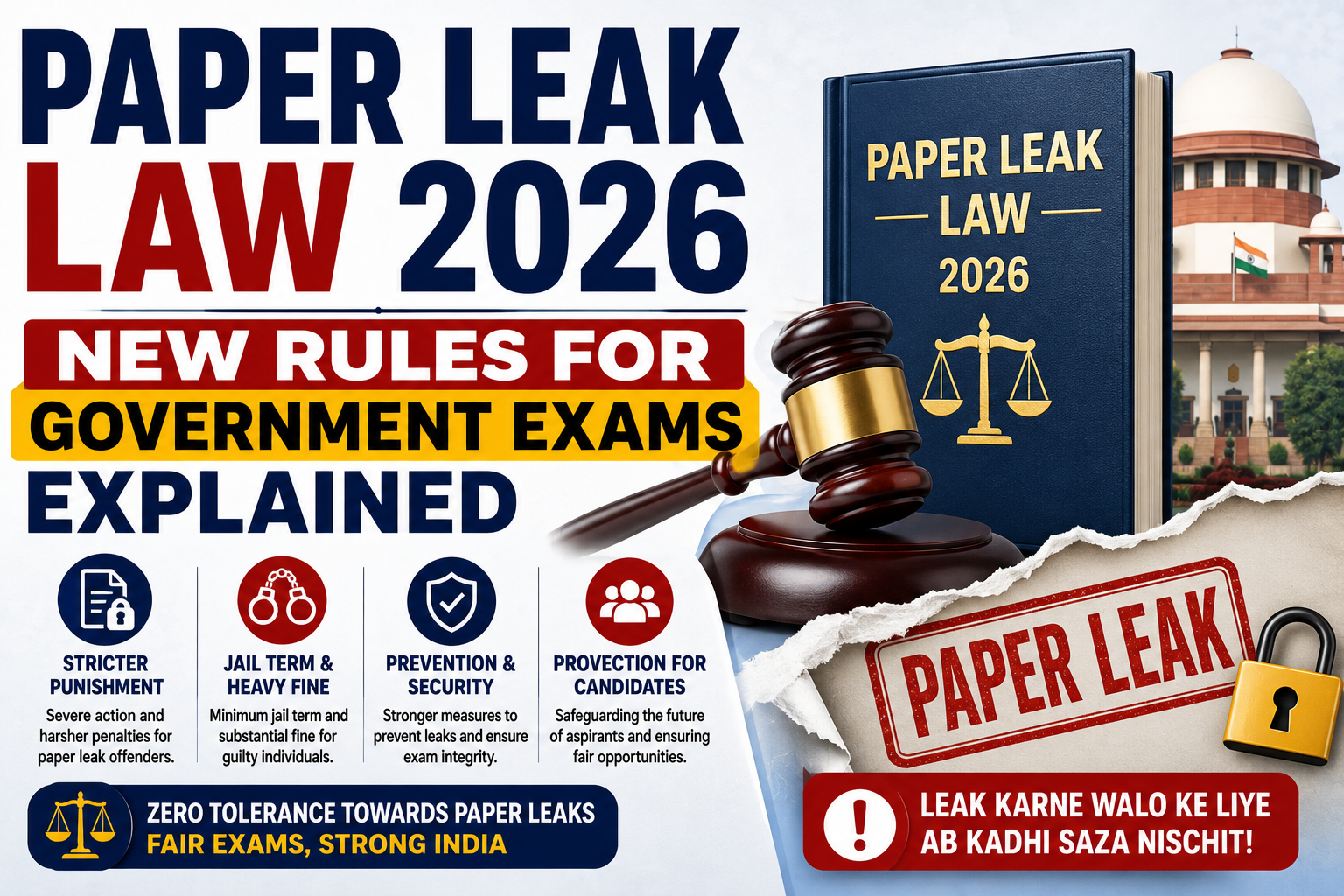
Paper leaks have become one of the biggest concerns surrounding competitive and government examinations in India. When a question paper is leaked, it does more than affect one examination. It can disrupt the careers of thousands of genuine candidates, force authorities to cancel or postpone exams, and reduce public confidence in the recruitment system.
To address this problem, India already had the Public Examinations (Prevention of Unfair Means) Act, 2024. In 2026, the government moved to strengthen this law through the Public Examinations (Prevention of Unfair Means) Amendment Bill, 2026. The Bill was introduced in the Lok Sabha on July 27, 2026, passed by the Lok Sabha on July 29 and by the Rajya Sabha on July 30.
The 2026 amendment significantly increases the proposed punishments for examination fraud and introduces stronger mechanisms for investigation and trial. These include higher jail terms and fines, Special Task Forces, Special Fast Track Courts and time-bound investigation and trial provisions.
The framework is particularly relevant to candidates appearing for major examinations conducted by bodies such as UPSC, SSC, Railway Recruitment Boards, IBPS and NTA, among others covered by the law.
For students and government-job aspirants, it is important to understand what the law actually changes, who can be punished, and what candidates should keep in mind while appearing for competitive examinations.
What Is the Paper Leak Law in India?
India’s main central law dealing specifically with unfair practices in public examinations is the Public Examinations (Prevention of Unfair Means) Act, 2024.
The law was introduced to create a dedicated legal framework against practices such as question-paper leaks, organized cheating, impersonation and other forms of examination fraud.
The 2024 Act covers public examinations conducted by specified authorities, including UPSC, SSC, Railway Recruitment Boards, IBPS and NTA, as well as examinations conducted by notified central government authorities.
The 2026 amendment seeks to make this framework considerably tougher.
What Has Changed Under the 2026 Paper Leak Law?
The biggest changes proposed under the 2026 amendment include:
- Higher imprisonment for individuals involved in unfair means
- Higher financial penalties
- Tougher punishment for service providers
- Longer debarment of service providers
- Increased punishment for organised examination crime
- Special Task Forces for investigation
- Special Fast Track Courts
- A two-month investigation timeline
- A three-month trial timeline after filing of the chargesheet
- Special Public Prosecutors for these cases
- A dedicated appellate mechanism through High Courts
The objective is not only to increase punishment but also to make investigation and prosecution more structured and faster.
Which Government Exams Are Covered?
The central law applies to public examinations conducted by specified public examination authorities.
The framework covers major bodies such as:
- Union Public Service Commission (UPSC)
- Staff Selection Commission (SSC)
- Railway Recruitment Boards (RRBs)
- Institute of Banking Personnel Selection (IBPS)
- National Testing Agency (NTA)
- Ministries and attached offices of the Central Government
- Other authorities notified by the Central Government
The law therefore has direct relevance for millions of candidates preparing for government recruitment and national-level entrance examinations.
Candidates should remember that state government examinations can also be governed by separate state laws and regulations. The central law should not be treated as a replacement for state-specific anti-cheating laws.
What Is Considered Unfair Means?
The law is designed to address a broad range of examination-related malpractice rather than only the physical act of leaking a question paper.
Unfair practices can include activities intended to improperly influence examination results or give candidates an unlawful advantage.
Examples can include:
- Leaking question papers
- Sharing examination material without authorization
- Providing unauthorized assistance to candidates
- Manipulating examination systems
- Impersonating another candidate
- Tampering with examination records
- Creating or using fraudulent examination documents
- Organised cheating arrangements
The exact offence and punishment depend on the nature of the conduct and the applicable provisions of the law.
Tougher Punishment for Individuals
One of the most important changes concerns the punishment for individuals who resort to unfair means.
Under the 2024 Act, the relevant punishment was imprisonment of three to five years and a fine of up to ₹10 lakh.
The 2026 amendment proposes increasing this to five to 10 years of imprisonment and a maximum fine of ₹50 lakh.
This is a substantial increase.
The message behind the change is clear: examination fraud is being treated as a serious offence rather than merely an administrative violation.
Higher Penalties for Service Providers
Modern examinations often depend on private or contracted service providers for technology, examination centres, logistics and other functions.
The law therefore also addresses malpractice involving service providers.
Under the earlier framework, a service provider involved in unfair means could face a fine of up to ₹1 crore.
The 2026 amendment proposes increasing the maximum fine to ₹5 crore.
The amendment also proposes extending the period for which a service provider can be barred from conducting public examinations from four years to eight years.
This is intended to create greater accountability among organisations involved in examination administration.
Directors and Senior Management Can Face Action
The proposed changes also increase accountability for directors and senior management of service providers involved in examination malpractice.
Under the earlier provisions, the punishment could range from three to 10 years of imprisonment along with a fine of ₹1 crore.
The amendment proposes increasing the minimum imprisonment to five years and raising the maximum fine to ₹5 crore.
This provision is significant because examination fraud can involve more than individual employees. Authorities may investigate whether people in positions of responsibility knowingly participated in or facilitated malpractice.
Tougher Punishment for Organised Examination Crime
The amendment proposes especially strict punishment for organised crime related to public examinations.
Under the 2024 law, organised crime could attract imprisonment of five to 10 years and a fine of at least ₹1 crore.
The 2026 amendment proposes increasing the minimum imprisonment to seven years and increasing the minimum fine to ₹10 crore.
This targets organised networks rather than isolated instances of misconduct.
Such networks can involve multiple people working together to obtain, distribute or exploit examination material.
What Is a Special Task Force?
Another major feature of the 2026 amendment is the proposed use of Special Task Forces for investigation.
The existing framework allows investigation by an officer not below the rank of Deputy Superintendent of Police or Assistant Commissioner of Police and allows the Central Government to refer cases to a central investigating agency.
The amendment adds a provision allowing the Central Government to constitute a Special Task Force for investigating offences under the law.
This can be particularly useful in complicated cases involving multiple locations, organised networks and digital evidence.
Investigation Must Be Completed Within Two Months
The proposed amendment introduces a time limit for investigation.
Investigations into offences under the law are required to be completed within two months.
The intention is to prevent examination-fraud cases from remaining unresolved for long periods.
However, it is important to understand that a statutory timeline does not automatically guarantee that every investigation will be completed within the prescribed period in practice.
The PRS analysis has also pointed out that the Bill does not specify a consequence if the two-month investigation period is not met.
Special Fast Track Courts for Paper Leak Cases
The 2026 amendment proposes a dedicated judicial mechanism for offences under the law.
Each state and Union Territory would designate a Court of Session as a Special Fast Track Court for trying offences under the Act.
These courts would also be able to deal with connected offences under the Bharatiya Nyaya Sanhita and other applicable laws in the same trial.
The government has also stated that six Special Fast Track Courts were already operational at the time the amendment was presented in Parliament, with more planned.
Three-Month Trial Timeline
The amendment also proposes a time-bound trial process.
Trials are intended to be conducted on a day-to-day basis, subject to the court’s procedures and circumstances.
The proposed framework requires the trial to be completed within three months from the filing of the chargesheet.
This is designed to ensure that cases involving paper leaks and organised examination fraud do not remain pending for years.
At the same time, the practical functioning of these timelines will depend on judicial capacity, availability of witnesses, evidence and other procedural factors.
Special Public Prosecutors
The amendment also provides for the appointment of Special Public Prosecutors for Special Fast Track Courts dealing with offences under the law.
The purpose is to ensure that cases involving examination fraud receive dedicated legal handling.
This is part of the broader effort to create a specialised system from investigation through trial.
What Happens to Service Providers Found Guilty?
Service providers involved in examination malpractice can face both financial and operational consequences.
Under the proposed framework, a guilty service provider could face:
- Fine of up to ₹5 crore
- Debarment from conducting public examinations for up to eight years
- Additional consequences for responsible directors or senior management
The intention is to make examination authorities and their contracted partners more accountable for maintaining examination security.
Can Candidates Be Punished Under the Law?
Yes, candidates can face consequences if they themselves engage in conduct covered by the law.
The law is not intended to punish candidates simply because an examination has been leaked or cancelled.
A candidate’s involvement in unfair means is a separate matter.
For example, knowingly participating in an organised cheating arrangement or using illegally obtained examination material can potentially expose a person to legal action depending on the facts and applicable provisions.
Candidates should therefore stay away from Telegram groups, WhatsApp groups, websites or individuals claiming to possess leaked examination papers.
What If a Candidate Receives a Leaked Paper?
This is an important practical question.
If a candidate unexpectedly receives a message claiming to contain a leaked question paper, the safest course is not to download, share, sell or use the material.
Candidates should not assume that forwarding a leaked paper is harmless.
Instead, they should preserve relevant information and report suspected malpractice through the appropriate official or law-enforcement channel where appropriate.
Using leaked material can raise serious legal and examination-related consequences depending on the circumstances.
Does the Law Cancel an Examination Automatically?
No.
A paper leak does not mean that every examination must automatically be cancelled under the central anti-paper-leak law.
The examination authority assesses the circumstances, evidence and impact of the alleged irregularity before deciding what action is necessary.
Possible administrative responses can include:
- Cancellation
- Re-examination
- Re-test for affected candidates
- Withholding results
- Investigation
- Answer-key review
- Other corrective measures
The appropriate response depends on the examination and the nature of the irregularity.
Why Was the 2026 Amendment Introduced?
The government has cited repeated incidents of examination leaks and malpractice as the reason for strengthening the legal framework.
The amendment was introduced after a series of examination-related controversies and comes during a period of renewed attention to the security of national-level competitive examinations.
PRS notes that NEET 2026 was cancelled and conducted again in the following month following an alleged paper leak.
The government has argued that stronger penalties and faster investigations are necessary to protect genuine candidates.
How Will the Law Affect Government Job Aspirants?
For candidates, the biggest impact is likely to be indirect.
The law is primarily aimed at people and organisations involved in examination malpractice rather than ordinary candidates who follow the rules.
However, candidates may notice stronger examination-security measures, including:
- More rigorous identity verification
- Increased surveillance
- Digital monitoring
- Stricter entry procedures
- Greater scrutiny of examination centres
- Stronger action against suspicious activity
These measures may make examinations more controlled, but they are intended to protect candidates who prepare honestly.
How Will the Law Help Honest Candidates?
A fair examination system depends on all candidates competing under the same conditions.
A paper leak can provide an unfair advantage to a small group while forcing thousands of genuine candidates to repeat months of preparation.
Stronger laws can help deter organised groups from attempting to manipulate examinations.
The government’s stated objective is to protect merit, transparency and the interests of genuine students and job aspirants.
What About NTA and Competitive Entrance Exams?
The law is particularly relevant to examinations conducted by the National Testing Agency (NTA) for admission to higher educational institutions.
NTA has faced considerable scrutiny over examination security, and in 2026 the agency has undertaken additional reforms aimed at strengthening its examination system.
Recent reporting says NTA has introduced a four-tier checking system for question papers and additional security measures as part of a broader overhaul.
These administrative reforms operate alongside the legal framework created by the anti-paper-leak legislation.
What About SSC, UPSC and Railway Exams?
Candidates preparing for major recruitment examinations should be aware that the central law covers examinations conducted by agencies including:
SSC
The Staff Selection Commission conducts major recruitment examinations such as CGL, CHSL, MTS and other examinations.
UPSC
UPSC conducts national-level examinations including Civil Services, NDA, CDS, CAPF and others.
Railway Recruitment Boards
RRBs conduct recruitment examinations for various posts in Indian Railways.
IBPS
IBPS conducts examinations for recruitment to participating banking institutions.
The 2024 Act specifically includes these major recruitment bodies within its scope.
What Should Candidates Do to Stay Safe?
Candidates do not need to take extraordinary measures. The most important thing is to follow official examination procedures.
Download Information Only From Official Sources
Use the official website of the examination authority for:
- Notifications
- Admit cards
- Answer keys
- Results
- Exam schedules
- Correction notices
Avoid Unverified Paper-Leak Claims
Do not trust social-media posts promising leaked papers, answer keys or guaranteed questions.
Never Pay for Leaked Material
Anyone demanding money for an alleged question paper may be attempting to scam candidates or involve them in illegal activity.
Keep Your Application Details Accurate
Incorrect personal information can create problems during verification.
Follow Examination-Centre Rules
Do not carry prohibited electronic devices or unauthorized material into the examination centre.
Paper Leak Law 2026: Penalty Comparison
| Category | 2024 Act | 2026 Amendment |
|---|---|---|
| Individual unfair means | 3–5 years + fine up to ₹10 lakh | 5–10 years + fine up to ₹50 lakh |
| Service provider | Fine up to ₹1 crore | Fine up to ₹5 crore |
| Service-provider debarment | 4 years | 8 years |
| Directors/senior management | 3–10 years + ₹1 crore fine | 5–10 years + ₹5 crore fine |
| Organised crime | 5–10 years + minimum ₹1 crore fine | 7–10 years + minimum ₹10 crore fine |
| Investigation | No specific two-month limit in the Act | 2-month timeline proposed |
| Trial | No specific three-month timeline | 3-month timeline proposed |
| Investigation mechanism | Police/central agency provisions | Special Task Force also proposed |
The comparison is based on the 2024 Act and the provisions of the 2026 amendment.
Is the 2026 Law Different From the 2024 Law?
Yes.
The 2024 legislation created India’s dedicated central framework for preventing unfair means in public examinations.
The 2026 amendment strengthens that existing framework rather than creating an entirely separate anti-paper-leak law.
The most important difference is the severity of penalties and the introduction of faster investigative and judicial mechanisms.
Why Stronger Punishment Alone May Not Stop Paper Leaks
Strict punishment can act as a deterrent, but preventing paper leaks also depends on how examination systems are designed and managed.
Security must cover the entire examination chain, including:
- Question creation
- Printing
- Digital storage
- Transportation
- Examination-centre management
- Staff access
- Computer systems
- Candidate verification
- Result processing
This is why the government is also focusing on administrative and technological reforms.
The NTA’s reported four-tier question-paper checking system is one example of a broader attempt to strengthen examination security beyond punishment alone.
What Should Students Remember About the New Law?
The most important message for candidates is simple: do not participate in any form of examination malpractice.
Preparing honestly remains the safest approach.
Candidates should also understand that receiving an unverified message about a paper leak does not mean the material is genuine. Many scams circulate around competitive examinations, particularly before major tests.
Instead of chasing shortcuts, candidates should focus on the official syllabus, previous-year papers, mock tests and verified examination updates.
Key Takeaways
The major points about the Paper Leak Law 2026 are:
- India already has the Public Examinations (Prevention of Unfair Means) Act, 2024.
- The 2026 amendment seeks to strengthen that law.
- The amendment Bill was introduced in Lok Sabha on July 27, 2026.
- It was passed by Lok Sabha on July 29 and Rajya Sabha on July 30.
- The framework covers major examination bodies such as UPSC, SSC, RRBs, IBPS and NTA.
- The proposed punishment for individuals rises to five to 10 years of imprisonment and a fine of up to ₹50 lakh.
- The maximum fine for service providers rises to ₹5 crore.
- Service-provider debarment increases from four to eight years.
- Organised examination crime attracts a proposed minimum punishment of seven years and a minimum ₹10 crore fine.
- Special Task Forces can be constituted for investigation.
- Investigation is proposed to be completed within two months.
- Special Fast Track Courts are proposed for examination-related offences.
- Trials are proposed to be completed within three months after filing of the chargesheet.
- Special Public Prosecutors can be appointed for these cases.
- Candidates should avoid leaked papers, unauthorized material and unfair means.
Final Thoughts
The Paper Leak Law 2026 represents a significant strengthening of India’s legal response to examination fraud. The existing 2024 law established the country’s central framework against unfair means in public examinations, while the 2026 amendment seeks to make the system tougher through higher penalties, stronger investigation mechanisms and faster trials.
For individuals involved in examination malpractice, the proposed consequences are considerably more severe than under the original framework. Organised crime and involvement by examination service providers can attract particularly heavy penalties.
For genuine candidates, the purpose of these measures is to protect the credibility of competitive examinations. A student who spends months or years preparing for a government examination should be able to compete without worrying that a leaked paper or organised cheating network will determine the result.
However, stronger laws are only one part of the solution. Secure question-paper management, reliable technology, responsible examination centres and effective investigations are equally important.
Candidates should therefore focus on legitimate preparation and use only official examination information. If a paper-leak claim appears online, do not assume it is genuine or safe to use. Following the rules and avoiding unauthorized material is the best way to protect both your examination candidature and your future career.
Read More: Competitive Exam Rules Changed in 2026: Complete List of Major Updates