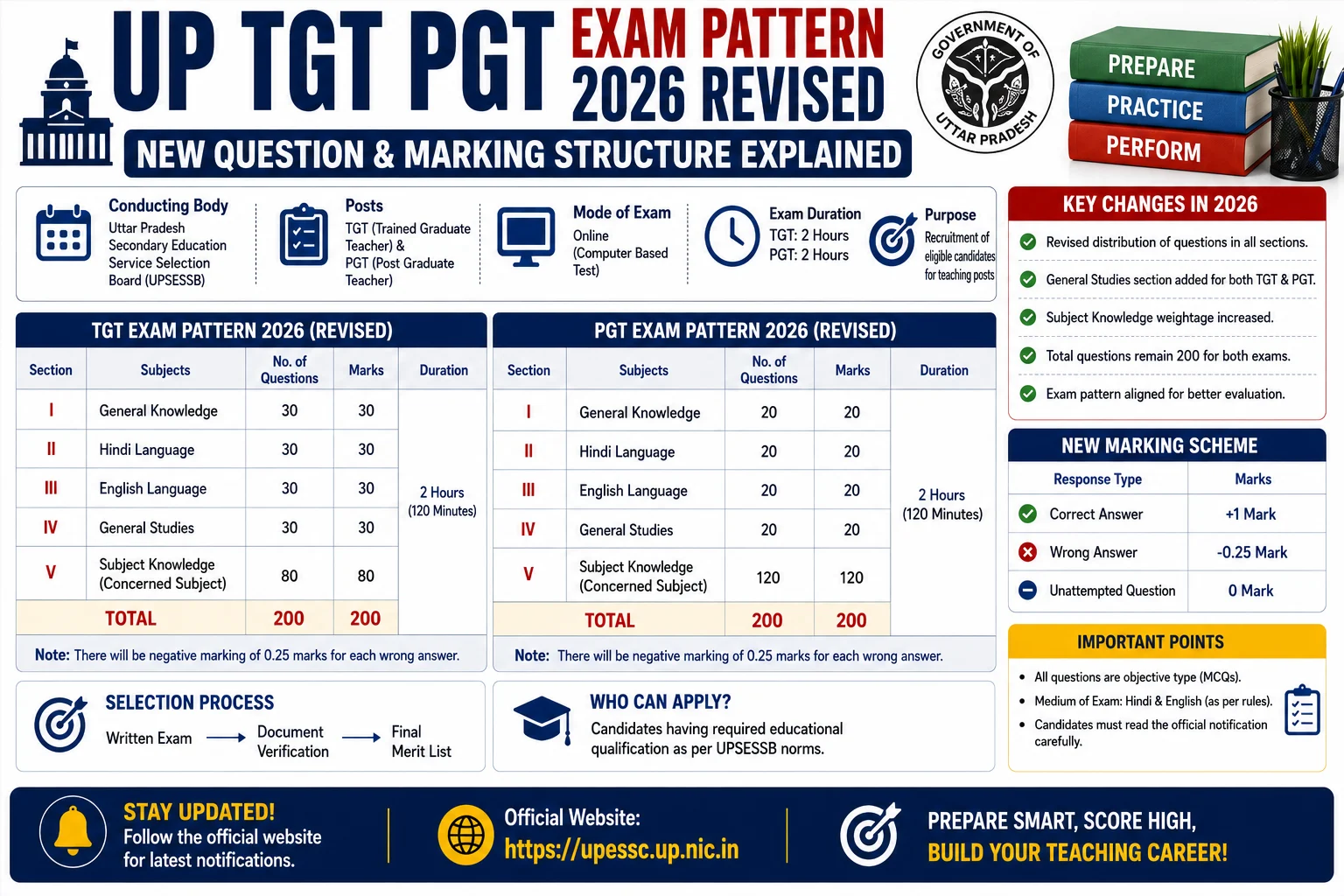
The UP TGT PGT Exam Pattern 2026 has undergone a major change, making it important for teaching aspirants in Uttar Pradesh to review their preparation strategy. The revised structure introduces a different distribution of questions, adds a General Studies component and brings in negative marking in the written examination.
According to recent reports on the revised UP TGT PGT syllabus and examination structure, both TGT and PGT written examinations are being reorganised around 120 questions carrying 360 marks, with 90 questions from the concerned subject and 30 questions from General Studies. Each question carries 3 marks, and negative marking applies for incorrect answers.
This is a significant departure from the earlier pattern, in which the written paper was generally described as having 125 subject-based questions, with TGT candidates receiving 4 marks per question and PGT candidates receiving 3.4 marks per question, without negative marking.
For candidates preparing for the 2026 recruitment cycle, understanding this revised structure is important because simply following previous-year preparation strategies may no longer be enough.
What Has Changed in UP TGT PGT Exam Pattern 2026?
The major changes reported in the revised pattern include:
- Total questions reduced from 125 to 120
- Written examination changed to 360 marks
- 90 questions from the concerned subject
- 30 questions from General Studies
- 3 marks for every correct answer
- Negative marking introduced
- TGT written examination followed by merit-based selection
- PGT candidates have an additional interview component
- Examination remains offline and OMR-based
The revised structure is intended to assess both subject knowledge and general awareness, rather than focusing almost entirely on the candidate’s specialised subject.
UP TGT PGT Revised Exam Pattern 2026 at a Glance
| Particular | UP TGT 2026 | UP PGT 2026 |
|---|---|---|
| Exam Mode | Offline/OMR | Offline/OMR |
| Total Questions | 120 | 120 |
| Subject Questions | 90 | 90 |
| General Studies Questions | 30 | 30 |
| Total Written Marks | 360 | 360 |
| Marks per Question | 3 | 3 |
| Exam Duration | 2 Hours | 2 Hours |
| Negative Marking | Applicable | Applicable |
| Interview | No | Yes, as applicable |
| Written Exam Focus | Subject + GS | Subject + GS |
The revised pattern has been reported following the release of the updated syllabus and examination framework.
UP TGT Exam Pattern 2026
The Trained Graduate Teacher (TGT) examination will now include two broad components:
- Concerned Subject
- General Studies
The subject section will contain 90 questions, while General Studies will contain 30 questions.
Each question carries 3 marks, making the total written examination worth 360 marks.
UP TGT Question Distribution
| Section | Questions | Marks |
|---|---|---|
| Concerned Subject | 90 | 270 |
| General Studies | 30 | 90 |
| Total | 120 | 360 |
This means the concerned subject still accounts for the largest portion of the examination, but General Studies now has a meaningful 25% share of the written paper.
UP PGT Exam Pattern 2026
The revised Post Graduate Teacher (PGT) examination follows the same basic written-paper structure.
Candidates will answer:
- 90 subject-specific questions
- 30 General Studies questions
With 3 marks per question, the written examination carries 360 marks.
The PGT selection process also includes an interview component, making the overall selection structure different from TGT recruitment.
UP TGT PGT New Marking Scheme 2026
The marking scheme is one of the most important changes candidates need to understand.
Under the revised structure:
- Correct answer = 3 marks
- Incorrect answer = negative marking
- Unanswered question = no marks
The reported revised syllabus specifies negative marking for both TGT and PGT examinations.
Candidates should therefore change their attempt strategy.
Earlier preparation material that assumes no negative marking should not be blindly followed for the revised examination.
Why Negative Marking Matters
Negative marking changes the way candidates should approach the paper.
When there was no penalty for incorrect answers under the earlier pattern, candidates could attempt questions more freely.
With negative marking, random guessing can reduce the final score.
Candidates should therefore focus on:
- Accuracy
- Question selection
- Elimination techniques
- Time management
- Strong conceptual understanding
Before marking an uncertain answer, candidates should consider whether they can eliminate one or more options confidently.
UP TGT PGT Exam Duration
The revised written examination is scheduled around a two-hour duration, or 120 minutes.
With 120 questions to answer in 120 minutes, candidates have an average of approximately one minute per question.
However, this does not mean every question should receive exactly one minute.
Some General Studies questions may take only a few seconds, while a difficult subject question may require more time.
Candidates should therefore develop a flexible time-management strategy.
General Studies Added to the Examination
One of the biggest changes is the introduction of a dedicated General Studies section.
The revised structure allocates:
30 questions = 90 marks
to General Studies.
This means candidates can no longer focus exclusively on their teaching subject.
General Studies preparation should now become a regular part of the daily study plan.
What Can Be Covered Under General Studies?
The exact detailed syllabus should be checked against the latest official UPESSC/UP education recruitment notice.
Candidates can generally prepare areas such as:
- Current affairs
- Indian history
- Indian geography
- Indian polity
- Economy
- General science
- Uttar Pradesh-related general knowledge
- Important national developments
- Important government schemes
- General awareness
Candidates should avoid relying on an old General Studies syllabus if the revised official syllabus provides a different topic list.
UP TGT Subject-Wise Preparation
The concerned subject continues to be the most important part of the TGT written examination.
With 90 out of 120 questions coming from the subject, it accounts for 75% of the written paper.
Candidates should therefore continue to give priority to their specialised subject.
For example, a candidate applying for TGT Mathematics should focus heavily on Mathematics, while an English candidate should prepare the prescribed English syllabus in depth.
The exact syllabus differs according to the subject.
UP PGT Subject Preparation
PGT candidates also need strong command over their concerned subject.
The revised structure provides 90 subject questions, accounting for 270 out of 360 written marks.
Because PGT posts require postgraduate-level subject knowledge, candidates should not restrict preparation to basic concepts.
Preparation should include:
- Core concepts
- Advanced topics
- Important theories
- Subject-specific facts
- Previous examination questions
- Application-based questions
- Regular revision
UP PGT Interview
The PGT recruitment process differs from TGT because the selection framework includes an interview component.
The revised reporting on the 2026 pattern lists a 40-mark interview for PGT candidates.
Therefore, PGT aspirants should not consider the written examination to be the only stage that matters.
After preparing for the written paper, candidates should also be ready to discuss:
- Their subject
- Teaching experience
- Educational background
- Teaching methodology
- General awareness
- Classroom situations
- Subject-specific issues
The exact interview weightage and selection methodology should be confirmed from the latest official recruitment notification.
TGT vs PGT Exam Pattern 2026
There are important similarities and differences between the two examinations.
| Feature | TGT | PGT |
|---|---|---|
| Written Questions | 120 | 120 |
| Subject Questions | 90 | 90 |
| General Studies | 30 | 30 |
| Written Marks | 360 | 360 |
| Marks per Question | 3 | 3 |
| Negative Marking | Yes | Yes |
| Duration | 2 hours | 2 hours |
| Interview | Not applicable in the same manner | Applicable |
The major difference is therefore not the basic written-paper structure but the broader selection process.
Earlier UP TGT PGT Pattern vs Revised 2026 Pattern
Candidates who have been preparing using older books should understand the difference.
| Feature | Earlier Pattern | Revised 2026 Pattern |
|---|---|---|
| Questions | 125 | 120 |
| TGT Written Marks | 500 | 360 |
| PGT Written Marks | 425 | 360 |
| Subject Focus | Primarily subject-based | Subject + General Studies |
| General Studies | Not separately structured in the same way | 30 questions |
| Marks per Question | TGT: 4; PGT: 3.4 | 3 |
| Negative Marking | No | Yes |
| Duration | 2 hours | 2 hours |
Earlier pattern details are reported by multiple exam-preparation sources, while the revised structure reflects the 2026 updates.
Why Candidates Should Not Rely Only on Old Books
The change in question distribution and marking system means older preparation material may not accurately reflect the current examination.
An old book can still be useful for subject preparation, particularly where the syllabus overlaps.
However, candidates should supplement it with:
- Updated General Studies material
- Revised syllabus
- New-pattern mock tests
- Current affairs
- Negative-marking practice
- Updated previous-year analysis
The objective should be to prepare according to the latest examination structure, not simply the previous recruitment cycle.
How to Prepare for the Revised UP TGT PGT Exam
Give 75% Attention to the Subject
Since 90 of the 120 questions are from the concerned subject, most preparation time should remain focused there.
A strong subject score can make a significant difference.
Add General Studies to Your Daily Routine
Instead of studying General Studies only at the end, spend some time every day on current affairs and static GK.
Practise With Negative Marking
Mock tests should use the revised marking system.
This will help candidates understand how many questions they should realistically attempt.
Analyse Every Mock Test
Do not simply record your score.
Check:
- Which questions were wrong?
- Were they conceptual mistakes?
- Did you guess?
- Did you misread the question?
- Did you spend too much time?
- Which topics repeatedly cause errors?
This analysis is often more valuable than taking another mock test without reviewing the previous one.
How to Manage Time in the Exam
Candidates have 120 minutes for 120 questions.
A useful approach is to divide the paper into manageable blocks.
First Round
Attempt questions that you can answer confidently.
Second Round
Return to questions that require moderate thinking.
Final Round
Use the remaining time for carefully considered uncertain questions.
Because negative marking is now applicable, the final round should not become a guessing session.
General Studies Preparation Strategy
Candidates can divide General Studies preparation into three areas.
Static GK
Study:
- History
- Geography
- Polity
- Economy
- Science
Current Affairs
Follow important events from India and around the world.
Give particular attention to developments related to Uttar Pradesh.
Revision
Make short notes and revise them regularly.
General Studies is memory-heavy, so repeated revision is essential.
Subject Preparation Strategy
For the concerned subject, candidates should follow a structured cycle:
Concept → Practice → Revision → Mock Test → Error Analysis
Start by identifying weak topics.
Then revise the relevant theory before attempting a large number of questions.
Once the basics are strong, shift towards timed practice.
Importance of Mock Tests
Mock tests have become even more important because of the introduction of negative marking.
Candidates should practise:
- Full-length tests
- Subject tests
- General Studies tests
- Time-bound tests
Try to simulate the actual examination environment by completing the paper within two hours.
Common Mistakes to Avoid
Ignoring General Studies
The 30-question General Studies section now carries 90 marks.
Ignoring it can result in a significant loss of potential marks.
Guessing Too Many Answers
Negative marking means careless attempts can reduce your score.
Using Only Previous-Year Pattern
The older 125-question pattern is not the best guide to the revised structure.
Focusing Only on Easy Questions
Candidates should build enough subject knowledge to handle moderate and difficult questions.
Ignoring Current Affairs
General Studies preparation should not be limited to static GK.
Starting PGT Interview Preparation Too Late
PGT candidates should become comfortable discussing their subject and teaching approach well before the interview stage.
UP TGT PGT Exam 2026: Important Checklist
Before beginning final preparation, candidates should check:
- Latest official syllabus
- Revised exam pattern
- Subject-wise syllabus
- General Studies topics
- Negative-marking rules
- Examination duration
- Number of questions
- Previous-year questions
- Updated mock tests
- Current affairs
- Examination notification
- Admit-card instructions
Is the UP TGT PGT Exam Pattern 2026 Completely Different?
The pattern is substantially revised, but the core purpose of the examination remains the same: assessing candidates for teaching positions through their subject knowledge and other relevant abilities.
The biggest structural change is the move from the older 125-question format toward a 120-question paper combining subject knowledge with General Studies, along with negative marking.
Therefore, candidates do not need to throw away everything they have studied.
Instead, they should adapt their preparation.
Their existing subject knowledge remains useful, but they now need to add General Studies and change their test-taking strategy because of negative marking.
What Should Candidates Do Now?
Candidates preparing for UP TGT and PGT recruitment should immediately review their study plan.
A practical approach is:
Step 1: Download and read the latest syllabus.
Step 2: Separate the 90 subject questions from the 30 General Studies questions.
Step 3: Identify topics that require additional preparation.
Step 4: Start practising questions under the new marking system.
Step 5: Take weekly mock tests.
Step 6: Analyse mistakes after every test.
Step 7: Increase full-length mock-test frequency closer to the examination.
This approach will help candidates adjust without completely restarting their preparation.
Final Thoughts
The UP TGT PGT Exam Pattern 2026 Revised update is important for every teaching aspirant preparing for recruitment in Uttar Pradesh. The revised written examination changes the number of questions, marks distribution and preparation requirements.
The new structure reported for both TGT and PGT includes 120 questions and 360 written marks, with 90 questions from the concerned subject and 30 questions from General Studies. Each question carries 3 marks, and negative marking has been introduced.
This means candidates need to make two major adjustments: strengthen their General Studies preparation and become more selective while attempting questions.
At the same time, the concerned subject remains the largest part of the paper, accounting for 270 of the 360 written marks. Candidates should therefore not allow General Studies preparation to reduce the time devoted to their core subject.
PGT candidates should also remember the additional interview stage reported under the revised selection structure.
Most importantly, candidates should rely on the latest official UPESSC notification and syllabus rather than older articles or coaching material. Some websites continue to display the earlier 125-question, no-negative-marking pattern, so checking the current official information is essential.
With a revised study plan, regular mock tests and careful attention to negative marking, candidates can adapt to the new structure without starting their preparation from scratch.
Read More: Railway Exam New Rules 2026: Latest Changes in CBT & Selection Process