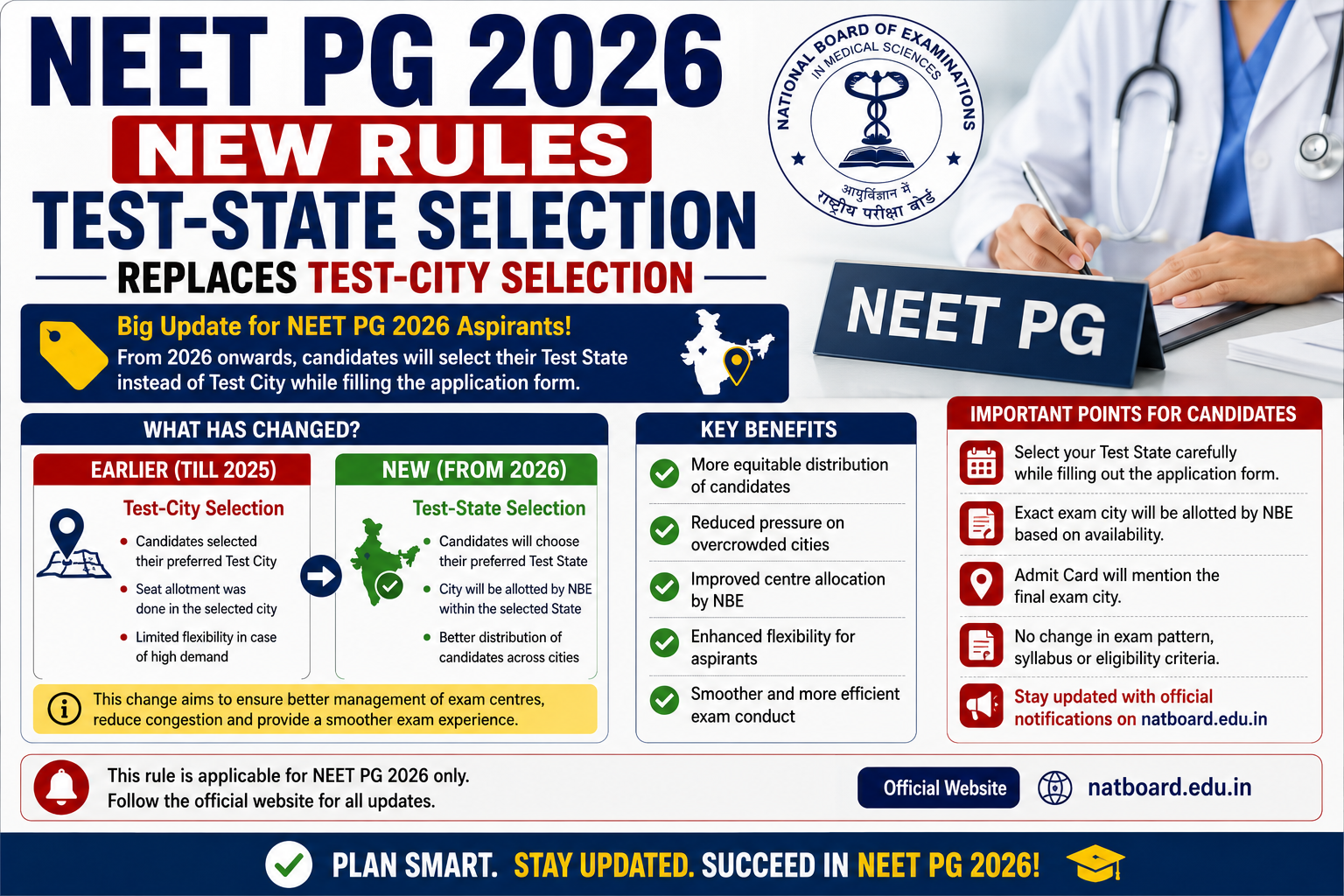
The NEET PG 2026 new rules have introduced an important change in the way candidates indicate their preferred examination location. Instead of directly choosing a preferred test city during the application process, candidates are required to select three preferred test states.
The National Board of Examinations in Medical Sciences (NBEMS) issued an advisory explaining the revised process for NEET-PG 2026. Under the new system, candidates have to select three preferred states, with specific conditions governing the choices. The first preferred state must be the state mentioned as the candidate’s correspondence state in the application form, while the other two preferences must be from neighbouring states.
The change is important because candidates no longer have the same level of control over the exact city where they will take the examination. Instead, NBEMS will allocate the test city based on availability and the preferences submitted by the candidate.
The revised system also means that NEET PG 2026 test-city allocation is not based on a first-come, first-served principle. Submitting the application earlier does not provide an advantage in getting a preferred city.
For medical aspirants, this makes it important to understand the new location-selection process before making travel and accommodation plans.
What Has Changed in NEET PG 2026?
The biggest change is the replacement of direct test-city selection with test-state selection during the relevant application process.
Under the revised arrangement:
- Candidates select three preferred test states.
- The first preferred state must be the candidate’s correspondence state.
- The second and third choices must be from neighbouring states.
- Candidates do not directly select their preferred examination city through the same city-selection process used earlier.
- NBEMS allocates the test city based on the available examination infrastructure and applicable preferences.
- Allocation is not on a first-come, first-served basis.
This change is intended to provide NBEMS with greater flexibility in distributing candidates across available examination centres.
NEET PG 2026 Test-State Selection Explained
The new system requires candidates to think at the state level rather than the city level.
Suppose a candidate’s correspondence state is Uttar Pradesh.
The candidate must select Uttar Pradesh as the first preferred test state.
The remaining two choices must be selected from neighbouring states, subject to the rules specified by NBEMS.
This does not mean that the candidate can select any three states in India.
The preference structure is deliberately restricted.
What Is the First Preferred Test State?
The first preferred test state must correspond to the state mentioned in the candidate’s application form.
This is one of the most important conditions under the new NEET PG 2026 location-selection process.
Candidates should therefore check the correspondence-state information in their application carefully before selecting their preferences.
A mistake at this stage could affect the candidate’s available choices.
What Are the Second and Third Test-State Choices?
The second and third preferred states must be selected from neighbouring states.
The purpose of this requirement is to keep the examination location reasonably connected to the candidate’s stated state preference rather than allowing completely unrelated locations across the country.
Candidates should therefore think about:
- Road connectivity
- Railway availability
- Flight options
- Distance from home
- Accommodation
- Travel time
- Availability of examination centres
This can help them make more practical choices.
Does NEET PG 2026 Still Have Test Cities?
Yes.
The change does not mean that NEET PG will stop being conducted in cities.
The important difference is that candidates are not selecting their exact city in the same way as under the earlier process.
NBEMS will determine the test city after considering the candidate’s state preferences and the availability of suitable examination centres.
The candidate’s allotted city will be communicated later through the relevant NBEMS process.
Is NEET PG 2026 Test-City Allocation First Come, First Served?
No.
This is one of the most important points candidates should remember.
NBEMS has clarified that test-city allocation for NEET PG 2026 is not based on first-come, first-served selection.
Therefore, candidates should not assume that submitting an application earlier will automatically increase their chances of receiving a particular city.
The new process is based on state preferences and allocation according to available capacity.
Why Did NBEMS Change the Selection System?
A major reason for changing the system is to improve the allocation of candidates across available examination infrastructure.
Direct city selection can create situations where certain popular cities fill quickly while other locations have unused capacity.
The state-based approach gives the examination authority greater flexibility to distribute candidates.
It can also help NBEMS manage examination centres more efficiently when a large number of medical graduates appear for the same examination.
Does Choosing a State Guarantee a City?
No.
Selecting a state does not guarantee that the candidate will receive a particular city within that state.
This is an important distinction.
For example, if a candidate selects Maharashtra as a preferred state, it does not necessarily mean that the examination will be held in Mumbai, Pune or another particular city.
The actual test city depends on the allocation made by NBEMS.
Candidates should therefore wait for the official city information rather than booking non-refundable travel solely on the basis of their preferred state.
What Is the Difference Between Test-City and Test-State Selection?
| Earlier Approach | NEET PG 2026 Approach |
|---|---|
| Candidate could indicate city preferences | Candidate selects state preferences |
| Focus was on specific cities | Focus is on three states |
| City availability was important at selection | NBEMS allocates city within the available system |
| First-come-first-served concerns existed | Allocation is not first-come-first-served |
| Greater city-level preference | Greater flexibility for NBEMS |
The key change is therefore who controls the final city allocation.
Under the revised approach, candidates provide state-level preferences while NBEMS handles the final city allocation.
How Many Test States Can Candidates Select?
Candidates are required to select three preferred test states for NEET PG 2026.
The first preference must satisfy the correspondence-state requirement, while the other two must be neighbouring states.
Candidates should enter all three preferences carefully.
They should not assume that the third preference will never be used.
If sufficient capacity is unavailable in the preferred options, allocation may depend on the availability and rules applicable to the examination.
Can Candidates Choose Any State They Want?
No.
The preference system has specific restrictions.
The first preference must be the correspondence state, while the other two choices need to be neighbouring states.
This means candidates cannot simply choose three popular examination locations based on personal convenience.
The new system is designed around a geographical preference structure.
What Should Candidates Check Before Selecting Their States?
Candidates should carefully verify:
1. Correspondence State
Check the state listed in your NEET PG application.
2. Neighbouring States
Make sure your second and third choices meet the neighbouring-state requirement.
3. Travel Connectivity
Consider whether the state has convenient road, rail or air connectivity.
4. Accommodation
Think about whether affordable accommodation is available in likely examination cities.
5. Emergency Travel Options
Candidates travelling long distances should consider alternative routes in case of delays.
Will Earlier Application Give an Advantage?
No.
The new system specifically removes the need to rush simply to secure a preferred city on a first-come, first-served basis.
NBEMS has clarified that submitting the application early does not provide an advantage in test-state or test-city allocation.
Candidates should therefore focus on entering accurate information rather than submitting the form in a hurry.
However, they should still follow the official application deadlines and avoid waiting until the final day.
When Will Candidates Know Their Test City?
Candidates receive test-city information before the examination through the process specified by NBEMS.
For NEET PG 2026, NBEMS issued city-intimation information in August, with the examination scheduled for August 30, 2026.
The city-intimation information should not be confused with the final admit card.
Candidates should check the official NBEMS communication for their allotted city and later download the admit card according to the notified schedule.
What If the Allotted City Is Different From the Preferred Location?
Candidates should be prepared for this possibility.
Selecting a preferred state does not guarantee a particular city.
The final allocation depends on the examination authority’s available infrastructure and allocation process.
Therefore, candidates should avoid making assumptions such as:
“I selected this state, so I will definitely get my nearest city.”
The purpose of the new system is precisely to give NBEMS greater flexibility in allocating cities.
What If the Allotted City Is Far From Home?
Candidates should first check the exact city mentioned in the official city-intimation slip or admit card.
Once the location is confirmed, they can plan:
- Train travel
- Flights
- Bus travel
- Local transport
- Accommodation
- Reporting-time requirements
Candidates should plan to reach the city well before the examination rather than depending on same-day long-distance travel.
This becomes particularly important for candidates who are allocated a city several hours away from their home.
NEET PG 2026 Has Other Major Changes Too
The test-state selection change is only one part of the broader NEET PG 2026 reforms.
The 2026 examination has also introduced changes related to the examination format and security.
Recent reports on the revised NEET PG 2026 arrangements highlight:
- A single examination shift
- Changes in the number of questions
- Mandatory Aadhaar authentication
- Biometric verification
- Expansion of examination-centre options
- Changes intended to provide more uniform examination conditions
These changes make it particularly important for candidates to read the latest NBEMS notices instead of relying on information from previous NEET PG cycles.
NEET PG 2026 Single-Shift Examination
Another significant change is that NEET PG 2026 is being conducted in a single shift across the country.
This is intended to provide candidates with a more uniform testing environment.
A single shift can reduce concerns related to different question sets or varying examination conditions between shifts.
For candidates, it also means that the examination schedule needs to be followed precisely.
NEET PG 2026 Exam Date
The NEET PG 2026 examination is scheduled for August 30, 2026.
Candidates should check the official NBEMS website and their admit card for the final reporting time, centre address and examination-day instructions.
Mandatory Aadhaar Authentication and Biometric Verification
NEET PG 2026 also includes stronger identity-verification measures.
Recent reporting indicates that Aadhaar authentication and biometric checks are mandatory as part of the revised examination process.
Candidates should make sure their identity information and examination documents are accurate.
Any discrepancy should be addressed through the official process rather than ignored until examination day.
Why the New Test-State System Matters to Candidates
The biggest practical impact is that candidates need to be more flexible about their final examination city.
Earlier, city-level preferences could make candidates feel that they had greater control over where they would appear.
Under the revised system, the candidate provides a broader geographical preference and NBEMS determines the final city.
This may be inconvenient for candidates who strongly prefer a particular city, but it can also allow the examination authority to distribute candidates more efficiently.
Advantages of the New NEET PG Test-State Selection
The revised system could provide several administrative advantages.
Better Centre Management
NBEMS can distribute candidates among available cities based on capacity.
Reduced First-Come-First-Served Pressure
Candidates do not need to rush simply because they fear their preferred city will fill up immediately.
Greater Flexibility for the Exam Authority
The authority can use available centres more efficiently.
Wider Centre Distribution
Recent changes have also been associated with efforts to expand examination locations and bring centres closer to candidates where possible.
Possible Challenges for Candidates
The new system can also create some challenges.
No Exact City Guarantee
Candidates cannot assume that their preferred city will be allotted.
Travel Planning Becomes More Important
Some candidates may have to travel to another city within their selected state.
Accommodation May Need Quick Booking
Once the city is announced, candidates may have limited time to arrange accommodation.
State Preference Needs Careful Selection
Candidates should choose neighbouring states that are realistically accessible.
How Candidates Should Prepare for the New Location System
A simple strategy can help.
Choose Practical States
Do not select a state merely because it contains a preferred city.
Consider the entire state and its connectivity.
Keep Travel Options Ready
Once the city is announced, immediately check trains, flights and buses.
Do Not Book Too Early
Avoid making expensive non-refundable bookings before receiving confirmed city information.
Keep Accommodation Options
Identify a few hotels or accommodations near likely examination locations.
Check the Admit Card Carefully
The final examination centre information should always be verified through the official NBEMS documents.
NEET PG 2026 Test-State Selection: Example
Suppose a candidate’s correspondence state is Karnataka.
A possible preference structure under the rules would be:
- Karnataka — First preference
- Tamil Nadu — Second preference, if applicable as a neighbouring state
- Kerala — Third preference, if applicable as a neighbouring state
The candidate would not directly guarantee Bengaluru, Chennai or another particular city through these state selections.
The example is only illustrative. Candidates should select states based on the actual options presented in the official application system and their own correspondence-state details.
What Candidates Should Not Do
Candidates should avoid:
- Selecting states without checking the correspondence-state requirement
- Assuming the first application submitted gets the best city
- Booking non-refundable tickets before city allocation
- Ignoring NBEMS city-intimation notices
- Relying on old NEET PG application instructions
- Assuming a state preference guarantees a particular city
- Waiting until the final moment to arrange travel after city allocation
NEET PG 2026 Test-State Selection: Quick Comparison
| Factor | Previous City-Based System | 2026 State-Based System |
|---|---|---|
| Preference level | City | State |
| Number of preferences | City choices under earlier process | 3 test states |
| First preference | City preference | Correspondence state |
| Other preferences | City-based | Neighbouring states |
| City guaranteed? | Subject to availability | No |
| First-come-first-served | Previously relevant | Not applicable |
| Final city allocation | Based on available city capacity | Allocated by NBEMS |
What Does This Mean for NEET PG Aspirants?
For most candidates, the new rule does not change how they prepare academically for NEET PG.
The biggest impact is on exam-day logistics.
Candidates should now be prepared for the possibility that their final examination city may not be their preferred city, even if the city is located within their chosen state.
Therefore, candidates should keep their travel plans flexible.
The academic preparation remains the priority, but travel planning should not be ignored.
Important NEET PG 2026 Checklist
Before the examination, candidates should confirm:
- Correct correspondence state
- Three valid test-state preferences
- Neighbouring-state requirement satisfied
- Application details submitted correctly
- City-intimation slip checked
- Admit card downloaded
- Examination-centre address verified
- Travel route planned
- Accommodation arranged
- Valid ID prepared
- Aadhaar/biometric requirements checked
- Examination-day instructions read
Final Thoughts
The NEET PG 2026 test-state selection rule is one of the most important changes candidates need to understand this year. Instead of choosing a preferred examination city directly, candidates are required to provide three preferred test states under the revised NBEMS process. The first preference must be the correspondence state mentioned in the application, while the other two preferences must be neighbouring states.
The change also means that candidates should not rush to submit their applications simply to obtain a preferred city. NBEMS has clarified that test-city allocation is not based on first-come, first-served selection.
For candidates, the biggest adjustment is therefore practical rather than academic. They should be flexible about the final city, keep travel options open and wait for the official city-intimation information before making firm travel arrangements.
NEET PG 2026 has introduced several other changes as well, including a single-shift examination and stronger identity-verification measures such as Aadhaar authentication and biometric checks.
The safest approach is to follow the latest notices issued by NBEMS, carefully verify all application information and avoid relying on instructions from previous NEET PG sessions.
Read More: Competitive Exam Rules Changed in 2026: Complete List of Major Updates