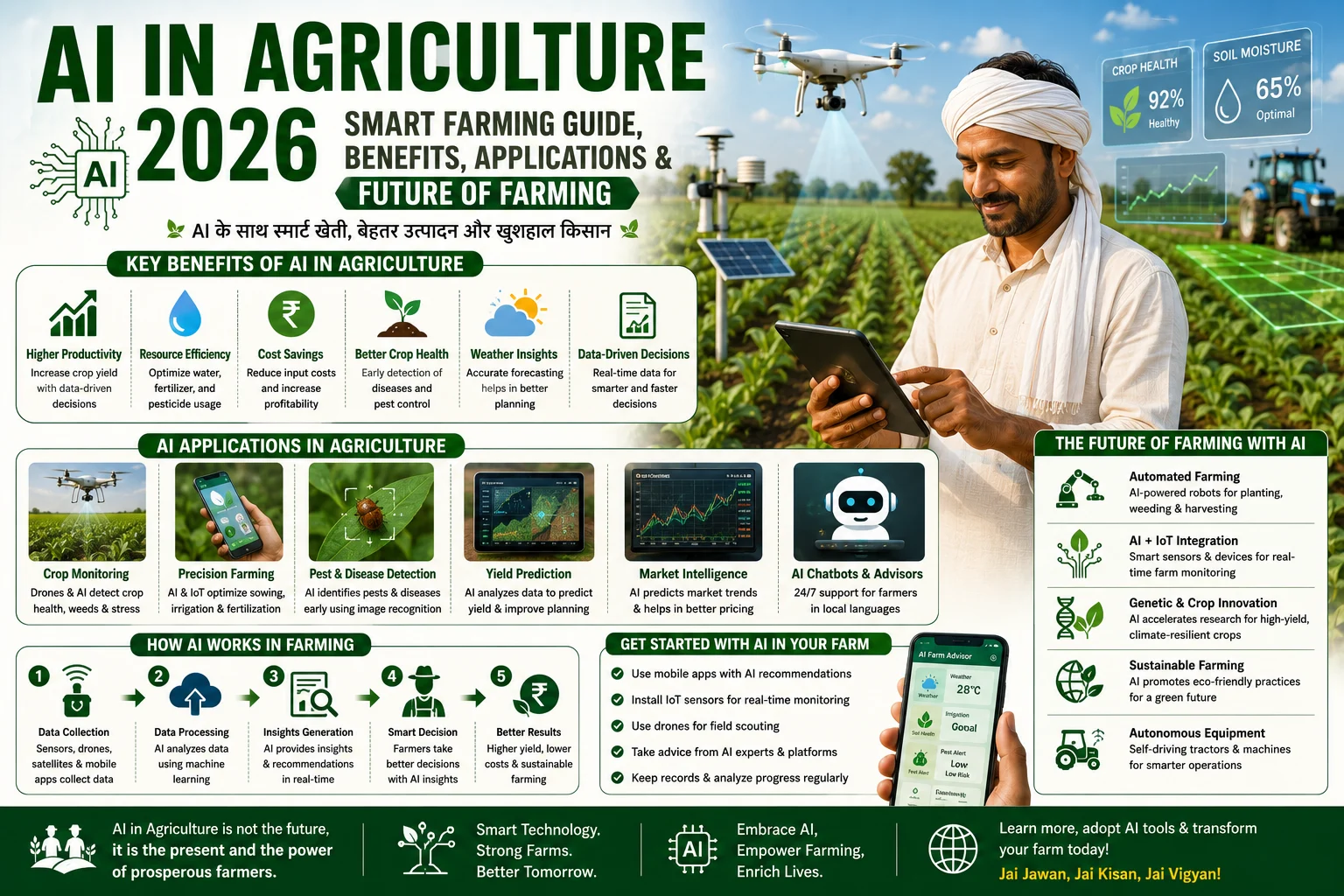
Artificial Intelligence (AI) is transforming agriculture by helping farmers make smarter decisions, increase productivity, and reduce farming costs. With the use of AI-powered tools, farmers can monitor crop health, predict weather conditions, detect plant diseases, optimize irrigation, and improve overall farm management. AI combines technologies such as Machine Learning (ML), Computer Vision, Internet of Things (IoT), drones, and satellite imagery to make farming more efficient and sustainable.
In 2026, AI is being widely adopted in Indian agriculture through smart farming solutions, precision agriculture, automated machinery, crop monitoring systems, and mobile applications. The Government of India is also promoting Digital Agriculture, encouraging farmers to use modern technologies for higher productivity and better income.
This guide explains everything about AI in Agriculture 2026, including its benefits, applications, technologies, challenges, government initiatives, and future opportunities for farmers.
What is AI in Agriculture?
Artificial Intelligence (AI) in agriculture refers to the use of computer systems and advanced technologies to perform farming tasks that normally require human intelligence.
AI helps farmers:
- Analyze crop data.
- Predict weather conditions.
- Detect crop diseases.
- Monitor soil health.
- Improve irrigation.
- Increase crop production.
The goal of AI is to make farming more efficient, profitable, and environmentally sustainable.
How AI is Transforming Agriculture
AI is changing traditional farming methods by introducing data-driven decision-making.
Farmers can now:
- Monitor crops using drones.
- Receive weather forecasts.
- Detect pest attacks early.
- Automate irrigation systems.
- Optimize fertilizer usage.
- Track farm activities through mobile applications.
These technologies reduce manual effort and improve agricultural productivity.
Applications of AI in Agriculture
Crop Monitoring
AI uses satellite images, drones, and smart sensors to monitor crop growth and identify unhealthy plants before significant damage occurs.
Weather Prediction
AI analyzes historical and real-time weather data to help farmers plan sowing, irrigation, and harvesting activities more effectively.
Disease Detection
AI-powered image recognition systems can identify crop diseases and nutrient deficiencies by analyzing photographs of plant leaves.
Smart Irrigation
AI monitors soil moisture and weather conditions to automatically schedule irrigation, reducing water wastage.
Pest Management
AI systems detect pest infestations at an early stage and recommend appropriate control measures.
Precision Farming
AI enables farmers to apply fertilizers, pesticides, and water only where needed, reducing costs and improving crop yields.
Yield Prediction
AI analyzes weather, soil conditions, and crop history to estimate crop production before harvest.
Farm Machinery Automation
Modern AI-powered tractors, harvesters, and agricultural robots help reduce labor costs and improve farming efficiency.
Technologies Used in Smart Farming
AI works together with several modern technologies.
- Artificial Intelligence (AI)
- Machine Learning (ML)
- Internet of Things (IoT)
- Drones
- GPS Technology
- Satellite Imaging
- Robotics
- Big Data Analytics
- Smart Sensors
- Cloud Computing
Benefits of AI in Agriculture
AI offers numerous advantages for farmers.
- Higher crop productivity.
- Early disease detection.
- Reduced farming costs.
- Better weather forecasting.
- Efficient irrigation management.
- Improved fertilizer usage.
- Increased farm profitability.
- Reduced labor dependency.
- Better decision-making.
- Sustainable farming practices.
Government Initiatives Supporting Digital Agriculture
The Government of India is promoting digital agriculture through several initiatives, including:
- Digital Agriculture Mission
- AgriStack
- National Agriculture Market (e-NAM)
- Soil Health Card Scheme
- PM-Kisan Digital Services
- Kisan Drone Initiative
These programs encourage the adoption of technology to improve agricultural productivity and farmer income.
Challenges of AI in Agriculture
Despite its benefits, AI adoption faces some challenges.
- High initial investment.
- Limited internet connectivity in rural areas.
- Lack of technical knowledge.
- Small landholdings.
- Limited access to advanced equipment.
- Data privacy concerns.
Addressing these challenges will help expand AI adoption among Indian farmers.
Future of AI in Indian Agriculture
The future of AI in agriculture looks promising.
In the coming years, AI is expected to support:
- Fully automated farming.
- Robot-assisted harvesting.
- Smart greenhouse management.
- AI-based crop insurance assessment.
- Real-time farm advisory services.
- Precision livestock management.
- Climate-smart agriculture.
These innovations will help improve food security and increase farmers’ income.
Tips for Farmers to Adopt AI
Farmers interested in smart farming should:
- Learn about digital farming technologies.
- Use agriculture mobile applications.
- Follow weather advisories.
- Adopt soil testing regularly.
- Use AI-enabled irrigation systems where feasible.
- Participate in government training programs.
- Stay updated with new agricultural technologies.
Frequently Asked Questions (FAQs)
What is AI in Agriculture?
AI in agriculture refers to the use of Artificial Intelligence to improve farming through crop monitoring, disease detection, weather prediction, irrigation management, and data-driven decision-making.
How does AI help farmers?
AI helps farmers improve productivity, reduce costs, detect crop diseases early, optimize irrigation, and make better farming decisions.
Is AI useful for small farmers?
Yes. Many AI-based mobile applications, weather advisory services, and digital farming platforms are designed to help small and marginal farmers improve agricultural practices.
Does the Government support AI in agriculture?
Yes. The Government of India is promoting digital agriculture through initiatives such as the Digital Agriculture Mission, AgriStack, e-NAM, and the Kisan Drone Initiative.
Can AI predict crop diseases?
Yes. AI-powered systems can analyze images of crops and identify diseases, pest attacks, and nutrient deficiencies at an early stage.
Conclusion
AI in Agriculture 2026 is revolutionizing farming by making agricultural practices smarter, faster, and more efficient. From crop monitoring and weather forecasting to precision farming and automated machinery, Artificial Intelligence is helping farmers increase productivity while reducing costs and resource wastage. As digital agriculture continues to grow in India, adopting AI-powered farming technologies can help farmers achieve higher yields, better income, and sustainable agricultural development.
Read More: Income Certificate Apply Online 2026: How to Apply, Eligibility, Documents, Fees & Status Check