India’s passport system has moved further toward chip-based e-Passports, and 2026 applicants should understand how the new electronic passport system works. The Ministry of External Affairs has rolled out the upgraded Passport Seva Programme V2.0 and e-Passport services across all 37 Passport Offices in India.
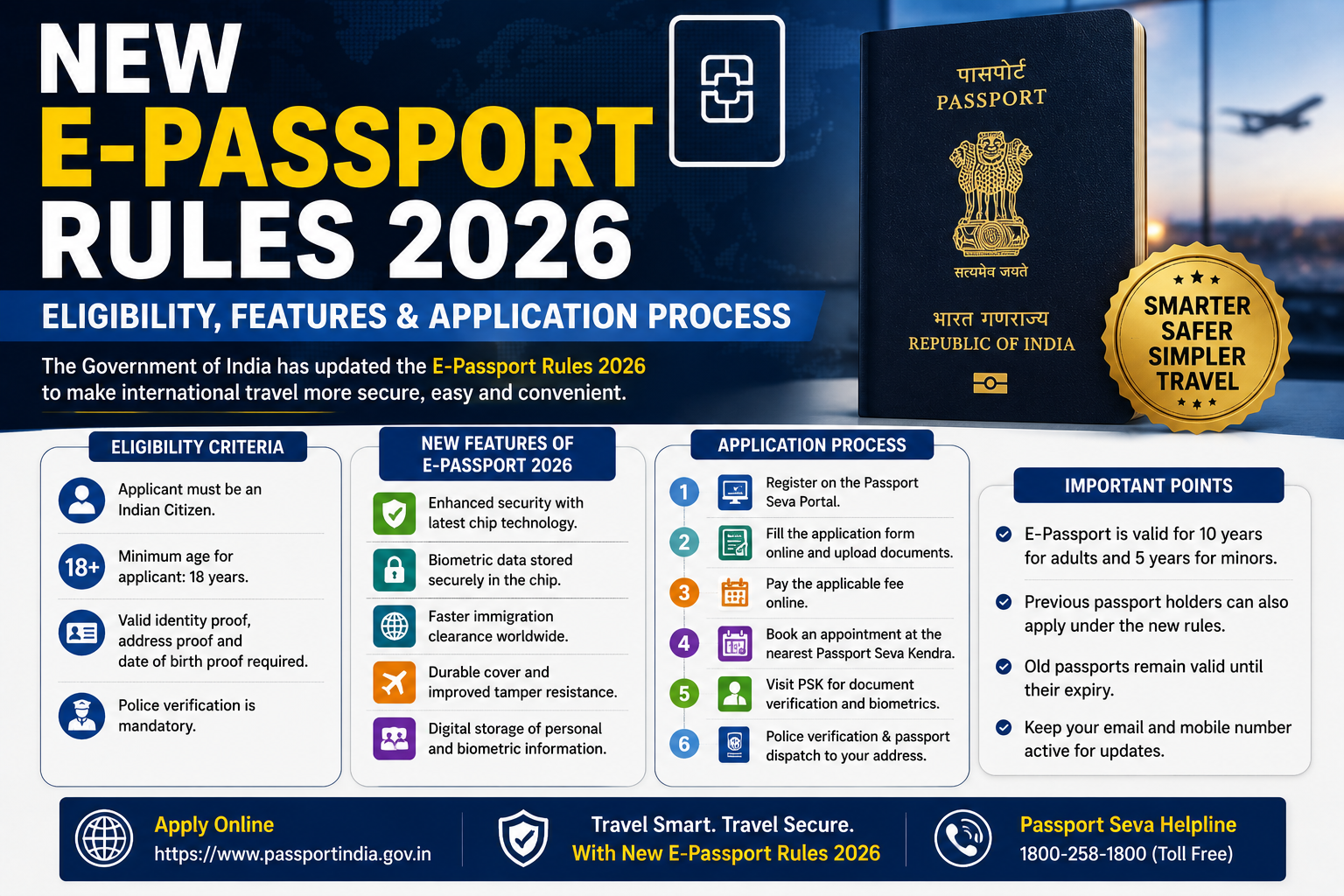
An e-Passport is not a completely digital passport. It is a physical passport booklet containing an embedded Radio Frequency Identification (RFID) chip and antenna. The chip securely stores the passport holder’s personal and biometric information and is designed to improve security and facilitate automated immigration processing.
A major point for applicants in 2026 is that the government has announced that all newly issued passports will be e-Passports, while existing non-electronic passports will continue to remain valid until their expiry.
What Is an E-Passport?
An e-Passport is a regular physical passport with an embedded electronic chip.
The chip contains securely stored information associated with the passport and helps immigration authorities verify the travel document electronically.
According to the Ministry of External Affairs, an Indian e-Passport is a combined paper and electronic passport with an RFID chip and antenna embedded in the passport booklet.
Therefore, an e-Passport does not mean that travellers will stop carrying a physical passport.
You will still receive a passport booklet and need to carry it when travelling internationally.
Are E-Passports Mandatory in 2026?
For newly issued passports, the government has stated that all newly issued passports will be e-Passports.
However, people who already have a traditional non-electronic passport do not need to replace it immediately simply because e-Passports are being introduced.
Existing non-electronic passports remain valid until their expiry, according to the Ministry of External Affairs.
This means there is no need to apply for an e-Passport solely because your existing passport does not contain a chip.
Who Is Eligible for an E-Passport?
There is no separate application category that requires citizens to apply specifically for an e-Passport.
Applicants applying for a fresh passport or eligible re-issue through the regular Passport Seva process will receive the passport according to the current issuance system.
The important distinction is:
- New passport: issued as an e-Passport under the current system.
- Existing traditional passport: remains valid until expiry.
- Re-issue: processed through the Passport Seva system and the new passport is issued under the prevailing system.
Passport Seva continues to provide services for both fresh passport applications and re-issue applications.
Key Features of E-Passports
The main features of India’s e-Passport system include:
Embedded RFID Chip
The passport contains an electronic chip with an antenna embedded in the booklet.
Enhanced Security
The electronic component helps strengthen the authentication of passport information and makes it harder to tamper with the document.
Biometric Information
The e-Passport system supports secure electronic storage and verification of the passport holder’s information and biometric data.
Faster Immigration Processing
Electronic verification can help immigration authorities process eligible travellers more efficiently, particularly where automated passport-control systems are available.
Better International Compatibility
The chip-based passport follows international standards for machine-readable and electronic travel documents, helping facilitate secure verification at international borders.
What Information Is Stored in an E-Passport Chip?
The e-Passport chip is designed to store information associated with the passport holder and passport document.
This can include:
- Personal information
- Passport details
- Photograph
- Biometric information
- Electronic authentication information
The chip is protected using security mechanisms designed to prevent unauthorised alteration and access.
Applicants should not confuse the chip with a GPS tracker. An e-Passport does not function as a location-tracking device.
Does an E-Passport Track Your Location?
No.
An e-Passport’s RFID chip is used for authentication and verification of the passport document.
It is not a GPS device and does not continuously transmit the traveller’s location.
The electronic chip is designed to be read by compatible passport-reading equipment when the document is presented for verification.
What Does the E-Passport Look Like?
An Indian e-Passport looks similar to a conventional passport booklet.
The major difference is the internationally recognised e-Passport symbol printed on the cover and the presence of an embedded electronic chip inside the booklet.
The physical passport continues to contain the usual printed information and visa pages.
How Is an E-Passport Different From a Traditional Passport?
| Feature | Traditional Passport | E-Passport |
|---|---|---|
| Physical booklet | Yes | Yes |
| Printed personal details | Yes | Yes |
| RFID chip | No | Yes |
| Electronic verification | Limited | Supported |
| Biometric data in chip | No | Yes |
| Security | Standard | Enhanced electronic security |
| International travel | Yes | Yes |
| Replacement required immediately? | No | Not applicable |
The most important point is that both are physical passports, but an e-Passport contains an electronic chip.
Do Existing Passport Holders Need to Apply Again?
No.
If you already have a valid traditional passport, you generally do not need to replace it merely because India has moved to e-Passports.
The Ministry of External Affairs has specifically stated that existing non-electronic passports will remain valid until their expiry.
When the existing passport expires and you apply for re-issue, the new passport will be issued according to the prevailing e-Passport system.
E-Passport Application Process 2026
There is no completely separate e-Passport application process.
Applicants continue to use the Passport Seva online system.
Step 1: Visit Passport Seva
Go to the official Passport Seva portal and register or log in.
Step 2: Select Passport Service
Choose the applicable service:
- Fresh Passport
- Re-issue of Passport
Passport Seva’s current online process provides these options through the services section.
Step 3: Fill Out the Application
Enter your:
- Name
- Date of birth
- Address
- Parents’ details
- Contact information
- Other required information
Review everything carefully before submitting.
Step 4: Pay the Passport Fee
Pay the applicable passport fee through the authorised online payment process.
Passport application fees were revised from 1 July 2026, so applicants should check the current fee before payment.
Step 5: Book an Appointment
Select an available Passport Seva Kendra (PSK) or Post Office Passport Seva Kendra (POPSK).
Applicants can choose a Passport Office and PSK/POPSK based on their convenience, subject to available appointments.
Step 6: Visit the Passport Centre
Attend the appointment with the required original documents and self-attested copies where applicable.
Passport Seva’s document guidance requires applicants to provide original documents along with the applicable self-attested copies.
Step 7: Complete Verification
Your application will undergo the applicable document and police-verification process.
Step 8: Receive the Passport
After approval and printing, the new passport is dispatched to the applicant according to the applicable Passport Seva process.
Documents Required for E-Passport Application
There is no separate document list simply because the passport is an e-Passport.
The documents depend on whether you are applying for a fresh passport, re-issue, Tatkaal service or another passport service.
Common documents can include:
- Aadhaar card
- Proof of address
- Proof of date of birth
- PAN card
- Birth certificate
- Existing passport for re-issue
- Educational documents, where applicable
- Supporting documents for changes in personal details
Passport Seva advises applicants to check the document requirements applicable to their specific application.
Is Aadhaar Required for an E-Passport?
Aadhaar can be used as an identity and address document where accepted under the passport application requirements.
Passport Seva’s application instructions also state that providing Aadhaar can help expedite passport processing.
However, applicants should check the official document requirements for their particular application rather than assuming that Aadhaar alone is sufficient in every case.
E-Passport Fees 2026
There is no separate “e-Passport fee” simply because the passport contains a chip.
Applicants pay the applicable passport service fee.
The revised passport fees effective from 1 July 2026 include:
| Service | Normal Fee | Tatkaal Fee |
|---|---|---|
| Fresh/Re-issue – 36 pages | ₹2,500 | ₹5,000 |
| Fresh/Re-issue – 60 pages | ₹3,500 | ₹6,000 |
| Lost/Damaged – 36 pages | ₹5,000 | ₹7,500 |
| Lost/Damaged – 60 pages | ₹6,000 | ₹8,500 |
| Minor – 36 pages | ₹1,750 | ₹4,250 |
Applicants should check the official Passport Seva fee calculator before payment because the applicable fee depends on the service and applicant category.
E-Passport and Tatkaal Service
Eligible applicants can use Tatkaal services when applying for a passport, subject to the applicable rules.
The introduction of e-Passports does not mean that applicants need to submit a separate e-Passport application under Tatkaal.
Instead, the applicant selects the appropriate passport service and Tatkaal option through Passport Seva.
E-Passport and Police Verification
The introduction of e-Passports does not eliminate police verification.
Whether police verification is required depends on the application type, applicant circumstances and records available with the Passport Office.
Passport Seva’s current instructions explain that police verification can be required before or after passport issuance depending on the case.
Will E-Passports Make Airport Immigration Faster?
Potentially, yes.
The electronic chip allows compatible immigration systems to electronically verify passport information.
This can make border processing more efficient, particularly at airports equipped with automated passport-control or e-gate systems.
However, the actual experience depends on:
- Airport infrastructure
- Immigration systems
- Destination country
- Availability of e-gates
- Traveller eligibility
- Border-control procedures
Therefore, having an e-Passport does not guarantee that every airport will provide an automatic immigration facility.
Can E-Passports Be Used Abroad?
Yes.
An Indian e-Passport is designed for international travel and electronic verification at compatible immigration systems.
The traveller still needs to satisfy the destination country’s:
- Visa requirements
- Entry requirements
- Immigration rules
- Passport-validity requirements
An e-Passport does not automatically provide visa-free entry to another country.
E-Passport Benefits for Travellers
The new passport system can offer several advantages.
Better Security
The electronic chip provides an additional layer of security and authentication.
Faster Verification
Compatible immigration systems can electronically verify passport information.
Reduced Risk of Document Tampering
Electronic security features make fraudulent modification more difficult.
Easier Automated Processing
The chip can support automated border-control systems and e-gates where available.
International Standardisation
Chip-based passports are widely used internationally and support modern travel-document standards.
What Happens If the E-Passport Chip Stops Working?
A damaged or malfunctioning chip does not necessarily mean that the physical passport becomes unreadable in every situation.
The passport booklet still contains printed information.
However, if the electronic component is damaged or the passport itself is damaged, the traveller may face additional checks or be advised to apply for a replacement depending on the circumstances.
Passport holders should take care not to bend, puncture or damage the passport booklet.
What If an E-Passport Is Lost?
The procedure remains similar to the loss of a conventional passport.
The loss should be reported promptly to the police and Passport Authority, and the applicant should apply for re-issue through the Passport Seva system.
Passport Seva’s current application instructions specifically advise passport holders to report loss immediately to the nearest police station and Passport Office or Indian Mission if abroad.
E-Passport Rollout Across India
The Ministry of External Affairs has stated that the e-Passport system and upgraded Passport Seva Programme V2.0 have been rolled out across all 37 Passport Offices in India.
This represents an important step toward modernising India’s passport issuance and immigration ecosystem.
Does Everyone Get an E-Passport Automatically?
For newly issued passports, the government has stated that all newly issued passports will be e-Passports.
Existing passport holders do not have to replace their current passport before its expiry simply because the new system has been introduced.
Therefore, there is no need to submit a separate application solely to convert an existing valid passport into an e-Passport.
E-Passport vs Digital Passport
These terms are sometimes used interchangeably, but they are not the same.
An e-Passport is a physical passport containing an electronic chip.
A digital passport would imply a purely electronic travel credential or digital identity that could potentially replace the physical document.
India’s e-Passport is not a replacement for the physical passport booklet.
Important Things Applicants Should Know in 2026
Before applying, remember:
- Newly issued Indian passports are being issued as e-Passports.
- Existing non-electronic passports remain valid until expiry.
- There is no separate e-Passport application form.
- The regular Passport Seva application process continues.
- The e-Passport contains an RFID chip.
- The chip helps with electronic verification.
- The e-Passport is still a physical passport.
- Passport fees were revised from 1 July 2026.
- Applicants must provide the required documents for their particular service.
- Police verification may still be required.
- E-Passport does not mean visa-free travel.
- Existing passport holders do not need immediate replacement solely because of the e-Passport rollout.
E-Passport Rules 2026 at a Glance
| Point | 2026 Rule |
|---|---|
| New passports | Issued as e-Passports |
| Existing traditional passports | Remain valid until expiry |
| Separate e-Passport form | Not required |
| Physical booklet | Yes |
| RFID chip | Yes |
| Electronic verification | Supported |
| Location tracking | No |
| Regular Passport Seva process | Continues |
| Tatkaal service | Available subject to eligibility |
| Passport fees | Revised from 1 July 2026 |
| International travel | Permitted with valid passport and required visa/entry documents |
Frequently Asked Questions
What is an e-Passport in India?
An e-Passport is a physical Indian passport containing an embedded RFID chip and antenna that enables secure electronic verification of passport information.
Are e-Passports mandatory in 2026?
Newly issued passports are being issued as e-Passports. Existing non-electronic passports remain valid until their expiry.
Do I need to apply separately for an e-Passport?
No. There is no separate e-Passport application process. You apply through the regular Passport Seva system for a fresh passport or re-issue.
What is stored in an e-Passport chip?
The chip securely stores information associated with the passport holder and passport document, including information used for electronic authentication and biometric verification.
Does an e-Passport track my location?
No. The RFID chip is intended for passport authentication and verification. It is not a GPS tracking device.
Can I travel internationally with an e-Passport?
Yes. An Indian e-Passport is designed for international travel. However, travellers must still comply with the visa and immigration requirements of the destination country.
Do existing passport holders need to replace their passport?
No. Existing non-electronic passports remain valid until expiry, according to the Ministry of External Affairs.
What is the application process for an e-Passport?
Applicants follow the normal Passport Seva process: register, select fresh passport or re-issue, complete the application, pay the applicable fee, book an appointment, submit documents and complete the required verification.
Is there an additional e-Passport fee?
There is no separate fee merely for receiving an e-Passport. Applicants pay the applicable passport service fee. Passport fees were revised from 1 July 2026.
Can I get an e-Passport through Tatkaal?
Eligible applicants can apply through the Tatkaal service. The applicable Tatkaal rules, documents and fees continue to apply.
Where can I apply for an Indian passport?
Passport Seva allows applicants to choose a Passport Office and the desired PSK/POPSK based on their preference, subject to appointment availability.
Conclusion
The New E-Passport Rules 2026 mark an important step in the modernisation of India’s passport system. The e-Passport combines the familiar physical passport booklet with an embedded RFID chip and antenna, allowing passport information to be electronically authenticated and supporting more secure and efficient immigration processing.
For applicants, the most important point is that there is no separate e-Passport application process. Citizens continue to use the regular Passport Seva system to apply for a fresh passport or re-issue. Under the current rollout, newly issued passports are being issued as e-Passports.
People who already hold a traditional passport do not need to replace it immediately. The Ministry of External Affairs has confirmed that existing non-electronic passports remain valid until their expiry.
The new system also does not mean that the physical passport has disappeared. Travellers will continue to carry a physical passport booklet, while the embedded chip provides an additional electronic layer for authentication.
Applicants should also remember that e-Passport rollout does not remove the usual passport requirements. Identity and address documents, appointment procedures, applicable police verification and other Passport Seva requirements continue to apply according to the applicant’s circumstances.
Another important 2026 update is the passport fee revision effective from 1 July 2026. Applicants should therefore check the latest Passport Seva fee calculator before making payment.
Overall, India’s move toward e-Passports is aimed at making passport documents more secure, technologically advanced and compatible with modern international border-control systems. For most citizens, the transition is simple: apply through the normal Passport Seva process, meet the applicable document requirements and receive the new passport under the current e-Passport system.