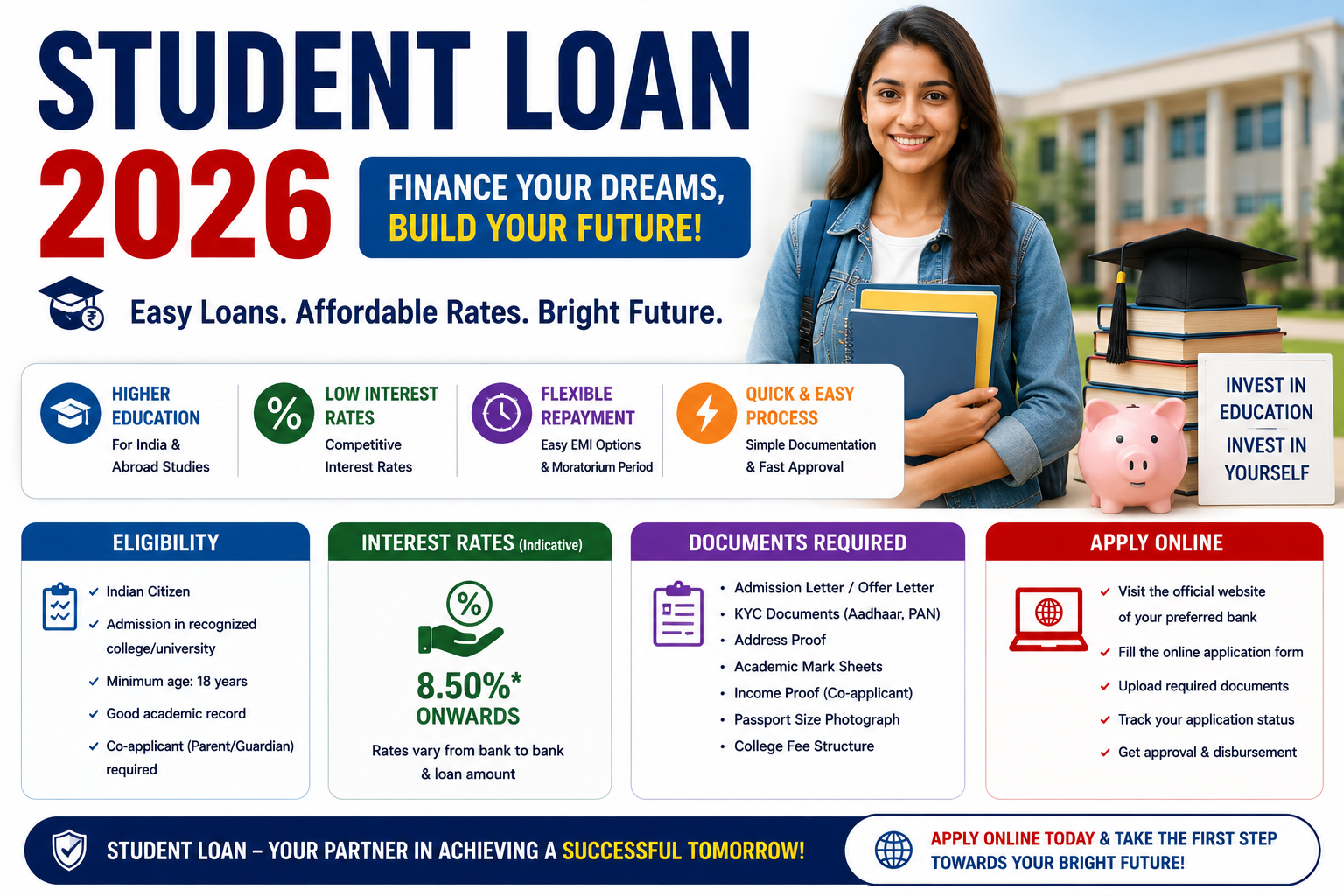
Higher education can involve significant expenses such as tuition fees, hostel charges, books, equipment, travel and other academic costs. For students who cannot meet these expenses entirely through personal or family savings, an education loan or student loan can provide financial support for eligible higher-education courses in India and abroad.
In 2026, students have access to education-loan products offered by public-sector banks, private banks and other financial institutions. Government-supported initiatives such as PM-Vidyalaxmi can also provide interest-subvention and credit-guarantee support to eligible students. Under the PM-Vidyalaxmi guidelines, eligible students with annual family income up to ₹8 lakh can receive a 3% interest subvention on education loans up to ₹10 lakh, subject to the scheme’s conditions.
Students can also explore education-loan options through the PM Vidyalaxmi portal, which provides a digital platform for applying for eligible education-loan schemes.
This guide explains Student Loan 2026, including eligibility, interest rates, eligible expenses, documents required, government interest support, repayment, and the online application process.
What Is a Student Loan?
A student loan, commonly called an education loan in India, is a loan designed to finance higher education.
Depending on the lender and loan scheme, it can be used for:
- Undergraduate courses
- Postgraduate courses
- Professional courses
- Technical courses
- Medical education
- Engineering courses
- Management programmes
- Diploma courses
- Research and doctoral programmes
- Other recognised higher-education programmes
Loans may be available for courses in India as well as eligible programmes abroad.
Student Loan 2026: Key Highlights
| Particular | Details |
|---|---|
| Loan Purpose | Financing eligible higher education |
| Courses | Degree, diploma, professional and technical courses, subject to lender rules |
| Study Location | India and abroad |
| Applicants | Eligible Indian students |
| Co-Applicant | Usually parent/guardian or another eligible person, depending on lender |
| Interest Rate | Varies by lender, scheme, course and borrower profile |
| Security | Depends on loan amount and lender policy |
| Repayment | Usually begins after the applicable moratorium period |
| Government Support | PM-Vidyalaxmi and other applicable schemes |
| Online Application | Available through participating lenders and PM Vidyalaxmi portal |
The exact terms can vary significantly between banks and loan products.
Student Loan Eligibility 2026
Education-loan eligibility is not identical across all banks.
Generally, the student should:
- Be an Indian citizen, where required by the scheme
- Have secured admission to an eligible recognised institution
- Have been selected through merit or an approved admission process
- Pursue an eligible course
- Meet the lender’s academic requirements
- Provide the required financial and KYC documents
- Have an eligible co-borrower where required
For example, the SBI Student Loan scheme states that eligible students should be Indian nationals who have secured admission to higher-education courses in recognised institutions in India or eligible foreign institutions.
Eligibility for Students Studying in India
Students planning to study in India may be eligible for education loans for recognised courses and institutions.
The lender can consider:
- Admission status
- Institution recognition
- Course type
- Academic performance
- Future employability
- Loan amount
- Parent/co-borrower’s financial profile
- Security requirements
The specific eligible institutions and courses vary between loan schemes.
Eligibility for Students Studying Abroad
Students planning to pursue higher education abroad can also apply for education loans from eligible Indian lenders.
The lender may consider:
- University or institution
- Country
- Course
- Admission letter
- Course duration
- Tuition fees
- Living expenses
- Travel expenses
- Academic record
- Co-borrower’s income
- Collateral or security requirements
Additional documentation may be required for overseas education.
Student Loan Interest Rates 2026
There is no single student-loan interest rate applicable to all borrowers in 2026.
Interest rates depend on:
- Bank
- Education-loan scheme
- Course
- Institution
- Loan amount
- Study location
- Credit profile
- Security offered
- Applicable benchmark
- Government interest-subvention eligibility
For example, SBI’s education-loan terms provide a 0.50% interest concession for girl students, subject to the applicable scheme terms. SBI also provides a further concession where the full interest during the moratorium is serviced, according to its published education-loan terms.
Students should therefore check the lender’s latest rate before applying rather than relying on an old interest-rate figure.
Government Interest Support for Student Loans
One of the important developments for students in 2026 is the PM-Vidyalaxmi Scheme.
The scheme is designed to provide financial support to meritorious students so that financial constraints do not prevent them from pursuing quality higher education.
Under the scheme guidelines:
- Students admitted to eligible Quality Higher Education Institutions (QHEIs) can qualify.
- Students with annual family income up to ₹8 lakh can be eligible for 3% interest subvention on education loans up to ₹10 lakh, subject to the scheme conditions.
- Students with annual family income up to ₹4.5 lakh pursuing eligible technical/professional courses can receive support under PM-USP Central Sector Interest Subsidy, where applicable.
- Education loans up to ₹7.5 lakh can be eligible for a government credit guarantee covering 75% of outstanding default, subject to the applicable guidelines.
These are government support provisions, not a universal reduction in the bank’s headline interest rate.
PM-Vidyalaxmi Scheme 2026
PM-Vidyalaxmi is an important government initiative for students seeking financial assistance for higher education.
The Ministry of Education’s guidelines provide for interest-subvention support for eligible students admitted to Quality Higher Education Institutions.
For eligible students with annual family income up to ₹8 lakh, the scheme provides 3% interest subvention on education loans up to ₹10 lakh, subject to the prescribed conditions.
The scheme supplements the existing PM-USP Central Sector Interest Subsidy scheme.
PM-USP Central Sector Interest Subsidy
Under the PM-USP Central Sector Interest Subsidy scheme, eligible students with annual family income up to ₹4.5 lakh pursuing approved technical or professional courses can receive 100% interest subvention during the moratorium period on education loans up to ₹10 lakh, subject to scheme conditions.
PM-Vidyalaxmi and PM-USP CSIS therefore provide different forms of government support depending on the student’s course, institution and family income.
What Expenses Does a Student Loan Cover?
Depending on the lender and loan scheme, an education loan can cover various academic expenses.
These may include:
- Tuition fees
- Examination fees
- Library fees
- Laboratory fees
- Hostel charges
- Books
- Equipment
- Instruments
- Uniforms
- Computer or other required equipment
- Travel expenses for eligible overseas studies
- Project work
- Study tours
- Thesis-related expenses
- Other approved education-related expenses
For example, SBI’s published student-loan scheme includes tuition, examination, library and laboratory fees and certain study-related expenses.
The exact amount and categories covered depend on the loan agreement.
How Much Student Loan Can I Get?
The maximum education-loan amount varies by:
- Bank
- Course
- Institution
- Study location
- Loan scheme
- Security
- Borrower’s profile
Some schemes offer relatively small loans without collateral, while larger loans may require security.
Students should not assume that the maximum advertised loan amount will automatically be sanctioned.
The lender will assess the total cost of education and repayment capacity before deciding the sanctioned amount.
Student Loan Without Collateral
Some education loans can be available without collateral up to specified limits, subject to the lender’s scheme and eligibility criteria.
The availability of a collateral-free loan can depend on:
- Loan amount
- Institution
- Course
- Government credit-guarantee coverage
- Bank policy
- Borrower profile
Under PM-Vidyalaxmi guidelines, education loans up to ₹7.5 lakh can qualify for a government credit guarantee covering 75% of outstanding default, subject to the applicable conditions.
Student Loan With Collateral
For higher loan amounts, lenders may require collateral or other security.
Collateral may include:
- Residential property
- Land
- Fixed deposits
- Other acceptable security
The lender decides what forms of security are acceptable.
The valuation and legal status of the collateral can also be checked before sanction.
Who Is the Co-Applicant for a Student Loan?
Students may need a parent, guardian or another eligible person as a co-borrower.
The co-applicant can be important because the student may not have an independent income while studying.
The lender may assess the co-borrower’s:
- Income
- Employment
- Credit history
- Existing liabilities
- Bank statements
- Repayment capacity
The exact co-applicant requirements vary by lender.
Documents Required for Student Loan 2026
The document list varies depending on the lender and whether the student is studying in India or abroad.
Common documents include:
Student Documents
- Aadhaar or other accepted identity proof
- PAN, where applicable
- Address proof
- Passport-size photographs
- Academic certificates
- Mark sheets
- Entrance-exam results
- Admission letter
- Course details
- Fee structure
Parent or Co-Borrower Documents
- Identity proof
- Address proof
- PAN
- Income proof
- Salary slips, where applicable
- Bank statements
- Income-tax returns, where applicable
- Employment or business documents
Property Documents
If collateral is required:
- Ownership documents
- Title documents
- Property tax records
- Valuation-related documents
- Other lender-required papers
Documents for PM-Vidyalaxmi Interest Subvention
The Ministry of Education lists documents such as:
- Student KYC
- Aadhaar
- PAN
- Address proof
- Previous qualifying examination marksheets
- Entrance-exam result
- Institution offer letter
- Fee structure
- Income certificate from the designated public authority
Additional documents may be required depending on the application.
How to Apply for a Student Loan Online in 2026
Students can apply directly through participating banks or use the PM Vidyalaxmi portal for eligible education-loan schemes.
The online process generally involves the following steps.
Step 1: Get Admission
First secure admission to an eligible institution and course.
Step 2: Collect Academic Documents
Keep marksheets, certificates, entrance-exam results and admission documents ready.
Step 3: Obtain the Fee Structure
Get the official fee structure from the educational institution.
Step 4: Check Education Loan Options
Compare different bank schemes based on:
- Interest rate
- Loan amount
- Collateral
- Moratorium
- Repayment period
- Processing charges
- Other conditions
Step 5: Register on PM Vidyalaxmi, If Applicable
Create a student account on the government-supported education-loan portal.
The portal allows students to explore participating education-loan schemes and submit applications online.
Step 6: Fill in the Application
Enter:
- Personal details
- Academic information
- Course details
- Institution details
- Loan requirement
- Co-borrower information
- Family income
Step 7: Upload Documents
Upload the required KYC, academic, admission and financial documents.
Step 8: Submit the Application
Review all information carefully before submitting the application.
Step 9: Bank Verification
The bank may verify:
- Admission
- Course
- Institution
- Student details
- Co-borrower
- Income
- Credit history
- Security, if applicable
Step 10: Loan Sanction
If the application meets the lender’s requirements, the bank may issue a sanction.
Step 11: Documentation and Disbursement
After completing the required documentation, the loan can be disbursed according to the agreed schedule.
How to Apply Through PM Vidyalaxmi Portal
The PM Vidyalaxmi platform is intended to make education-loan applications easier for students.
The general process is:
- Visit the official PM Vidyalaxmi portal.
- Register as a student.
- Complete your profile.
- Enter academic and admission details.
- Select suitable education-loan schemes.
- Provide financial and co-borrower information.
- Upload required documents.
- Submit the application.
- Track the application status through the portal.
Students should use the official government portal and verify the participating bank and scheme details before submitting an application.
Student Loan Repayment Period
The repayment period depends on the bank and loan scheme.
Many education loans provide a moratorium period so that students do not have to begin regular repayment immediately while studying.
For example, SBI’s published student-loan terms state that the repayment holiday can extend through the course period plus one year, or six months after obtaining a job, whichever is earlier, subject to the applicable terms.
The repayment period after the moratorium also varies according to the loan scheme.
What Is a Moratorium Period?
The moratorium period is the period during which regular principal repayment is generally deferred.
For education loans, it commonly covers:
- Course period
- Additional period after course completion
The exact period depends on the lender.
Students should understand that interest may continue to accrue during the moratorium.
SBI’s published terms, for example, state that simple interest is charged during the moratorium and that accrued interest may be added to the principal for repayment.
Is Interest Charged During the Study Period?
In many education-loan schemes, interest continues to accrue during the moratorium period even though regular repayment may be deferred.
Students should therefore check:
- Interest calculation method
- Moratorium terms
- Whether interest is serviced during study
- Whether unpaid interest is capitalised
- Repayment start date
Servicing interest during the study period, where financially possible and permitted, can affect the amount outstanding when regular repayment begins.
Student Loan Repayment After Course Completion
Once the applicable moratorium ends, the borrower generally begins regular repayment through EMIs.
The repayment schedule depends on:
- Loan amount
- Interest rate
- Repayment period
- Interest accumulated during moratorium
- Lender’s terms
Students should carefully review the repayment schedule before accepting the loan.
Education Loan for Girls
Some banks provide special concessions to female students.
For example, SBI’s published education-loan terms provide a 0.50% concession in the interest rate for girl students, subject to the applicable scheme terms.
However, students should check the latest lender-specific conditions before relying on a women-specific concession.
Student Loan for Studying Abroad
Education loans can help cover several costs associated with overseas education.
Depending on the scheme, these may include:
- Tuition fees
- Hostel charges
- Living expenses
- Books
- Equipment
- Travel
- Examination fees
- Other approved academic expenses
Students planning to study abroad should check whether the lender recognises the university and course before applying.
Student Loan for Medical Courses
Medical education can involve substantial tuition and other expenses.
Students pursuing eligible medical courses may apply for education loans subject to the lender’s course and institution requirements.
Banks can evaluate:
- Institution
- Course
- Admission
- Fee structure
- Academic record
- Loan requirement
- Co-borrower profile
- Security
Student Loan for Engineering Courses
Engineering students can apply for education loans for eligible programmes.
The lender may consider:
- Institution recognition
- Course
- Admission route
- Academic performance
- Fees
- Co-borrower income
- Security requirements
Students should compare loan products before choosing a lender.
Student Loan for MBA and Management Courses
Students pursuing eligible MBA and management programmes can also seek education loans.
Banks may consider the reputation and recognition of the institution, course fees and expected repayment capacity while assessing the application.
Student Loan for Diploma Courses
Certain diploma courses may qualify for education-loan financing, depending on the lender and scheme.
Students should verify course eligibility before applying.
Student Loan Tax Benefits
Education-loan borrowers may be eligible for an income-tax deduction on interest paid under Section 80E of the Income Tax Act, subject to the applicable conditions.
The deduction relates to the interest component of an eligible education loan rather than the principal repayment.
The loan must generally be taken for higher education of:
- The taxpayer
- Spouse
- Children
- A student for whom the taxpayer is a legal guardian
Tax rules and eligibility should be checked for the relevant assessment year.
How to Choose the Best Student Loan in 2026
Do not select a student loan solely because it has the lowest advertised interest rate.
Compare:
- Interest rate
- Benchmark
- Loan amount
- Collateral requirement
- Processing fee
- Moratorium
- Repayment tenure
- Prepayment conditions
- Interest during moratorium
- Government subsidy eligibility
- Credit guarantee
- Disbursement process
A loan with a slightly different interest rate may still be more suitable if its overall terms are better.
Student Loan Application Checklist
Before submitting your application, make sure you have:
- Admission letter
- Course fee structure
- Academic certificates
- Mark sheets
- Entrance-exam result
- Aadhaar/KYC documents
- PAN
- Address proof
- Passport, if studying abroad
- Parent/co-borrower documents
- Income proof
- Bank statements
- Property documents, if collateral is required
- Income certificate for government interest support, where applicable
Common Reasons for Student Loan Rejection
An education-loan application can be rejected or delayed because of:
- Non-recognised institution
- Ineligible course
- Incomplete documents
- Poor academic record
- Insufficient co-borrower income
- Weak credit history
- High existing liabilities
- Problems with collateral
- Inadequate admission documentation
- Incorrect application details
Students should carefully check the lender’s requirements before submitting an application.
How to Improve Student Loan Approval Chances
Choose a Recognised Institution
Check whether the course and institution are eligible under the selected loan scheme.
Maintain Complete Documents
Missing documents can delay verification.
Keep Academic Records Ready
Provide marksheets, entrance results and admission documents.
Choose a Suitable Loan Amount
Apply for an amount that corresponds to the actual education expenses.
Maintain a Strong Co-Borrower Profile
The co-borrower’s income and credit history can be important for the application.
Check Collateral Requirements
If security is required, ensure that the property documents are complete and legally clear.
Explore Government Support
Check PM-Vidyalaxmi and other applicable interest-subvention schemes before finalising the loan.
Frequently Asked Questions (FAQs)
What is a student loan?
A student loan, or education loan, is financing provided to eligible students for higher education expenses such as tuition fees, hostel charges, books and other approved costs.
Who can apply for a student loan in 2026?
Students who have secured admission to eligible higher-education courses and meet the lender’s academic, financial and documentation requirements can apply.
Can I get a student loan without collateral?
Some education-loan schemes provide collateral-free financing up to specified limits, subject to eligibility and lender rules. Government credit-guarantee support may also apply to eligible loans.
What documents are required for a student loan?
Common documents include KYC, academic records, admission letter, fee structure, income proof of the co-borrower, bank statements and collateral documents where applicable.
Can I apply for a student loan online?
Yes. Students can apply through participating banks and can also use the PM Vidyalaxmi portal for eligible education-loan schemes.
What is PM-Vidyalaxmi?
PM-Vidyalaxmi is a government scheme designed to provide financial support to eligible students pursuing higher education in Quality Higher Education Institutions.
What is the income limit for PM-Vidyalaxmi interest subvention?
Eligible students with annual family income up to ₹8 lakh can receive 3% interest subvention on education loans up to ₹10 lakh, subject to the scheme conditions.
Can girl students get a lower education-loan interest rate?
Some banks offer concessions to female students. SBI’s published education-loan terms provide a 0.50% interest concession for girl students, subject to applicable conditions.
When does education-loan repayment start?
Repayment generally starts after the applicable moratorium period. The exact repayment holiday varies by lender and loan scheme.
Is interest charged during the education period?
Interest may accrue during the study and moratorium period even when regular repayment is deferred. Borrowers should check the specific loan terms.
Can I get a student loan for studying abroad?
Yes. Eligible students can apply for education loans for recognised overseas institutions and courses, subject to the lender’s requirements.
Can education-loan interest be claimed as a tax deduction?
Eligible taxpayers may claim a deduction for qualifying education-loan interest under Section 80E, subject to the applicable tax rules.
Conclusion
A Student Loan 2026 can help students finance higher education when tuition fees and other academic expenses are difficult to manage through personal savings. Education loans are available from several banks and financial institutions for eligible courses in India and abroad.
The most important step is to compare loan terms carefully. Interest rates vary between lenders, and the final rate can depend on the loan scheme, course, institution, borrower profile and applicable concessions.
Government support can also make education financing more affordable for eligible students. Under PM-Vidyalaxmi, students admitted to eligible Quality Higher Education Institutions with annual family income up to ₹8 lakh can receive 3% interest subvention on education loans up to ₹10 lakh, subject to the scheme conditions.
Students should also check whether they qualify for the PM-USP Central Sector Interest Subsidy, credit-guarantee support or lender-specific concessions. For example, SBI provides a 0.50% interest concession to eligible girl students under its published education-loan terms.
Before applying, keep the admission letter, academic records, fee structure, KYC documents, co-borrower income documents and other required papers ready. Students can apply directly through participating banks or explore eligible options through the PM Vidyalaxmi portal.
Finally, remember that an education loan is a financial commitment that continues beyond college. Students and parents should understand the interest charged during the moratorium, repayment period, collateral requirements, government support and other loan conditions before accepting the loan.
Read More:How to Get a Home Loan with Low CIBIL Score in 2026