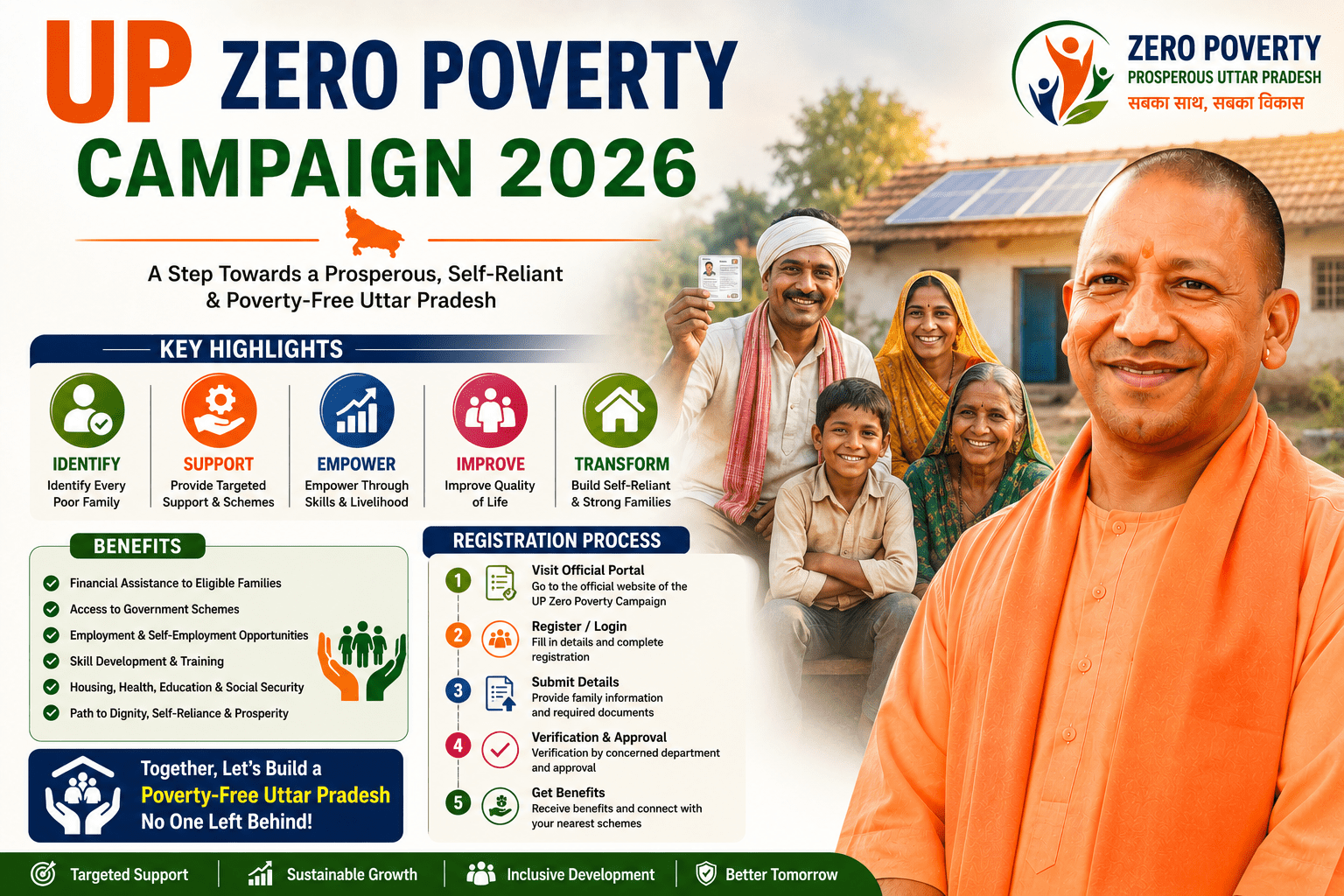
Poverty remains one of the biggest challenges in achieving inclusive development. To ensure that every eligible family has access to government welfare schemes and sustainable livelihood opportunities, the Government of Uttar Pradesh launched the UP Zero Poverty Campaign (Zero Poverty Uttar Pradesh Abhiyan). The campaign aims to identify the state’s most economically vulnerable families and connect them with multiple government welfare schemes, financial assistance, housing, healthcare, education, social security, and employment opportunities.
Launched on 2 October 2024 (Gandhi Jayanti), the campaign seeks to make Uttar Pradesh India’s first “Zero Poverty State” through a technology-driven identification system and convergence of various state and central government schemes. Rather than introducing a single cash benefit, the campaign integrates eligible families into numerous welfare programs to improve their quality of life and create sustainable sources of income.
This comprehensive guide explains everything about the UP Zero Poverty Campaign 2026, including eligibility, objectives, benefits, identification process, documents required, registration, livelihood support, and frequently asked questions.
What is the UP Zero Poverty Campaign?
The UP Zero Poverty Campaign is a flagship poverty alleviation initiative of the Government of Uttar Pradesh. The campaign identifies the poorest households in every Gram Panchayat using a technology-based survey and vulnerability assessment. Once identified, these families are connected to multiple welfare schemes instead of receiving assistance under a single program.
The initiative focuses on ensuring that eligible families receive benefits such as housing, healthcare, pensions, food security, skill development, employment, education, agricultural support, and financial inclusion. The government’s long-term goal is to help these families achieve sustainable annual incomes and become economically self-reliant.
Objectives of the UP Zero Poverty Campaign
The campaign has been launched with several important objectives:
- Eliminate extreme poverty in Uttar Pradesh.
- Identify the poorest households through a transparent survey.
- Ensure every eligible family receives government welfare benefits.
- Improve access to healthcare, education, and housing.
- Generate sustainable livelihood opportunities.
- Promote skill development and employment.
- Increase financial inclusion.
- Strengthen social security for vulnerable families.
- Improve nutrition and living standards.
- Ensure that no eligible family is left out of government schemes.
UP Zero Poverty Campaign 2026 Highlights
| Particular | Details |
|---|---|
| Scheme Name | UP Zero Poverty Campaign (Zero Poverty Uttar Pradesh Abhiyan) |
| State | Uttar Pradesh |
| Launch Date | 2 October 2024 |
| Implementing Authority | Government of Uttar Pradesh |
| Beneficiaries | Ultra-Poor Families |
| Objective | Poverty Elimination & Welfare Scheme Convergence |
| Registration Mode | Survey-Based Identification |
| Coverage | Rural Gram Panchayats |
| Benefit | Linkage with Multiple Government Schemes |
Key Benefits of the Campaign
The campaign does not provide a single financial grant. Instead, eligible families are connected with various welfare schemes based on their needs.
Access to Government Welfare Schemes
Eligible families are linked to multiple Central and State Government schemes, ensuring they receive all benefits for which they qualify.
Housing Support
Families without permanent housing may be considered for housing assistance under applicable government housing schemes.
Healthcare Benefits
Eligible households are linked to health insurance and cashless treatment schemes such as Ayushman Bharat and other state health initiatives.
Food Security
Families receive benefits under the Public Distribution System (PDS) and other food security programs where eligible.
Pension Schemes
Eligible elderly persons, widows, and persons with disabilities may be linked to social security pension schemes.
Livelihood Support
The campaign emphasizes creating sustainable income opportunities through self-employment, agriculture, livestock, and entrepreneurship support.
Skill Development
Youth from identified families receive skill training to improve employability and secure better-paying jobs.
Financial Inclusion
Beneficiaries are encouraged to open bank accounts, access government subsidies through Direct Benefit Transfer (DBT), and receive financial literacy support.
Agricultural Assistance
Eligible farming families may receive support through schemes related to irrigation, crop insurance, Kisan Credit Cards, farm mechanization, and agricultural subsidies.
How Does the Zero Poverty Campaign Work?
Unlike traditional schemes where individuals submit applications directly, the Zero Poverty Campaign follows a structured identification process.
Identification of Vulnerable Families
The government identifies the poorest households through surveys conducted at the Gram Panchayat level.
Technology-Based Assessment
A digital platform is used to evaluate households based on multiple vulnerability indicators.
Verification Process
Village-level committees verify the information collected during the survey to ensure transparency and accuracy.
Scheme Convergence
After verification, eligible families are linked with relevant government welfare programs according to their specific needs.
Continuous Monitoring
Government departments regularly monitor the progress of beneficiary families to ensure they continue receiving benefits and improve their economic condition.
Eligibility Criteria
Generally, families must satisfy the following conditions:
- Must be residents of Uttar Pradesh.
- Must belong to the economically weakest section.
- Should be identified during the official survey conducted under the campaign.
- Must satisfy the eligibility conditions of the welfare schemes linked under the campaign.
- Family details must be successfully verified by the concerned authorities.
Since the campaign is survey-based, there is no universal self-registration process for all beneficiaries.
Welfare Schemes Covered
Eligible families may be connected with several welfare programs, including:
- Pradhan Mantri Awas Yojana
- Mukhyamantri Awas Yojana
- Ayushman Bharat Health Scheme
- PM Kisan Samman Nidhi
- Social Security Pension Schemes
- Ration Card Benefits
- Kisan Credit Card
- Skill Development Programs
- Self Employment Schemes
- Women Empowerment Schemes
- Livestock Development Schemes
- Agricultural Subsidy Schemes
- Education Support Programs
- Employment and Livelihood Initiatives
The exact schemes depend on the family’s eligibility.
Skill Development and Employment Support
One of the major components of the campaign is livelihood generation.
Eligible youth from identified families receive:
- Skill development training.
- Industry-oriented certification.
- Placement assistance.
- Employment opportunities in private companies.
- Entrepreneurship support.
The government has partnered with industries and training organizations to improve employment opportunities for beneficiaries. Initial placements under the campaign have targeted jobs with salaries of around ₹18,400 per month after skill training.
Documents Required
During verification, the following documents may be required:
- Aadhaar Card
- Ration Card
- Residence Certificate
- Family ID (if applicable)
- Income Certificate
- Bank Passbook
- Mobile Number
- Passport-size Photograph
- Land Records (if applicable)
- Caste Certificate (if applicable)
The exact document requirements depend on the welfare schemes for which the family becomes eligible.
Registration Process
Unlike many government schemes, the Zero Poverty Campaign generally follows a survey-based identification model rather than an open public application process.
Step 1
Government survey teams identify economically vulnerable households.
Step 2
Village-level committees verify family details.
Step 3
The information is uploaded to the official Zero Poverty portal.
Step 4
Eligible families are digitally mapped with suitable government welfare schemes.
Step 5
Concerned departments process benefits under the applicable schemes.
Step 6
Families continue to receive support through regular monitoring and convergence of additional schemes.
Major Features of the Campaign
Some important features include:
- Technology-driven identification system.
- Village-level verification.
- Integration of multiple welfare schemes.
- Digital beneficiary database.
- Livelihood-focused approach.
- Skill development support.
- Employment generation.
- Financial inclusion.
- Transparent implementation.
- Continuous monitoring.
Progress of the Campaign
The campaign has made significant progress in identifying vulnerable families and connecting them with welfare schemes. According to recent government updates, around 35% of the targeted families have already been linked with 15 priority government schemes, demonstrating steady progress toward expanding welfare coverage across the state.
Common Reasons Why Families May Not Receive Benefits
Some households may not receive immediate benefits because:
- Family details could not be verified.
- Required documents are incomplete.
- The family is not found eligible under specific welfare schemes.
- Aadhaar or bank details contain errors.
- Duplicate records are detected.
- Land or identity records require correction.
Tips for Beneficiaries
To improve the chances of receiving benefits:
- Keep Aadhaar details updated.
- Ensure bank account details are correct.
- Link your mobile number with Aadhaar.
- Update ration card and family records.
- Cooperate during household surveys.
- Keep all documents readily available.
- Verify personal information carefully during verification.
Frequently Asked Questions (FAQs)
What is the UP Zero Poverty Campaign?
The UP Zero Poverty Campaign is a Government of Uttar Pradesh initiative that identifies extremely poor families and connects them with multiple welfare schemes, livelihood opportunities, and social security benefits.
Who can benefit from the campaign?
Economically vulnerable families identified through the official survey and verification process are eligible for benefits.
Is there an online application?
The campaign is primarily survey-based, and eligible families are identified through government surveys rather than a general online application.
Does the campaign provide direct cash assistance?
The campaign mainly focuses on linking eligible families with various existing government welfare schemes instead of providing a single cash payment.
What kind of support is provided?
Beneficiaries may receive housing, healthcare, pensions, ration benefits, skill development, employment assistance, agricultural support, and other welfare benefits depending on their eligibility.
Is skill training included?
Yes. The campaign includes skill development and employment initiatives to help eligible youth secure sustainable livelihoods.
How are beneficiaries selected?
Families are selected through village-level surveys, digital vulnerability assessments, and verification by local committees before being linked to government schemes.
Conclusion
The UP Zero Poverty Campaign 2026 is one of the most comprehensive poverty alleviation initiatives undertaken by the Government of Uttar Pradesh. Instead of offering a single financial benefit, the campaign adopts a holistic approach by identifying the poorest families and connecting them with multiple welfare schemes, skill development programs, healthcare services, housing assistance, and sustainable livelihood opportunities. Through technology-driven identification, transparent verification, and convergence of government schemes, the initiative aims to ensure that no eligible family is left behind and to move Uttar Pradesh closer to its goal of becoming a zero-poverty state.
Read More: UK Spouse Visa 2026 Guide: Eligibility, Requirements, Fees & Application Process