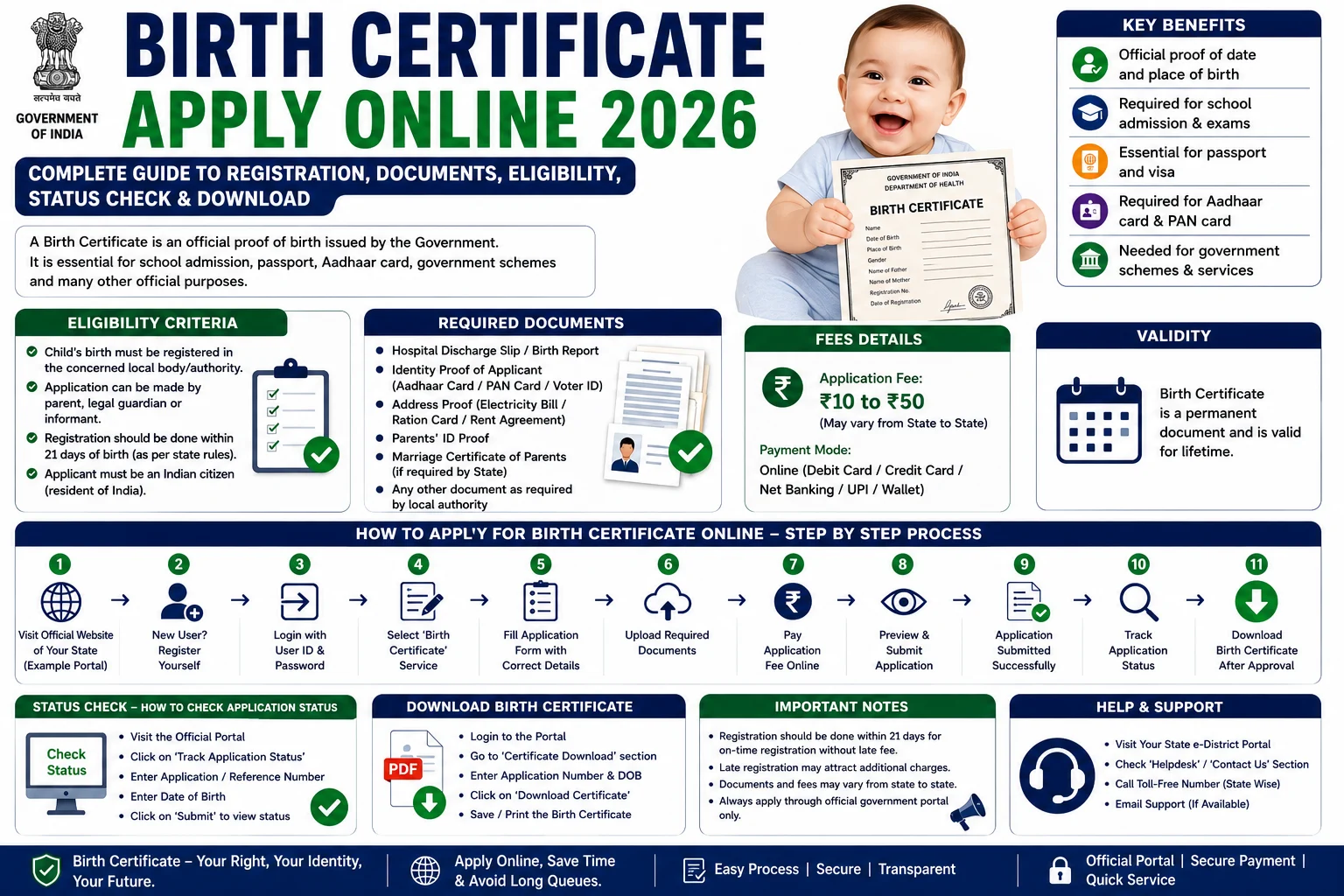
A Birth Certificate is one of the most important legal identity documents issued by the Government of India. It officially records a person’s birth details, including the name, date of birth, place of birth, parents’ names, and registration number. From school admissions to passport applications, Aadhaar enrollment, government schemes, and inheritance matters, a birth certificate serves as a fundamental proof of identity and age.
Under the Registration of Births and Deaths Act, 1969, registering every birth is mandatory in India. The Civil Registration System (CRS) has made the registration process more accessible by allowing citizens in many states and Union Territories to apply online, track their application status, and download digitally signed birth certificates. Implementation is managed by the respective State Governments, while the Registrar General of India coordinates the nationwide registration system.
This comprehensive guide explains everything you need to know about Birth Certificate Apply Online 2026, including eligibility, required documents, online registration process, late registration, application status, certificate download, fees, processing time, and frequently asked questions.
What is a Birth Certificate?
A Birth Certificate is an official document issued by the local Registrar of Births and Deaths that certifies the birth of a child. It contains important information such as:
- Child’s Name (if available)
- Date of Birth
- Time of Birth
- Place of Birth
- Gender
- Parents’ Names
- Registration Number
- Registration Date
- Issuing Authority
The certificate is accepted as valid proof of age and identity across India.
Birth Certificate Apply Online 2026 Overview
| Particular | Details |
|---|---|
| Document Name | Birth Certificate |
| Governing Law | Registration of Births and Deaths Act, 1969 |
| Issuing Authority | Registrar of Births & Deaths / Municipal Corporation / Gram Panchayat |
| Registration Mode | Online / Offline |
| Beneficiaries | All Children Born in India |
| Purpose | Legal Proof of Birth |
| Processing Time | Usually 7–21 Days (varies by state) |
| Official Portal | Civil Registration System (CRS) / State Birth Registration Portal |
Why is a Birth Certificate Important?
A birth certificate is required throughout a person’s life. It is used for:
- Aadhaar Card enrollment
- Passport application
- School admission
- College admission
- Government job applications
- Voter ID registration
- PAN Card application
- Driving Licence
- Government welfare schemes
- Inheritance and legal claims
- Visa and immigration purposes
- Insurance and banking documentation
Without a birth certificate, proving age and identity can become difficult in many official situations.
Benefits of a Birth Certificate
Legal Proof of Birth
It serves as the official government record of a person’s birth.
Identity Verification
Required for obtaining various identity documents.
Access to Education
Schools and colleges generally require a birth certificate during admission.
Government Scheme Benefits
Many central and state government schemes require birth registration.
Passport and Visa Applications
A birth certificate is commonly accepted as proof of date of birth.
Easy Access to Public Services
It simplifies access to healthcare, financial services, and social welfare programs.
Eligibility Criteria
The following individuals can apply:
- Parents or legal guardians of a newborn.
- Adult individuals seeking their own birth certificate.
- Authorized representatives where permitted.
- Applicants requesting delayed registration as per applicable rules.
Birth registration should ideally be completed soon after the birth. Delayed registration may require additional documents or approvals depending on state rules.
Documents Required
The required documents may vary slightly depending on the state or local authority. Commonly required documents include:
- Hospital Birth Report or Discharge Summary
- Parents’ Aadhaar Cards
- Proof of Residence
- Identity Proof of Parents
- Marriage Certificate (if applicable)
- Mobile Number
- Passport-size Photograph (if required)
- Affidavit (for delayed registration where applicable)
- Supporting documents for late registration
Always verify the document list on your state’s official portal before applying.
How to Apply for a Birth Certificate Online 2026
The online application process is similar across many states.
Step 1: Visit the Official Portal
Go to the Civil Registration System (CRS) portal or your state’s official birth registration website. The CRS portal supports online registration for many participating States and Union Territories, while some states use their own dedicated portals.
Step 2: Register or Login
Create an account using your mobile number and email address, or log in if you already have an account.
Step 3: Select Birth Registration
Choose the Birth Registration or Birth Certificate service.
Step 4: Fill the Application Form
Provide details such as:
- Child’s Name (if available)
- Date and Time of Birth
- Place of Birth
- Parents’ Details
- Address
- Contact Information
Step 5: Upload Documents
Upload scanned copies of all required documents in the prescribed format.
Step 6: Pay the Application Fee
If applicable, complete the online payment using the available payment methods.
Step 7: Submit the Application
Review all information carefully and submit the application.
Step 8: Save the Acknowledgement
Download or print the acknowledgement receipt for future reference.
Birth Registration Time Limits
The registration timeline generally follows these categories, though exact rules vary by state:
- Within 21 days of birth: Normal registration process.
- After 21 days: Delayed registration may require additional documentation or permission.
- After one year: Registration generally involves a more detailed verification process under applicable state rules.
Parents are advised to register the birth as early as possible to avoid additional procedures.
How to Check Birth Certificate Application Status
Most online portals provide an application tracking facility.
Follow these steps:
- Visit the official registration portal.
- Click Track Application Status.
- Enter the application or registration number.
- Complete OTP verification (if required).
- View the current status of your application.
How to Download Birth Certificate Online
Once the application is approved:
- Log in to the portal.
- Open Issued Certificates or Download Certificate.
- Select the registered birth record.
- Download the digitally signed Birth Certificate in PDF format.
Many local bodies also provide digitally verifiable certificates through their online portals.
State-wise Birth Certificate Application Process
Most states provide online birth registration through either the national CRS portal or their own citizen service portals.
Examples include:
- Uttar Pradesh – CRS / e-Nagarsewa (urban) or state services
- Bihar – ServicePlus Portal
- Delhi – Municipal Corporation / Revenue services
- Maharashtra – Municipal Corporation / CRS integration
- Rajasthan – e-Mitra
- Karnataka – Nadakacheri
- Tamil Nadu – e-Sevai
- Gujarat – Digital Gujarat
- Madhya Pradesh – e-District
The national Government Services Portal also provides links to state-specific services.
Processing Time
The processing period depends on the local authority and completeness of the application.
Typical timelines are:
- Normal Registration: 7–21 Days
- Delayed Registration: May take longer due to verification requirements.
Some municipal authorities specify service-level timelines for registrations made within the normal period.
Application Fees
The fee varies depending on:
- State Government
- Municipal Corporation
- Gram Panchayat
- Registration timeline (normal or delayed)
Many jurisdictions either provide the service free of cost or charge only a nominal fee for registration or certificate issuance. Always check the official portal for the applicable fee.
Common Reasons for Application Rejection
Applications may be rejected due to:
- Incorrect personal information
- Mismatch between submitted documents
- Missing mandatory documents
- Incorrect hospital details
- Late registration without required approvals
- Poor-quality scanned documents
- False declarations
Carefully review all information before submitting the application.
Tips for a Successful Birth Registration
- Register the birth as soon as possible after delivery.
- Ensure all details match hospital records.
- Upload clear, readable documents.
- Keep your registered mobile number active.
- Save the acknowledgement receipt.
- Apply only through official government portals.
- Track your application regularly.
Frequently Asked Questions (FAQs)
Q1. What is a Birth Certificate?
A Birth Certificate is an official government document that records a person’s birth details and serves as legal proof of birth.
Q2. Can I apply for a Birth Certificate online?
Yes. Many states and Union Territories allow online birth registration through the Civil Registration System (CRS) or their own official portals.
Q3. Is birth registration mandatory in India?
Yes. Registration of births is mandatory under the Registration of Births and Deaths Act, 1969.
Q4. What happens if the birth is registered late?
Late registration is possible, but additional documents, approvals, or affidavits may be required depending on the delay and state rules.
Q5. Can I download my Birth Certificate online?
Yes. After approval, many authorities provide a digitally signed certificate that can be downloaded online.
Q6. How long does it take to receive a Birth Certificate?
The processing time is generally 7 to 21 days for normal registrations, though it may vary by state and local authority.
Q7. Is there a national portal for birth registration?
Yes. The Civil Registration System (CRS) provides online services for many participating states and UTs, while other states use their own official portals.
Conclusion
The Birth Certificate Apply Online 2026 process has made birth registration more efficient and accessible through digital government services. Registering a birth promptly ensures that children receive an official legal identity from the beginning of life and helps them access education, healthcare, identity documents, and government benefits without unnecessary delays.
Although the registration process has been standardized under the Civil Registration System, individual states and local authorities may have different procedures, fees, and timelines. Applicants should therefore use the official government portal applicable to their state and submit complete and accurate information to ensure timely approval.
Read More: Minority Scholarship 2026: Eligibility, Apply Online & Complete Guide