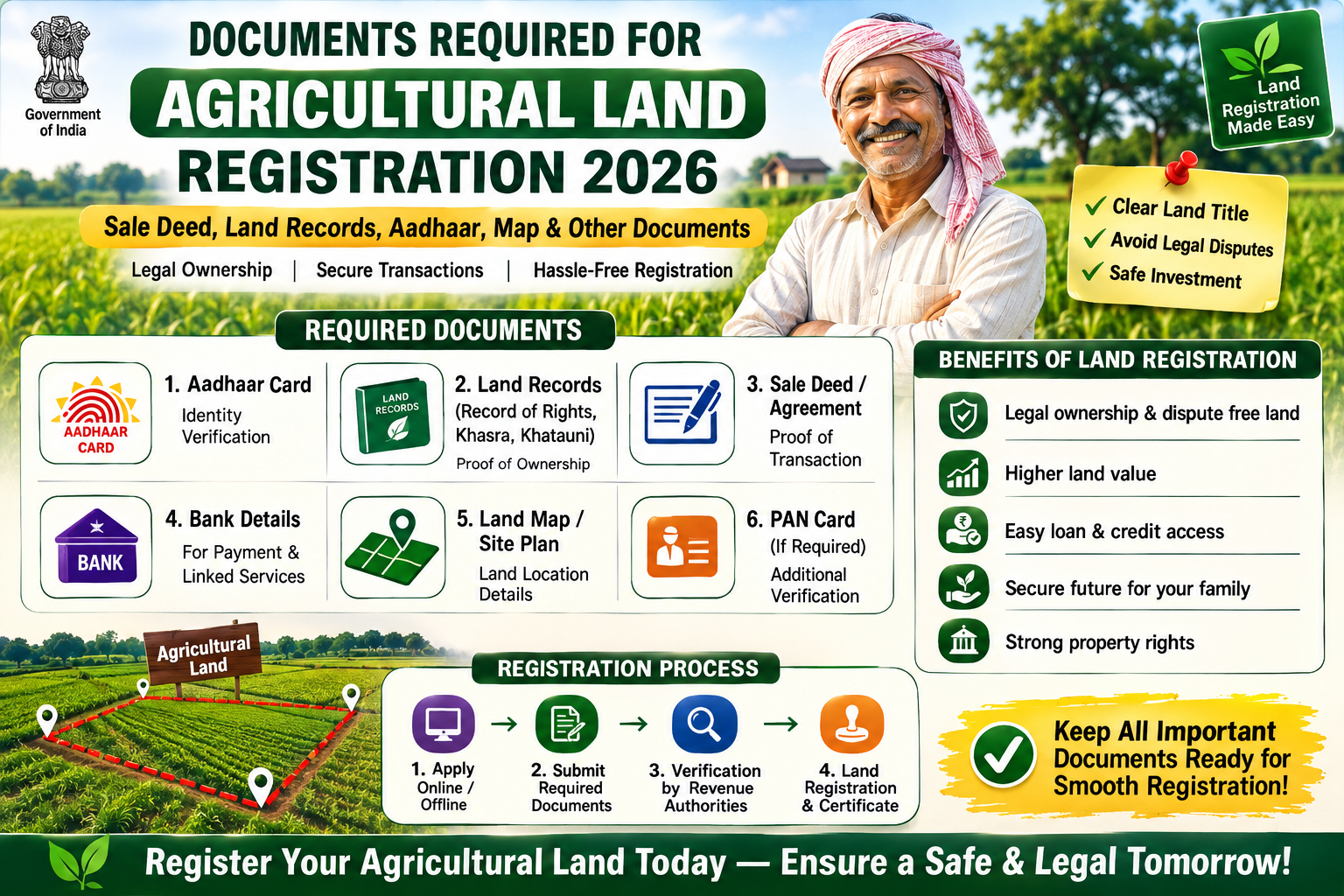
Agricultural land registration is an important legal process through which the transfer, sale, purchase, gift, or other legally recognized transaction involving agricultural land is formally recorded with the concerned registration authority. In 2026, land registration processes are increasingly supported by online property-registration systems, digital land records, e-stamping and appointment-based registration facilities.
The exact documents required for agricultural land registration are not identical across India. Land and property registration procedures are administered through the relevant State or Union Territory authorities, so requirements can vary depending on the location of the land, type of transaction, ownership status, land category and applicable state rules.
However, applicants generally need documents such as the sale deed or other transfer document, identity proof, address proof, land ownership records, previous title deed, land map, photographs, stamp-duty information and registration-fee details. Additional documents may be required if the land is inherited, jointly owned, mortgaged, leased or subject to special restrictions.
For example, Uttar Pradesh’s current registration guidance specifically lists documents such as the previous deed, land-category certificate, Khasra, Khatauni and a map showing surrounding properties for agricultural-land transfers. The Registration Act also requires sufficient property description and, for agricultural land in the applicable UP rules, a map or plan identifying the property.
This guide explains the Documents Required for Agricultural Land Registration 2026, including the main documents, land records, identity documents, sale deed, map, stamp duty, registration process, mutation, common mistakes and frequently asked questions.
What is Agricultural Land Registration?
Agricultural land registration is the process of officially recording a legally executed transaction involving agricultural land with the competent registration authority.
Registration may be required for transactions such as:
- Sale of agricultural land
- Purchase of agricultural land
- Gift of agricultural land
- Transfer of ownership
- Certain lease transactions
- Partition-related instruments
- Other registrable documents involving immovable property
Registration provides an official record of the transaction and helps establish evidence of the document and transaction. The National Portal of India describes registration systems as mechanisms for preserving evidence, providing publicity of documents, supporting title assurance and helping prevent fraud.
It is important to understand that registration of a document and mutation of land records are separate processes. After registration, the buyer or new owner may also need to apply for mutation in the revenue records according to the rules of the concerned state.
Agricultural Land Registration Documents 2026: Quick List
| Document | Purpose |
|---|---|
| Sale Deed/Transfer Deed | Records the transaction |
| Previous Sale Deed | Establishes previous title/ownership history |
| Aadhaar Card | Identity verification |
| PAN Card/Form 60/61, where applicable | Tax/transaction compliance |
| Address Proof | Verification of parties |
| Khasra Record | Identifies agricultural plot |
| Khatauni/Jamabandi/RoR | Shows landholding/revenue details |
| Land Map/Site Plan | Identifies location and boundaries |
| Land-Category Certificate | Required in some states |
| Encumbrance/Property Search Record | Helps check existing charges or transactions |
| Passport-Size Photographs | Registration identification |
| Stamp Duty Payment Proof | Confirms applicable duty payment |
| Registration Fee Payment Proof | Confirms registration fee payment |
| Witness ID Proof | Verification of witnesses, where required |
| Power of Attorney | Required if an authorized representative acts for a party |
| Legal Heir Documents | Required for inherited property, where applicable |
The exact list depends on the state and type of agricultural land transaction.
1. Sale Deed or Transfer Deed
The sale deed is one of the most important documents for agricultural land registration when the property is being sold.
The deed should contain sufficient information to identify:
- Seller
- Buyer
- Land location
- Plot/survey number
- Area
- Boundaries
- Sale consideration
- Transaction terms
- Ownership details
- Applicable declarations
The document should be prepared correctly and executed by the parties according to the applicable law.
For online registration in Uttar Pradesh, the current IGRSUP guidance states that the deed is prepared before registration and signatures of the parties and witnesses are completed according to the applicable rules.
2. Previous Sale Deed or Title Document
The previous sale deed or earlier title document is important for establishing the ownership history of the agricultural land.
It may help verify:
- Previous owner
- Chain of ownership
- Earlier transaction
- Property description
- Survey/khasra details
- Area of land
- Previous consideration
- Registered transaction details
Uttar Pradesh’s current Citizen Charter specifically lists the original previous deed, where available, among the documents for property transactions.
If the property has changed hands several times, the concerned authority or legal professional may require documents establishing the relevant chain of title.
3. Aadhaar Card
A valid Aadhaar Card is commonly used as identity proof during property registration.
The buyer and seller may need to provide identity documents to the registration authority.
Aadhaar may be used for:
- Identity verification
- Applicant identification
- Registration records
- Online application
- Appointment verification
However, applicants should check the specific state registration requirements because acceptable identity documents can vary.
4. PAN Card
A PAN Card may be required for certain property transactions depending on the transaction value and applicable tax rules.
In Uttar Pradesh, the current registration Citizen Charter specifies that where the transfer document involves consideration exceeding ₹5 lakh, a copy of the income-tax PAN card is required, or Form 60/61 where the applicable PAN requirement is not met.
Because tax and documentation rules can change, applicants should verify the current requirement for their state and transaction before registration.
5. Address Proof
The parties may also need to provide address or residence proof.
Commonly accepted documents may include:
- Aadhaar Card
- Voter ID
- Passport
- Driving Licence
- Government-issued address proof
- Other documents accepted by the registering authority
For online registration in Uttar Pradesh, the current guidance states that the original identity card and residence proof are to be produced before the concerned Sub-Registrar Office.
6. Khasra Document
The Khasra record is an important land record in several parts of India.
It can contain information such as:
- Plot or field number
- Land area
- Land location
- Cultivation-related information
- Land classification
- Revenue-related details
For agricultural land transactions in Uttar Pradesh, the current registration Citizen Charter specifically lists a copy of Khasra among the required documents.
The equivalent land record may have a different name in another state.
7. Khatauni, Jamabandi or Record of Rights
A Khatauni, Jamabandi, Record of Rights (RoR) or equivalent document can establish important information about the landholder and agricultural land.
The terminology differs by state.
For example:
- Uttar Pradesh commonly uses Khasra and Khatauni.
- Punjab and Haryana commonly use Jamabandi.
- Maharashtra commonly uses 7/12 and related revenue records.
- Other states have their own land-record terminology.
Applicants should obtain the latest certified or digitally verifiable land record accepted by the concerned registration or revenue authority.
8. Land Map or Site Plan
A land map or site plan can be especially important for agricultural property because the exact location and boundaries need to be identifiable.
The Registration Act requires sufficient description of immovable property. In the applicable Uttar Pradesh provisions, an agricultural-land document must also be accompanied by a map or plan showing the surrounding properties within the specified radius.
The map may help identify:
- Plot boundaries
- Adjacent land
- Roads
- Nearby properties
- Survey numbers
- Land location
The exact map format and requirements vary by state.
9. Land-Category Certificate
In some states, applicants may need a document establishing the nature or category of the land.
For agricultural land, this may be used to establish that the property is recorded as agricultural land.
In Uttar Pradesh, the current registration Citizen Charter specifically lists a land-category certificate from the tehsil for agricultural-land transfers.
Applicants should verify whether their state requires a similar certificate.
10. Encumbrance or Property Search Record
An Encumbrance Certificate (EC) or property search record can help determine whether the property has registered transactions, mortgages or other recorded encumbrances, depending on the state’s system.
Before purchasing agricultural land, buyers should carefully check:
- Existing mortgage
- Previous registered transactions
- Court-related restrictions
- Government claims, where recorded
- Existing charges
- Ownership disputes
The exact certificate name and availability differ across states.
11. Mutation Records
Mutation refers to updating the revenue records after a change in ownership or possession.
Mutation records may be relevant when verifying the seller’s current status in land records.
However, registration and mutation are not the same thing.
A registered sale deed records the transaction with the registration authority, while mutation updates the relevant revenue record. In many states, the buyer must separately apply for mutation after registration.
12. Passport-Size Photographs
Passport-size photographs may be required for the parties involved in the transaction.
Depending on state rules, photographs may be required for:
- Seller
- Buyer
- Witnesses
- Other concerned parties
For example, Uttar Pradesh’s current Citizen Charter lists three passport-size photographs each of the seller/first party and buyer/second party for the relevant property transaction.
Applicants should confirm the current number and format required in their state.
13. Witness Identity Proof
Many registration processes require witnesses to be present during execution or registration of the document.
Depending on the state, witnesses may need:
- Aadhaar
- Voter ID
- PAN
- Driving Licence
- Other valid identity proof
- Passport-size photograph
The witnesses should be capable of being properly identified by the registering authority.
14. Stamp Duty Payment Proof
Stamp duty is an important cost associated with many property transactions.
The amount depends on:
- State
- Type of transaction
- Property value
- Land category
- Relationship between parties, in certain transactions
- Applicable concessions or exemptions
The stamp duty must be paid through the prescribed method before or during registration according to state rules.
Many state registration departments now provide online stamp-duty calculators and e-stamping facilities. Uttar Pradesh’s registration portal, for example, provides facilities for e-stamp verification and stamp-duty/registration-fee calculation.
15. Registration Fee Payment Proof
Apart from stamp duty, a registration fee may also be payable.
Applicants should keep the payment receipt or transaction details as proof.
The registration fee differs according to the state and nature of the transaction.
Before payment, applicants should use the official state registration department’s fee calculator or current notification.
16. Power of Attorney
If the buyer or seller cannot personally appear before the registration authority, a legally valid Power of Attorney (POA) may be relevant.
The requirements for a POA vary depending on:
- Whether the principal is in India or abroad
- Whether the agent is authorized to execute the document
- Whether the POA is registered/authenticated
- Applicable state rules
In Uttar Pradesh’s registration rules, an agent presenting a document must produce a power of attorney authenticated in the manner prescribed by the Registration Act.
Because property transactions involve significant legal rights, a POA should be prepared and verified carefully.
17. Legal Heir Documents for Inherited Agricultural Land
If the agricultural land was inherited after the death of the previous owner, additional documents may be required.
These can include:
- Death certificate
- Legal heir certificate
- Succession certificate, where applicable
- Will
- Probate documents, where applicable
- Previous title documents
- Mutation records
- Family settlement documents
The exact documents depend on whether the property is inherited through a will, intestate succession, family settlement or another legally recognized process.
18. Partition or Family Settlement Documents
If agricultural land is being divided among family members, the applicable transaction may involve a:
- Partition deed
- Family settlement
- Release deed
- Relinquishment deed
- Gift deed
- Other legally recognized instrument
The required documents and stamp duty can vary according to the nature of the transaction and state rules.
19. NOC or Permission, Where Applicable
Certain agricultural land transactions may require No Objection Certificates (NOCs), permissions or approvals.
These requirements can arise because of:
- Land-use restrictions
- Ceiling laws
- Tenancy restrictions
- Tribal land protections
- Government land restrictions
- Special agricultural land laws
- Restricted transfer categories
- Acquisition or development restrictions
Therefore, buyers should verify whether the land can legally be transferred before entering into a transaction.
Agricultural Land Registration: General Process
Although the procedure varies between states, the general process is usually as follows.
Step 1: Verify Ownership
Check the seller’s title documents and current land records.
Step 2: Check the Land Records
Verify Khasra, Khatauni, Jamabandi, RoR or equivalent records.
Step 3: Check Encumbrances
Search for mortgages, registered claims, previous transactions and other recorded encumbrances.
Step 4: Verify Land Category
Confirm that the land is recorded under the correct category and check whether any special restrictions apply.
Step 5: Prepare the Sale or Transfer Deed
The deed should accurately describe the property and transaction.
Step 6: Calculate Stamp Duty and Registration Fee
Use the official state registration system to determine applicable charges.
Step 7: Pay Applicable Charges
Complete stamp-duty and registration-fee payment through the prescribed method.
Step 8: Submit Online Application
Where online registration is available, create an application and enter the required information.
For example, Uttar Pradesh’s current online property-registration system requires applicants to create an application number and password before completing the registration form.
Step 9: Book Appointment
Where required, select an appointment for appearing before the Sub-Registrar.
The current Uttar Pradesh system provides an Appointment for Property Registration facility.
Step 10: Appear Before the Registration Authority
The buyer, seller and required witnesses appear with original documents and identification.
Step 11: Biometric/Identity Verification
The registration office completes the required identity and document verification.
Step 12: Registration of the Document
After successful verification and completion of formalities, the document is registered.
Step 13: Collect the Registered Deed
The registered document or digital certificate can be obtained according to the state’s procedure.
Step 14: Apply for Mutation
The new owner should complete the applicable mutation process in the revenue records.
Agricultural Land Registration in Different States
One of the most important things to remember is that agricultural land registration is not governed by one identical document checklist across India.
The basic framework comes from central laws such as the Registration Act, 1908, but land administration and many registration procedures are handled by State/UT authorities.
For example, the National Portal of India lists state-specific Registration and Stamps Department systems, while the Department of Land Resources provides information about land-related legislation and rules.
Therefore, the documents required in:
- Uttar Pradesh
- Bihar
- Delhi
- Haryana
- Punjab
- Rajasthan
- Maharashtra
- Madhya Pradesh
- Karnataka
- Tamil Nadu
may not be exactly the same.
Important Checks Before Buying Agricultural Land
Before registering agricultural land, buyers should verify more than just the seller’s Aadhaar and sale deed.
Important checks include:
- Seller’s ownership
- Chain of title
- Land records
- Khasra/survey number
- Land area
- Boundaries
- Land category
- Existing mortgage
- Court cases or disputes
- Government acquisition
- Transfer restrictions
- Ceiling restrictions
- Tenancy rights
- Tribal or protected land restrictions
- Access road
- Actual possession
- Tax/revenue status
- Mutation status
A property lawyer or qualified land-record professional can help with title verification when the transaction is complex or high-value.
Common Mistakes During Agricultural Land Registration
Applicants should avoid these common mistakes:
Incorrect Land Details
Entering the wrong survey, khasra or plot number can create serious problems.
Name Mismatch
Differences between Aadhaar, sale deed and land records should be resolved where necessary.
Ignoring Previous Ownership
Buyers should verify the complete title chain instead of relying only on the latest document.
Not Checking Encumbrances
A property may have an existing mortgage or recorded claim.
Incorrect Land Area
The area mentioned in the deed should match the relevant land records.
Missing Map
Agricultural-land transactions may require a map or plan under applicable state rules.
Wrong Stamp Duty
Underpayment or incorrect payment can delay registration.
Ignoring Mutation
Registration does not necessarily mean that the revenue records have automatically been updated.
Relying on Unofficial Agents
Applicants should verify fees, documents and application status through official government systems.
Online Agricultural Land Registration in 2026
Several states now provide online property-registration systems.
Online facilities may include:
- New applicant registration
- Property registration application
- Document preparation
- Stamp-duty calculation
- Fee payment
- Appointment booking
- Application status
- Registered deed certificate
- Certified copy services
- Property search
For example, Uttar Pradesh’s current registration portal provides online property registration, property search, registered deed certificate, certified copies, stamp-duty information and appointment-related services.
The National Generic Document Registration System (NGDRS) is also used across participating states/UTs to support electronic property-document registration.
Frequently Asked Questions (FAQs)
What documents are required for agricultural land registration in 2026?
Common documents include the sale deed or transfer deed, previous title deed, Aadhaar/identity proof, address proof, land records such as Khasra and Khatauni/Jamabandi/RoR, land map, photographs, stamp-duty payment details and registration-fee details. Additional documents depend on the state and type of transaction.
Is Aadhaar mandatory for agricultural land registration?
Aadhaar is commonly used as an identity document, but the exact acceptable identity documents and requirements depend on the concerned state’s registration rules.
Is the original sale deed required?
The document to be registered must be prepared and executed according to applicable rules. Previous original title documents may also be required for verification. In Uttar Pradesh, the current Citizen Charter lists the original previous deed, where available.
Is a land map required for agricultural land registration?
A land map or plan can be required for agricultural land. Under the applicable Uttar Pradesh provisions, agricultural land documents must be accompanied by a map or plan identifying the property and surrounding properties within the specified radius.
What is Khasra?
Khasra is a land/revenue record used in several Indian states to identify agricultural plots and related land information.
What is Khatauni?
Khatauni is a revenue record commonly used in states such as Uttar Pradesh to record landholding-related information. Other states may use different terms such as Jamabandi or Record of Rights.
Is PAN required for agricultural land registration?
PAN requirements depend on the transaction and applicable tax rules. In Uttar Pradesh, the current Citizen Charter specifies PAN or applicable Form 60/61 for certain transfers above ₹5 lakh.
Do I need to pay stamp duty?
Property transactions generally involve applicable stamp duty and registration charges, although rates, exemptions and concessions vary by state and transaction type.
Is registration the same as mutation?
No. Registration records the transaction with the registration authority, while mutation updates the revenue/land records following a change in ownership.
Can agricultural land be registered online?
Many states provide online property-registration facilities, although physical appearance, identity verification and biometric procedures may still be required. For example, Uttar Pradesh currently provides an online property registration application and appointment facility.
Can agricultural land be transferred to anyone?
Not necessarily. Agricultural land transfers can be subject to state-specific restrictions involving land ceilings, tenancy, protected communities, land-use rules, government land and other legal conditions. Buyers should verify transfer eligibility before completing the transaction.
What should I check before purchasing agricultural land?
Check the seller’s title, latest land records, land category, survey/khasra number, area, boundaries, encumbrances, mutation status, restrictions, access and any pending disputes before purchasing.
Conclusion
The Documents Required for Agricultural Land Registration 2026 generally include the sale or transfer deed, previous ownership documents, Aadhaar or other identity proof, address proof, land records, land map, photographs and payment documents for stamp duty and registration fees. Depending on the circumstances, additional documents such as legal heir certificates, power of attorney, NOCs, land-category certificates, PAN, partition deeds or cultivation documents may also be required.
The most important point is that there is no single document checklist that applies identically across every Indian state. Registration and land-record procedures are administered through the relevant State/UT authorities, so applicants should check their state’s latest registration rules before preparing the application.
Before purchasing or transferring agricultural land, applicants should also verify the title, land records, boundaries, land category, encumbrances and transfer restrictions. After registration, the new owner should complete the applicable mutation process so that the revenue records can be updated.
Using the official state registration portal and obtaining professional legal advice for complicated or high-value transactions can help reduce the risk of documentation errors and ownership disputes.
Read More: Farmer Registration Documents 2026: Aadhaar, Land Records, Bank Details & Other Required Documents