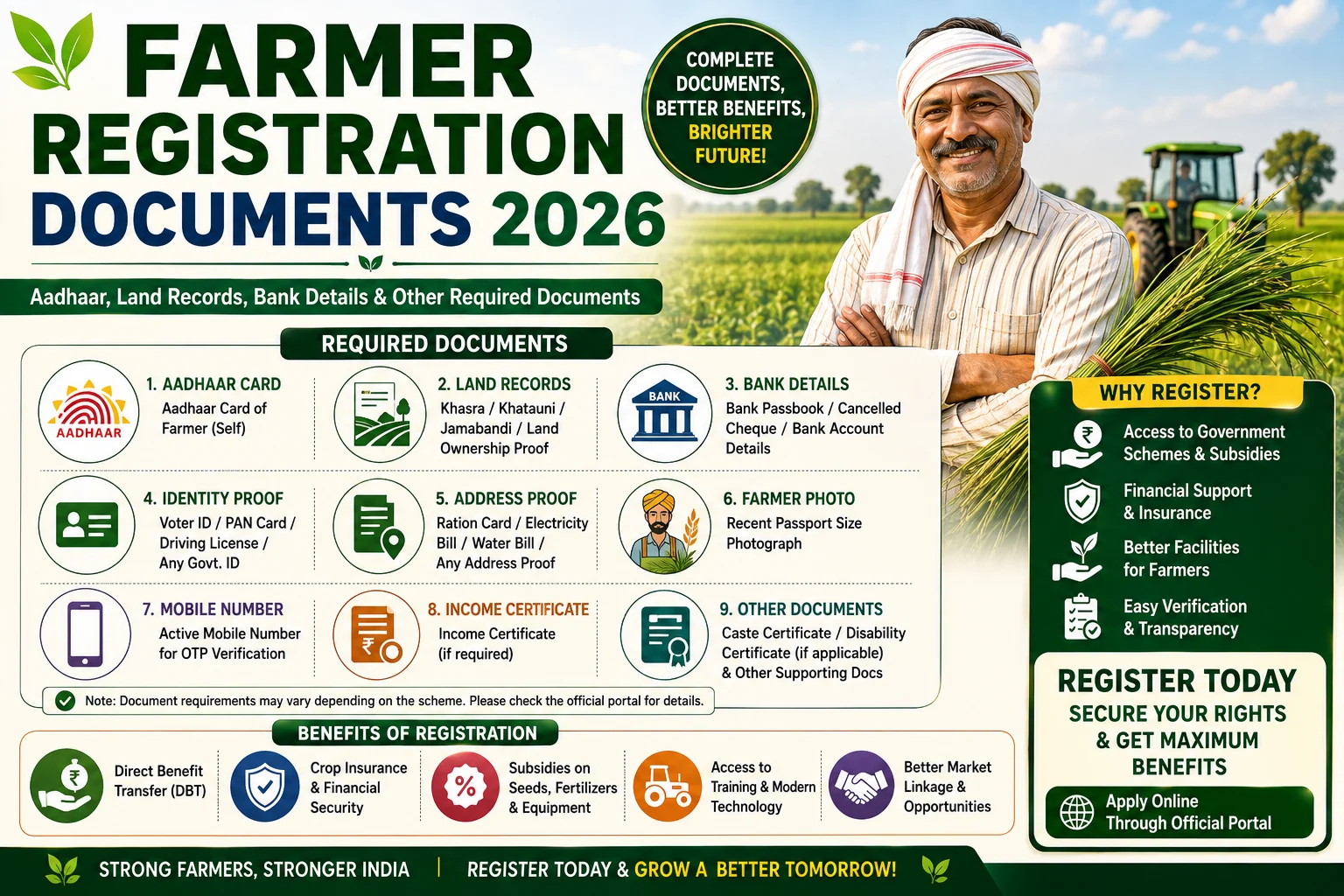
Farmer registration is an important process for farmers who want to access government agriculture schemes, subsidies, crop-related services, financial assistance, insurance, credit facilities, and digital farming services. In 2026, many government agriculture services increasingly use digital farmer databases and Farmer IDs to connect farmers with their land records and government benefits.
The exact documents required depend on the scheme, state and type of farmer registration. However, some documents are commonly requested across agriculture portals, including Aadhaar Card, mobile number, land ownership or cultivation records, bank account details, address proof and photographs.
The Government of India’s AgriStack Farmer Registry is designed to create a unique Farmer ID and link farmer information with farmland records for scheme delivery and agricultural services. The official AgriStack platform explains that the Farmer Registry is maintained by states according to common standards and is linked with farmland plot records.
Similarly, the current PM-KISAN farmer registration system requires Aadhaar authentication and asks for information such as Aadhaar number, mobile number and state.
This guide explains the Farmer Registration Documents 2026, including Aadhaar, land records, bank details, mobile number, income or category certificates, Farmer ID requirements, document verification and common reasons for rejection.
What is Farmer Registration?
Farmer registration is the process of recording a farmer’s identity and agricultural information on a government agriculture portal or Farmer Registry.
Depending on the state and scheme, registration can connect details such as:
- Farmer’s identity
- Aadhaar
- Mobile number
- Address
- Land ownership
- Cultivated land
- Bank account
- Crop information
- Farmer ID
- Eligibility for government schemes
The objective is to make it easier for government departments to identify eligible farmers and deliver benefits directly.
Under AgriStack, each farmer is intended to receive a unique Farmer ID, while the Farmer Registry is linked with farmland plot records for purposes such as scheme delivery and agricultural services.
Farmer Registration Documents 2026: Quick List
| Document | Why It May Be Required |
|---|---|
| Aadhaar Card | Identity verification and eKYC |
| Mobile Number | OTP, alerts and communication |
| Land Records | Verification of land ownership/holding |
| Bank Passbook | Receiving eligible payments |
| IFSC Code | Bank transfer processing |
| Address Proof | State/residence verification |
| Passport-Size Photograph | Registration and identification |
| PAN Card | Required for some applications |
| Caste Certificate | Category-based benefits, where applicable |
| Income Certificate | Income-based schemes |
| Farmer ID | Identification after Farmer Registry registration |
| Lease/Cultivation Documents | For eligible cultivators where permitted |
| Crop Details | Crop-specific schemes and services |
Not every farmer will need every document. The final requirement should always be checked against the specific scheme or state portal.
1. Aadhaar Card
The Aadhaar Card is one of the most important documents for farmer registration in 2026.
Government agriculture services increasingly use Aadhaar-based authentication to verify the identity of beneficiaries.
For example, the current PM-KISAN registration form asks applicants to enter their Aadhaar number and states that Aadhaar is authenticated with UIDAI before the registration can proceed.
Aadhaar is Used For
- Identity verification
- eKYC
- Beneficiary authentication
- Preventing duplicate registrations
- Linking government benefits
- Farmer ID-related processes
Farmers should ensure that their name and other basic details are correct in Aadhaar.
2. Mobile Number
A valid mobile number is another important requirement.
The mobile number may be used for:
- OTP verification
- Registration confirmation
- Application updates
- Scheme notifications
- Farmer ID-related communication
- Payment-related information
The current PM-KISAN registration form asks for a mobile number along with Aadhaar and state details.
Farmers should preferably provide a mobile number that is regularly active and accessible to them.
3. Land Records
Land records are particularly important for farmer registration because many agricultural schemes are linked to landholding or cultivation.
Depending on the state, acceptable land-related documents can include:
- Record of Rights (RoR)
- Khasra/Khatauni
- Jamabandi
- 7/12 extract
- Patta
- Land ownership certificate
- Mutation records
- Digitized land records
- Other state-specific revenue records
The name of the land record varies from one state to another.
For PM-KISAN, the government uses the prevailing land ownership system/land records of states and Union Territories to identify eligible landholder farmer families.
Why Land Records Matter
Land records help authorities verify:
- Ownership
- Survey or plot number
- Area of land
- Location
- Landholder’s name
- Mutation status
- Eligibility for land-based benefits
Farmers should ensure that their land records are updated and that the name on the records matches their identity documents wherever required.
4. Bank Account Details
A farmer’s bank account details are important for receiving eligible government payments and subsidies.
Farmers may be asked to provide:
- Bank account number
- Bank name
- Branch name
- IFSC code
- Passbook copy
- Account holder’s name
The official PM-KISAN FAQ identifies Bank Account Number and IFSC Code among the mandatory information used for transfer of benefits, while mobile number is recommended where available.
Important Bank Account Tips
Before registration, check that:
- The account is active.
- The account holder’s name is correct.
- The account number is entered correctly.
- The IFSC code is accurate.
- The bank account is eligible for the intended payment mechanism.
- Aadhaar seeding requirements, where applicable, have been completed.
Incorrect bank details can cause payment failures even after a farmer has successfully registered.
5. Address Proof
Depending on the state or scheme, farmers may be asked for address or residence proof.
Possible documents include:
- Voter ID
- Ration Card
- Driving Licence
- Electricity bill
- Residence certificate
- Government-issued address proof
- Other documents accepted by the concerned authority
Address verification may be particularly important for state-specific agriculture schemes.
6. Passport-Size Photograph
Some farmer registration processes require a recent photograph.
The photograph may be used for:
- Farmer profile
- Identity verification
- Application records
- Farmer ID documentation
The required image size and format can vary between portals.
7. Farmer ID
The Farmer ID is becoming increasingly important under the AgriStack Farmer Registry.
AgriStack states that each farmer will be assigned a unique Farmer ID, based on Aadhaar as per the relevant framework, along with a digitally verifiable credential. The Farmer Registry is designed to connect the farmer with farmland plot records for scheme delivery and agricultural services.
However, farmers should understand that Farmer ID is generally an output of the Farmer Registry process rather than a document that a new applicant already possesses.
Some state Farmer Registry portals allow farmers to enroll, check enrollment status and view farmer details.
8. Income Certificate
An income certificate is not required for every farmer registration.
However, it may be required when applying for schemes where eligibility depends on:
- Annual family income
- Economic status
- Subsidy category
- Financial assistance
- Special welfare eligibility
Farmers should obtain the income certificate from the competent authority if the particular scheme requires it.
9. Caste Certificate
A caste certificate may be required for schemes that provide special benefits to:
- SC farmers
- ST farmers
- OBC farmers
- Other notified categories
If a farmer is applying for a category-specific subsidy or assistance programme, the relevant certificate should be valid and issued by the competent authority.
10. Cultivation or Lease Documents
Land ownership and cultivation are not always the same.
In some agricultural programmes, benefits may be available to eligible cultivators or tenant farmers depending on the scheme’s rules.
Where permitted, farmers may need documents such as:
- Registered lease agreement
- Cultivation certificate
- Tenant farmer certificate
- Sharecropper certificate
- Local agriculture department certification
This requirement is scheme-specific, so farmers should not assume that a tenant farmer is automatically eligible for every land-based government benefit.
11. Crop Details
Some registrations and agriculture schemes may ask for information about the crops being cultivated.
Details can include:
- Crop name
- Season
- Cultivated area
- Survey/plot number
- Irrigation status
- Sowing details
Crop information may be used for:
- Crop insurance
- Procurement
- Subsidies
- Agricultural advisories
- Crop surveys
- Disaster assistance
12. PAN Card
A PAN Card is not universally required for farmer registration.
However, it may be requested for certain:
- Business-related agriculture activities
- Higher-value transactions
- Entrepreneurship schemes
- Institutional registrations
- Specific subsidies or financial programmes
Farmers should submit PAN details only when the particular application requires them.
Farmer Registration for PM-KISAN
Farmers applying for PM-KISAN should pay particular attention to Aadhaar authentication, land-related eligibility and bank information.
The current PM-KISAN portal provides a New Farmer Registration facility and requires Aadhaar authentication.
The official portal also states that eKYC is mandatory for PM-KISAN registered farmers.
The PM-KISAN system provides facilities for:
- New Farmer Registration
- Self-registration
- CSC registration
- Registration status
- Updating missing information
- Mobile number updates
- Know Your Status
Farmer Registration Under AgriStack
AgriStack’s Farmer Registry is designed to create a standardized digital identity for farmers.
The system connects:
Farmer → Farmer ID → Land Records → Government Schemes & Services
The official AgriStack platform explains that the Farmer Registry is intended to contain minimal demographic information required for identification and eligibility determination, while being dynamically linked with farmland plot records.
This digital infrastructure is expected to make agricultural scheme delivery more efficient and reduce repeated submission of information across different government services.
How to Register as a Farmer in 2026
The process varies by state and scheme, but the general procedure is:
Step 1: Identify the Relevant Registration
Determine whether you need:
- PM-KISAN registration
- State Farmer Registration
- AgriStack Farmer Registry
- Farmer ID
- Crop registration
- Agriculture subsidy registration
Step 2: Keep Documents Ready
Prepare Aadhaar, land records, bank details, mobile number and other scheme-specific documents.
Step 3: Visit the Official Portal
Use the official government agriculture portal or your state’s Farmer Registry portal.
Step 4: Complete Aadhaar Verification
Where Aadhaar authentication is required, complete the prescribed eKYC or OTP/biometric process.
Step 5: Enter Farmer Details
Provide:
- Name
- Father’s/spouse’s name
- Date of birth
- Address
- Mobile number
- Land details
- Bank details
Step 6: Upload Documents
Upload the documents requested by the portal.
Step 7: Submit the Application
Review the information carefully and submit the registration.
Step 8: Complete Verification
The concerned department may verify land records, identity and other information.
Step 9: Receive Farmer ID
If the registration is under a Farmer Registry that generates an ID, the Farmer ID can be issued after successful enrollment and verification.
Step 10: Check Registration Status
Use the relevant portal’s status-check facility to monitor your registration.
Common Reasons for Farmer Registration Rejection
Farmers may face rejection or delays because of:
- Aadhaar details not matching.
- Incorrect name spelling.
- Land record not updated.
- Land record not matching the applicant.
- Incorrect bank account number.
- Wrong IFSC code.
- Inactive bank account.
- Missing documents.
- Duplicate registration.
- Incorrect mobile number.
- Unverified land ownership.
- Application submitted under the wrong category.
What to Do If Land Records Are Not in Your Name?
If the land record does not reflect the farmer’s current ownership, the farmer should first approach the appropriate revenue or land records authority for correction or mutation, as applicable.
For land-based schemes such as PM-KISAN, the state/UT land records are used to identify eligible landholder farmer families.
A farmer should not upload unrelated documents or make false ownership claims simply to complete registration.
What If the Bank Account Name and Aadhaar Name Are Different?
A mismatch between identity and bank details can cause verification or payment issues.
Farmers should check:
- Aadhaar name
- Bank account holder name
- Farmer registration name
- Land record name
If there is a genuine mismatch, it is advisable to have the relevant record corrected through the appropriate authority before applying for benefits.
Is Aadhaar Mandatory for Every Farmer Scheme?
No. Aadhaar requirements depend on the particular scheme and applicable government rules.
However, Aadhaar authentication is an important part of several current farmer services. For example, the PM-KISAN registration portal requires Aadhaar authentication, and eKYC is mandatory for registered PM-KISAN farmers.
Farmers should always check the specific scheme’s official requirements.
Frequently Asked Questions (FAQs)
What are the main documents required for farmer registration in 2026?
The commonly required documents include Aadhaar Card, mobile number, land records, bank account details, IFSC code, address proof and photograph. Additional documents depend on the state and scheme.
Is Aadhaar mandatory for farmer registration?
Aadhaar is required for several farmer services and schemes. For example, the current PM-KISAN registration process requires Aadhaar authentication.
Which land documents are required?
The exact document varies by state. It may include Record of Rights, Khasra/Khatauni, Jamabandi, 7/12 extract, Patta, mutation records or other officially recognized land records.
Is a bank account required?
For schemes involving direct financial benefits, bank account details are generally required. PM-KISAN’s official information includes bank account number and IFSC code among the beneficiary information used for benefit transfers.
What is Farmer ID?
Farmer ID is a unique digital identifier being created under the AgriStack Farmer Registry. It is designed to connect farmer information with farmland records and facilitate access to government schemes and agricultural services.
Can tenant farmers register?
Tenant and cultivator eligibility varies according to the particular scheme and state. Land ownership is a specific eligibility condition for some schemes, while other programmes may recognize eligible cultivators under their own rules.
What should I do if my land records contain an error?
Contact the appropriate state revenue or land records authority and request correction or mutation according to the applicable procedure.
Can I register without a mobile number?
Some registration systems may have different requirements, but a mobile number is strongly useful for OTP verification, notifications and communication. The current PM-KISAN registration form specifically asks for a mobile number.
How can I check my farmer registration status?
The relevant state Farmer Registry or scheme portal generally provides a status-check facility. PM-KISAN, for example, provides facilities to check self-registration and Farmer/CSC registration status.
Conclusion
The Farmer Registration Documents 2026 generally revolve around four important categories: identity, land, banking and contact information. Aadhaar helps establish identity, land records verify agricultural holdings where required, bank details enable eligible government payments, and a mobile number facilitates OTP verification and communication.
With the expansion of AgriStack and Farmer Registry systems, Farmer ID and digitally linked land information are becoming increasingly important for accessing agricultural schemes and services.
Farmers should keep their Aadhaar, land records, bank account and mobile number updated and ensure that names and other details are consistent across documents. Since requirements can differ between states and schemes, the safest approach is to check the latest official notification before submitting an application.
Read More: Delhi Widow Pension Scheme 2026: Eligibility, ₹2,500 Monthly Pension, Documents & Apply Online