Farmer Bank Account and Direct Benefit Transfer (DBT) registration are important for farmers who want to receive government subsidies, financial assistance, agricultural incentives, insurance benefits, and payments directly into their bank accounts. In 2026, several agriculture-related government schemes use digital beneficiary databases, Aadhaar authentication, bank-account verification, and DBT mechanisms to transfer eligible benefits.
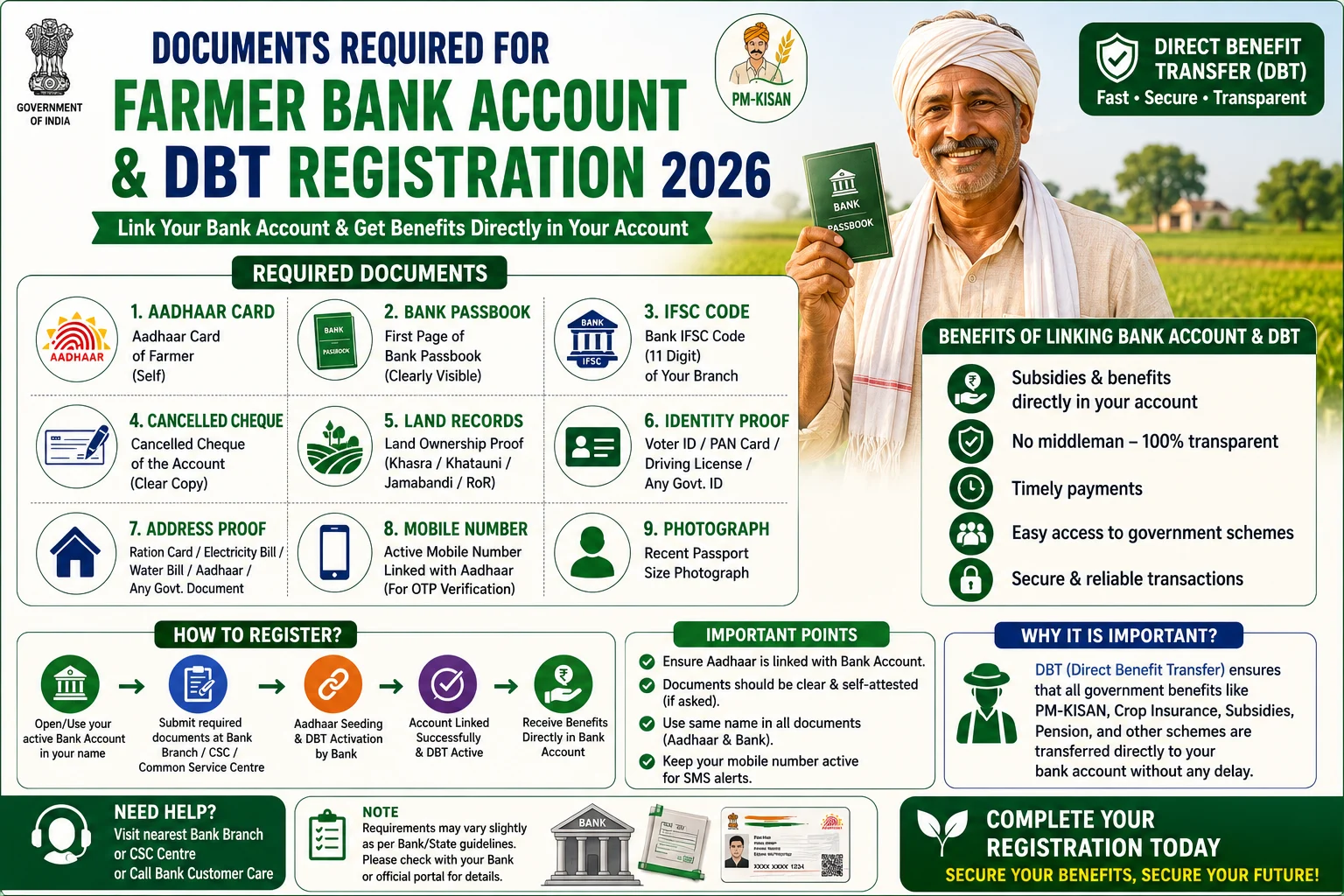
The documents required can vary depending on the government scheme, state, agriculture department, bank and type of benefit. However, farmers generally need a valid Aadhaar Card, mobile number, bank account details, passbook, IFSC code and land-related information. Additional documents such as residence proof, Farmer ID, land records, caste certificate or income certificate may be required for particular schemes.
The Government of India’s DBT system supports Aadhaar-linked services and provides facilities related to bank account-Aadhaar linking status and Aadhaar-enabled services. Its DBT payment guidelines also state that bank account details should ideally be captured when a beneficiary is enrolled and that beneficiary records may be validated through bank-account validation or Aadhaar validation through the NPCI mapper.
For agriculture beneficiaries, the PM-KISAN registration system is one example where Aadhaar authentication is required during new farmer registration, while bank and other beneficiary details are used for benefit delivery.
This guide explains the Documents Required for Farmer Bank Account & DBT Registration 2026, including Aadhaar, bank passbook, account number, IFSC, mobile number, land records, Farmer ID, Aadhaar seeding, DBT activation, common errors and the registration process.
What is Farmer Bank Account & DBT Registration?
Farmer bank account registration means providing and verifying a farmer’s banking details so that eligible government benefits can be transferred directly to the farmer’s account.
DBT, or Direct Benefit Transfer, is a government mechanism through which eligible benefits are transferred directly to beneficiaries instead of being distributed through multiple intermediaries.
For farmers, DBT may be used for eligible:
- Agriculture subsidies
- Farmer assistance
- Input subsidies
- Crop-related payments
- Fertilizer-related benefits
- Insurance-related claims
- Government incentives
- Welfare payments
- Scheme-specific financial assistance
The exact benefit and payment method depend on the individual government scheme.
Farmer Bank Account & DBT Documents 2026: Quick List
| Document/Information | Main Purpose |
|---|---|
| Aadhaar Card | Identity and authentication |
| Mobile Number | OTP and communication |
| Bank Passbook | Account verification |
| Bank Account Number | Receiving DBT payments |
| IFSC Code | Identifying the bank branch |
| Aadhaar-Bank Seeding | Enabling applicable Aadhaar-based payments |
| Land Records | Farmer/land verification where required |
| Farmer ID | Digital farmer identification where applicable |
| Address Proof | State/residence verification |
| Passport-Size Photograph | Identification where required |
| PAN Card | Certain financial/business applications |
| Caste Certificate | Category-specific benefits |
| Income Certificate | Income-based schemes |
| Cultivation/Lease Proof | Applicable cultivator-based schemes |
Not every farmer needs to submit all these documents. The final requirement depends on the scheme and state.
1. Aadhaar Card
The Aadhaar Card is one of the most important documents for farmer DBT registration.
Aadhaar may be used for:
- Identity verification
- eKYC
- Beneficiary authentication
- Eliminating duplicate records
- Linking farmer records
- Accessing Aadhaar-enabled DBT services
For example, the current PM-KISAN New Farmer Registration portal requires the farmer to enter an Aadhaar number and states that the Aadhaar number is authenticated with UIDAI before registration can proceed.
Farmers should ensure that their Aadhaar details are correct, particularly:
- Name
- Date of birth
- Gender
- Address
- Mobile number, where applicable
A mismatch between Aadhaar and other government records can sometimes result in verification problems.
2. Mobile Number
A valid mobile number should be kept ready during farmer bank account and DBT registration.
The mobile number may be used for:
- OTP verification
- Registration confirmation
- Application updates
- Payment notifications
- Scheme-related communication
- eKYC-related services
The current PM-KISAN registration form specifically asks for the farmer’s mobile number along with Aadhaar number and State.
Farmers should preferably provide a mobile number that remains active and accessible to them.
3. Bank Passbook
A bank passbook is commonly used to verify the farmer’s bank account information.
The passbook normally contains:
- Account holder’s name
- Account number
- Bank name
- Branch
- IFSC code
- Other account information
Farmers should keep a recent and clearly readable copy of their passbook if a scheme requires document upload or physical verification.
The name printed in the bank passbook should ideally match the farmer’s name in Aadhaar and the relevant beneficiary records.
4. Bank Account Number
The bank account number is essential when the government benefit is transferred directly to the farmer’s bank account.
Farmers should carefully enter the complete account number without:
- Missing digits
- Extra digits
- Spaces where not permitted
- Incorrect characters
An incorrect account number can result in payment failure or rejection during bank verification.
The DBT payment procedure recognizes bank-account validation as one of the methods used to validate beneficiary registration.
5. IFSC Code
The Indian Financial System Code (IFSC) identifies a particular bank branch.
Farmers may be asked to provide the IFSC code during registration for:
- DBT payments
- Subsidy applications
- Agriculture schemes
- Government financial assistance
The IFSC should be taken from the latest bank passbook, bank statement or official bank source.
Farmers should be careful if their bank branch has recently changed or merged because the IFSC may have been updated.
6. Aadhaar-Bank Account Linking or Seeding
For applicable DBT systems, farmers may need to ensure that their Aadhaar is properly linked or seeded with the bank account.
The Government of India’s DBT portal provides a facility for checking Citizen’s Bank Account-Aadhaar linking status and information relating to Aadhaar seeding on the NPCI mapper.
Aadhaar-bank linking and Aadhaar seeding should not be treated as exactly the same technical process in every context. Farmers should follow the instructions given by their bank and the particular government scheme.
How to Check
Farmers can:
- Contact their bank branch.
- Ask whether Aadhaar is linked with the account.
- Ask whether the account is seeded for the applicable DBT mechanism.
- Check the relevant DBT/Aadhaar status facility where available.
- Correct any mismatch before applying for benefits.
7. Land Records
Land records may be required for agriculture schemes where eligibility is connected with land ownership or cultivation.
Common land documents include:
- Khasra
- Khatauni
- Jamabandi
- Record of Rights
- 7/12 extract
- Patta
- Mutation record
- Land ownership certificate
- Digitized land record
- Other state-specific revenue records
The exact document differs between states.
For example, PM-KISAN uses the prevailing land ownership records of the respective States/UTs to identify eligible landholding farmer families.
Land records may therefore be required even when the primary purpose of the application is to receive a DBT payment.
8. Farmer ID
A Farmer ID is becoming increasingly important as digital agricultural registries develop.
The current PM-KISAN registration portal includes a facility related to Farmer ID creation when an applicant’s Farmer ID has not yet been generated.
Farmer ID can help connect a farmer’s digital identity with agricultural information and relevant government services.
Farmers should therefore follow the Farmer ID creation instructions shown on the relevant official portal whenever required.
9. Address or Residence Proof
Some state-specific farmer registration and DBT schemes may require proof that the applicant is a resident of the concerned state or locality.
Possible documents include:
- Voter ID
- Ration Card
- Residence certificate
- Driving Licence
- Electricity bill
- Government-issued address proof
The requirement depends on the particular scheme.
For Central Government schemes, state residence may not always be a separate eligibility condition, while state government schemes may require it.
10. Passport-Size Photograph
Some farmer registration processes may require a recent photograph.
A photograph can be used for:
- Farmer profile
- Application verification
- Physical registration
- CSC-based registration
- Department records
The exact size and format depend on the portal or registration centre.
11. PAN Card
A PAN Card is not required for every farmer bank account or DBT registration.
It may be required for certain:
- Agriculture businesses
- Financial transactions
- Entrepreneurship programmes
- Institutional registrations
- Tax-related requirements
- Specific government schemes
Farmers should provide PAN details only when the relevant application requires them.
12. Caste Certificate
A caste certificate may be required when applying for schemes that provide special benefits to eligible categories.
These may include schemes for:
- Scheduled Castes
- Scheduled Tribes
- OBC communities
- Other notified categories
A caste certificate is not a universal requirement for all farmer DBT registrations.
13. Income Certificate
An income certificate may be required for schemes where benefits depend on the farmer’s or family’s financial condition.
It may be requested for:
- Income-based subsidies
- Financial assistance
- Special welfare schemes
- Category-specific programmes
- Certain agriculture support programmes
However, an income certificate is not automatically required for every DBT registration.
14. Cultivation or Lease Documents
Land ownership and cultivation can sometimes be different.
Certain state-level schemes may provide benefits to eligible cultivators, tenant farmers or sharecroppers subject to their own rules.
Where permitted, farmers may be asked for:
- Lease agreement
- Cultivation certificate
- Tenant farmer certificate
- Sharecropper certificate
- Agriculture department certificate
Farmers should check the scheme’s rules before assuming that tenant or leased land automatically qualifies for a benefit.
Bank Account Requirements for DBT
Having a bank account alone does not always guarantee successful DBT payment.
Farmers should verify:
- Account is active.
- Account holder name is correct.
- Account number is accurate.
- IFSC code is correct.
- Aadhaar linkage requirements are completed where applicable.
- Account is eligible for the relevant payment mechanism.
- There are no restrictions preventing government credit.
- Beneficiary details match the scheme records.
The DBT payment SOP states that bank account details should ideally be collected during beneficiary enrollment and describes bank account or Aadhaar validation as part of beneficiary validation.
How to Open a Farmer Bank Account for DBT
Farmers who do not already have a suitable bank account can visit a bank branch or use an applicable banking service to open an account.
Generally, the bank may require:
- Aadhaar Card
- PAN Card, where applicable
- Photograph
- Mobile number
- Address proof
- Other KYC documents prescribed by the bank
After opening the account, the farmer should ask the bank about the procedure for linking Aadhaar and enabling applicable DBT services.
How to Register Bank Details for DBT
The exact procedure differs according to the scheme.
A general process is:
Step 1: Identify the Scheme
Find out which government scheme you want to receive the benefit from.
Step 2: Check Eligibility
Read the latest eligibility requirements.
Step 3: Prepare Documents
Keep Aadhaar, bank passbook, account number, IFSC, mobile number and scheme-specific documents ready.
Step 4: Verify Bank Details
Check the account number and IFSC carefully.
Step 5: Complete Aadhaar Authentication
Complete Aadhaar authentication or eKYC if required.
Step 6: Submit Bank Details
Enter or submit your bank account information through the official scheme portal or designated office.
Step 7: Complete Verification
The concerned department and/or payment system may verify the submitted information.
Step 8: Check DBT Status
Once registered, farmers should monitor the scheme’s beneficiary/payment status.
PM-KISAN and Farmer DBT Registration
PM-KISAN is one of the most widely known agricultural DBT-linked schemes.
The current PM-KISAN registration system requires:
- Aadhaar number
- Mobile number
- State
- Aadhaar authentication
The portal also provides Farmer ID-related functionality.
Farmers can also check the status of self-registered farmers or farmers registered through CSC using the official PM-KISAN status facility.
However, PM-KISAN is only one example. Other agriculture schemes can have different registration and banking requirements.
Common Reasons for DBT Payment Failure
Farmers may experience DBT payment problems because of:
Incorrect Account Number
One wrong digit can prevent the payment from reaching the intended account.
Incorrect IFSC
An outdated or incorrect IFSC can cause transaction problems.
Aadhaar Not Linked
The required Aadhaar-bank linkage may not have been completed.
NPCI Mapping Issue
Where Aadhaar-based payment routing is applicable, the required NPCI mapper status may need correction.
Name Mismatch
The farmer’s name may differ between Aadhaar, bank records and scheme records.
Inactive Bank Account
An inactive or closed account can prevent successful credit.
Incorrect Farmer Details
Incorrect registration information can delay beneficiary verification.
eKYC Not Completed
For schemes where eKYC is mandatory, pending eKYC can affect benefit processing.
What to Do If DBT Payment Is Not Received?
If an eligible farmer has not received a government benefit, the farmer should:
- Check the scheme’s beneficiary status.
- Verify the bank account number.
- Confirm the IFSC code.
- Check Aadhaar-bank linkage where applicable.
- Ask the bank about DBT/Aadhaar seeding status.
- Check whether eKYC is complete.
- Verify land and beneficiary details.
- Contact the concerned agriculture department or scheme helpdesk.
- Submit a grievance if the official portal provides the facility.
For PM-KISAN, the official portal provides registration status and other beneficiary-information services.
Important Difference Between Aadhaar Linking and DBT
Farmers often use the terms Aadhaar linking, Aadhaar seeding and DBT activation interchangeably, but they can refer to different steps in the payment process.
A farmer may need to ensure that:
- Aadhaar is correctly recorded.
- Aadhaar authentication is successful.
- The bank has completed the required linking/seeding process.
- The account is eligible for the applicable payment method.
- The government scheme has the correct beneficiary bank details.
The exact technical requirement depends on the payment mechanism used by the scheme.
Tips to Avoid DBT Registration Problems
Farmers should follow these precautions:
- Keep Aadhaar details updated.
- Keep the bank account active.
- Verify account number before submission.
- Check the latest IFSC.
- Ask the bank about Aadhaar seeding.
- Keep the mobile number active.
- Ensure land records are updated.
- Complete mandatory eKYC.
- Avoid duplicate registrations.
- Keep copies of applications and acknowledgement receipts.
- Use only official government portals.
- Check beneficiary status regularly.
Frequently Asked Questions (FAQs)
What documents are required for farmer bank account and DBT registration?
The commonly required documents include Aadhaar Card, mobile number, bank passbook, bank account number and IFSC code. Land records, Farmer ID, residence proof and other documents may be required depending on the scheme.
Is Aadhaar mandatory for DBT?
Aadhaar requirements depend on the particular scheme and payment mechanism. Several government benefit programmes use Aadhaar authentication or Aadhaar-enabled services. For example, PM-KISAN’s current new farmer registration requires Aadhaar authentication.
Is a bank account necessary for farmer DBT?
For benefits transferred directly into a bank account, valid bank-account details are necessary. The Government of India’s DBT payment procedure specifically provides for bank-account validation during beneficiary registration.
What bank details are required?
Farmers may generally need to provide the account holder’s name, bank account number, bank name, branch and IFSC code.
What is Aadhaar seeding?
Aadhaar seeding refers to linking Aadhaar information with the bank/payment system in the manner required for applicable Aadhaar-based services. Farmers can check relevant Aadhaar-bank linking information through the DBT ecosystem or their bank.
What is Farmer ID?
Farmer ID is a digital farmer identifier used in emerging agricultural digital-registration systems. The current PM-KISAN portal includes a process for Farmer ID creation where one has not been generated.
Can I use any bank account for DBT?
The account must meet the requirements of the particular government scheme and payment mechanism. Farmers should confirm that the account is active and properly registered for the applicable benefit.
What should I do if my bank account has changed?
Update the bank details through the official scheme portal or the prescribed department/channel. Do not rely on unofficial agents to change beneficiary banking information.
Can a farmer use a joint bank account?
The acceptability of a joint account depends on the particular scheme and its beneficiary-payment rules. Farmers should confirm the requirement with the concerned scheme or bank.
How can I check whether Aadhaar is linked to my bank account?
Farmers can contact their bank and use available government/DBT facilities for checking Aadhaar-bank linking status where supported. The DBT portal provides a Citizen’s Bank Account-Aadhaar linking status facility.
What happens if my name is different on Aadhaar and bank records?
A name mismatch can create verification or payment issues. The farmer should contact the concerned bank or authority and have the relevant records corrected before relying on the account for DBT payments.
Conclusion
The Documents Required for Farmer Bank Account & DBT Registration 2026 mainly include Aadhaar Card, mobile number, bank passbook, bank account number and IFSC code. Depending on the agricultural scheme, farmers may also need land records, Farmer ID, address proof, cultivation documents, income certificates or category certificates.
Keeping bank and identity information accurate is particularly important because government DBT systems use beneficiary validation to ensure that financial assistance reaches the correct person. The Government of India’s DBT guidelines recognize bank-account validation and Aadhaar-based validation as important parts of beneficiary registration and payment processing.
Farmers should also check Aadhaar-bank linking or seeding requirements where applicable, keep their bank account active, complete mandatory eKYC for schemes such as PM-KISAN, and regularly check their beneficiary or payment status. The current PM-KISAN portal, for example, requires Aadhaar authentication during new farmer registration and provides online status facilities for registered farmers.
Because DBT requirements differ across schemes and states, farmers should always follow the latest instructions published by the concerned government department, agriculture portal, bank or official scheme website.