Organic farming is receiving increasing attention as farmers, consumers and governments focus on soil health, sustainable agriculture, reduced chemical use and better-quality agricultural produce. To encourage farmers to adopt organic practices, the Government of India and State Governments implement different programmes that provide support for organic inputs, certification, training, cluster development, demonstrations, value-chain development and other activities.
For farmers looking for an organic farming subsidy in 2026, it is important to understand that there is no single universal application form or document list for every organic farming subsidy in India. Requirements depend on the particular scheme, state, implementing department, type of organic farming activity and whether the applicant is an individual farmer, farmer group, FPO, cooperative or another eligible organization.
One of the important national programmes is the Paramparagat Krishi Vikas Yojana (PKVY), which promotes organic farming and PGS-India certification. The Delhi Government’s current scheme page also lists PKVY as a programme supporting organic farming and soil health.
Other organic-farming support programmes may cover different activities, including organic inputs, certification, training, processing, marketing and value-chain development. Therefore, farmers should first identify the exact subsidy or programme before preparing their documents.
This guide explains the Documents Required for Organic Farming Subsidy 2026, including Aadhaar, land records, bank details, Farmer ID, photographs, cultivation records, certification documents, group documents and other paperwork that may be required.
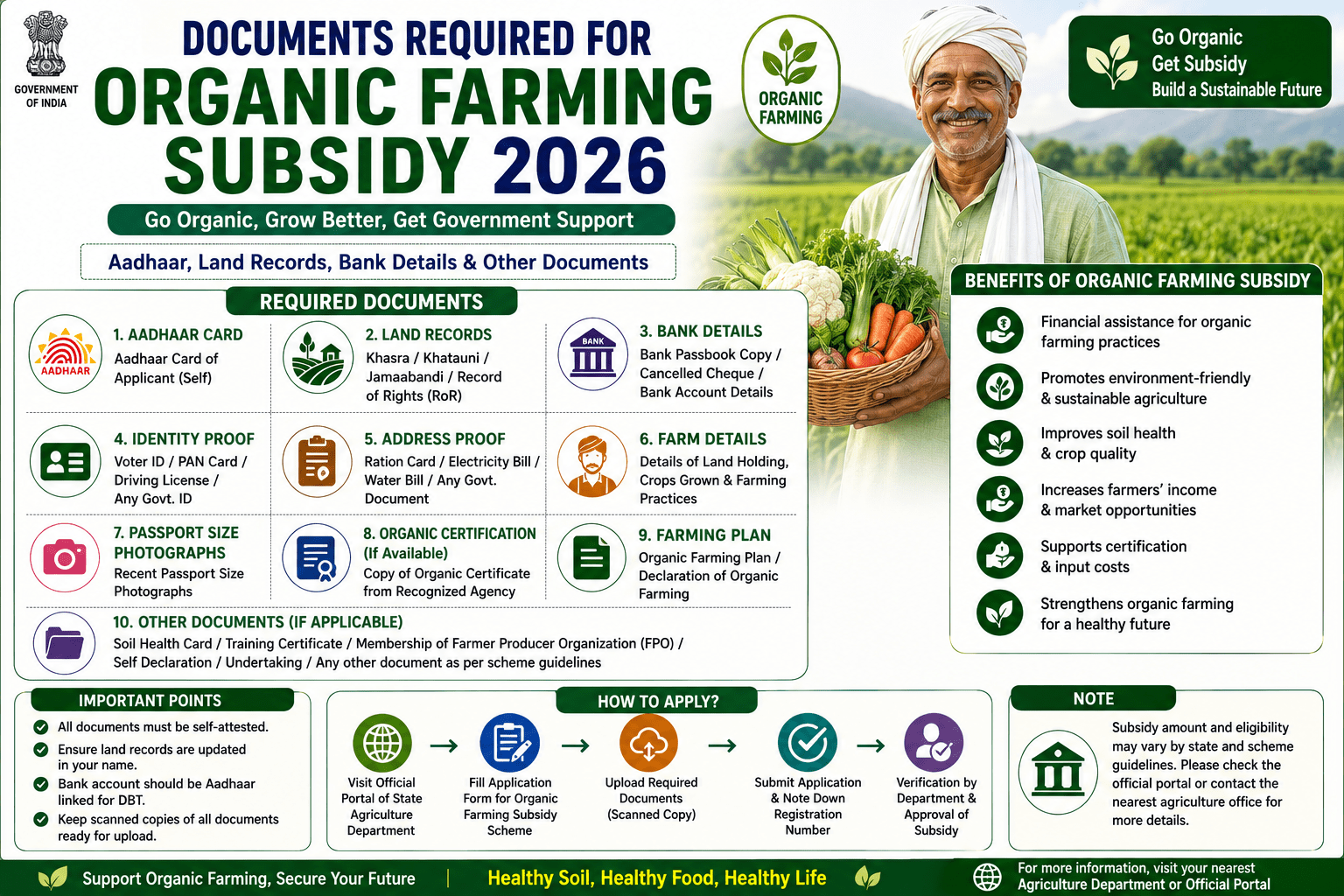
Organic Farming Subsidy Documents 2026: Quick List
| Document | Purpose |
|---|---|
| Aadhaar Card | Identity verification |
| Mobile Number | OTP and communication |
| Bank Passbook | Bank-account verification |
| Bank Account Number | Receiving subsidy/assistance |
| IFSC Code | Electronic fund transfer |
| Land Records | Ownership/holding verification |
| Farmer ID | Digital farmer identification, where applicable |
| Address/Residence Proof | State or local eligibility |
| Passport-Size Photograph | Applicant identification |
| Cultivation Records | Verification of farming activity |
| Organic Certification/Registration | Certification-related programmes |
| Soil Test Report | Required for some agricultural programmes |
| Lease/Cultivation Proof | For eligible tenant cultivators, where permitted |
| Caste Certificate | Category-based assistance, where applicable |
| Income Certificate | Income-based schemes, where applicable |
| FPO/Group Registration | Group or collective applications |
| Project Report | Commercial or infrastructure-related assistance |
| Bills/Invoices | Reimbursement-based assistance, where applicable |
Not every applicant will need all of these documents. The final checklist should be confirmed from the latest notification of the particular scheme.
What is Organic Farming Subsidy?
Organic farming subsidy refers to financial or material support provided under government programmes to encourage farmers to adopt organic and sustainable agricultural practices.
Depending on the programme, assistance may support:
- Organic inputs
- Bio-fertilizers
- Bio-pesticides
- Compost
- Organic manure
- Training
- Certification
- Demonstration plots
- Cluster development
- Quality improvement
- Packaging
- Processing
- Marketing
- Farmer Producer Organizations
- Organic value chains
The Paramparagat Krishi Vikas Yojana is specifically intended to promote organic farming and improve soil health. It promotes the Participatory Guarantee System for India (PGS-India), a group-based approach to organic certification.
1. Aadhaar Card
The Aadhaar Card is one of the most commonly requested identity documents for farmer-related government schemes.
Aadhaar may be used for:
- Identity verification
- eKYC
- Beneficiary identification
- Preventing duplicate applications
- Linking farmer records
- Digital registration
Farmers should make sure that the name and basic information in Aadhaar are accurate.
If the farmer’s name differs significantly between Aadhaar and land or bank records, the application may require additional verification or correction.
2. Mobile Number
An active mobile number should be kept ready.
It may be used for:
- OTP verification
- Registration
- Application updates
- Subsidy-related notifications
- Department communication
- Farmer ID-related services
Farmers should preferably provide a mobile number that they regularly use.
3. Bank Passbook
A copy of the farmer’s bank passbook may be required when applying for financial assistance or subsidy.
The passbook helps verify:
- Account holder’s name
- Bank name
- Account number
- Branch
- IFSC code
Farmers should ensure that the bank account is active and belongs to the applicant or the beneficiary recognized under the scheme.
4. Bank Account Number
A valid bank account is important when the subsidy or financial assistance is transferred through DBT.
The applicant should carefully enter:
- Account number
- Account holder name
- Bank name
- Branch
- IFSC code
One incorrect digit can result in payment failure.
Farmers should check the account details against the latest bank passbook or official bank statement before submitting the application.
5. IFSC Code
The IFSC code identifies the bank branch used for electronic fund transfers.
It may be required for:
- Direct Benefit Transfer
- Subsidy payments
- Financial assistance
- Reimbursement
Farmers should use the latest IFSC because bank mergers or branch changes can result in an updated code.
6. Land Ownership Records
Land records are among the most important documents for agricultural subsidy applications.
Depending on the state, farmers may need:
- Khasra
- Khatauni
- Jamabandi
- Record of Rights
- 7/12 extract
- Patta
- Mutation record
- Land ownership certificate
- Digitized land record
The exact name varies from state to state.
Land records can establish:
- Ownership
- Plot number
- Area of land
- Location
- Cultivation details
- Land category
Farmers should ideally ensure that their land records are updated before applying.
7. Farmer ID
A Farmer ID is becoming increasingly important as agricultural services move toward digital farmer registries.
Where a state or scheme has implemented a Farmer Registry, the applicant may be asked to provide an existing Farmer ID or complete Farmer ID registration.
The current PM-KISAN registration system, for example, includes Farmer ID-related functionality.
However, Farmer ID requirements differ between schemes and states.
8. Address or Residence Proof
State-level organic farming programmes may require proof that the farmer is a resident of the concerned state.
Possible documents include:
- Voter ID
- Aadhaar Card
- Ration Card
- Residence certificate
- Driving Licence
- Government-issued address proof
The requirement depends on the implementing authority.
9. Passport-Size Photograph
A recent photograph may be required for:
- Application forms
- Farmer registration
- Physical verification
- Farmer profile
- Department records
Farmers should keep a few recent photographs available when applying through an agriculture department, CSC or other physical registration centre.
10. Cultivation Proof
Some programmes may require evidence that the applicant is actually engaged in farming.
Possible documents can include:
- Land records
- Crop records
- Cultivation certificate
- Agriculture department certificate
- Lease document
- Tenant farmer certificate
- Other accepted evidence of agricultural activity
The exact requirement depends on whether the scheme is based on land ownership, cultivation or participation in an organic farming cluster.
11. Organic Certification Documents
If the subsidy or programme specifically involves certified organic production, certification-related documents may be required.
Depending on the certification system, applicants may need:
- Organic certification application
- Registration with the certification system
- Farm details
- Organic management plan
- Certification records
- Inspection records
- Certificate issued by the authorized certification body
PKVY promotes PGS-India certification, which is based on a participatory approach involving producers and consumers rather than conventional third-party certification.
For export-oriented organic production, the applicable certification framework can be different.
Farmers should therefore not assume that PGS-India certification and NPOP certification are interchangeable.
12. Soil Test Report
A soil test report may be requested for certain agricultural programmes.
It can provide information about:
- Soil pH
- Nutrient status
- Organic matter
- Soil fertility
- Recommended soil management
Although a soil test report is not necessarily mandatory for every organic farming subsidy, farmers should keep it available if the particular programme requires soil assessment.
13. Lease or Tenant Farmer Documents
If the applicant is cultivating land that they do not own, the scheme may require proof of lawful cultivation or tenancy where tenant farmers are eligible.
Possible documents include:
- Registered lease agreement
- Cultivation certificate
- Tenant farmer certificate
- Sharecropper certificate
- Local agriculture department verification
This is highly scheme-specific.
Farmers should check the eligibility conditions before applying because some land-based schemes are restricted to landowners.
14. Caste Certificate
A caste certificate may be required when a programme provides additional assistance to specified categories.
It can be relevant for eligible:
- SC farmers
- ST farmers
- OBC farmers
- Other notified categories
A caste certificate is not a universal requirement for organic farming subsidy applications.
15. Income Certificate
An income certificate may be required where the particular scheme has an income-based eligibility condition.
It may be used to establish:
- Annual family income
- Economic status
- Eligibility for additional assistance
- Priority category
Farmers should obtain the certificate from the competent authority if specifically required.
16. FPO or Farmer Group Documents
Organic farming programmes can also operate through farmer groups, clusters, cooperatives and Farmer Producer Organizations (FPOs).
For group applications, additional documents may include:
- FPO registration certificate
- Society registration certificate
- Cooperative registration
- Memorandum/bye-laws
- List of members
- Member Aadhaar details
- Bank account details
- Authorized representative details
- Board resolution
- Cluster details
The requirement depends on the programme.
17. Project Report
A project report may be required if the subsidy is related to a commercial organic farming activity or infrastructure project.
The report may contain:
- Applicant details
- Land details
- Type of organic activity
- Proposed investment
- Organic inputs
- Equipment
- Estimated cost
- Expected production
- Marketing plan
- Financial projections
- Implementation timeline
A project report is more likely to be required for larger infrastructure or enterprise-oriented support than for a basic farmer registration.
18. Bills and Invoices
Some subsidy programmes operate on a reimbursement or expenditure-verification basis.
In such cases, applicants may need:
- Purchase bills
- GST invoices
- Equipment invoices
- Input purchase receipts
- Vendor details
- Payment proof
Farmers should keep original bills safely and purchase eligible items only from authorized vendors where the scheme requires it.
19. Training or Certification Records
Some organic farming programmes provide training and capacity-building support.
Where applicable, farmers may be asked to provide:
- Training certificate
- Organic farming course certificate
- Participation record
- Cluster training record
- Certification-related documents
These requirements vary significantly between programmes.
Organic Farming Subsidy Schemes in India
Farmers should understand that organic farming support is provided through multiple programmes rather than one universal subsidy.
Paramparagat Krishi Vikas Yojana
PKVY is an important programme for promoting organic farming. The Delhi Government’s current page describes it as a scheme aimed at supporting and promoting organic farming and improving soil health. It also promotes PGS-India certification.
Mission Organic Value Chain Development for North Eastern Region
MOVCDNER is focused specifically on the North Eastern Region and supports organic value-chain development.
Its assistance can involve different components related to:
- Organic inputs
- Certification
- Farmer groups
- Value chains
- Processing
- Marketing
Therefore, documentation can differ from PKVY.
National Mission on Natural Farming
Natural farming is related to sustainable agricultural practices but should not automatically be treated as identical to certified organic farming.
The Government has also implemented the National Mission on Natural Farming (NMNF) and developed an online monitoring portal for implementation.
Farmers should check whether the benefit they are applying for relates to organic farming, natural farming, or another agricultural programme.
How to Apply for Organic Farming Subsidy 2026
The process depends on the particular scheme and state.
A general process may look like this:
Step 1: Identify the Scheme
First determine which organic farming programme applies to you.
Step 2: Check Eligibility
Read the latest eligibility conditions.
Step 3: Prepare Documents
Keep Aadhaar, land records, bank details, mobile number and other scheme-specific documents ready.
Step 4: Register as a Farmer
Complete Farmer Registry or agriculture-department registration if required.
Step 5: Join a Cluster or Group
If the programme operates through clusters, join the designated organic farming cluster or farmer group.
Step 6: Complete Certification Requirements
Complete PGS-India or another applicable certification process where required.
Step 7: Submit Application
Submit the subsidy or assistance application through the official agriculture portal, department office, cluster authority or other prescribed channel.
Step 8: Verification
The concerned officials may verify:
- Farmer identity
- Land
- Cultivation
- Organic farming activity
- Documents
- Bank information
Step 9: Approval
After successful verification, the application is approved according to the scheme’s guidelines.
Step 10: Receive Assistance
Eligible assistance may be provided through DBT, reimbursement, input support or another approved mechanism.
The Delhi Government’s current PKVY page directs applicants to the scheme’s detailed application information rather than providing a single universal online application form.
Important Checks Before Applying
Farmers should verify the following before submitting an application:
- Is the scheme available in your state?
- Are individual farmers eligible?
- Is land ownership mandatory?
- Are tenant farmers eligible?
- Is organic certification required?
- Is cluster membership required?
- Is Farmer ID required?
- Is Aadhaar authentication required?
- Is DBT mandatory?
- Is a bank account required in the beneficiary’s name?
- Are only approved inputs eligible?
- Is prior approval required before purchasing equipment or inputs?
- Are bills required?
- Is physical inspection required?
These questions can prevent farmers from spending money on activities that may not qualify for assistance.
Common Reasons for Rejection
Organic farming subsidy applications can face delays or rejection because of:
- Incorrect Aadhaar details
- Land record mismatch
- Incomplete bank details
- Invalid IFSC code
- Missing certification documents
- Incomplete application
- Ineligible land
- Missing cluster registration
- Unverified cultivation details
- Purchase from an unauthorized vendor
- Missing invoices
- Applying after the deadline
- Failure to meet scheme-specific eligibility conditions
Tips to Get Documents Ready
Farmers can prepare in advance by keeping a digital and physical file containing:
- Aadhaar Card
- Land records
- Bank passbook
- Mobile number
- Farmer ID
- Address proof
- Photographs
- Organic certification documents
- Soil report
- Cultivation documents
- Relevant certificates
- Purchase bills
Digital copies should be clear and readable, while original documents should be retained safely for verification.
Frequently Asked Questions (FAQs)
What documents are required for organic farming subsidy in 2026?
Common documents include Aadhaar Card, land records, bank passbook, bank account details, IFSC code, mobile number and photographs. Depending on the scheme, Farmer ID, organic certification, soil report, cultivation proof, caste certificate, income certificate or group documents may also be required.
Is Aadhaar mandatory for organic farming subsidy?
Aadhaar requirements vary by scheme. Many government agricultural programmes use Aadhaar-based identification or eKYC, but farmers should check the particular scheme’s current guidelines.
Is land ownership proof required?
Land records are commonly required for land-based agricultural assistance. However, the exact requirement depends on the scheme and whether tenant or cultivator farmers are eligible.
Do I need an organic certificate?
Not necessarily for every programme. PKVY promotes PGS-India certification, while other organic programmes may use different certification systems.
What is PKVY?
Paramparagat Krishi Vikas Yojana is a government programme that supports and promotes organic farming and soil health. It promotes PGS-India certification.
Can tenant farmers apply for organic farming subsidy?
It depends on the scheme. Some programmes may recognize eligible cultivators, while others may be based on land ownership. Farmers should check the specific guidelines.
Is a bank account necessary?
For subsidies or financial assistance transferred through DBT, a valid bank account is generally necessary. Farmers should ensure that their account information is correct and meets the payment requirements of the scheme.
Is a soil test report mandatory?
A soil test report is not universally mandatory. It may be required under specific agricultural programmes or for particular activities.
Can FPOs apply for organic farming support?
Some organic farming programmes support farmer groups, clusters and organizations. The exact eligibility and documents depend on the programme.
Can I apply for more than one organic farming scheme?
Potentially, but receiving multiple benefits for the same activity may be restricted. Farmers should check the specific scheme guidelines before applying for overlapping assistance.
Where can I apply for organic farming subsidy?
The application channel depends on the scheme and state. Farmers may need to apply through a State Agriculture Department, official agriculture portal, designated implementing agency, cluster, FPO or other authorized channel.
Conclusion
The Documents Required for Organic Farming Subsidy 2026 generally include Aadhaar Card, land records, bank account details, mobile number and photographs. Depending on the scheme, farmers may also need Farmer ID, organic certification, cultivation proof, soil test reports, income or caste certificates, FPO documents, project reports and purchase invoices.
The most important point is that organic farming subsidy is not one single nationwide application with one fixed document checklist. Different programmes support different activities and may have different eligibility and documentation requirements. Paramparagat Krishi Vikas Yojana (PKVY) is one of the major programmes supporting organic farming, while other initiatives cover specific regions or activities.
Farmers should first identify the exact scheme available in their state, check whether they are eligible, and then prepare only the documents requested in the official notification. Keeping Aadhaar, land records, bank details and Farmer ID information updated can make the registration and verification process easier.
Farmers should also avoid purchasing inputs or equipment solely on the expectation of receiving a subsidy unless the scheme specifically permits that expenditure. In reimbursement-based programmes, prior approval, approved vendors and valid invoices may be essential.
Read More: Delhi Widow Pension Scheme 2026: Eligibility, ₹2,500 Monthly Pension, Documents & Apply Online