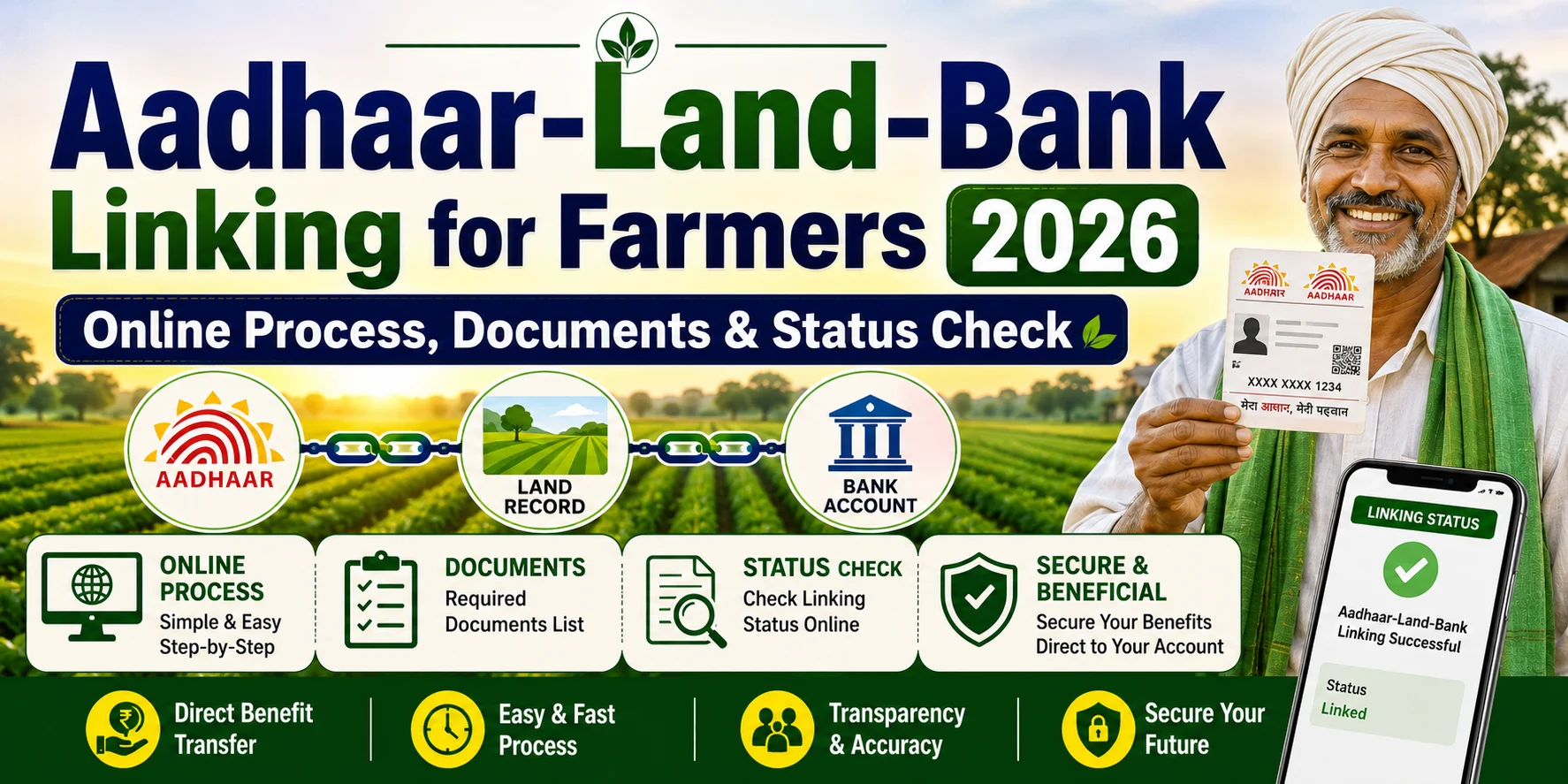
Aadhaar-Land-Bank Linking for Farmers 2026 has become increasingly important for accessing agricultural schemes and receiving government benefits through Direct Benefit Transfer (DBT). In particular, PM-KISAN uses verified land records along with Aadhaar-based identification and Aadhaar-seeded bank accounts for beneficiary verification and payment.
Under PM-KISAN, eligible farmers receive ₹6,000 per year in three instalments through DBT into Aadhaar-seeded bank accounts. The Government has stated that land details must be seeded on the PM-KISAN portal, the bank account must be linked with Aadhaar, and e-KYC must be completed for benefits.
It is important to understand that Aadhaar-land linking and Aadhaar-bank linking are two different processes. Land records are generally verified or seeded through the relevant agriculture/revenue system, while Aadhaar-bank seeding is completed through the farmer’s bank and NPCI mapping for DBT.
This guide explains how farmers can check and complete these linkages, which documents may be required, how the process works, common problems and how to correct mismatched information.
What Is Aadhaar-Land-Bank Linking?
Aadhaar-land-bank linking refers to maintaining accurate connections between three important sets of farmer information:
- Aadhaar details – used for identity and authentication.
- Agricultural land records – used to verify landholding and eligibility where required.
- Bank account – used to receive eligible government payments through DBT.
These records do not necessarily get linked through one single portal.
For example:
- Aadhaar can be linked with the bank account through the bank.
- Land ownership details are maintained in State/UT land records.
- Scheme-specific land information may be seeded or verified on the relevant agriculture portal.
- PM-KISAN uses Aadhaar-based authentication, digitised land records and DBT for beneficiary verification and payment.
Why Is Aadhaar-Land-Bank Linking Important for Farmers?
Correctly matching these records can help prevent problems in government scheme applications and payments.
It can help with:
- Farmer identity verification
- Landholding verification
- DBT payments
- PM-KISAN beneficiary verification
- e-KYC
- Agriculture subsidy applications
- Farmer Registry services
- Reducing duplicate or incorrect beneficiary records
The Government has specifically stated that PM-KISAN payments are made into Aadhaar-seeded bank accounts and that farmers whose bank accounts are not seeded with Aadhaar cannot have payments processed until the requirement is completed.
Aadhaar-Land-Bank Linking 2026: Quick Overview
| Particular | Details |
|---|---|
| Aadhaar | Farmer identity and authentication |
| Land Record | Ownership/landholding verification |
| Bank Account | Receives eligible DBT payments |
| e-KYC | Aadhaar-based beneficiary verification |
| PM-KISAN | Uses land records, Aadhaar-based verification and DBT |
| Bank Seeding | Completed through the bank/NPCI system |
| Land Updating | Generally handled through State/UT land-record or agriculture systems |
| Main Documents | Aadhaar, land records, bank details and scheme-specific documents |
| Status | Can be checked through applicable official portals |
Aadhaar Linking With Bank Account for Farmers
Aadhaar-bank linking is particularly important for receiving DBT benefits.
According to UIDAI, a farmer or beneficiary can request the bank to link Aadhaar with the bank account by submitting the bank’s mandate and consent form. The bank then seeds the Aadhaar with the NPCI mapper so the account can function as a DBT-enabled account.
The process generally involves:
- Visiting the bank.
- Requesting Aadhaar seeding/linking.
- Providing Aadhaar details.
- Completing the bank’s consent/mandate process.
- Bank verification.
- Aadhaar linking with the customer account.
- NPCI mapping for DBT, where applicable.
The official DBT Aadhaar-seeding form also provides an option for the customer to nominate the account for receiving DBT benefits.
How to Link Aadhaar With Bank Account
Farmers can generally follow these steps:
Step 1: Visit Your Bank
Visit the branch where your account is maintained.
Step 2: Ask for Aadhaar Seeding
Request the Aadhaar linking/seeding form or DBT mandate form.
Step 3: Provide Aadhaar Details
Enter:
- Aadhaar number
- Bank account number
- Name
- Mobile number
- Other information requested by the bank
Step 4: Submit Consent
Sign the bank’s Aadhaar-seeding consent/mandate form.
Step 5: Complete Verification
The bank verifies the submitted information.
Step 6: NPCI Mapping
For DBT purposes, the bank completes the required NPCI mapping process.
Step 7: Check Status
After processing, check whether the account is Aadhaar-seeded for DBT.
UIDAI states that bank seeding status can be checked through the myAadhaar facility, while the information is fetched from NPCI.
How to Check Aadhaar-Bank Linking Status
Farmers should verify whether their Aadhaar is correctly seeded with the bank account.
UIDAI provides a bank-seeding-status facility through its Aadhaar services. The information is fetched from the NPCI system.
Farmers can also contact their bank and ask whether:
- Aadhaar is linked to the account.
- Aadhaar is seeded in NPCI.
- The account is DBT-enabled.
- The account is the active account for Aadhaar-based DBT.
This distinction is important because simply having Aadhaar details recorded in the bank’s customer profile does not necessarily mean that the account is correctly mapped for DBT.
Can a Farmer Have Multiple Aadhaar-Linked Bank Accounts?
A farmer may have more than one bank account linked with Aadhaar, but DBT payments through the Aadhaar-based payment system are directed according to the active NPCI mapping.
UIDAI explains that when a person has multiple bank accounts, DBT can be received in the account selected through the applicable mandate/consent process and mapped for DBT.
Therefore, farmers who have recently changed banks should check which account is currently mapped for DBT.
Aadhaar and Land Record Linking
Land linking is different from bank seeding.
The farmer’s land information is maintained through the relevant State or UT land-record system. Depending on the scheme, these records may then be used for beneficiary verification.
For PM-KISAN, cultivable landholding is a primary eligibility criterion, subject to the scheme’s exclusions. The Government has also stated that land records must be seeded in the PM-KISAN portal for benefits.
Farmers should therefore make sure that their land record contains accurate:
- Name
- Survey/Khasra number
- Land area
- Village
- Ownership details
- Mutation information
How to Link or Update Land Details for Farmer Schemes
The exact procedure depends on the state.
Generally, farmers should:
Step 1: Check the Latest Land Record
Obtain the latest Khasra, Khatauni, Jamabandi, 7/12, RoR or equivalent document.
Step 2: Verify the Farmer’s Name
Compare the name in the land record with the Aadhaar and farmer records.
Step 3: Check Land Area
Verify the recorded agricultural area.
Step 4: Check Survey or Plot Number
Make sure the Khasra, survey, gata or plot number is correct.
Step 5: Check Mutation
If the land was purchased, inherited or partitioned, verify that mutation has been completed where required.
Step 6: Update the Relevant Agriculture Portal
Use the applicable State Agriculture Department or Farmer Registry system if the scheme provides an online land-seeding/update facility.
Step 7: Complete Verification
Follow the state-specific verification process.
Documents Required for Aadhaar-Land-Bank Linking
The exact documents vary depending on the process being completed.
However, farmers should generally keep the following ready:
Aadhaar Card
Used for identity verification and authentication.
Bank Passbook
Useful for confirming:
- Account number
- Account holder
- IFSC
- Bank branch
Mobile Number
An active mobile number may be required for OTPs and notifications.
Latest Land Record
Depending on the state, this may be:
- Khasra
- Khatauni
- Jamabandi
- 7/12 extract
- 8-A
- Record of Rights
- Land ownership certificate
Farmer ID
If the state has implemented Farmer Registry and requires Farmer ID for the relevant service.
PAN Card
May be required for specific banking or financial processes.
Mutation Documents
Useful when land ownership has recently changed.
Sale Deed
May be required for recently purchased agricultural land.
Legal Heir Documents
May be required for inherited agricultural land.
Aadhaar-Land-Bank Linking for PM-KISAN
PM-KISAN is one of the clearest examples of why farmers should keep these records accurate.
The Government states that PM-KISAN provides ₹6,000 annually in three equal instalments to eligible farmer families through DBT into Aadhaar-seeded bank accounts.
The Government has also stated that PM-KISAN beneficiaries need:
- Land details seeded in the PM-KISAN portal
- Aadhaar-seeded bank account
- Completed e-KYC
for benefit processing.
In March 2026, the Government reported that the 22nd PM-KISAN instalment was transferred to more than 9.32 crore farmers and that the scheme uses Aadhaar-based authentication and digitised land records for beneficiary verification.
What Is Land Seeding in PM-KISAN?
Land seeding means connecting the eligible farmer’s relevant landholding information with the farmer’s beneficiary record in the PM-KISAN system.
This helps establish that the beneficiary has the agricultural landholding required under the scheme.
The Government has stated that land seeding was made mandatory along with Aadhaar-based payment and e-KYC for PM-KISAN benefits.
What Is Aadhaar Seeding?
Aadhaar seeding means associating the Aadhaar number with the relevant beneficiary or bank record.
For DBT purposes, bank Aadhaar seeding involves:
- Verification of Aadhaar and linking it to the customer’s bank account.
- Seeding the Aadhaar in the NPCI mapper.
The official DBT documentation explains these as the two steps involved in Aadhaar seeding for DBT.
What Is DBT?
Direct Benefit Transfer (DBT) is a system through which eligible government benefits are transferred directly to beneficiaries’ bank accounts.
The official DBT Bharat portal provides a dedicated section for farmers and currently reports hundreds of government schemes using the DBT ecosystem.
Aadhaar-based DBT can help ensure that payments reach the intended beneficiary through the account mapped for DBT.
Aadhaar-Land-Bank Linking vs Farmer ID
These are related but different concepts.
| Aadhaar-Land-Bank Linking | Farmer ID |
|---|---|
| Connects identity, land and banking information for relevant services | Creates a unique digital farmer identity |
| Used for verification and DBT-related processes | Part of the Farmer Registry |
| Bank seeding is handled through bank/NPCI | Farmer Registry is implemented through state systems |
| Land information comes from revenue/agriculture records | Farmer ID can be linked with land parcels |
| Particularly important for schemes such as PM-KISAN | Designed for broader digital agriculture services |
Farmers should not assume that getting a Farmer ID automatically completes Aadhaar-bank seeding.
What If Aadhaar Is Not Linked With the Bank?
If Aadhaar is not seeded with the bank account where a scheme requires Aadhaar-based DBT, payment may not be processed.
The Government specifically stated in February 2026 that PM-KISAN payments cannot be processed when a farmer’s bank account is not seeded with Aadhaar. It also noted that focused drives are being conducted with States/UTs, CSCs and India Post Payments Bank to facilitate Aadhaar seeding.
The solution is generally to approach the bank and complete the Aadhaar-seeding process.
What If Land Details Are Not Linked?
If the farmer’s land information has not been seeded or verified for a scheme, the application or benefit can remain pending.
Farmers should:
- Obtain the latest land record.
- Check ownership details.
- Check survey/Khasra number.
- Check land area.
- Complete mutation if required.
- Contact the State Agriculture/Revenue authority.
- Update the scheme portal when the correction facility is available.
What If the Farmer’s Name Is Different in Aadhaar and Land Records?
This is a common source of verification problems.
For example:
Aadhaar: Suresh Kumar
Land Record: Suresh Kumar Singh
The farmer should first determine which record contains the incorrect information.
If the land record is wrong, the farmer should approach the relevant revenue authority for correction.
If the Aadhaar information is incorrect, the farmer should use the applicable Aadhaar update process.
Farmers should avoid creating duplicate registrations simply because of a spelling mismatch.
What If the Landowner Has Died?
If agricultural land has been inherited, the new owner’s name should be updated through the applicable legal and revenue process.
Relevant documents can include:
- Death certificate
- Legal heir certificate
- Succession documents
- Will, where applicable
- Mutation documents
- Updated land record
After the land record is updated, the farmer can follow the relevant agriculture-scheme correction or registration procedure.
What If the Farmer Has Changed Bank Accounts?
Farmers who have moved from one bank to another should check their Aadhaar seeding and NPCI mapping.
Simply opening a new bank account does not necessarily mean that DBT payments will automatically move to it.
The farmer should:
- Visit the new bank.
- Submit the Aadhaar-seeding/DBT mandate.
- Request the bank to complete the required NPCI mapping.
- Confirm the new account’s DBT status.
- Check the relevant government scheme portal.
UIDAI states that farmers can change the bank account used for DBT by visiting the respective bank branch and submitting the bank’s mandate and consent form.
What If the Bank Says Aadhaar Is Linked but DBT Is Not Coming?
This can happen when Aadhaar is linked in the bank’s internal system but the required NPCI mapping is not active or another bank account remains mapped for DBT.
Farmers should specifically ask the bank:
- Is Aadhaar linked to my account?
- Is my Aadhaar seeded in NPCI?
- Is this account DBT-enabled?
- Is this the account currently mapped for Aadhaar-based DBT?
The official DBT documentation explains that NPCI mapping is an important part of making an account eligible to receive Aadhaar-based DBT.
What If PM-KISAN Payment Is Not Received?
Farmers should check each requirement separately.
Check 1: Land Seeding
Confirm that land details are seeded/verified.
Check 2: Aadhaar-Bank Seeding
Confirm that the bank account is Aadhaar-seeded.
Check 3: e-KYC
Confirm that PM-KISAN e-KYC is complete.
Check 4: Beneficiary Status
Check the current status on the PM-KISAN portal.
Check 5: Bank Account
Confirm that the account is active and correctly mapped for DBT.
The Government has stated that PM-KISAN benefits are released after the relevant mandatory requirements are completed.
How to Complete PM-KISAN e-KYC
PM-KISAN provides multiple e-KYC methods.
The official PM-KISAN e-KYC document describes:
- OTP-based e-KYC
- Biometric e-KYC through CSCs/State Seva Kendras
- Face-authentication-based e-KYC through the PM-KISAN mobile app
For OTP-based e-KYC, the farmer needs an Aadhaar-linked active mobile number.
Common Problems in Aadhaar-Land-Bank Linking
Aadhaar-Bank Seeding Pending
The bank may not have completed NPCI mapping.
Land Record Not Updated
The revenue record may still show an old owner.
Name Mismatch
Different spellings may prevent successful verification.
Wrong Bank Account
The farmer may have changed accounts without updating the DBT mapping.
Wrong Land Area
The application may show a different area from the official land record.
Incorrect Survey Number
The wrong Khasra or survey number may have been entered.
e-KYC Pending
PM-KISAN benefits can be affected if mandatory e-KYC is incomplete.
Mobile Number Problem
The Aadhaar-linked mobile may be inactive or incorrect.
How to Avoid Aadhaar-Land-Bank Linking Problems
Farmers can take a few simple precautions.
Keep Aadhaar information accurate.
Check the name and other details before starting registration.
Keep land records updated.
Complete mutation after purchase, inheritance or partition.
Use the latest bank account information.
Do not continue using an old account for DBT after changing banks without updating the mapping.
Complete e-KYC.
For schemes such as PM-KISAN, complete the applicable e-KYC process.
Check land details carefully.
Verify the survey number, land area and ownership.
Keep documents together.
Maintain copies of Aadhaar, land records and bank documents.
Aadhaar-Land-Bank Linking Checklist 2026
Before applying for or checking farmer benefits, use this checklist:
- Aadhaar details are correct.
- Aadhaar-linked mobile number is active.
- Bank account is active.
- Aadhaar is linked with the bank account.
- Aadhaar is seeded in NPCI where required for DBT.
- Correct bank account is mapped for DBT.
- Latest land record is available.
- Farmer’s name is correct in the land record.
- Survey/Khasra number is correct.
- Land area is correct.
- Mutation is completed where applicable.
- Land details are seeded/verified for the relevant scheme.
- Farmer ID is completed where required.
- PM-KISAN e-KYC is completed where applicable.
- Scheme beneficiary status has been checked.
Frequently Asked Questions (FAQs)
What is Aadhaar-Land-Bank Linking for Farmers?
It refers to maintaining accurate connections between the farmer’s Aadhaar identity, agricultural land information and bank account for relevant government schemes and DBT services.
Is Aadhaar-bank linking mandatory for PM-KISAN?
For PM-KISAN, the Government has stated that benefits are transferred to Aadhaar-seeded bank accounts and that payments cannot be processed where the required Aadhaar seeding has not been completed.
Is land linking mandatory for PM-KISAN?
Land seeding is a mandatory requirement for PM-KISAN benefits. The Government has stated that beneficiaries need their land details seeded in the PM-KISAN portal.
How can I link Aadhaar with my bank account?
Visit your bank branch, submit the bank’s Aadhaar-seeding/mandate form and provide the required consent and Aadhaar details. The bank then completes the applicable linking and NPCI-mapping process.
How can I check Aadhaar-bank seeding status?
UIDAI provides a bank-seeding-status facility through its Aadhaar services, using information fetched from NPCI. Farmers can also confirm the status with their bank.
Can I receive DBT in any Aadhaar-linked bank account?
For Aadhaar-based DBT, the relevant account is the one mapped for DBT through the applicable NPCI process. If you have multiple accounts, check which account is currently mapped.
What documents are required for Aadhaar-bank linking?
Generally, the bank may require Aadhaar details, account information and a signed consent/mandate form. Additional documents can depend on the bank’s KYC requirements.
What documents are required for land linking?
This depends on the state. Common records include Khasra, Khatauni, Jamabandi, 7/12, RoR or other official land records.
What if my name is wrong in the land record?
Contact the relevant State/UT revenue authority and follow its correction process. Once the underlying land record is corrected, update the applicable farmer-scheme record.
What if my land was recently inherited?
Complete the applicable succession and mutation process so that the revenue record reflects the current landholder.
What if I changed my bank account?
Ask your new bank to complete Aadhaar seeding and the required DBT/NPCI mapping. Also check the relevant government scheme after the change. UIDAI confirms that beneficiaries can change the bank account used for DBT through the bank’s mandate process.
Is Farmer ID the same as Aadhaar-land-bank linking?
No. Farmer ID is a digital farmer identity under the Farmer Registry, while Aadhaar-bank seeding and land-record verification are separate processes.
Is e-KYC required along with Aadhaar-bank and land linking?
For PM-KISAN, e-KYC is among the mandatory requirements for benefit processing.
Can I complete e-KYC online?
PM-KISAN provides OTP-based and face-authentication-based methods, while biometric e-KYC is available through CSCs and State Seva Kendras.
Conclusion
Aadhaar-Land-Bank Linking for Farmers 2026 is important for maintaining accurate farmer records and receiving eligible government benefits through DBT. However, Aadhaar linking with a bank, land-record verification and Farmer Registry registration are separate processes, even though they can work together for government agriculture services.
For PM-KISAN, the Government has clearly stated that farmers need land details seeded in the PM-KISAN portal, an Aadhaar-seeded bank account and completed e-KYC for benefit processing.
Farmers should therefore check three areas carefully: identity, land and banking information. Aadhaar should contain correct personal details, land records should show the correct owner and land information, and the bank account should be properly Aadhaar-seeded and mapped for DBT where required.
If a farmer changes banks, purchases or inherits agricultural land, or discovers a name or land-area mismatch, the relevant records should be updated instead of creating a new application unnecessarily.
For bank-related Aadhaar seeding, farmers can approach their bank and submit the required mandate and consent form. UIDAI also provides a facility for checking bank-seeding status.
For land-related corrections, farmers should use the relevant State/UT revenue or agriculture department because land-record systems and procedures differ between states.
Keeping Aadhaar, land records, bank details, Farmer ID and scheme information consistent can reduce verification problems and help ensure that eligible benefits reach the correct account.
Read More: Delhi Health Insurance & Financial Assistance Schemes 2026: Eligibility, Benefits, Documents & Apply