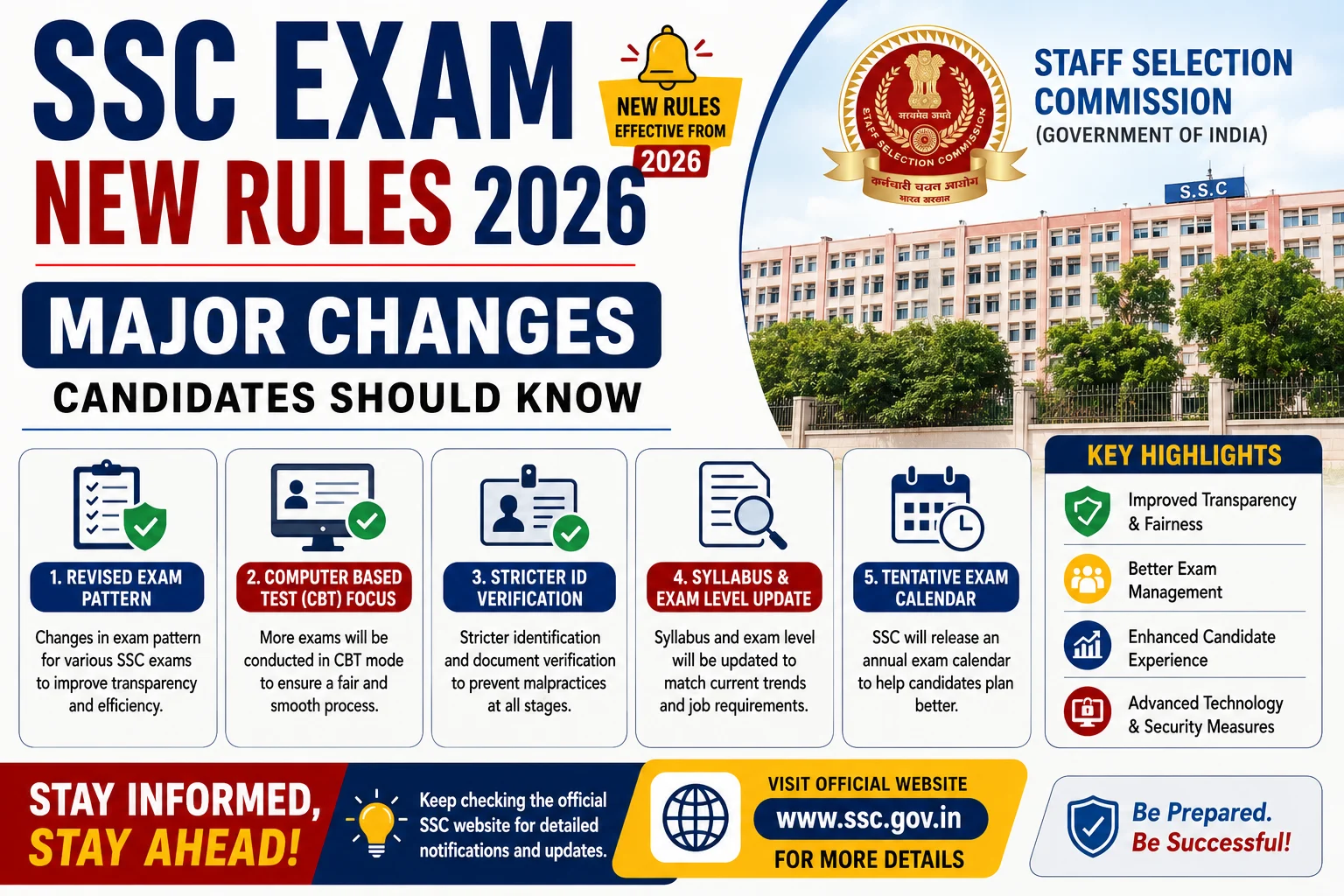
The Staff Selection Commission (SSC) has introduced and continued several important examination-related changes that candidates should understand while preparing for SSC exams in 2026. These changes cover areas such as Aadhaar-based authentication, One-Time Registration (OTR), application corrections, identity verification, question paper and response-sheet access, normalization, and exam security.
For candidates preparing for examinations such as SSC CGL, CHSL, Selection Post, Stenographer, MTS, JE and other recruitment exams, keeping track of these rules is just as important as preparing the syllabus. A small mistake in personal details, identity verification or the application form can create problems later in the recruitment process.
The SSC has also advised candidates to rely on official notices and the Commission’s website for the latest information. The Commission’s current website provides examination notices, syllabus, application information, admit cards, answer keys, results and other candidate resources.
Here are the major SSC exam new rules 2026 that candidates should know before applying or appearing for an examination.
SSC Exam New Rules 2026: What Has Changed?
The major changes and continuing reforms candidates need to watch include:
- New One-Time Registration on the current SSC website
- Aadhaar-based authentication and identity verification
- Stricter matching of personal details with certificates
- Limited application correction windows
- Restrictions on multiple applications
- Digital access to question papers and responses
- Greater use of technology for exam security
- Normalization for examinations conducted in multiple shifts
- More careful verification of reservation and eligibility documents
- Increased emphasis on identity verification before appointment
These measures are intended to make recruitment more secure and reduce errors, impersonation and irregularities during the examination process.
1. New One-Time Registration on SSC Website
One of the most important changes for candidates is the use of the new SSC website and its One-Time Registration (OTR) system.
Candidates who registered on the older SSC website should not assume that their previous OTR will automatically work on the new platform. The SSC’s 2026 examination notices state that an OTR created on the old website, ssc.nic.in, will not be functional on the new website, ssc.gov.in. Candidates applying through the new system need to complete OTR on the current platform.
Once an OTR is successfully created on the new website, it remains valid for examinations applied for through that platform.
This means candidates should complete their registration carefully instead of creating unnecessary duplicate accounts.
2. Aadhaar-Based Authentication Is Being Used
SSC has strengthened identity verification by implementing Aadhaar-based authentication in its examination process.
Under the current system, candidates may authenticate their identity through Aadhaar during One-Time Registration and the online application process.
This is intended to improve the accuracy of candidate identification and reduce the possibility of impersonation or fraudulent applications.
Candidates should therefore ensure that their personal details are accurate and consistent with their official records.
3. Alternative Documents for Candidates Unable to Authenticate Through Aadhaar
Not every candidate may be able to complete Aadhaar-based authentication.
SSC’s examination instructions provide an alternative document-based verification process for candidates who cannot authenticate through Aadhaar. Depending on the requirement, candidates may need documents supporting their:
- Name
- Date of birth
- Address
- Gender
- Photograph
Accepted documents can include Aadhaar, Voter ID, PAN Card, Driving Licence, government-issued identity documents and other specified records.
Candidates should check the specific examination notice because the accepted documents and procedure can vary.
4. Special Relaxation for Visually Handicapped Candidates
The 2026 SSC CGL notice includes a specific provision for visually handicapped candidates regarding Aadhaar face authentication.
Such candidates are exempted from the Aadhaar face-authentication requirement at the online application stage and may use alternative Aadhaar-based verification methods such as OTP authentication.
This provision is intended to address practical difficulties that candidates may face with mobile-based facial recognition.
Candidates requiring accessibility-related facilities should carefully read the relevant examination notice before completing their application.
5. Name and Date of Birth Must Match Your Certificate
SSC has emphasized that candidates must enter their name and date of birth exactly as recorded in their matriculation or secondary examination certificate.
The 2026 Selection Post Phase XIV notice states that candidates whose name or date of birth differs from the required records may face serious consequences, including being prevented from appearing in the examination or cancellation of candidature during later verification.
This is an important rule that candidates should not overlook.
Before submitting an application, compare the following details with your Class 10 or matriculation certificate:
- Full name
- Date of birth
- Father’s name
- Mother’s name, where required
Avoid using nicknames, shortened names or different spellings.
6. Only One Application Should Be Submitted
SSC has strict rules regarding duplicate applications.
The 2026 Combined Hindi Translators examination notice states that only one online application is allowed during the normal application period. If multiple applications with different registration numbers are detected, the Commission can reject the applications and cancel the candidate’s candidature.
Candidates who submit multiple applications and appear more than once may also face debarment from SSC examinations according to the applicable rules.
Therefore, candidates should not submit another application simply because they believe they made a small mistake in the first one.
7. Application Correction Window Is Limited
SSC provides a correction window for certain examinations, allowing candidates to modify permitted details after the normal application period.
However, the correction window is not unlimited.
For example, the 2026 CHSLE notice provides a limited period during which candidates can correct or modify permitted application details after the closing date. Once the corrected/final application is submitted or the correction period expires, further changes are generally not entertained.
Candidates should therefore review the application carefully before submitting it.
8. The Latest Corrected Application Becomes Valid
If a candidate uses the permitted correction window, the latest corrected application is treated as the valid application under the applicable SSC rules.
Earlier versions can be cancelled after the corrected application is submitted.
This makes it particularly important to check every field before final submission.
Do not make unnecessary corrections simply because the correction window is available.
9. Question Papers and Responses Can Be Made Available to Candidates
SSC introduced an important transparency-related reform allowing candidates to view their own question papers, recorded responses and correct answers in applicable examinations.
The reform was announced by the government in October 2025 as part of SSC’s efforts to improve transparency and candidate access to examination information.
This can help candidates understand their performance and identify possible issues with answers or the answer key.
Candidates should carefully follow the timeline provided by SSC for accessing these materials.
10. Answer-Key Challenge Process Is Important
After an examination, SSC may provide candidates with an opportunity to check the provisional answer key and raise objections within the specified period.
Candidates should not wait until the final day to submit an objection.
If you believe an answer is incorrect, carefully check the question, official answer and supporting evidence before submitting a challenge.
The objection procedure, fee and deadline depend on the examination.
11. Normalization Is Used for Multi-Shift Exams
Many SSC examinations are conducted in multiple shifts.
Because different question papers can have different difficulty levels, SSC has implemented normalization methods to provide a more balanced comparison of candidate performance across shifts. The Commission has identified normalization as part of its examination reforms aimed at ensuring fair results.
Candidates should therefore not assume that the raw score alone will determine their final position when normalization applies.
The exact method should be checked in the relevant examination notice.
12. Identity Verification Is Becoming More Important
SSC has increased its focus on identity verification during the recruitment process.
For example, the Commission has issued identity-verification notices for candidates shortlisted in examinations such as CHSL and Stenographer.
This means qualifying an examination is not necessarily the end of the verification process.
Candidates may need to establish their identity again at later stages.
13. Document Verification Can Affect Final Selection
Candidates should not assume that qualifying the Computer-Based Examination guarantees appointment.
SSC may verify eligibility documents at the appropriate stage.
The 2026 Selection Post notice states that candidature is provisional at the examination stage and that supporting documents can be checked during scrutiny and document verification. If a claim made in the application cannot be substantiated, candidature can be cancelled.
Candidates should therefore keep their original certificates and valid supporting documents ready.
14. Reservation Certificates Must Be in the Prescribed Format
Candidates applying under categories such as:
- SC
- ST
- OBC
- EWS
- PwBD
- ESM
must satisfy the applicable eligibility requirements and possess the required certificates in the prescribed format.
SSC specifically advises candidates seeking reservation benefits to ensure that they are eligible and have the appropriate supporting certificates.
A candidate should not claim a reservation category simply because they believe they are eligible. The certificate and other conditions must meet the rules applicable to the examination.
15. Eligibility Is Not Fully Verified at the Initial Application Stage
SSC generally accepts applications provisionally.
The Commission’s examination notices make it clear that detailed scrutiny of eligibility may not be completed at the Computer-Based Examination stage. Later verification can include educational qualifications, age, experience and other requirements.
This means candidates must independently confirm that they meet the eligibility criteria before applying.
Submitting an application successfully does not automatically mean that you are eligible for appointment.
16. Post Preferences Can Be Important
In examinations such as SSC CGL, candidates may be asked to provide preferences for posts and departments.
Candidates should make these choices carefully because the final allocation is based on merit and the preferences submitted by the candidate, along with applicable requirements.
The 2025 CGL notice states that once a post is allotted, subsequent requests for a change of post or service are not entertained because the allotment is treated as final and irreversible.
Candidates should therefore research the posts before submitting their preferences.
17. Physical and Medical Requirements Still Matter
Some SSC posts have additional physical, medical or other specific requirements.
A candidate may be selected based on examination performance but later found unsuitable for a particular post because they do not meet its prescribed requirements.
SSC advises candidates to review post-specific educational, physical and medical standards before giving preferences.
This is especially important for posts involving physical standards or specific medical requirements.
18. Do Not Wait Until the Last Date to Apply
SSC repeatedly advises candidates to submit applications well before the closing date.
Waiting until the final hours can create problems because of:
- Website traffic
- Login issues
- Payment failures
- Internet problems
- Technical errors
- Document upload problems
The Commission specifically advises candidates not to wait until the last day because heavy website traffic can make it difficult to submit an application.
Early submission gives candidates more time to resolve technical issues.
19. SSC Is Increasing Exam Security
The Commission has also introduced technology-based measures to strengthen examination security.
The reforms announced by the government include digital safeguards and measures designed to protect the examination process from malpractice and irregularities.
Candidates should therefore be extremely careful about examination rules involving prohibited items, impersonation, unfair means and unauthorized communication.
Violating examination rules can result in cancellation of candidature or debarment.
20. Candidates Should Follow the Official SSC Website
SSC conducts multiple examinations every year, and the rules are not necessarily identical for every examination.
For example, CGL, CHSL, Stenographer, MTS, Selection Post and other examinations can have different eligibility criteria, correction rules, examination patterns and selection processes.
Therefore, candidates should not rely entirely on old preparation material.
The official SSC website provides examination notices, syllabus, examination calendars, answer keys, results and other candidate resources.
SSC Exam 2026: Important Checklist for Candidates
Before applying for an SSC examination, candidates should check:
Complete OTR on the current SSC website.
Check whether Aadhaar authentication is required.
Enter your name exactly as recorded in your matriculation certificate.
Enter your date of birth correctly.
Verify category and reservation details.
Check educational qualification requirements.
Check age limits and applicable relaxation.
Review post-specific physical or medical requirements.
Upload valid documents in the required format.
Submit only one application.
Check the application carefully before final submission.
Use the correction window only when necessary.
Keep your application number and login details safe.
Download the admit card when released.
Follow identity-verification instructions.
Check answer keys and response sheets when made available.
Keep original documents ready for verification.
How These New SSC Rules Affect Candidates
The overall direction of the changes is clear: SSC is moving toward a more technology-driven and verification-focused recruitment process.
For candidates, this means exam preparation is no longer limited to studying the syllabus.
Applicants must also pay attention to:
- Accurate registration
- Identity verification
- Correct documentation
- Application deadlines
- Correction windows
- Examination instructions
- Post preferences
- Document verification
A candidate with strong exam preparation can still face problems if the application contains incorrect personal information or unsupported eligibility claims.
Final Thoughts
The SSC Exam New Rules 2026 bring greater emphasis on digital registration, identity verification, accurate candidate information, application corrections and examination transparency.
The use of Aadhaar-based authentication, the new OTR system, stricter personal-detail matching, limited correction windows and stronger identity verification are particularly important for candidates. SSC has also introduced measures allowing candidates to access their own question papers and responses in applicable examinations, while normalization continues to be used to support fair comparison across shifts.
Candidates should remember that SSC conducts several examinations, and the exact rules can differ between them. Therefore, the safest approach is to read the latest official notification for the specific examination instead of depending on old rules or information circulating on social media.
Carefully checking your application, submitting it early, keeping documents ready and following official SSC updates can help you avoid preventable mistakes during the 2026 recruitment cycle.
Read More: How to Reapply After Visa Refusal: Steps, Documents, Reasons & Tips for Approval