Competitive examinations in India are becoming increasingly digital, technology-driven and focused on stronger identity and document verification. In 2026, candidates preparing for exams such as SSC, UPSC, Railway, NEET, JEE, UGC NET and other major recruitment or entrance examinations need to pay attention not only to the syllabus but also to updated application, examination and verification procedures.
However, there is no single set of rules that applies to every competitive examination. SSC, UPSC, Railway Recruitment Boards and NTA conduct examinations under different regulations. Some changes are specific to a particular exam, while others are broader reforms being introduced across examination systems.
Recent developments in 2026 show a stronger focus on secure question-paper handling, identity verification, digital examination systems, online correction facilities, recorded responses and greater transparency. The National Testing Agency (NTA), for example, is undergoing a major examination-system overhaul following concerns over question-paper security and examination integrity.
Candidates should therefore check the official notification for the examination they are applying for before relying on any general rule.
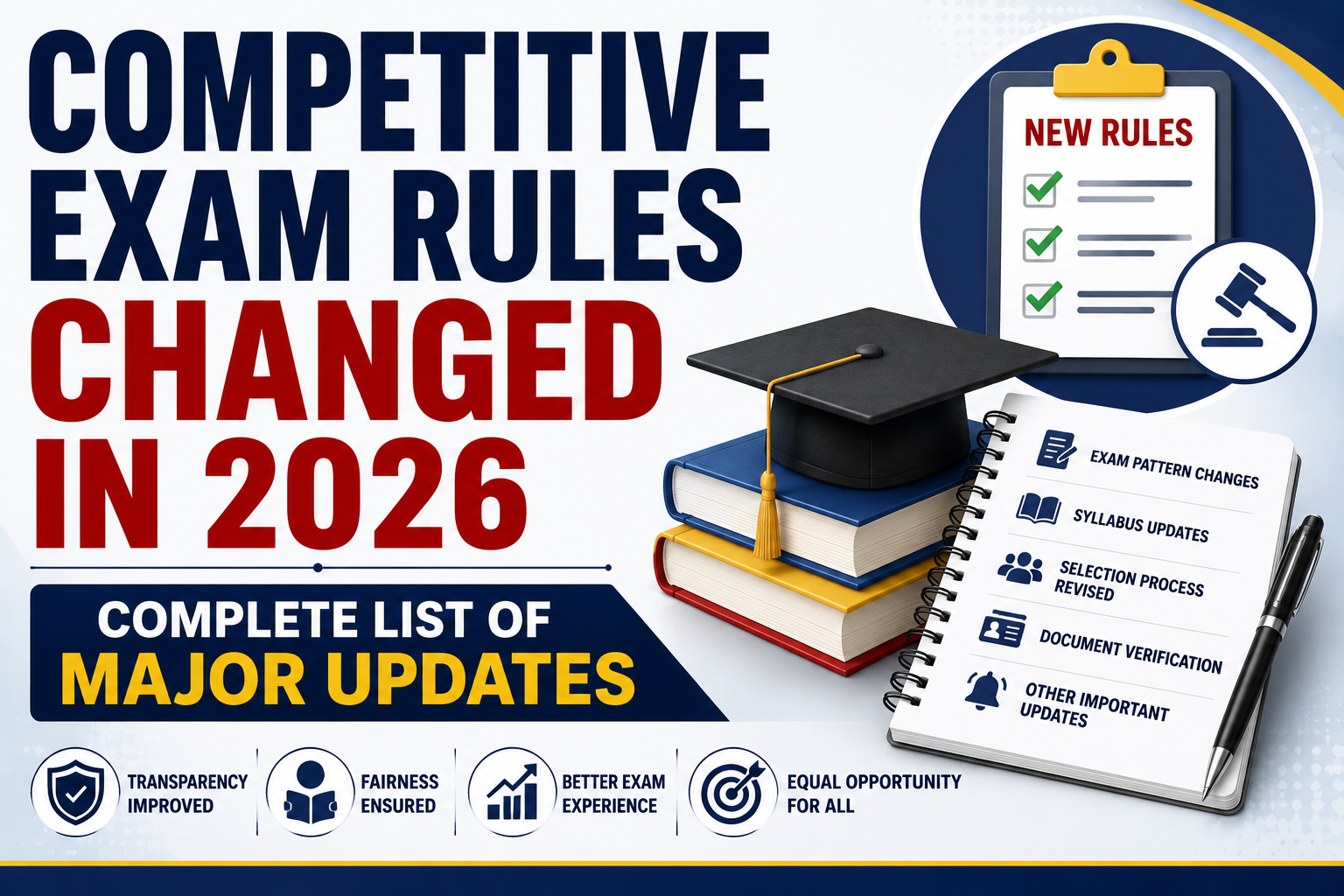
What Are the Major Competitive Exam Rule Changes in 2026?
The important developments candidates should know include:
- Greater use of Aadhaar and digital identity verification
- New or updated One-Time Registration systems
- More technology-based examination security
- Stricter checking of candidate information
- Limited application correction windows
- Greater access to recorded responses and question papers
- Online answer-key objection systems
- Stronger document verification
- Increased security around question-paper preparation
- Greater use of Computer-Based Tests
- More structured examination calendars and schedules
- Stronger action against impersonation and unfair means
These changes are intended to make competitive examinations more secure, transparent and reliable.
1. Aadhaar-Based Identity Verification Is Becoming More Important
Identity verification is one of the major areas receiving attention in competitive examinations.
Some examination authorities are using Aadhaar-based authentication to verify candidates during registration and application. SSC, for example, has incorporated Aadhaar-based authentication into its newer registration and examination processes.
The purpose is to reduce impersonation, duplicate registrations and identity-related fraud.
Candidates should ensure that their personal information is accurate and consistent across their Aadhaar, educational certificates and application forms.
If Aadhaar authentication is not possible in a particular examination, candidates should check the notification for alternative identity-verification procedures.
2. One-Time Registration Systems Are Being Updated
One-Time Registration, commonly known as OTR, is increasingly being used by recruitment authorities to simplify applications for multiple examinations.
SSC has moved candidates to its newer registration system on the current website. Candidates who registered under an older platform should not automatically assume that their previous OTR will remain valid on a new system.
The same principle applies to other examination authorities: candidates should use the registration platform specified in the latest official notification.
An OTR profile should be created carefully because incorrect personal information can create problems during later stages of recruitment.
3. Personal Details Must Be Entered Carefully
Competitive examination authorities are becoming stricter about candidate information.
Candidates should carefully check:
- Full name
- Date of birth
- Father’s name
- Mother’s name, where required
- Gender
- Category
- Address
- Educational qualifications
- Photograph
- Signature
- Identity-document details
For recruitment examinations, the name and date of birth may need to match the matriculation or secondary-school certificate.
A small spelling difference may not always lead to cancellation, but candidates should avoid creating inconsistencies wherever possible.
4. Duplicate Applications Can Lead to Problems
Candidates should not submit multiple applications for the same examination unless the official notification specifically allows it.
Recruitment authorities can reject duplicate applications or take action when a candidate deliberately submits multiple forms.
If you make a mistake in an application, check whether an official correction window is available instead of submitting another application.
This is particularly important for SSC and other large recruitment examinations where applications are processed electronically.
5. Application Correction Windows Are Limited
Many competitive examinations now provide online correction facilities.
However, the correction window is generally available only for a limited period.
Candidates should check:
- Correction start date
- Correction closing date
- Fields that can be modified
- Correction charges, if applicable
- Whether corrections can be made more than once
Once the correction period ends, authorities may not accept further changes.
Therefore, candidates should review their application carefully before final submission.
6. Computer-Based Tests Are Becoming the Standard
Computer-Based Tests, or CBTs, are now central to many competitive and recruitment examinations.
SSC and Railway recruitment increasingly rely on CBT-based examination systems, while NTA conducts several major entrance and eligibility examinations through computer-based or digitally managed processes.
This means candidates should become comfortable with:
- Reading questions on a screen
- Selecting answers digitally
- Moving between questions
- Marking questions for review
- Managing time on a computer
- Submitting responses correctly
Regular online mock tests can help candidates adjust to the actual examination environment.
7. Question-Paper Security Is Receiving Greater Attention
One of the biggest examination-related developments in 2026 is the increased focus on question-paper security.
The NTA is undergoing a major overhaul after controversies involving examination security and question-paper handling. Reports in August 2026 said the agency is introducing a four-tier checking system for examination papers, restructuring its question-paper preparation process and strengthening security around its offices.
The changes are aimed at reducing errors, leaks and unauthorized access to examination material.
The Supreme Court has also emphasized the need to institutionalize NTA and introduce technological reforms to strengthen the examination system.
8. NTA Is Strengthening Its Examination System
The NTA conducts several major examinations, including NEET, JEE Main, UGC NET and other national-level tests.
In 2026, the agency is implementing broader reforms following concerns about examination management.
Reported measures include:
- Four-level checks for examination papers
- Changes to question-paper preparation
- Stronger internal security
- Restructuring of the examination team
- Greater technological safeguards
- Enhanced monitoring of examination processes
The purpose is to reduce errors and strengthen confidence in national-level entrance and eligibility examinations.
Candidates should therefore expect greater emphasis on examination security and verification.
9. Recorded Responses and Question Papers Are Becoming More Accessible
Another important change is greater transparency after examinations.
In applicable examinations, candidates may be allowed to view:
- Their recorded responses
- Question papers
- Provisional answer keys
- Correct answers
- Objection details
NTA’s 2026 notices, for example, include provisions for displaying provisional answer keys and question papers with recorded responses for certain examinations.
This gives candidates a clearer way to evaluate their performance and identify possible errors in provisional answer keys.
10. Online Answer-Key Objections Are Important
Many examination authorities provide an online objection facility after releasing provisional answer keys.
Candidates who believe that a question or answer is incorrect can submit an objection during the specified period.
Before submitting an objection, candidates should:
- Check the question carefully.
- Compare it with the provisional answer.
- Refer to reliable academic sources.
- Follow the prescribed objection format.
- Submit the objection before the deadline.
- Pay the applicable fee, where required.
An objection submitted after the deadline may not be considered.
11. Examination Security Measures Are Increasing
Competitive examination authorities are placing greater emphasis on preventing unfair means.
Depending on the examination, security measures may include:
- Biometric verification
- Photograph matching
- Aadhaar authentication
- Facial recognition
- Digital attendance
- CCTV monitoring
- Electronic surveillance
- Strict entry procedures
- Restricted examination-centre access
The exact measures vary between examinations.
Candidates should therefore read the examination-day instructions carefully.
12. Candidates Must Carry the Required Identity Documents
Candidates should not arrive at an examination centre without checking the required documents.
Depending on the examination, candidates may need:
- Admit card
- Government-issued photo ID
- Passport-size photograph
- Additional identity documents
- Disability certificate, where applicable
- Other documents specifically mentioned in the admit card
A candidate who fails to satisfy the identity-verification requirements may face difficulty entering the examination centre.
13. Document Verification Is Becoming Stricter
For recruitment examinations, qualifying the written examination does not necessarily guarantee appointment.
Candidates may have to undergo document verification.
Authorities can check:
- Educational qualifications
- Date of birth
- Category
- Reservation certificates
- Experience
- Identity
- Disability status, where applicable
- Other eligibility conditions
Candidates should keep their original documents and valid supporting certificates ready.
14. Reservation Certificates Need Special Attention
Candidates applying under SC, ST, OBC, EWS or PwBD categories should carefully check the certificate requirements.
A certificate may need to be:
- Issued by the appropriate authority
- In the prescribed format
- Valid for the relevant period
- Based on the required criteria
Candidates should not assume that an old certificate will automatically be accepted.
The exact requirements differ between examinations, so the relevant notification should always be checked.
15. UPSC Candidates Should Follow the New Application Portal
UPSC has also moved its examination application process toward its new application portal.
The UPSC website currently directs candidates to upsconline.nic.in for examination applications.
Candidates appearing for examinations such as Civil Services, NDA, CDS, CAPF, Engineering Services and other UPSC examinations should therefore use the application system specified in the current notification.
The UPSC’s 2026 examination pages continue to publish examination notifications, admit cards, question papers and results through its official website.
16. UPSC Candidates Need to Follow Exam-Specific Instructions
UPSC does not have one identical selection process for every examination.
For example, Civil Services Examination includes Preliminary and Main examinations followed by the personality test, while examinations such as NDA, CDS, CAPF and Engineering Services have their own eligibility and selection structures.
The official UPSC 2026 examination calendar and individual notifications provide the applicable details.
Candidates should therefore avoid using the rules of one UPSC examination for another.
17. Railway Exams Are Becoming More Technology-Driven
Railway Recruitment Boards are also expanding technology-based recruitment.
The Railway Ministry stated in June 2026 that departmental examinations were being conducted through CBT and that Indian Railways planned to expand tablet-based testing. The Ministry described the recruitment process as technology-driven, transparent and focused on accuracy.
For Railway candidates, this means regular CBT practice is becoming increasingly important.
RRB recruitment can include different stages depending on the post, such as:
- CBT 1
- CBT 2
- Aptitude test
- Typing or skill test
- Physical Efficiency Test
- Document verification
- Medical examination
The exact process should always be checked in the applicable CEN.
18. Examination Calendars Are Becoming More Important
Candidates should track official examination calendars rather than waiting for random announcements.
UPSC regularly publishes its examination calendar and individual examination schedules.
Similarly, recruitment bodies such as SSC and Railway Recruitment Boards issue examination calendars, notifications and schedules.
A calendar can help candidates plan:
- Syllabus completion
- Mock tests
- Revision
- Application dates
- Admit-card downloads
- Examination preparation
However, candidates should treat the official notification as the final authority when dates or conditions change.
19. More Attention to Application Data
Candidates are increasingly expected to maintain accurate information across their examination profiles.
If your name, date of birth or other information changes, follow the official procedure for updating it.
Do not create multiple profiles simply because one application contains an error.
The information entered during registration can remain connected to later applications, examination records and verification.
20. Unfair Means Can Have Serious Consequences
Competitive examinations are becoming stricter about cheating and impersonation.
Candidates can face cancellation or debarment for violations such as:
- Impersonation
- Using prohibited electronic devices
- Carrying unauthorized material
- Communicating with another candidate
- Using unfair assistance
- Manipulating examination systems
- Submitting false documents
Candidates should carefully read the instructions on the admit card and examination notice.
Even an apparently minor rule violation can have serious consequences if it falls under the examination’s unfair-means provisions.
21. AI and Technology Are Changing Examination Security
The growing use of technology is also changing how examination authorities detect irregularities.
Digital identity verification, automated monitoring, data analysis and other technology-based systems can help identify suspicious activity.
At the same time, authorities are strengthening security around examination content to prevent unauthorized access.
The Supreme Court’s recent emphasis on technological reforms at NTA shows that technology is expected to play a larger role in protecting the examination process.
22. What Candidates Should Do Before Applying
Before submitting an application in 2026, candidates should:
- Read the complete official notification.
- Check eligibility.
- Confirm age requirements.
- Verify educational qualifications.
- Check reservation conditions.
- Prepare identity documents.
- Complete OTR if required.
- Check photograph and signature requirements.
- Review every application field.
- Submit the application before the deadline.
- Save the final application and payment receipt.
Do not wait until the final day unless absolutely necessary.
Competitive Exam 2026 Checklist
Check the latest official notification.
Confirm eligibility.
Complete the required OTR.
Verify name and date of birth.
Check Aadhaar or alternative ID requirements.
Upload the correct photograph and signature.
Check category and certificate requirements.
Submit only the permitted number of applications.
Save the application form.
Track the correction window.
Download the admit card on time.
Carry the required ID to the examination centre.
Follow examination-day instructions.
Check the provisional answer key.
Raise objections before the deadline if necessary.
Keep original documents ready for verification.
Which Competitive Exams Are Affected?
The changes discussed above are relevant to different examinations in different ways.
SSC Exams
SSC recruitment has introduced stronger digital registration and identity-verification procedures, along with application and correction controls.
UPSC Exams
UPSC candidates should use the current application portal and follow the examination-specific notification and schedule. The 2026 UPSC cycle includes Civil Services, NDA, CDS, CAPF and several other examinations.
Railway Exams
RRB recruitment continues to expand CBT-based testing and digital examination processes.
NTA Exams
NTA-administered examinations are undergoing broader security and procedural reforms, particularly following concerns over examination integrity.
Why Candidates Should Take These Changes Seriously
Earlier, many students focused almost entirely on the syllabus and preparation books.
In 2026, that approach is no longer enough.
Candidates also need to understand the complete examination journey, including registration, identity verification, application correction, examination-day requirements, answer-key objections and document verification.
A candidate can perform well academically but still face problems because of an incorrect application or missing document.
The safest approach is to treat the official notification as part of your preparation.
Final Thoughts
The Competitive Exam Rules Changed in 2026 reflect a wider shift toward secure, transparent and technology-based examinations in India.
The most noticeable developments include stronger identity verification, updated registration systems, tighter application controls, wider use of CBT, digital access to recorded responses, online answer-key objections and increased security around question-paper preparation.
The NTA is currently undergoing a particularly significant examination-system overhaul, with reported four-tier paper checks, restructuring of its examination team and stronger security measures. The Supreme Court has also emphasized the need for institutional and technological reforms to strengthen the agency.
At the same time, UPSC continues to publish exam-specific schedules and instructions through its official systems, while other bodies such as SSC and Railway Recruitment Boards have their own recruitment rules.
Therefore, candidates should not assume that one new rule applies to every competitive examination. Always check the latest official notification for the specific exam you are preparing for.
Keeping your documents ready, entering accurate information, following deadlines and staying updated with official notices can help you avoid mistakes that have nothing to do with your academic preparation.
Read More: Lost Passport with a Valid Visa: What to Do, Replacement Process & Important Rules