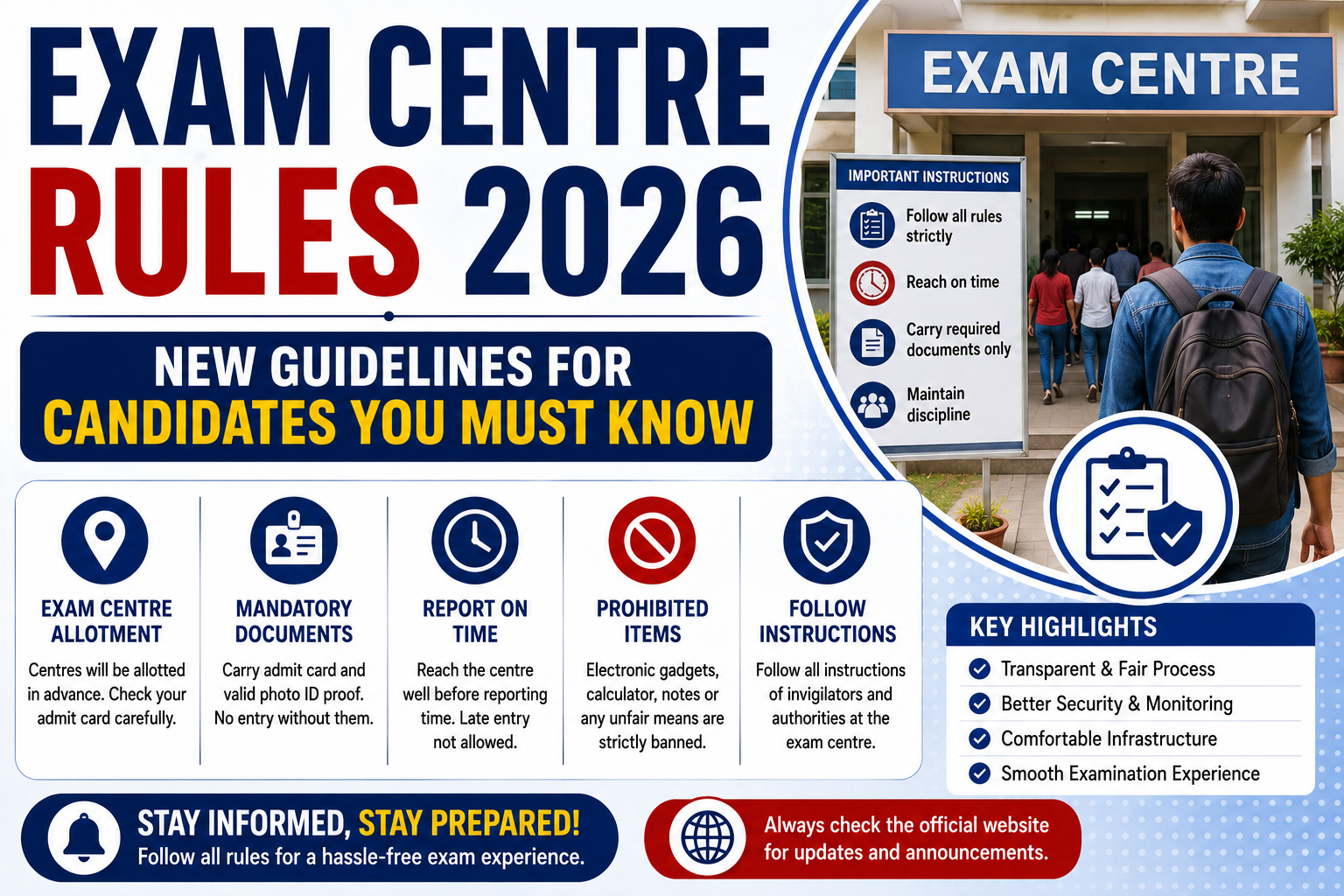
Appearing for a competitive examination is not only about preparing the syllabus and reaching the examination centre on time. Candidates also need to follow several exam centre rules in 2026 relating to identity documents, admit cards, permitted items, dress, reporting time, frisking, electronic devices and examination-hall conduct.
These rules can vary depending on the examination authority. SSC, UPSC, Railway Recruitment Boards and NTA may have different instructions for their respective examinations. Therefore, candidates should always read the instructions printed on their admit card and the latest official notice for their particular exam.
Recent 2026 instructions from SSC and NTA show a stronger focus on identity verification, early reporting, security checks and restrictions on prohibited items. For example, SSC requires candidates who could not complete Aadhaar-based authentication to report two hours before the scheduled examination time and carry additional identity documents.
NTA has also issued specific 2026 advisories covering dress code, permissible items, biometric verification and examination-centre procedures for examinations such as NEET and CUET.
Understanding these rules beforehand can help candidates avoid unnecessary stress and, more importantly, prevent mistakes that could stop them from entering the examination hall.
What Are the Exam Centre Rules in 2026?
While instructions differ from one examination to another, candidates should generally be prepared for the following requirements:
- Carrying a valid admit card or admission certificate
- Carrying an original valid photo ID
- Reaching the centre before the reporting deadline
- Completing identity verification and frisking
- Following dress-code instructions where applicable
- Avoiding prohibited electronic devices
- Not carrying unnecessary baggage
- Following instructions from invigilators
- Using only the stationery or rough sheets permitted by the authority
- Following examination-hall conduct rules
- Cooperating with biometric or other verification procedures
The admit card remains the most important document because it contains examination-specific instructions.
1. Carry Your Admit Card
Candidates must carry a valid admit card, admission certificate or e-call letter, depending on the examination.
SSC instructions, for example, require candidates to bring a printout of the Admission Certificate to the examination hall.
Before leaving home, check:
- Candidate name
- Registration number
- Roll number
- Examination date
- Shift
- Reporting time
- Examination centre address
- Photograph
- Signature
- Special instructions
Do not assume that showing the admit card on your phone will be accepted unless the examination authority specifically permits it.
A printed copy is generally the safer option.
2. Carry an Original Photo ID
A valid photo identity document is another important requirement.
Depending on the examination, accepted IDs may include:
- Aadhaar Card
- Voter ID
- PAN Card
- Passport
- Driving Licence
- School, college or university ID
- Government-issued photo ID
- Employer ID, where permitted
SSC’s 2026 instructions specify that candidates who have not completed Aadhaar authentication must carry an original valid photo ID showing the date of birth as printed on the Admission Certificate.
Candidates should check the exact list in their own admit card.
3. Your Date of Birth Must Match
One of the most important identity checks is the date of birth.
SSC’s examination instructions state that if the photo ID does not contain the date of birth, candidates must carry an additional original document supporting their date of birth. If the date of birth on the Admission Certificate does not match the identity document or supporting certificate, the candidate may not be allowed to appear.
Therefore, check your documents before examination day.
If your ID does not show your date of birth, keep the required additional document ready.
4. Candidates Without Aadhaar Authentication May Need to Report Earlier
Candidates who could not undergo Aadhaar-based authentication may have additional verification requirements.
For certain SSC examinations, such candidates are required to report two hours before the scheduled examination time. They also need to carry two recent passport-size colour photographs and an original valid photo ID.
This is an important rule because arriving at the normal reporting time may not leave enough time for additional verification.
If your admit card gives a different reporting instruction, follow the instruction on the admit card.
5. Reach the Examination Centre Early
Reaching the centre at the last minute is one of the easiest mistakes to avoid.
Candidates should allow sufficient time for:
- Traffic
- Finding the centre
- Parking or transport
- Entry queues
- Identity verification
- Frisking
- Biometric verification
- Security checks
NTA’s 2026 NEET advisory specifically advised candidates to reach the examination centre well before the reporting window and account for traffic and weather conditions.
Early arrival becomes even more important if you are required to undergo additional verification.
6. Check the Exact Centre Address
Do not rely entirely on a map application when travelling to an unfamiliar examination centre.
NTA specifically advised NEET 2026 candidates to verify the exact examination-centre address from their admit card because map applications may sometimes show incorrect location pins.
A good approach is to:
- Check the centre address a day before.
- Search for the location in advance.
- Calculate travel time.
- Identify an alternative route.
- Leave home with sufficient extra time.
If possible, visiting the centre location before examination day can reduce confusion.
7. Electronic Devices Are Strictly Restricted
One of the most important exam centre rules is the restriction on electronic devices.
Depending on the examination, prohibited items can include:
- Mobile phones
- Smartwatches
- Bluetooth devices
- Earphones
- Headphones
- Calculators
- Cameras
- Electronic gadgets
- Storage devices
- Communication devices
SSC’s general examination instructions specifically prohibit electronic gadgets such as mobile phones, Bluetooth devices, headphones, spy cameras, scanners, calculators and storage devices inside the examination lab. Possession can result in cancellation and other action under applicable rules.
Do not assume that switching off your phone makes it permissible.
If an item is prohibited, leave it at home.
8. Smartwatches Can Create Problems
Candidates should be particularly careful with smartwatches.
Even when used only as a timekeeping device, a smartwatch can fall under prohibited electronic devices.
SSC instructions specifically mention watches among prohibited items and state that an electronic timer is available on the computer screen in applicable computer-based examinations.
Therefore, candidates should not wear a smartwatch simply because they intend to use it as a normal watch.
Check the specific exam instructions before carrying any watch.
9. Calculators May Not Be Allowed
Candidates should not carry a calculator unless the examination instructions specifically permit it.
NTA examination instructions list calculators among prohibited materials for applicable examinations.
This includes electronic calculators and, depending on the exam, other calculation devices.
If a calculator is required or permitted for a particular examination, the authority will specify the allowed type and procedure.
10. Avoid Carrying Bags and Unnecessary Items
Candidates should avoid taking bags, purses and unnecessary belongings to the examination centre.
SSC advises candidates not to bring bags and prohibited items because the Commission does not necessarily provide arrangements for their safe custody.
Similarly, NTA examination instructions have stated that candidates should not bring baggage into the examination centre.
The safest approach is to carry only what the admit card specifically requires.
11. Do Not Carry Food Without Checking the Rules
Food and beverages may be restricted inside examination halls.
For example, NTA’s NEET 2026 advisory states that mobile phones, smartwatches, Bluetooth devices, calculators, wallets, jewellery, metallic accessories and food packets are not allowed inside the examination hall.
At the same time, NTA’s 2026 NEET advisory permits transparent water bottles and provides specific provisions for certain medical needs.
Candidates with medical conditions should therefore check the specific examination instructions instead of assuming that all food or drinks are prohibited in every situation.
12. Transparent Water Bottles May Be Allowed in Some Exams
Some examination authorities have introduced specific provisions for transparent water bottles.
For NEET UG 2026, NTA allowed candidates to carry transparent water bottles.
However, this should not be treated as a universal rule for every competitive examination.
The permitted items depend on the examination.
Always follow the latest instructions issued for your particular exam.
13. Dress Code Rules Can Apply
Certain examinations may issue specific dress-code instructions.
For NEET UG 2026, NTA advised candidates regarding permissible clothing and footwear. It stated that light clothing was preferred, while full sleeves or woollens could be worn if needed, subject to additional frisking time. Slippers and low heels were preferred footwear.
Candidates should therefore read the dress-code advisory if their examination authority has issued one.
14. Religious or Customary Attire May Require Additional Checking
Candidates wearing articles or clothing associated with religious or customary practices should check the examination-specific instructions.
NTA’s NEET 2026 advisory allowed articles or objects of faith, but candidates were advised to report early because such items may require additional frisking.
The important point is that candidates should not arrive late because of additional security checks.
If you expect a longer frisking process, reach the centre earlier than usual.
15. Avoid Metallic Accessories
Metallic accessories can create additional security concerns.
Depending on the examination, candidates may be advised to avoid:
- Jewellery
- Bracelets
- Earrings
- Metallic hair accessories
- Chains
- Charms
- Kadas
- Nose pins
SSC’s examination instructions advise candidates to avoid items such as nose pins, bracelets, earrings, charms and kadas because they can increase the time required for frisking.
If an item is essential because of religious or customary reasons, check the specific instructions and reach the centre early.
16. Biometric Verification May Be Used
Modern examination systems increasingly use biometric or digital identity verification.
NTA’s 2026 notice archive includes separate advisories on biometric verification and exception protocols for NEET UG 2026 re-examination.
Candidates should cooperate with the verification process.
If there is a problem with biometric authentication, do not panic. Examination authorities may have an exception procedure, but candidates need to follow the instructions provided by the centre staff.
17. Photograph Requirements Matter
Some examinations require candidates to carry recent passport-size photographs.
For SSC candidates unable to complete Aadhaar authentication, the 2026 instructions require at least two recent colour passport-size photographs in addition to the Admission Certificate and original photo ID.
Candidates should check whether their examination requires:
- Recent passport-size photographs
- Photograph on the admit card
- Photograph on an attendance sheet
- Specific background or size
- Any other photograph-related requirement
Do not assume that an old photograph will always be accepted.
18. PwD/PwBD Candidates Have Additional Requirements
Candidates using facilities such as a scribe may have to carry additional documents.
SSC’s 2026 instructions state that PwBD/PwD candidates using a scribe facility may need to carry the required medical certificate, undertaking and a copy of the scribe’s photo ID proof.
Similar requirements can apply to NTA examinations.
Candidates using accessibility facilities should carefully check the relevant notice well before examination day.
19. Follow the Invigilator’s Instructions
Once inside the examination centre, candidates must follow the instructions of the centre superintendent and invigilators.
This includes instructions relating to:
- Seating
- Identity verification
- Computer login
- Rough work
- Question-paper handling
- Breaks
- Submission
- Leaving the examination hall
NTA’s examination instructions require candidates to follow the directions of the Centre Superintendent and invigilators.
Arguing with examination staff or ignoring instructions can create unnecessary problems.
20. Rough Work Must Be Done Only on Permitted Sheets
Candidates should not bring their own loose sheets for calculations or rough work unless specifically allowed.
In applicable NTA examinations, calculations and writing work must be done on the rough sheet provided at the centre, which must be handed back to the invigilator after the test.
SSC similarly states that paper for rough work will be provided in the examination lab for applicable computer-based examinations.
Never carry loose notes into the examination hall.
21. Do Not Leave the Examination Hall Without Permission
Candidates should remain at their assigned seat and follow the rules regarding leaving the examination room.
NTA instructions state that candidates cannot leave their seat or examination room without permission from the Centre Superintendent or invigilator and must follow the applicable instructions concerning rough sheets and other examination material.
The exact exit procedure can vary by examination.
22. Do Not Appear More Than Once
Candidates should carefully check their allotted examination date and shift.
SSC’s general instructions state that candidates must not appear in the examination more than once; violation can lead to cancellation and other action.
If you have received more than one piece of examination information, verify the correct date and shift through the official portal.
23. Candidates Can Be Under Video Surveillance
Security monitoring is an increasingly important part of computer-based examinations.
SSC’s general instructions state that examination labs are under video surveillance.
Candidates should therefore behave as they would in a strictly monitored examination environment.
Do not attempt to communicate with other candidates or use prohibited material.
24. Unfair Means Can Lead to Cancellation
Candidates who violate examination rules can face serious consequences.
Depending on the examination and offence, consequences may include:
- Cancellation of candidature
- Disqualification
- Debarment from future examinations
- Seizure of prohibited devices
- Legal or criminal proceedings in serious cases
SSC specifically warns that possession of prohibited electronic devices can lead to cancellation, legal or criminal proceedings and debarment under applicable rules.
This is why candidates should never take unnecessary risks with prohibited items.
25. Check Your Centre One Day Before the Exam
A simple preparation step can save considerable stress.
Before examination day:
- Locate the centre on a map.
- Check the route.
- Estimate travel time.
- Check public transport availability.
- Identify an alternative route.
- Keep your admit card ready.
- Prepare your ID documents.
- Check permitted and prohibited items.
SSC itself advises candidates to visit the examination venue at least one day before the examination so that they can reach on time.
26. Do Not Depend on Social Media for Last-Minute Rules
Candidates often receive examination updates through WhatsApp, Telegram, Instagram or other social-media platforms.
These can be useful for general awareness, but they should not replace official communication.
NTA has repeatedly published examination advisories and notices through its official channels, including specific 2026 notices for dress code, biometric verification, admit cards and examination-centre procedures.
If a message says that a particular item is suddenly permitted or prohibited, verify it through the official examination authority.
Exam Centre Rules 2026: What to Carry?
A basic exam-day checklist can include:
| Item | Should You Carry It? |
|---|---|
| Admit Card | Yes |
| Original Photo ID | Yes |
| Passport-size photographs | If required |
| Additional DOB proof | If required |
| PwD/PwBD documents | If applicable |
| Scribe documents | If applicable |
| Transparent water bottle | Only if permitted |
| Mobile phone | No, unless specifically permitted |
| Smartwatch | Generally no |
| Calculator | Only if specifically permitted |
| Notes/books | No |
| Loose paper | No |
| Jewellery/metal accessories | Avoid unless permitted |
| Large bag | Avoid |
The exact requirements can change from one examination to another, so candidates should treat this as a general checklist rather than a universal list.
What Candidates Should Not Do at the Exam Centre
Avoid these common mistakes:
- Arriving just before the gate closes
- Forgetting the admit card
- Carrying an invalid ID
- Bringing a smartwatch
- Carrying a mobile phone
- Carrying loose papers
- Wearing unnecessary metallic accessories
- Ignoring the dress-code advisory
- Bringing a large bag
- Depending on a mobile map without checking the centre address
- Ignoring biometric verification
- Arguing with examination staff
- Using unauthorized material
- Leaving the examination room without permission
Most of these mistakes are completely avoidable with a little preparation.
Exam Day Checklist for Candidates
Before Leaving Home
- Check your admit card.
- Check the exam date and shift.
- Check the centre address.
- Keep your original photo ID ready.
- Keep photographs ready if required.
- Keep additional certificates ready if required.
- Check dress-code instructions.
- Remove prohibited electronic items from your bag.
- Plan your route.
At the Examination Centre
- Reach early.
- Follow the entry instructions.
- Cooperate with frisking.
- Complete biometric verification if required.
- Show your documents when asked.
- Follow the seating instructions.
- Use only permitted material.
- Follow the invigilator’s instructions.
During the Examination
- Read the instructions on the screen.
- Use only the permitted rough sheets.
- Do not communicate with other candidates.
- Do not use unauthorized devices.
- Follow the time displayed on the computer.
- Submit the examination according to the instructions.
Why Exam Centre Rules Are Becoming Stricter
Competitive examinations now involve very large numbers of candidates, and authorities are increasingly using technology to protect the examination process.
Identity authentication, biometric checks, video surveillance, controlled entry and restrictions on electronic devices are intended to reduce impersonation, cheating and other unfair practices.
For candidates, these measures can sometimes make entry slower, but they are also designed to create a more secure and fair examination environment.
The recent 2026 advisories from NTA and SSC show that candidates are expected to take identity verification and examination-centre instructions seriously.
Important: Rules Can Differ by Examination
There is no single Exam Centre Rules 2026 document applicable to every examination in India.
For example:
- SSC may have one set of instructions.
- NTA may issue separate instructions for NEET, JEE, CUET and UGC NET.
- UPSC can prescribe its own examination-day requirements.
- RRBs can have different rules depending on the recruitment.
- State-level examinations can have separate instructions.
Even within the same examination authority, instructions can change between examination sessions.
Therefore, the latest admit card and official examination notice should always be treated as the final source of instructions.
Final Thoughts
The Exam Centre Rules 2026 place greater emphasis on identity verification, timely reporting, security checks and responsible conduct inside examination centres.
Candidates should carry their admit card and required original ID, reach the centre well before the reporting time and avoid prohibited items such as mobile phones, smartwatches, Bluetooth devices, calculators and unauthorized papers. SSC and NTA have also issued specific 2026 instructions covering Aadhaar authentication, biometric verification, dress requirements and permitted items.
The safest strategy is simple: read your admit card carefully, check the latest official notice and prepare your examination-day documents the night before.
Do not rely on an old checklist because examination authorities can introduce exam-specific instructions. A few minutes of preparation can prevent a major problem at the examination centre.
For students and government-job aspirants, following exam-centre rules is just as important as knowing the syllabus. Reaching early, carrying the correct documents and avoiding prohibited items can help you enter the examination hall confidently and focus on what really matters — answering the questions.
Read More:Railway Exam New Rules 2026: Latest Changes in CBT & Selection Process