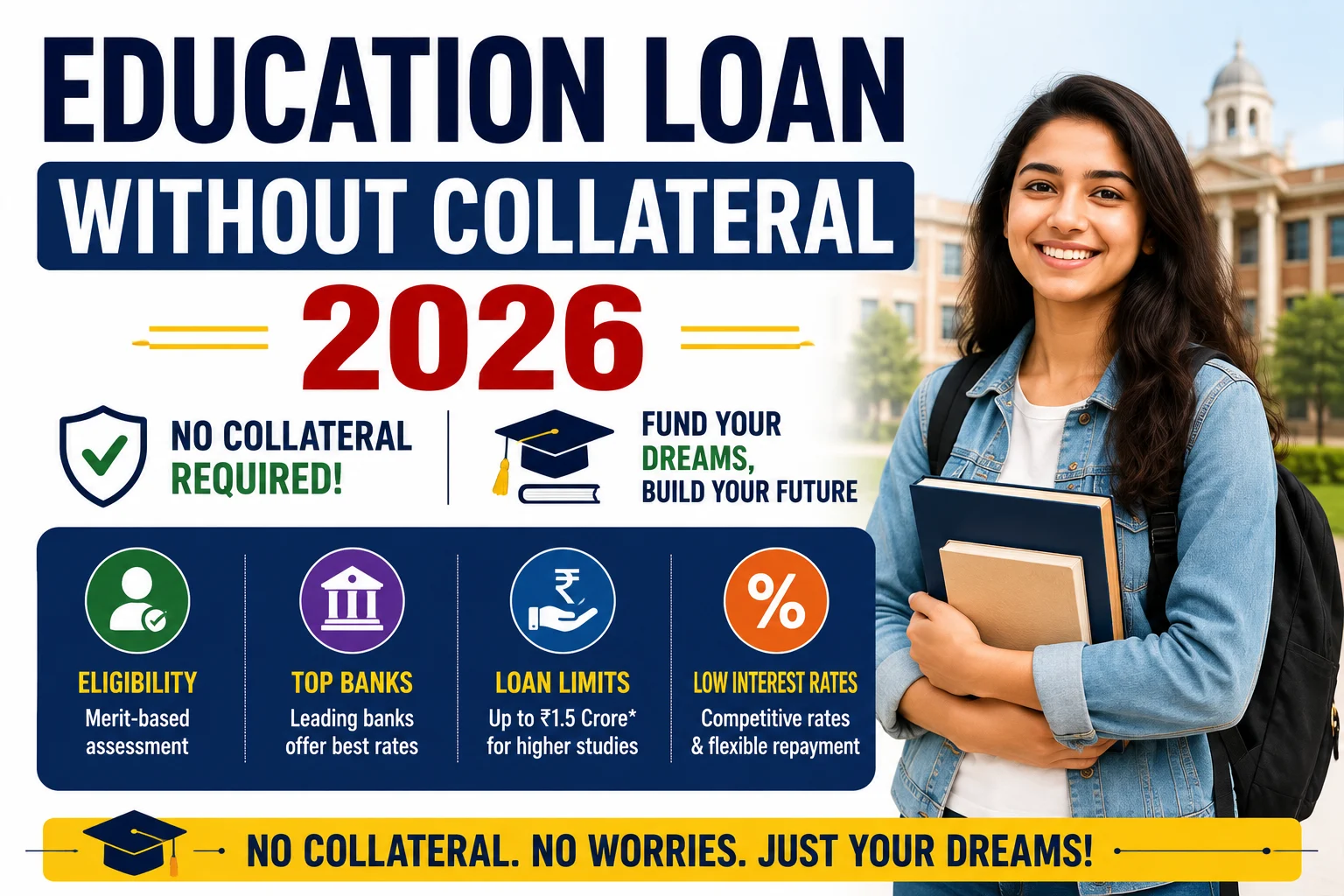
An education loan can help students manage the cost of higher education without putting an immediate financial burden on their families. However, one of the biggest concerns for students and parents is whether a loan can be obtained without pledging property, fixed deposits or other assets as collateral.
In 2026, students have several options for collateral-free education loans. The most important is the PM-Vidyalaxmi Scheme, which provides collateral-free and guarantor-free education loans to eligible students admitted to designated Quality Higher Educational Institutions (QHEIs). The scheme’s guidelines state that eligible loans can be provided without collateral or a third-party guarantee, with the loan amount determined based on the student’s education expenses and applicable scheme conditions.
Apart from PM-Vidyalaxmi, individual banks also offer education-loan products without collateral for specified loan amounts, institutions or student categories. For example, SBI’s regular Student Loan Scheme provides loans up to ₹7.50 lakh without collateral, while Bank of Maharashtra states that its regular education-loan scheme does not require collateral up to ₹7.50 lakh.
This guide explains Education Loan Without Collateral 2026, including eligibility, banks, loan limits, PM-Vidyalaxmi benefits, documents, interest rates, application process and repayment.
What Is an Education Loan Without Collateral?
An education loan without collateral is a loan where the student or family does not have to pledge a property, land, fixed deposit or other tangible asset as security for the loan.
However, collateral-free does not necessarily mean co-borrower-free.
Depending on the loan scheme, the student’s parent or guardian may still need to become a joint co-borrower.
For example, SBI’s regular student-loan scheme requires a parent or guardian as co-borrower for loans up to ₹7.50 lakh but does not require collateral or a third-party guarantee.
Under PM-Vidyalaxmi, eligible students can receive collateral-free and guarantor-free education loans through the participating banking system, subject to the scheme’s eligibility conditions.
Education Loan Without Collateral 2026: Key Highlights
| Particular | Details |
|---|---|
| Loan Type | Education loan without collateral |
| Main Government Scheme | PM-Vidyalaxmi |
| Collateral | Not required under eligible PM-Vidyalaxmi loans |
| Third-Party Guarantee | Not required under PM-Vidyalaxmi |
| Parent/Guardian | May be required as co-borrower depending on the scheme |
| Eligible Institutions | Designated Quality Higher Educational Institutions |
| Loan Amount | Need-based under PM-Vidyalaxmi; bank-specific limits for regular loans |
| Government Credit Guarantee | 75% of outstanding default for eligible loans up to ₹7.5 lakh |
| Interest Support | Available to eligible students under specified income conditions |
| Application | Online through PM-Vidyalaxmi portal for eligible schemes |
The exact loan amount, interest rate, margin and repayment conditions depend on the bank and loan product.
PM-Vidyalaxmi: Major Option for Collateral-Free Education Loans
The PM-Vidyalaxmi Scheme was introduced to provide financial support to meritorious students pursuing higher education in designated Quality Higher Educational Institutions.
The scheme specifically provides for collateral-free and guarantor-free education loans for eligible students. The Ministry of Education’s guidelines also clarify that for qualifying QHEIs, there is no general ceiling on family income or loan amount for the collateral-free loan facility, with financing linked to the eligible education expenses.
This is an important distinction from traditional education-loan rules, where collateral requirements often increase once the loan crosses a specified amount.
Who Is Eligible for a Collateral-Free PM-Vidyalaxmi Loan?
Students generally need to satisfy the following conditions:
- Be eligible under the PM-Vidyalaxmi scheme
- Secure admission to a designated QHEI
- Obtain admission through the prescribed merit-based process
- Pursue an eligible higher-education course
- Submit the required documents
- Meet the applicable bank’s loan-processing requirements
The list of eligible institutions is updated by the Department of Higher Education. Recent 2026 government notices have added or clarified institutions eligible under the scheme.
Is There an Income Limit for a Collateral-Free Education Loan?
This is an important point.
There is no general family-income ceiling for the collateral-free PM-Vidyalaxmi loan itself, according to the scheme guidelines.
However, income limits apply to certain interest-subvention benefits.
For example, eligible students with annual family income up to ₹8 lakh can receive a 3% interest subvention on eligible education loans up to ₹10 lakh during the moratorium period, subject to scheme conditions.
Therefore:
Collateral-free loan eligibility and interest-subsidy eligibility are not the same thing.
Education Loan Without Collateral: Loan Limits
There is no single loan limit applicable to every collateral-free education loan.
The limit depends on the loan scheme.
Under PM-Vidyalaxmi
The scheme provides need-based financing linked to eligible education expenses. The official guidelines provide examples of collateral-free and guarantor-free financing of ₹10 lakh and even ₹30 lakh for qualifying QHEIs and courses.
Therefore, it would be incorrect to say that every PM-Vidyalaxmi collateral-free loan is capped at ₹7.5 lakh.
Under Regular Bank Education Loans
Individual banks may impose their own collateral-free limits.
For example, SBI’s regular Student Loan Scheme provides:
- Up to ₹7.50 lakh — no collateral
- Above ₹7.50 lakh — tangible collateral generally required
subject to the scheme’s conditions.
Bank of Maharashtra’s regular Model Education Loan Scheme similarly states that loans up to ₹7.50 lakh are provided without collateral, while loans above that amount require acceptable tangible security.
Banks Offering Education Loans Without Collateral in 2026
Several banks offer collateral-free education-loan options. The exact conditions differ.
State Bank of India
SBI’s regular Student Loan Scheme provides loans up to ₹7.50 lakh without collateral or third-party guarantee, with the parent or guardian acting as co-borrower.
SBI also offers the PM-Vidyalaxmi loan product for eligible students in designated institutions.
Canara Bank
Canara Bank’s PM-Vidyalaxmi product states that eligible students can obtain education loans without collateral security and without a guarantor. The bank currently lists eligible QHEIs and provides need-based financing under the scheme.
Canara Bank also offers Vidya Turant, a collateral-free and guarantor-free education-loan product. Its published information lists loan quantum of up to ₹50 lakh, ₹40 lakh or ₹30 lakh depending on institution category.
Bank of Maharashtra
Bank of Maharashtra’s PM-Vidyalaxmi product provides collateral-free education loans to eligible students admitted to qualifying institutions. Its published scheme states that no collateral security is required.
The bank’s regular Model Education Loan Scheme also provides collateral-free loans up to ₹7.50 lakh under its applicable conditions.
Other Participating Banks
PM-Vidyalaxmi operates through participating scheduled banks and financial institutions.
Students should not assume that every bank offers identical interest rates, loan limits or documentation requirements. The final loan terms depend on the participating lender and the student’s profile.
Comparison of Collateral-Free Education Loan Options
| Bank/Scheme | Collateral-Free Option | Indicative Loan Limit | Important Condition |
|---|---|---|---|
| SBI Student Loan | Yes | Up to ₹7.50 lakh | Parent/guardian as co-borrower |
| SBI PM-Vidyalaxmi | Yes | Need-based under scheme | Eligible QHEI admission |
| Canara Bank PM-Vidyalaxmi | Yes | Need-based | Eligible QHEI |
| Canara Vidya Turant | Yes | Up to ₹30–50 lakh depending on institution category | Eligible institutions |
| Bank of Maharashtra Model Education Loan | Yes | Up to ₹7.50 lakh | Applicable education-loan conditions |
| Bank of Maharashtra PM-Vidyalaxmi | Yes | Need-based | Eligible QHEI |
Note: Interest rates, institution lists and loan conditions can change. Students should verify the latest terms with the bank before applying.
Can I Get an Education Loan of ₹10 Lakh Without Collateral?
Yes, in certain cases.
Under PM-Vidyalaxmi, eligible students admitted to qualifying QHEIs can receive collateral-free and guarantor-free financing based on eligible education expenses. The official guidelines give examples where students can receive collateral-free financing above ₹7.5 lakh.
However, a regular education-loan product from a bank may have a lower collateral-free limit.
For example, SBI’s standard Student Loan Scheme requires collateral for loans above ₹7.50 lakh.
Therefore, the answer depends on which education-loan scheme you are using.
Can I Get a ₹20 Lakh Education Loan Without Collateral?
It may be possible under certain specialised or PM-Vidyalaxmi-linked products, provided the student and institution satisfy the relevant eligibility requirements.
The PM-Vidyalaxmi guidelines provide illustrative examples of collateral-free loans above ₹20 lakh for qualifying institutions and courses.
Some bank-specific products can also provide higher collateral-free limits for students admitted to selected institutions.
For example, Canara Bank’s Vidya Turant scheme lists collateral-free financing up to ₹50 lakh depending on the institution category.
Can I Get a ₹30 Lakh Education Loan Without Collateral?
Under eligible PM-Vidyalaxmi circumstances, yes.
The Ministry of Education’s official guidelines provide an example of a ₹30 lakh collateral-free and guarantor-free loan for a student admitted to a qualifying QHEI where the total eligible course and related expenses amount to approximately ₹30 lakh.
This does not mean every student can automatically receive ₹30 lakh without collateral.
The institution, course, eligible expenses and bank’s assessment all matter.
Education Loan Without Collateral for Study Abroad
Students planning to study abroad may also find collateral-free options, but eligibility varies significantly.
Some specialised bank schemes provide higher unsecured limits for selected institutions.
For example, SBI’s Global Ed-Vantage information includes a collateral-free option above ₹7.50 lakh for certain eligible overseas institutions, subject to scheme conditions.
Students should therefore check:
- University eligibility
- Country
- Course
- Loan amount
- Collateral requirement
- Margin
- Interest rate
- Co-borrower requirement
before choosing a lender.
Education Loan Without Collateral for IIT, IIM, NIT and Other Premier Institutes
Students admitted to premier institutions may have access to specialised education-loan products with higher collateral-free limits.
The exact limit depends on:
- Institution
- Course
- Bank
- Loan scheme
- Admission category
- Academic programme
SBI’s Scholar Loan Scheme, for example, provides need-based loans for select premier institutions, with loan limits varying according to institution category.
Education Loan Without Collateral for Girls
Some banks offer interest concessions to female students.
For example, SBI’s published education-loan rates provide a 0.50% interest concession for girl students under specified education-loan products.
This is separate from the collateral-free benefit.
A girl student should therefore check both:
- Whether the loan is collateral-free
- Whether a women-specific interest concession applies
Education Loan Without Collateral for Low-Income Families
Government interest-subvention programmes can provide additional support to students from lower-income families.
Under PM-Vidyalaxmi, students with annual family income up to ₹8 lakh may qualify for 3% interest subvention on eligible education loans up to ₹10 lakh during the moratorium, subject to the scheme conditions.
For certain eligible technical and professional courses, students with annual family income up to ₹4.5 lakh may also qualify for support under the PM-USP Central Sector Interest Subsidy framework.
Education Loan Without Collateral: Documents Required
The documents depend on the bank and scheme, but students should generally prepare the following.
Student Documents
- Aadhaar
- PAN
- Address proof
- Passport-size photographs
- Academic certificates
- Previous examination marksheets
- Entrance-exam result
- Admission letter
- Course details
- Fee structure
Co-Borrower Documents
Where a co-borrower is required:
- Aadhaar/KYC
- PAN
- Address proof
- Income proof
- Salary slips
- Bank statements
- Income-tax documents, where applicable
- Existing loan details
Bank of Maharashtra’s PM-Vidyalaxmi documentation, for example, includes student KYC, PAN, admission proof, entrance-exam result and co-applicant income documents.
Additional Documents for Government Interest Support
Students applying for applicable interest-subvention benefits may need an income certificate issued by the designated authority.
Is a Co-Borrower Required for a Collateral-Free Education Loan?
This depends on the scheme.
For regular education loans, a parent or guardian commonly acts as co-borrower.
SBI’s regular Student Loan Scheme, for example, requires a parent/guardian as co-borrower even though collateral is not required up to ₹7.50 lakh.
Under PM-Vidyalaxmi, the scheme is specifically designed to provide collateral-free and guarantor-free education loans, although participating-bank documentation may still require parent/guardian co-obligation according to the scheme structure. Bank of Maharashtra’s PM-Vidyalaxmi terms, for example, specify parents/guardians as joint co-borrowers while requiring no collateral.
Education Loan Without Collateral Interest Rates 2026
Interest rates are not uniform across banks.
They can depend on:
- Loan scheme
- Institution
- Loan amount
- Benchmark
- Student category
- Bank
- Applicable concessions
For example, SBI currently publishes different rates for its PM-Vidyalaxmi and regular Student Loan products.
Canara Bank’s PM-Vidyalaxmi page currently advertises a rate starting from 6.75% per annum, subject to its terms and conditions.
Students should verify the applicable rate on the date of application because education-loan rates can change.
Does Collateral-Free Mean No Interest?
No.
Collateral-free only means that qualifying collateral security is not required.
The loan still carries interest unless the student qualifies for a government interest-subvention benefit that covers some or all of the applicable interest during the specified period.
For example, PM-Vidyalaxmi provides 3% interest subvention for eligible students within the prescribed family-income category, subject to scheme conditions.
Is There a Government Credit Guarantee?
Yes.
Under PM-Vidyalaxmi, education loans up to ₹7.5 lakh are eligible for a 75% credit guarantee of outstanding default, subject to the applicable government guidelines.
The credit guarantee supports the lender; it should not be interpreted as a cash benefit paid directly to the student.
Education Loan Without Collateral: Repayment Period
The repayment period varies by bank and loan product.
For example, Bank of Maharashtra’s PM-Vidyalaxmi scheme provides repayment for up to 15 years after the moratorium period.
SBI’s regular Student Loan Scheme also provides repayment over up to 15 years after the applicable repayment holiday.
Students should check:
- Moratorium period
- Repayment start date
- Total repayment period
- Interest during moratorium
- Prepayment rules
What Is the Moratorium Period?
The moratorium is the period during which regular repayment is generally deferred.
Under Bank of Maharashtra’s PM-Vidyalaxmi scheme, the moratorium is the course period plus one year after completion of study.
The exact moratorium can differ between lenders.
Importantly, interest may continue to accrue during the moratorium.
How to Apply for Education Loan Without Collateral Online
Eligible students can apply through the PM-Vidyalaxmi portal for participating schemes.
The process generally involves:
Step 1: Register
Create a student account on the PM-Vidyalaxmi portal.
Step 2: Complete the Application
Enter:
- Personal information
- Academic details
- Course details
- Institution
- Fee information
- Co-borrower details
Step 3: Upload Documents
Submit the required KYC, admission, academic and income documents.
Step 4: Select the Loan
Search and select an appropriate education-loan scheme.
Step 5: Submit to the Bank
Submit the application to the selected participating bank.
Step 6: Bank Verification
The bank will assess the application and verify the relevant information.
Step 7: Loan Sanction
If the application meets the requirements, the bank can issue the sanction.
Step 8: Disbursement
The loan is disbursed according to the approved education expenses and lender terms.
Bank of Maharashtra’s current PM-Vidyalaxmi instructions describe the process as registration, filling the common education-loan application form and submitting the application to the selected bank.
How to Improve Your Chances of Getting a Collateral-Free Education Loan
Choose an Eligible Institution
For PM-Vidyalaxmi, admission to an eligible QHEI is one of the most important requirements.
Keep Your Admission Documents Ready
The admission letter and official fee structure are essential for assessing the loan requirement.
Maintain a Strong Co-Borrower Profile
Where a parent or guardian is required as co-borrower, their income and existing liabilities can affect the bank’s assessment.
Keep Your Credit History Clean
The bank may evaluate the financial profile of the co-borrower.
Apply for a Realistic Loan Amount
The loan should correspond to eligible education expenses.
Submit Complete Documents
Incomplete applications can cause delays.
Check Government Benefits
If your family income falls within the applicable limit, check whether you qualify for interest-subvention support.
Common Reasons for Rejection of a Collateral-Free Education Loan
An application may be rejected or delayed because of:
- Institution not eligible
- Course not eligible
- Admission not meeting scheme requirements
- Incomplete documents
- Incorrect information
- Weak co-borrower profile
- Poor credit history
- Insufficient repayment capacity
- Loan amount not supported by eligible expenses
- Problems with admission documentation
A collateral-free loan does not mean that the bank skips its normal credit and eligibility assessment.
Collateral-Free vs Collateral-Based Education Loan
| Feature | Without Collateral | With Collateral |
|---|---|---|
| Property Security | Not required under eligible schemes | Usually required |
| Loan Amount | Depends on scheme | Can generally be higher |
| Risk to Family Asset | No pledged property | Pledged asset may be at risk |
| Processing | May be simpler | Legal and valuation checks required |
| Co-Borrower | Often required | Generally required |
| Interest Rate | Depends on scheme | May be lower for some products |
| Eligibility | Institution/profile dependent | Often broader for larger loans |
| Suitable For | Eligible students with qualifying profiles | Higher education expenses requiring larger financing |
Important Things to Check Before Taking a Collateral-Free Education Loan
Before accepting the loan, compare:
- Interest rate
- Benchmark
- Loan amount
- Margin
- Processing charges
- Moratorium
- Repayment tenure
- Interest during moratorium
- Prepayment rules
- Government subsidy eligibility
- Disbursement schedule
- Course and institution eligibility
Do not select a loan simply because it is advertised as “zero collateral.”
The overall cost and repayment terms are equally important.
Frequently Asked Questions (FAQs)
Can I get an education loan without collateral in 2026?
Yes. Several education-loan schemes provide collateral-free financing. PM-Vidyalaxmi is specifically designed to provide collateral-free and guarantor-free education loans to eligible students admitted to qualifying QHEIs.
What is the maximum collateral-free education loan?
There is no single maximum limit for all schemes. Under PM-Vidyalaxmi, financing is need-based and the official guidelines provide examples of collateral-free loans up to ₹30 lakh for qualifying courses and institutions.
Can I get a ₹7.5 lakh education loan without collateral?
Yes. SBI’s regular Student Loan Scheme provides loans up to ₹7.50 lakh without collateral, subject to its eligibility requirements.
Can I get a ₹10 lakh education loan without collateral?
Yes, it can be possible under PM-Vidyalaxmi for eligible students and qualifying institutions. The scheme’s guidelines provide examples of collateral-free financing above ₹7.5 lakh.
Can I get a ₹20 lakh education loan without collateral?
Certain PM-Vidyalaxmi and specialised bank products can provide higher collateral-free loans, depending on the institution, course and eligibility.
Can I get a ₹30 lakh education loan without collateral?
Yes, the PM-Vidyalaxmi guidelines provide an illustrative example of a ₹30 lakh collateral-free and guarantor-free education loan for an eligible QHEI and course.
Which banks offer education loans without collateral?
Banks including SBI, Canara Bank and Bank of Maharashtra offer collateral-free education-loan options under specific schemes. Other participating banks may also provide eligible products.
Is PM-Vidyalaxmi available to all students?
No. Eligibility depends on admission to designated Quality Higher Educational Institutions and other scheme conditions. The QHEI list is updated by the Department of Higher Education.
Is there an income limit for a collateral-free PM-Vidyalaxmi loan?
The collateral-free loan itself does not have a general family-income ceiling under the scheme guidelines. However, income limits apply to certain interest-subvention benefits.
Does a collateral-free loan require a parent as co-borrower?
It depends on the scheme. Regular bank education loans commonly require a parent or guardian as co-borrower. PM-Vidyalaxmi is collateral-free and guarantor-free, but participating banks can require parent/guardian co-borrower documentation under the scheme.
Is interest charged on a collateral-free education loan?
Yes. Collateral-free means no collateral security is required; it does not mean the loan is interest-free. Eligible students may receive government interest subvention under specified schemes.
Can I get a collateral-free loan for studying abroad?
Yes, some bank products provide collateral-free loans for eligible overseas institutions. The amount and eligibility depend on the lender and institution.
Can girls get an interest concession on education loans?
Some banks offer special concessions. SBI, for example, lists a 0.50% concession for girl students under specified education-loan products.
How can I apply for a collateral-free education loan online?
Eligible students can register on the PM-Vidyalaxmi portal, complete the common application form, select a participating bank and submit the application online.
Conclusion
An Education Loan Without Collateral 2026 can be a useful option for students who do not want to pledge property or other assets to finance higher education.
However, there is an important difference between regular collateral-free education loans and PM-Vidyalaxmi loans.
Under regular bank education-loan products, collateral-free limits are often restricted. For example, SBI’s standard Student Loan Scheme provides up to ₹7.50 lakh without collateral, while loans above that amount generally require tangible security.
The PM-Vidyalaxmi Scheme offers a broader collateral-free option for eligible students admitted to designated Quality Higher Educational Institutions. Its official guidelines provide for collateral-free and guarantor-free financing based on eligible education expenses and even provide illustrative examples of loans of ₹10 lakh and ₹30 lakh without collateral.
Students should also remember that collateral-free does not mean interest-free. Interest is normally payable unless the student qualifies for an applicable government interest-subvention benefit. Eligible students with annual family income up to ₹8 lakh may receive 3% interest subvention on eligible education loans up to ₹10 lakh during the moratorium, subject to scheme conditions.
The choice of bank is also important. SBI, Canara Bank and Bank of Maharashtra currently publish collateral-free education-loan options under different schemes, but their loan limits, interest rates, institution requirements and repayment conditions differ.
Before applying, students should verify the eligible institution list, loan amount, interest rate, margin, co-borrower requirement, repayment period and government benefits. They should also prepare admission documents, academic records, KYC documents and co-borrower income documents in advance.
Finally, do not choose an education loan simply because it requires no collateral. Compare the complete terms and understand how much you will eventually have to repay. A carefully selected collateral-free education loan can help students pursue higher education while avoiding the need to pledge a family property or other valuable asset.
Read More: Home Loan 2026: Interest Rates, Eligibility, Documents & Application Process