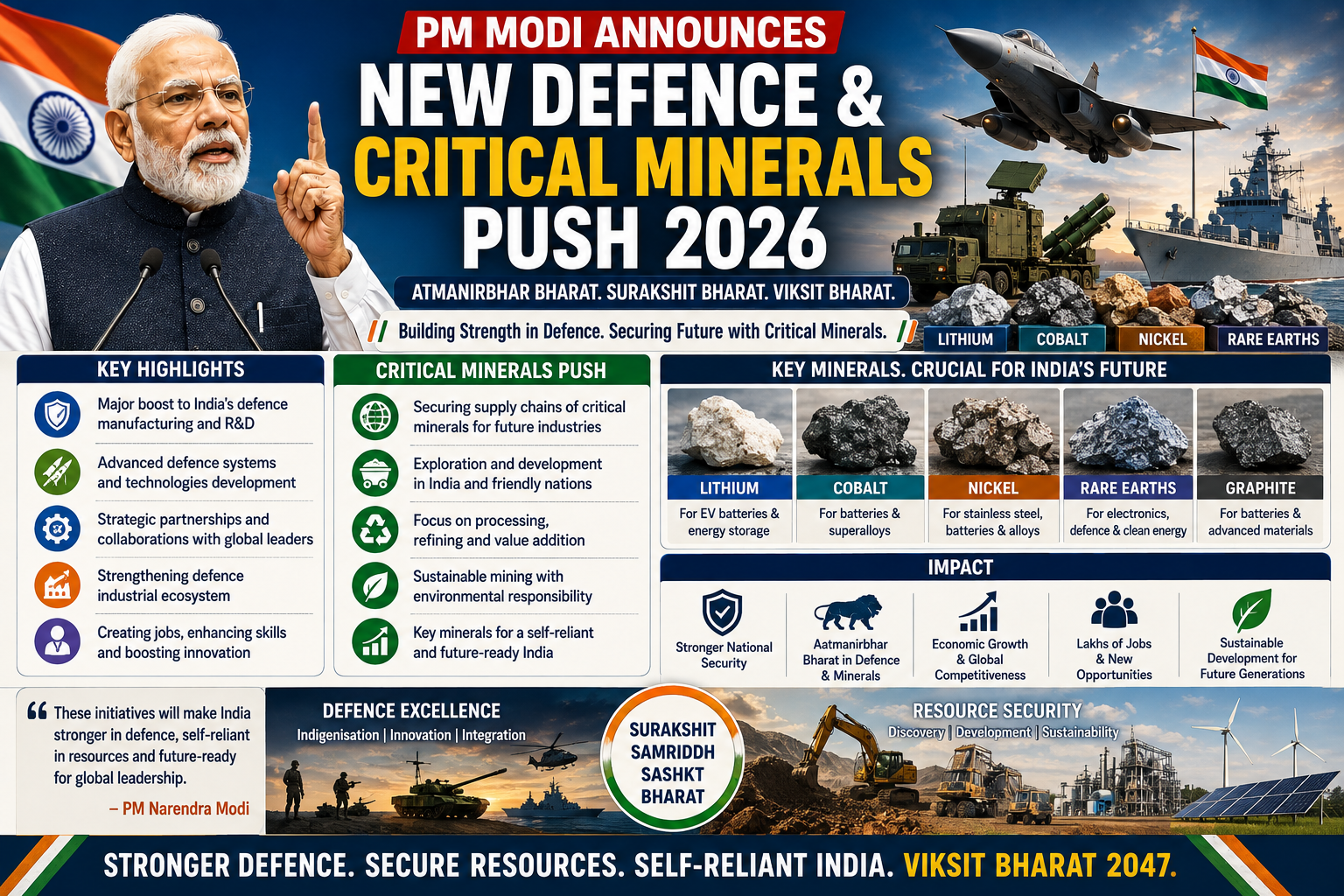
Prime Minister Narendra Modi’s Independence Day address on 15 August 2026 placed strong emphasis on defence self-reliance and securing critical minerals, making both areas important parts of India’s broader Viksit Bharat 2047 strategy. The defence push focuses on indigenous technologies such as drones, counter-drone systems and hypersonic capabilities, while the critical-minerals strategy aims to reduce dependence on foreign sources of strategic raw materials.
The announcements are part of a wider Atmanirbhar Bharat approach, under which India is seeking greater domestic capability in defence manufacturing, advanced technology, energy, semiconductors and essential minerals. Critical minerals are particularly important because they are required for modern industries, clean-energy technologies, electronics and defence equipment.
What Did PM Modi Announce on Defence?
During his Independence Day speech, PM Modi highlighted Raksha Shakti, or defence power, as one of the seven major pillars of his Saptadhara vision for Viksit Bharat.
He emphasised that India should become increasingly self-reliant in defence manufacturing and move toward becoming a global supplier of next-generation defence technologies. Key areas highlighted included:
- Indigenous drones
- Counter-drone systems
- Hypersonic technology
- Advanced defence equipment
- Defence manufacturing
- Defence exports
- Indigenous research and innovation
Why Is Defence Self-Reliance Important for India?
Defence self-reliance is aimed at reducing India’s dependence on imported military equipment and technologies.
Domestic defence capabilities can help India:
- Strengthen national security
- Reduce import dependence
- Develop strategic technologies domestically
- Create defence manufacturing jobs
- Encourage private-sector participation
- Support defence startups
- Increase defence exports
- Build stronger domestic supply chains
The government’s broader defence strategy has increasingly focused on developing and manufacturing more equipment within India.
Focus on Indigenous Drones
Drones have become increasingly important in modern warfare, surveillance and border security.
PM Modi stressed the need for India to develop its own indigenous drone and counter-drone systems.
This could create opportunities for Indian companies working in:
- Drone manufacturing
- Artificial intelligence
- Sensors
- Robotics
- Electronics
- Communication systems
- Navigation technology
- Defence software
The counter-drone segment is also becoming important because military forces need technologies capable of detecting and neutralising hostile unmanned systems.
Push for Hypersonic Technology
Another important area highlighted by PM Modi was hypersonic technology.
Hypersonic systems travel at extremely high speeds and require advanced capabilities in areas such as propulsion, materials, guidance and control systems.
India’s focus on this technology reflects the government’s broader objective of developing advanced defence capabilities domestically.
For India’s technology ecosystem, this can encourage research in:
- Aerospace engineering
- Propulsion
- Advanced materials
- Electronics
- Guidance systems
- Artificial intelligence
- High-performance computing
Defence Production and Exports
India’s defence strategy is no longer focused only on meeting domestic requirements.
The government increasingly wants Indian companies to become global defence suppliers.
PM Modi highlighted the need for India to develop next-generation defence technologies that can be supplied to other countries.
This can potentially benefit:
- Defence PSUs
- Private defence companies
- MSMEs
- Startups
- Engineering firms
- Aerospace companies
- Electronics manufacturers
What Are Critical Minerals?
Critical minerals are raw materials that are considered particularly important for economic development, national security and strategic technologies, while their supply can be vulnerable to disruption.
They are used in sectors such as:
- Electronics
- Batteries
- Electric vehicles
- Renewable energy
- Defence
- Telecommunications
- Semiconductors
- Aerospace
- Advanced manufacturing
As technology-intensive industries expand, securing reliable supplies of these minerals has become an important strategic priority for countries around the world.
Why Is India Focusing on Critical Minerals?
India’s growing manufacturing and technology sectors require reliable access to essential raw materials.
Dependence on overseas sources can create vulnerabilities if:
- Global supply chains are disrupted
- Export restrictions are imposed
- Prices rise sharply
- Geopolitical tensions affect supplies
- Production becomes concentrated in a few countries
PM Modi has therefore emphasised the importance of developing domestic capabilities and building international supply partnerships for critical minerals.
National Critical Minerals Mission
The National Critical Minerals Mission is a major government initiative aimed at strengthening India’s critical-mineral supply chain.
The mission covers activities such as:
- Mineral exploration
- Domestic mining
- Processing
- Recycling
- Technology development
- Overseas mineral acquisition
- Strategic supply partnerships
The government has been exploring more than 1,200 locations for critical minerals as part of the broader effort to strengthen self-reliance.
Which Industries Need Critical Minerals?
Critical minerals are important for several strategic sectors.
Defence
Advanced defence systems, sensors, electronics and aerospace technologies can require specialised minerals and materials.
Electric Vehicles
EV batteries and electric motors depend on several important mineral inputs.
Renewable Energy
Solar, wind and energy-storage technologies require various critical raw materials.
Electronics
Smartphones, computers, telecommunications equipment and other electronics depend on specialised materials.
Semiconductors
Advanced electronics and semiconductor manufacturing require reliable access to strategic materials.
Aerospace
Aircraft, spacecraft and advanced propulsion systems can require specialised metals and materials.
Critical Minerals and Clean Energy
The transition toward cleaner energy is increasing demand for several minerals used in:
- Batteries
- Electric vehicles
- Solar technologies
- Wind turbines
- Energy storage
- Power infrastructure
Therefore, critical-mineral security is increasingly linked with energy security.
India’s strategy aims to ensure that its clean-energy transition does not create a new form of dependence on imported raw materials.
Critical Minerals and Defence
The connection between critical minerals and national security is particularly important.
Modern defence systems depend heavily on advanced electronics, sensors, communication equipment, aerospace systems and specialised materials.
A disruption in the supply of essential minerals could therefore affect both economic and defence capabilities.
This is why the government considers critical-mineral security an important component of strategic autonomy.
Deep-Sea Exploration and Mineral Security
India is also expanding exploration of resources beneath the sea.
During his Independence Day address, PM Modi highlighted the Samudra Manthan approach and India’s efforts to explore offshore resources, including minerals and energy resources. Reports noted a policy shift toward greater deep-sea exploration.
Deep-sea exploration could potentially help India identify additional sources of:
- Critical minerals
- Energy resources
- Marine resources
- Strategic raw materials
However, deep-sea mining is technologically complex and requires careful environmental and regulatory management.
Defence and Critical Minerals: How Are They Connected?
The two priorities may appear different, but they are closely connected.
Modern defence equipment depends on advanced technologies, and advanced technologies require specialised materials.
For example:
Critical minerals → Advanced materials → Electronics → Defence systems
Similarly:
Critical minerals → Batteries → Electric mobility → Defence and industrial applications
Securing mineral supplies can therefore strengthen India’s ability to manufacture strategic technologies domestically.
What Does This Mean for Indian Startups?
The new focus could create opportunities for startups working in emerging technology areas.
Potential areas include:
- Defence drones
- Counter-drone systems
- AI
- Robotics
- Aerospace
- Cybersecurity
- Advanced materials
- Mineral exploration
- Recycling
- Battery technology
- Semiconductor materials
Government procurement and defence innovation programmes could also provide opportunities for smaller companies that develop specialised technologies.
What Does This Mean for MSMEs?
MSMEs could benefit from the growing domestic defence manufacturing ecosystem.
Opportunities may emerge in:
- Components
- Electronics
- Precision engineering
- Machinery
- Software
- Aerospace parts
- Drone components
- Defence equipment
- Maintenance services
The development of domestic supply chains can allow smaller manufacturers to participate in larger defence and technology projects.
What Does This Mean for Students?
The defence and critical-minerals push could create long-term opportunities for students in technical and scientific disciplines.
Relevant fields include:
- Mechanical engineering
- Electrical engineering
- Electronics engineering
- Aerospace engineering
- Metallurgy
- Materials science
- Mining engineering
- Geology
- Chemistry
- Computer science
- Artificial intelligence
- Robotics
Students interested in these sectors should monitor recruitment, internships, research opportunities and technical programmes announced by relevant government organisations and companies.
Potential Employment Opportunities
The expansion of defence manufacturing and mineral exploration can generate employment across several areas.
Defence Sector
- Engineers
- Technicians
- Researchers
- Software developers
- Drone specialists
- Aerospace professionals
- Manufacturing workers
Critical Minerals Sector
- Geologists
- Mining engineers
- Metallurgists
- Environmental specialists
- Processing experts
- Research scientists
- Exploration professionals
The initiatives are not, however, a direct government-job recruitment scheme. Actual vacancies will depend on individual organisations and projects.
Defence Push and Atmanirbhar Bharat
The defence initiative fits directly into the broader Atmanirbhar Bharat strategy.
India’s objective is to develop domestic capabilities in areas that are strategically important rather than relying excessively on foreign suppliers.
The same principle is being applied across:
- Defence
- Semiconductors
- Nuclear energy
- Critical minerals
- Energy
- Digital technology
- Manufacturing
The 2026 Independence Day address placed these areas within the broader goal of strategic self-reliance.
Defence Push Under Saptadhara
Defence is one of the seven pillars of PM Modi’s Saptadhara framework.
The seven broad areas are:
- Manufacturing
- Agriculture and food production
- Technology and innovation
- Gati Shakti
- Defence power
- Green and blue economy
- India’s soft power
The defence pillar specifically focuses on self-reliance and advanced domestic capabilities.
Critical Minerals and Viksit Bharat 2047
Critical minerals also support several other Saptadhara priorities.
They are essential for:
- Manufacturing
- Technology
- Defence
- Green energy
- Electric mobility
- Infrastructure
This makes mineral security a cross-sector issue rather than a mining-sector concern alone.
A reliable supply of strategic minerals could help India develop domestic industries while reducing vulnerabilities in global supply chains.
Key Highlights at a Glance
| Area | Key Focus |
|---|---|
| Defence | Greater self-reliance |
| Drones | Indigenous drone systems |
| Counter-Drones | Domestic defence capabilities |
| Hypersonic Technology | Advanced defence research |
| Defence Manufacturing | Domestic production and exports |
| Critical Minerals | Secure strategic resources |
| Exploration | More domestic mineral exploration |
| Supply Chains | Global partnerships and diversification |
| Deep-Sea Resources | Exploration of offshore resources |
| Viksit Bharat | Long-term strategic self-reliance |
Challenges Ahead
The push for defence self-reliance and critical-mineral security is ambitious and will require long-term investment.
Technology Development
Advanced defence technologies require extensive research, testing and development.
High Investment
Mining, mineral processing and advanced defence manufacturing require substantial capital.
Global Competition
India will compete with established global players in defence technology and mineral supply chains.
Environmental Concerns
Mining and deep-sea exploration must be managed carefully to minimise environmental impacts.
Skilled Workforce
India will need specialists in engineering, mining, geology, materials science and advanced technologies.
Supply Chain Development
Finding minerals is only the first step. India also needs processing, refining, recycling and manufacturing capabilities.
Frequently Asked Questions (FAQs)
What did PM Modi announce about defence in 2026?
PM Modi emphasised greater defence self-reliance and highlighted the need for India to develop indigenous drones, counter-drone systems and advanced technologies such as hypersonic systems.
What is India’s critical minerals push?
It is the broader effort to secure essential minerals required for energy, industry, defence and technology, through domestic exploration, processing, recycling and international supply partnerships.
What is the National Critical Minerals Mission?
It is a government mission focused on strengthening India’s critical-mineral supply chain and reducing dependence on external sources. Exploration has been undertaken across more than 1,200 locations.
Why are critical minerals important for defence?
Advanced defence equipment relies on specialised materials, electronics and technologies that can depend on critical minerals. Secure mineral supplies can therefore support defence manufacturing and strategic autonomy.
Will the defence push create jobs?
It can create opportunities in engineering, manufacturing, aerospace, electronics, software, research and other technical areas. Actual recruitment will depend on individual projects and organisations.
Can students benefit from the new initiatives?
Students in engineering, geology, mining, materials science, electronics, aerospace, AI and related fields may find new education and career opportunities as these sectors expand.
Is this a direct government scheme?
No. The defence and critical-minerals announcements are part of broader national policy and development priorities rather than a single scheme for which citizens can submit a general application.
How are critical minerals connected to green energy?
Critical minerals are used in technologies such as batteries, electric vehicles, renewable-energy systems and energy storage, making mineral security important for the clean-energy transition.
Conclusion
The PM Modi Defence & Critical Minerals Push 2026 reflects India’s growing emphasis on strategic self-reliance. During the 2026 Independence Day address, the Prime Minister highlighted defence self-reliance, indigenous drones, counter-drone systems and hypersonic technology while also stressing the importance of securing critical minerals for India’s economic and national-security needs.
The defence push aims to move India further toward becoming a producer and exporter of advanced defence technologies, rather than remaining dependent on imports. The focus on drones, counter-drone systems and hypersonic technology also demonstrates how modern defence is increasingly connected with artificial intelligence, electronics, aerospace and advanced materials.
At the same time, the critical-minerals strategy addresses another important vulnerability. Minerals required for batteries, electronics, renewable energy, semiconductors and defence are becoming increasingly important to national economies. India is therefore working to expand exploration, processing and supply partnerships while reducing excessive external dependence.
The National Critical Minerals Mission, including exploration across more than 1,200 locations, is an important part of this strategy. Deep-sea exploration and international partnerships could further expand India’s access to strategic resources.
For Indian students, engineers, startups and MSMEs, these developments could create opportunities across defence technology, aerospace, drones, AI, mining, geology, materials science, electronics and advanced manufacturing.
However, achieving genuine self-reliance will require more than announcements. India will need sustained investment, research and development, skilled professionals, reliable supply chains, environmental safeguards and globally competitive manufacturing capabilities.
Overall, the 2026 push on defence and critical minerals is closely connected with PM Modi’s wider Saptadhara and Viksit Bharat 2047 vision, in which manufacturing, technology, defence, energy and resource security are expected to work together to strengthen India’s economic and strategic position.
Read More:PM Modi Announces 5 New Nuclear Reactors: What You Need to Know