Buying a tractor can be a major investment for farmers, especially small and marginal farmers. To reduce the financial burden of agricultural machinery, government farm mechanization programmes provide subsidies or financial assistance for eligible machinery, including tractors and tractor-operated equipment.
In 2026, tractor subsidy support is being implemented through agricultural mechanization programmes and State Government schemes. The Sub-Mission on Agricultural Mechanization (SMAM) is an important framework for promoting farm mechanization, while states operate their own application systems and may prescribe additional requirements. The Government’s 2026 information on SMAM highlights support for small farmers, women and other disadvantaged groups to improve access to agricultural machinery.
One important point is that there is no single document list that applies to every tractor subsidy application across India. The required documents can change according to the state, subsidy component, farmer category, tractor type and implementing department.
For example, Maharashtra’s official farm mechanization scheme lists Aadhaar Card, 7/12 certificate, 8-A certificate, equipment quotation, testing certificate, caste certificate for eligible SC/ST applicants, self-declaration and pre-sanction letter among the required documents.
Similarly, Haryana’s 2026 agricultural machinery subsidy application process requires documents such as PAN Card, valid tractor RC and self-declaration for the particular farm-machinery assistance described in its official notice.
Therefore, farmers should always check the latest notification issued by their State Agriculture Department before applying.
What Is Tractor Subsidy 2026?
Tractor subsidy is financial assistance provided under eligible agricultural mechanization programmes to help farmers purchase approved farm machinery.
The objective is to:
- Promote farm mechanization.
- Reduce dependence on manual labour.
- Improve farm productivity.
- Reduce cultivation costs.
- Support small and marginal farmers.
- Improve access to modern agricultural machinery.
- Encourage efficient use of farm equipment.
The Department of Agriculture and Farmers Welfare implements SMAM through State Governments, with state-level portals and processes used for applications and subsidy delivery.
The exact subsidy amount is not the same for every tractor. It can depend on:
- Tractor type
- Horsepower
- Farmer category
- State
- Scheme component
- Applicable cost ceiling
- Subsidy percentage
- Availability of funds
Therefore, farmers should not assume that a fixed percentage or amount applies nationwide.
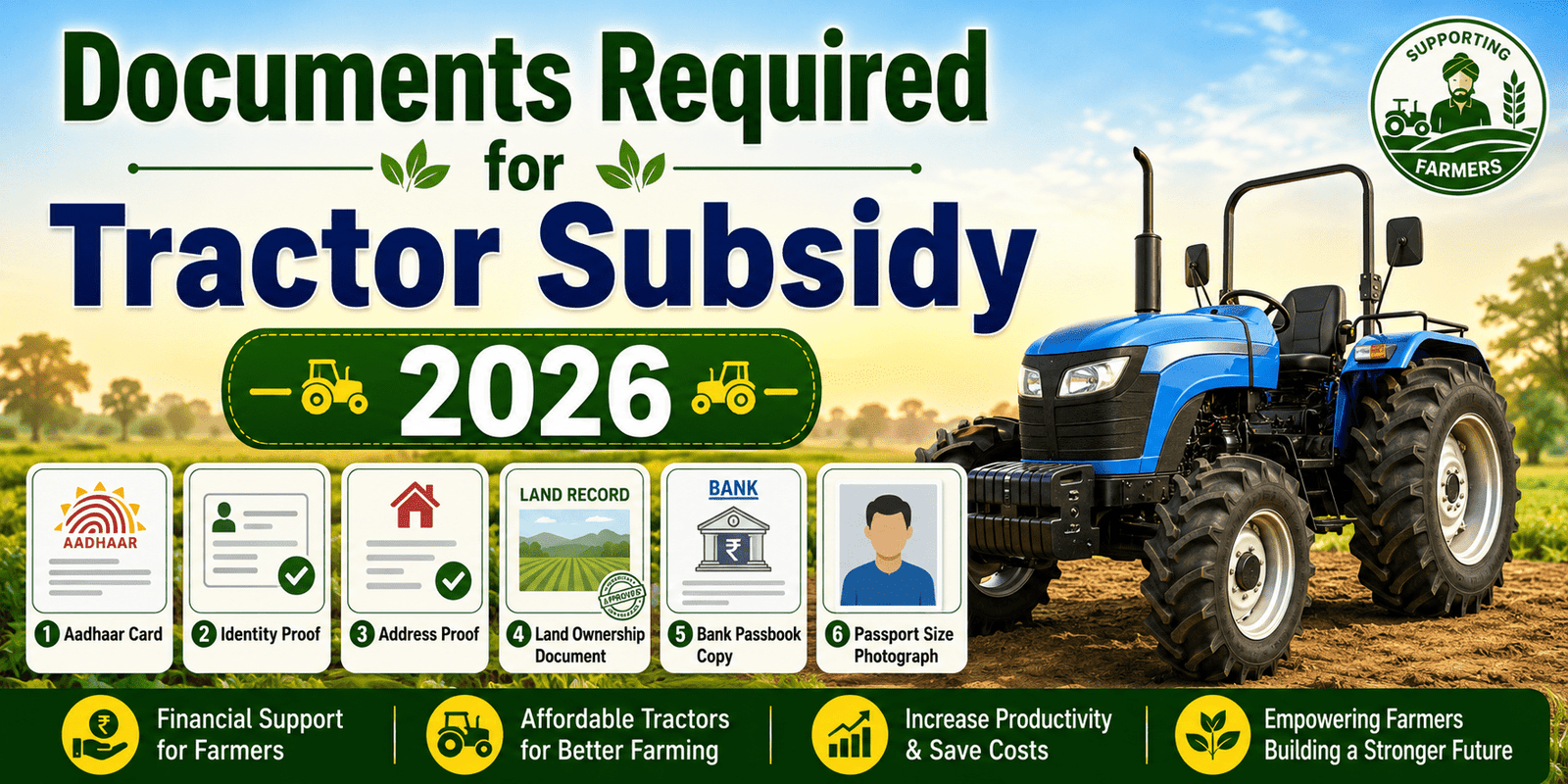
Tractor Subsidy Documents 2026: Quick List
The following table provides a general checklist.
| Document | Purpose |
|---|---|
| Aadhaar Card | Identity verification |
| Mobile Number | Registration and OTP |
| Bank Passbook | DBT/payment details |
| Land Record | Landholding verification |
| 7/12 or equivalent record | State-specific land proof |
| 8-A or equivalent record | Landholding details in applicable states |
| PAN Card | Financial/identity requirements where applicable |
| Passport-size Photograph | Application identification |
| Tractor Quotation | Proposed tractor purchase |
| Approved Tractor Details | Machinery verification |
| Caste Certificate | Category-based benefit, where applicable |
| Self-Declaration | Applicant declaration |
| Pre-Sanction Letter | Subsidy approval process, where applicable |
| Tractor RC | Existing tractor/family tractor proof where required |
| Purchase Invoice | Post-purchase subsidy verification |
| Payment Receipt | Purchase/payment confirmation |
| Other State-Specific Documents | As required by the department |
Not every applicant will need every document. The final checklist depends on the specific scheme and state.
1. Aadhaar Card
Aadhaar Card is one of the most commonly required documents for agricultural subsidy applications.
It can be used for:
- Identity verification
- Farmer registration
- Aadhaar authentication
- DBT-related processes
- Linking the application with the farmer’s profile
The farm mechanization system has historically used Aadhaar-based farmer registration, and the central FMDBT process has provided for farmer registration using Aadhaar number, mobile number and name as per Aadhaar.
Farmers should check that the name on Aadhaar matches the name used in their agriculture and bank records.
2. Aadhaar-Linked Mobile Number
An active mobile number is useful during online registration.
It may be required for:
- OTP verification
- Application registration
- Status updates
- Communication from the department
- Login or authentication
Farmers should use a mobile number that they can access regularly.
If the portal requires an Aadhaar-linked mobile number, make sure the number is correctly linked before starting the application.
3. Bank Passbook
The front page of the bank passbook is commonly requested for subsidy applications.
It can provide:
- Account holder name
- Account number
- Bank name
- Branch
- IFSC code
This information is important because eligible subsidy payments are generally transferred through the prescribed payment mechanism.
Some government agricultural mechanization services specifically list the front page of the bank passbook among supporting documents. For example, the Andaman and Nicobar Administration’s farm mechanization service lists Aadhaar, land RoR and the front page of the bank passbook among supporting documents.
Farmers should ensure that the bank account is active and that the account-holder name is correct.
4. Land Ownership Documents
Land documents are particularly important when the subsidy programme requires proof that the applicant is an eligible farmer.
Depending on the state, accepted documents may include:
- Khasra
- Khatauni
- Jamabandi
- Record of Rights
- 7/12 extract
- 8-A certificate
- Land ownership certificate
- Other state-specific revenue records
For example, Maharashtra’s official farm mechanization scheme specifically requires 7/12 and 8-A certificates for eligible farmer applicants.
Farmers should submit the latest land record available through the relevant State Government system.
5. 7/12 Extract
The 7/12 extract is particularly relevant for farmers in Maharashtra.
It can provide information related to:
- Landholder
- Survey number
- Land area
- Land use
- Cultivation
- Revenue details
Maharashtra’s official MahaDBT agriculture scheme page lists the 7/12 certificate among the required documents for farm mechanization assistance.
Farmers from other states should not assume that 7/12 is required because different states use different land-record systems.
6. 8-A Certificate
The 8-A certificate is another land-related document used in Maharashtra.
It can provide information about the farmer’s landholding account.
Maharashtra’s official farm mechanization scheme lists both 7/12 and 8-A certificates among the required documents.
Farmers applying under other state schemes should check the equivalent land document prescribed by their State Agriculture Department.
7. Khasra, Khatauni or Jamabandi
Farmers outside Maharashtra may need other land records.
Depending on the state, these can include:
- Khasra
- Khatauni
- Jamabandi
- Record of Rights
- Survey record
- Gata details
These documents can help establish:
- Farmer’s name
- Agricultural land
- Survey number
- Land area
- Ownership
- Village
Farmers should make sure the land information matches the application.
8. Tractor Quotation
A quotation from an authorized tractor dealer may be required before the purchase.
The quotation can show:
- Tractor manufacturer
- Model
- Horsepower
- Basic price
- Applicable taxes
- Total cost
- Dealer information
Maharashtra’s official farm mechanization scheme specifically lists a quotation of the equipment/tools to be purchased among the required documents.
Farmers should obtain the quotation from a dealer or source accepted under the particular scheme.
9. Approved Tractor or Machinery Details
Not every tractor model may qualify for subsidy.
Government machinery programmes use prescribed machinery specifications and approved equipment categories.
The Department of Agriculture and Farmers Welfare has also established procedures concerning tractor testing and benchmark specifications for tractors included in subsidy schemes. In 2023, the Government simplified tractor testing requirements by allowing manufacturers to participate based on CMVR/Conformity of Production certification and related declarations, while requiring subsequent testing documentation.
Therefore, farmers should check whether the tractor model they intend to purchase is eligible under the relevant subsidy programme.
10. Testing Certificate
Some schemes may ask for a testing certificate or approved machinery certification.
For example, Maharashtra’s official farm mechanization scheme lists the quotation along with the testing certificate of a Central Government-approved agency among the required documents.
This requirement generally relates to the machinery being purchased rather than the farmer’s personal eligibility.
Farmers should obtain the appropriate document from the authorized dealer or manufacturer when the portal requires it.
11. PAN Card
A PAN Card may be requested depending on the state, scheme and transaction requirements.
For example, Haryana’s 2026 agricultural machinery subsidy notice specifically mentions PAN Card among the documents to be uploaded for the relevant machinery subsidy application.
Farmers should enter the PAN details exactly as shown on the PAN document.
12. Caste Certificate
A caste certificate may be required if the farmer is applying under a category-specific subsidy provision.
For example, Maharashtra’s official farm mechanization scheme specifically lists a caste certificate for SC/ST beneficiaries.
Farmers should upload a valid certificate issued by the competent authority.
Do not select a reserved category unless the farmer actually meets the applicable eligibility conditions.
13. Self-Declaration
A self-declaration may be required as part of the application.
The declaration can confirm information such as:
- Applicant’s eligibility
- Land details
- Machinery purchase
- Previous subsidy benefits
- Accuracy of information
The exact declaration format varies by state.
Both Maharashtra’s official scheme information and Haryana’s 2026 machinery-subsidy notice refer to self-declaration as part of the documentation process.
Farmers should read the declaration carefully before signing or submitting it.
14. Pre-Sanction Letter
Some tractor subsidy programmes require a pre-sanction letter before the farmer purchases the tractor.
This is an important point because farmers should not assume that they can purchase any tractor first and claim subsidy later.
Maharashtra’s official farm mechanization scheme lists Pre Sanction Letter among the required documents.
If the particular scheme follows a pre-sanction process, farmers should wait for the required approval before purchasing the machinery.
15. Tractor Registration Certificate (RC)
A tractor RC can be required in certain applications.
For example, Haryana’s June 2026 official notice for agricultural machinery subsidy requires a valid tractor RC for the relevant crop-residue-management machinery application. The notice also states that a tractor registered in the name of a family member can be relevant to eligibility under that particular programme.
This does not mean every new tractor subsidy application requires an existing tractor RC.
The requirement depends on the particular subsidy component.
16. Purchase Invoice
After purchasing the tractor, the farmer may need to submit the original purchase invoice or an accepted digital invoice.
The invoice can establish:
- Tractor model
- Purchase price
- Dealer
- Buyer
- Date of purchase
- Registration information
Some subsidy systems require purchase-related documents before releasing the approved benefit.
17. Payment Receipt
A payment receipt or proof of payment may be requested during post-purchase verification.
This can help establish that the farmer actually purchased the approved machinery.
Farmers should preserve:
- Dealer invoice
- Payment receipt
- Bank payment record
- Tractor RC
- Other purchase documents
until the subsidy process is completed.
18. Tractor Registration Details
The department may request the tractor’s registration information after purchase.
This can include:
- Registration number
- Chassis number
- Engine number
- Model
- Manufacturer
- Purchase date
The exact information depends on the state’s verification process.
Farmers should ensure that the details in the application, invoice and RC match.
19. Land Record for Small and Marginal Farmers
Some mechanization programmes give preference or different assistance levels to specific beneficiary categories.
The Government’s 2026 PIB backgrounder on SMAM highlights expanded access for small farmers, women and disadvantaged groups.
Therefore, farmers should keep accurate land records and category documents if the particular subsidy programme provides different assistance based on farmer category.
20. Documents for Women Farmers
Women farmers may receive preference or additional support under some mechanization programmes.
The exact benefit varies by scheme.
The central 2026 SMAM backgrounder states that the programme expands access to small farmers, women and disadvantaged groups.
If a state scheme provides a specific benefit for women applicants, the farmer may need additional documents establishing eligibility.
21. Documents for SC/ST Farmers
SC/ST applicants may receive different assistance under certain schemes.
Where the subsidy requires category verification, farmers may need:
- Caste certificate
- Aadhaar
- Land record
- Bank details
- Other scheme-specific documents
Maharashtra’s official mechanization scheme explicitly lists a caste certificate for SC/ST beneficiaries.
Tractor Subsidy Application Process 2026
The application process varies by state, but it generally follows a similar sequence.
Step 1: Check the Current Scheme Notification
First check the latest notification from the State Agriculture Department.
Look for:
- Eligible tractor category
- Horsepower limit
- Subsidy percentage
- Maximum subsidy
- Farmer categories
- Application dates
- Required documents
- Dealer requirements
Step 2: Register on the Official Portal
Use the official agriculture or farm mechanization portal.
Some states have dedicated online systems. The Central Government has also supported the FMDBT system for farm mechanization, while several states operate their own portals.
Step 3: Complete Farmer Registration
Enter the required:
- Aadhaar
- Mobile number
- Farmer details
- Land information
- Bank details
Step 4: Select Tractor Subsidy
Choose the applicable tractor or farm machinery component.
Step 5: Upload Documents
Upload the documents requested by the portal.
Step 6: Submit the Application
Review the information carefully before final submission.
Step 7: Wait for Verification
The department may verify:
- Farmer details
- Land records
- Category
- Machinery eligibility
- Bank information
Step 8: Receive Pre-Sanction, Where Applicable
If the scheme requires pre-sanction, wait for the approval before purchasing the tractor.
Step 9: Purchase the Approved Tractor
Purchase the tractor according to the scheme conditions.
Step 10: Upload Purchase Documents
Submit the invoice, RC and other documents requested after purchase.
Step 11: Physical or Digital Verification
The department may verify the machinery and purchase.
Step 12: Subsidy Payment
After successful verification, the subsidy is processed according to the applicable scheme rules.
Is Tractor Subsidy Available Across India?
Agricultural mechanization support is implemented through Central and State Government programmes, but the specific tractor subsidy, eligibility and application process vary by state.
The Department of Agriculture and Farmers Welfare has stated that SMAM is implemented through State Governments, and several states have their own online portals for the scheme.
Therefore, farmers should not rely on a generic “all India tractor subsidy” percentage.
The actual benefit depends on the scheme operating in the farmer’s state.
How Much Tractor Subsidy Can Farmers Get?
There is no single fixed subsidy amount for every tractor in 2026.
The subsidy may depend on:
- State
- Tractor horsepower
- 2WD or 4WD category
- Farmer category
- Scheme component
- Approved cost ceiling
- Available funds
For example, the Andaman and Nicobar Administration published 2026 information showing different assistance ceilings for certain tractor categories under horticulture mechanization.
Similarly, state-specific farm mechanization schemes can prescribe their own subsidy limits.
Therefore, farmers should check the latest state notification before calculating the expected subsidy.
Can Farmers Buy the Tractor Before Approval?
Farmers should be careful about this.
If the scheme requires pre-sanction, purchasing the tractor before receiving approval can affect subsidy eligibility.
Maharashtra’s official farm mechanization scheme lists a Pre Sanction Letter as a required document.
Therefore, applicants should read the purchase conditions carefully and wait for pre-sanction when the scheme requires it.
Can a Farmer Get Subsidy on a Second Tractor?
This depends on the scheme.
Some schemes restrict repeated benefits for the same machinery or component.
For example, Maharashtra’s official scheme states that a farmer who has already received a benefit for a particular component/equipment may not be eligible for the same component for a specified period, while another component may remain available.
Therefore, farmers should check their previous subsidy history before applying.
Common Reasons for Tractor Subsidy Application Rejection
Applications can face problems because of:
- Incorrect Aadhaar details
- Wrong bank account
- Outdated land record
- Name mismatch
- Incorrect survey number
- Ineligible tractor model
- Missing quotation
- Missing caste certificate
- Incorrect category
- Missing pre-sanction
- Purchase before approval
- Duplicate application
- Incomplete self-declaration
- Unclear document uploads
- Previous subsidy already received
- Application submitted after the deadline
Farmers should check the application carefully before final submission.
How to Avoid Tractor Subsidy Document Rejection
Farmers can reduce errors by following these steps.
Keep the Latest Land Record
Do not use an old document if the ownership or land area has changed.
Match the Name
Make sure the name matches Aadhaar, bank and land records as far as applicable.
Verify Bank Details
Check the account number and IFSC from the latest bank document.
Obtain the Correct Quotation
Use a quotation from an authorized or approved dealer where required.
Check Tractor Eligibility
Confirm that the tractor model and specifications fall under the subsidy component.
Complete Pre-Sanction
Do not purchase early if pre-sanction is mandatory.
Upload Clear Documents
Make sure every document is readable.
Keep Originals Safe
Preserve the original documents for verification.
Tractor Subsidy Documents Checklist 2026
Before applying, farmers can use this checklist:
- Aadhaar Card
- Aadhaar-linked mobile number
- Bank passbook
- Land ownership record
- Khasra/Khatauni/Jamabandi/7/12 or equivalent
- 8-A certificate, where applicable
- PAN Card, where required
- Passport-size photograph
- Tractor quotation
- Approved machinery/testing document, where required
- Caste certificate, where applicable
- Self-declaration
- Pre-sanction letter, where applicable
- Tractor RC, where required
- Purchase invoice
- Payment receipt
- Other state-specific documents
Frequently Asked Questions (FAQs)
What documents are required for tractor subsidy in 2026?
Common documents include Aadhaar Card, land records, bank passbook, tractor quotation, self-declaration and other scheme-specific documents. Some states also require PAN, caste certificate, pre-sanction letter, testing certificate or tractor RC. Maharashtra’s official scheme, for example, lists Aadhaar, 7/12, 8-A, quotation, testing certificate, caste certificate where applicable, self-declaration and pre-sanction letter.
Is Aadhaar required for tractor subsidy?
Aadhaar is commonly used for farmer identification and registration in agricultural mechanization programmes. The central FMDBT registration process has used Aadhaar, mobile number and name as per Aadhaar.
Is a land document required for tractor subsidy?
Land documents are commonly required, but the exact record varies by state. Maharashtra, for example, requires 7/12 and 8-A certificates under its farm mechanization scheme.
Is a bank passbook required?
Many subsidy application systems request bank details or a copy of the bank passbook for payment-related verification. The exact requirement depends on the state scheme.
Do I need a tractor quotation?
A quotation may be required before purchase. Maharashtra’s official scheme specifically lists the equipment quotation among its required documents.
What is a pre-sanction letter?
A pre-sanction letter is an approval issued before the eligible machinery purchase under schemes that follow a pre-sanction process. If your scheme requires one, purchasing the tractor before approval may affect eligibility.
Can I buy the tractor before applying for subsidy?
Do not assume that you can. If the scheme requires prior approval or pre-sanction, follow that process before purchasing the tractor.
Is PAN Card mandatory for all tractor subsidy applications?
Not necessarily. PAN requirements vary by state, scheme and applicant. Haryana’s 2026 machinery subsidy notice, for example, specifically requires PAN Card for the relevant application.
Is a caste certificate required?
It may be required for applicants seeking category-specific benefits. Maharashtra’s official scheme specifically lists a caste certificate for SC/ST beneficiaries.
Can small and marginal farmers apply for tractor subsidy?
Eligibility depends on the particular state and scheme. The 2026 central SMAM backgrounder highlights support for small farmers and other targeted groups as part of farm mechanization efforts.
Can women farmers get tractor subsidy?
Women farmers may receive preference or targeted assistance under certain mechanization programmes. The actual benefit depends on the applicable state and scheme rules.
Can I get subsidy for a second tractor?
It depends on the scheme’s previous-benefit restrictions. Some programmes limit repeated assistance for the same machinery component. Maharashtra’s official scheme, for example, has restrictions on receiving the same component again for a specified period.
Is tractor subsidy the same in every state?
No. Subsidy rates, maximum limits, eligibility conditions, documents and application procedures can vary by state and scheme.
Where can I apply for tractor subsidy?
Farmers should apply through the official State Agriculture Department, farm mechanization portal or other authorized platform specified in the current scheme notification.
How is tractor subsidy paid?
The payment process depends on the scheme. Eligible subsidy is generally processed through the prescribed government payment system after approval and verification.
Conclusion
The documents required for tractor subsidy 2026 depend on the State Government scheme, tractor category and farmer’s eligibility. There is no single document checklist that applies identically across India.
However, farmers should generally keep Aadhaar Card, mobile number, bank passbook, updated land records, tractor quotation, farmer-category documents and self-declaration ready. Depending on the scheme, additional documents such as 7/12, 8-A, PAN Card, caste certificate, testing certificate, pre-sanction letter, tractor RC, purchase invoice and payment receipt may also be required.
The Central Government’s farm mechanization programme supports wider access to agricultural machinery, while States implement many of the application and subsidy processes.
Farmers should pay particular attention to the pre-sanction requirement. If the selected scheme requires approval before purchase, buying a tractor before receiving that approval can create eligibility problems.
It is also important to verify whether the selected tractor model is eligible under the applicable subsidy component. Government procedures for tractor testing and approved machinery specifications are part of the broader mechanization framework.
Before submitting an application, farmers should check the latest notification, update their land records, verify bank details and keep clear copies of all documents. Most importantly, they should use only the official State Agriculture Department or authorized farm mechanization portal for registration and document submission.
Read More: Delhi Widow Pension Scheme 2026: Eligibility, ₹2,500 Monthly Pension, Documents & Apply Online