Agricultural Machinery Subsidy 2026 is an important support mechanism for farmers who want to purchase modern agricultural equipment without bearing the entire cost themselves. Government farm mechanization programmes provide financial assistance for eligible machinery and implements to encourage the use of modern technology, improve farm productivity and reduce cultivation costs.
The Sub-Mission on Agricultural Mechanization (SMAM) is one of the major frameworks for promoting farm mechanization in India. Under farm mechanization programmes, assistance can be available for different types of agricultural machinery and implements, subject to the applicable scheme, state rules, equipment specifications and available funds.
However, there is no single document list applicable to every farmer across India. The documents required can vary depending on the State Government, machinery being purchased, farmer category, subsidy component and application procedure.
For example, Maharashtra’s official Sub-Mission on Farm Mechanization page lists Aadhaar Card, 7/12 Certificate, 8-A Certificate, equipment quotation, testing certificate, caste certificate for eligible SC/ST beneficiaries, self-declaration and pre-sanction letter among the required documents.
In some states, farmers may also need bank details, Farmer ID, land records, machinery invoices, registration documents or other supporting records.
This article explains the documents required for agricultural machinery subsidy 2026, the application process, land and identity documents, category-specific documents, common mistakes and important points farmers should check before purchasing machinery.
What Is Agricultural Machinery Subsidy 2026?
Agricultural machinery subsidy is financial assistance provided under eligible government farm mechanization schemes to encourage farmers to purchase approved agricultural machinery and implements.
The assistance may cover equipment such as:
- Tractors
- Power tillers
- Rotavators
- Seed drills
- Cultivators
- Harvesters
- Reapers
- Threshers
- Planters
- Sprayers
- Paddy machinery
- Crop-residue management equipment
- Other approved farm implements
The exact equipment eligible for subsidy depends on the particular scheme and state.
Maharashtra’s official farm mechanization programme, for example, states that its objective is to increase access to farm mechanization and provide financial assistance for the procurement of farm machinery and implements.
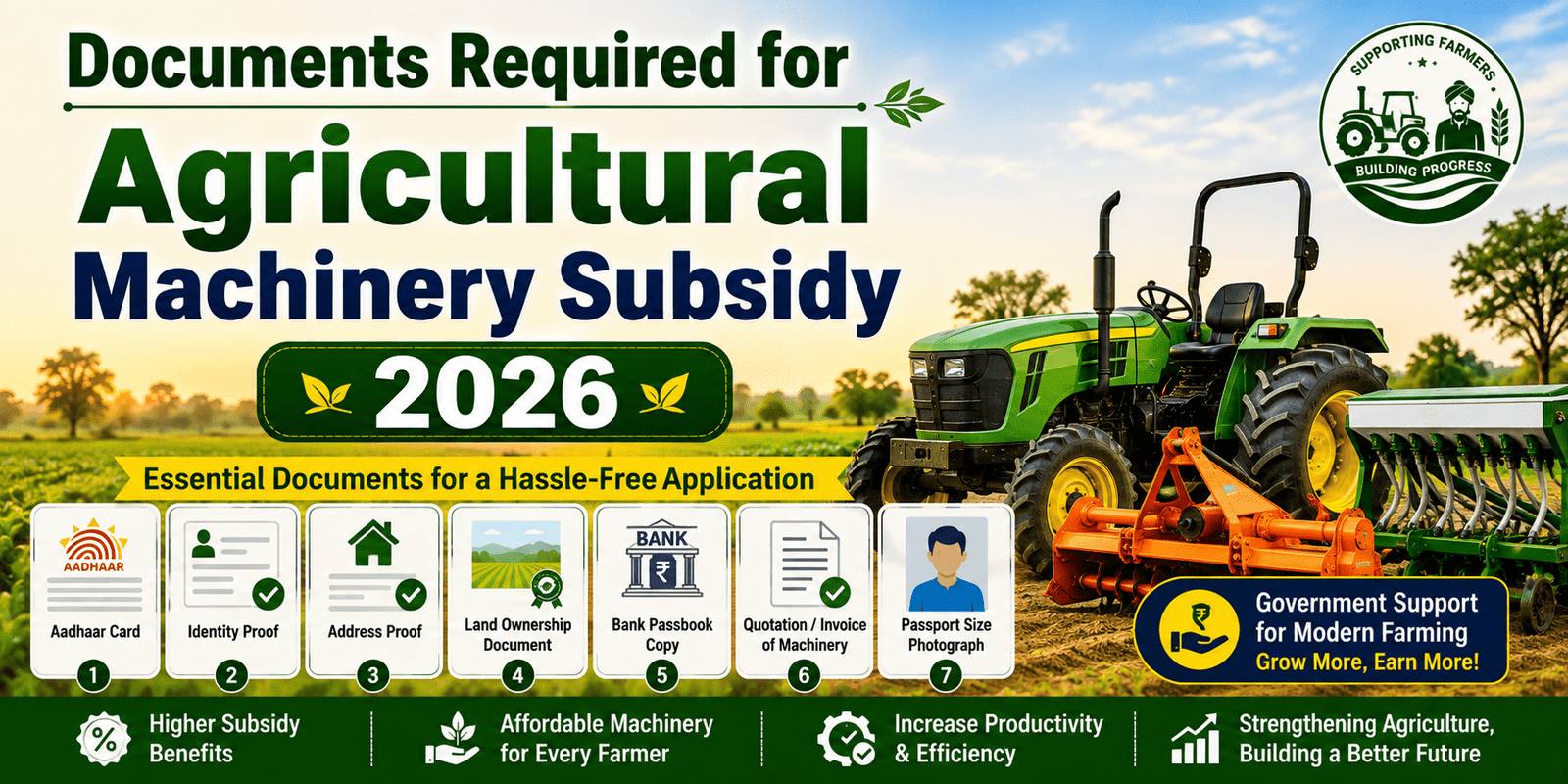
Agricultural Machinery Subsidy Documents 2026: Quick List
| Document | Purpose |
|---|---|
| Aadhaar Card | Farmer identity verification |
| Aadhaar-linked Mobile Number | OTP and authentication |
| Farmer ID | Digital farmer identification where required |
| Land Record | Landholding verification |
| 7/12 Certificate | State-specific land proof |
| 8-A Certificate | Landholding details in applicable states |
| Khasra/Khatauni/Jamabandi | State-specific land records |
| Bank Passbook | Bank and DBT details |
| Machinery Quotation | Details of equipment to be purchased |
| Testing Certificate | Machinery eligibility/technical verification |
| Caste Certificate | Category-based subsidy |
| Self-Declaration | Applicant declaration |
| Pre-Sanction Letter | Required before purchase under applicable schemes |
| Purchase Invoice | Proof of machinery purchase |
| Machinery Registration/RC | Verification where applicable |
| Other Documents | As specified by the State Government |
Important: Farmers do not necessarily need every document listed above. The final requirement depends on the particular machinery subsidy scheme and state.
1. Aadhaar Card
The Aadhaar Card is one of the most commonly required documents for agricultural subsidy applications.
It can be used for:
- Farmer identification
- Aadhaar authentication
- Registration
- Beneficiary verification
- Linking the application with the farmer profile
Maharashtra’s official farm mechanization scheme specifically lists Aadhaar Card as a required document.
Farmers should check that their name and other details are correct before submitting the application.
If the name in Aadhaar differs significantly from the name in the farmer’s land or bank records, it may create verification issues.
2. Aadhaar-Linked Mobile Number
An active mobile number is important for online agricultural subsidy applications.
It may be required for:
- OTP verification
- Farmer registration
- Login
- Application updates
- Authentication
- Receiving department notifications
Farmers should keep the mobile number active throughout the application process.
If the state portal requires Aadhaar-based OTP authentication, farmers should ensure that the mobile number is linked with Aadhaar.
3. Farmer ID
The Farmer ID under AgriStack/Farmer Registry is becoming increasingly important for accessing agriculture-related services.
The exact requirement varies by state and scheme.
For example, Maharashtra’s current MahaDBT information states that an AgriStack Farmer ID is mandatory for certain agriculture-scheme benefits and directs farmers without a Farmer ID to visit a Common Service Centre with Aadhaar and the Aadhaar-linked mobile number.
Therefore, farmers should check whether Farmer ID is mandatory for the machinery subsidy they are applying for.
4. Land Ownership Documents
Land records are commonly used to establish the farmer’s agricultural landholding.
Depending on the state, these may include:
- Khasra
- Khatauni
- Jamabandi
- Record of Rights
- 7/12 extract
- 8-A certificate
- Land ownership certificate
- Other revenue records
The exact document name differs from state to state.
Farmers should always submit the latest available land record if the scheme requires land ownership or cultivation verification.
5. 7/12 Certificate
The 7/12 extract is particularly important for farmers in Maharashtra.
It can contain information about:
- Survey number
- Landholder
- Land area
- Cultivation
- Land-related revenue information
Maharashtra’s official Sub-Mission on Farm Mechanization specifically lists the 7/12 Certificate among the required documents.
Farmers in other states should use their state’s equivalent land record rather than assuming that a 7/12 document is required.
6. 8-A Certificate
The 8-A Certificate is another important land document in Maharashtra.
It can provide information about the farmer’s landholding account.
The official Maharashtra farm mechanization scheme lists both 7/12 and 8-A certificates as required documents.
If you are applying in another state, the equivalent landholding document may be required instead.
7. Khasra, Khatauni or Jamabandi
Farmers in states where different land-record systems are used may need:
- Khasra
- Khatauni
- Jamabandi
- RoR
- Gata details
- Survey records
These documents can help verify:
- Farmer’s name
- Agricultural land
- Plot number
- Land area
- Village
- Ownership
Farmers should make sure the information matches the details entered in the subsidy application.
8. Bank Passbook
A bank passbook may be required for subsidy-related payment and beneficiary verification.
The bank document can provide:
- Account holder name
- Account number
- Bank name
- Branch
- IFSC code
Farmers should ensure that the bank account is active and the name matches the applicant’s identity records.
If the subsidy is transferred through DBT, incorrect bank information can cause payment delays.
9. Machinery Quotation
A quotation for the agricultural machinery is an important document in many subsidy programmes.
The quotation generally contains:
- Equipment name
- Manufacturer
- Model
- Machinery specifications
- Price
- Dealer details
- Applicable taxes
- Total cost
Maharashtra’s official farm mechanization scheme specifically requires a quotation of the equipment/tools to be purchased.
Farmers should obtain the quotation from an appropriate or authorized dealer where the scheme requires it.
10. Testing Certificate
Some agricultural machinery subsidy schemes require a testing certificate from an approved agency.
The purpose is to establish that the equipment meets the technical requirements prescribed under the applicable mechanization programme.
Maharashtra’s official scheme specifically mentions a testing certificate from a Central Government-approved agency along with the equipment quotation.
Farmers should check whether the particular equipment requires such certification before purchasing it.
11. Caste Certificate
A caste certificate may be required when the subsidy programme provides specific benefits for certain categories.
For example, Maharashtra’s farm mechanization scheme requires a caste certificate for SC/ST beneficiaries.
Farmers applying under a reserved category should keep a valid certificate issued by the competent authority.
The certificate should be uploaded in the prescribed format if required by the portal.
12. Self-Declaration
A self-declaration may be required during the subsidy application process.
The declaration can relate to:
- Applicant eligibility
- Ownership information
- Machinery purchase
- Previous subsidy benefits
- Accuracy of information
- Compliance with scheme conditions
Maharashtra’s official farm mechanization scheme includes a self-declaration in its required-document list.
Farmers should read the declaration carefully before signing or submitting it.
13. Pre-Sanction Letter
A pre-sanction letter is an important document in schemes where approval must be obtained before purchasing the machinery.
Farmers should not assume that they can purchase the equipment first and claim the subsidy later.
Maharashtra’s official farm mechanization scheme includes a Pre Sanction Letter among the required documents.
Therefore, if the scheme follows a pre-sanction process, farmers should wait for the required approval before purchasing the machinery.
14. Purchase Invoice
After purchasing the approved agricultural machinery, the farmer may need to submit the purchase invoice.
The invoice can establish:
- Machinery purchased
- Model
- Price
- Dealer
- Buyer
- Purchase date
It is important to preserve the original invoice until the subsidy process is completely finished.
15. Payment Receipt
Some subsidy systems may require proof that the farmer has paid for the equipment.
This can include:
- Dealer receipt
- Bank transaction record
- Payment confirmation
- Other accepted payment proof
The exact requirement varies by state.
Farmers should avoid cash transactions where the scheme or dealer process requires traceable payment documentation.
16. Machinery Registration or RC
For some types of machinery, especially tractors or registered vehicles, the department may require registration details.
This can include:
- Registration number
- Chassis number
- Engine number
- Model
- Manufacturer
However, this is not a universal requirement for every agricultural implement.
It depends on the machinery and subsidy component.
17. Tractor Ownership Proof
If the subsidy is for tractor-operated machinery, the scheme may sometimes require proof of tractor availability or ownership.
For example, Maharashtra’s farm mechanization scheme states that if a tractor is in the name of a parent or unmarried family member and another family member applies for tractor-operated equipment, proof of having the tractor must be uploaded.
This is a scheme-specific requirement, not a universal document requirement.
18. Documents for Small and Marginal Farmers
Some subsidy programmes provide different assistance levels or priority for particular farmer categories.
Farmers may need landholding records to establish their category or eligibility.
The applicable documents can include:
- Land records
- Farmer ID
- Aadhaar
- Bank details
- Category certificate, where applicable
The actual benefit and eligibility conditions depend on the specific programme.
19. Documents for Women Farmers
Some agricultural mechanization programmes provide targeted support or preference to women farmers.
If a state scheme offers a category-specific benefit, additional documentation may be required according to its rules.
Farmers should check the latest notification instead of assuming that the same benefit applies across every state.
20. Documents for SC/ST Farmers
SC/ST farmers applying under category-specific assistance should generally keep their valid caste certificate ready.
The official Maharashtra farm mechanization scheme specifically includes a caste certificate for SC/ST beneficiaries.
Other states may have different category requirements.
Agricultural Machinery Covered Under Subsidy
Depending on the scheme, subsidy assistance may be available for different types of farm machinery.
Common examples include:
- Tractor
- Power tiller
- Rotavator
- Cultivator
- Seed drill
- Planter
- Reaper
- Harvester
- Thresher
- Sprayer
- Paddy transplanter
- Crop-residue management machinery
- Other approved implements
Not every machine is eligible under every scheme.
The farmer should check the approved machinery list before purchasing equipment.
Agricultural Machinery Subsidy Application Process 2026
The exact process differs by state, but the general procedure can be understood through the following steps.
Step 1: Check the Latest Scheme Notification
Before applying, check:
- Eligibility
- Eligible machinery
- Subsidy limits
- Application dates
- Required documents
- Farmer categories
- Pre-sanction requirements
- Purchase conditions
Step 2: Complete Farmer Registration
Register on the official State Agriculture Department or farm mechanization portal.
Where required, complete Farmer ID registration first.
Step 3: Select Machinery
Choose the eligible equipment or machinery component.
Step 4: Obtain Quotation
Get the required quotation from the appropriate dealer.
Step 5: Upload Documents
Upload Aadhaar, land records, bank details and other documents requested by the portal.
Step 6: Submit Application
Review all details before final submission.
Step 7: Department Verification
The department may verify the farmer, land, category and machinery details.
Step 8: Receive Pre-Sanction
If the scheme requires pre-sanction, wait for the approval.
Step 9: Purchase Machinery
Purchase the approved equipment according to the scheme’s conditions.
Step 10: Upload Invoice and Other Purchase Documents
Submit the invoice and other documents requested after purchase.
Step 11: Verification
The department may conduct physical or digital verification.
Step 12: Subsidy Disbursement
After successful verification, the eligible subsidy is processed according to the scheme rules.
Is Farmer ID Mandatory for Agricultural Machinery Subsidy?
There is no single answer for every state and every machinery subsidy.
Farmer ID requirements are increasingly being introduced into State agriculture portals.
For example, the Maharashtra MahaDBT portal currently states that Farmer ID registered through AgriStack is mandatory to avail benefits of agriculture schemes and advises farmers without a Farmer ID to visit a CSC with Aadhaar and the Aadhaar-linked mobile number.
Therefore, farmers should check the current requirements of their state before beginning the application.
Can Farmers Apply Without Land Documents?
It depends on the subsidy component.
For many farm mechanization programmes, landholding or agricultural activity information is important for determining eligibility.
For example, Maharashtra’s official farm mechanization scheme requires 7/12 and 8-A certificates.
However, requirements can differ for specific machinery, farmer groups or state programmes.
Can Farmers Buy Machinery Before Subsidy Approval?
Farmers should be extremely careful about this.
If the subsidy programme requires pre-sanction before purchase, buying the machinery before receiving approval can affect eligibility.
The Maharashtra farm mechanization scheme explicitly includes a Pre Sanction Letter among its required documents.
Therefore, always check the purchase sequence mentioned in the current scheme notification.
Common Reasons for Agricultural Machinery Subsidy Application Rejection
Applications can be delayed or rejected because of:
- Incorrect Aadhaar details
- Name mismatch
- Wrong land record
- Outdated land ownership
- Incorrect survey number
- Incorrect bank account
- Missing Farmer ID
- Missing quotation
- Unapproved machinery
- Missing testing certificate
- Missing caste certificate
- Incorrect category
- Missing self-declaration
- Purchase before pre-sanction
- Duplicate application
- Unclear document uploads
- Previous subsidy restrictions
Farmers should carefully check the application before submission.
Common Document Mistakes to Avoid
Using an Old Land Record
An old land document may show a previous owner or incorrect land area.
Wrong Survey Number
One incorrect digit can result in land verification problems.
Name Mismatch
Different spellings across Aadhaar, bank and land records can cause problems.
Incorrect Bank Details
An incorrect account number or IFSC can affect subsidy payment.
Buying Machinery Too Early
If pre-sanction is required, purchasing before approval can create eligibility issues.
Uploading Blurred Documents
Make sure every document is clear and readable.
Using an Unapproved Machine
Check whether the selected machinery is eligible under the particular subsidy component.
Missing Category Certificate
SC/ST or other category-specific benefits may require supporting certificates.
Agricultural Machinery Subsidy Document Checklist 2026
Before submitting the application, farmers can use this checklist:
- Aadhaar Card
- Aadhaar-linked mobile number
- Farmer ID, where required
- Latest land record
- 7/12 or equivalent land document
- 8-A certificate, where applicable
- Khasra/Khatauni/Jamabandi, where applicable
- Bank passbook
- Machinery quotation
- Testing certificate, where required
- Caste certificate, where applicable
- Self-declaration
- Pre-sanction letter, where applicable
- Purchase invoice
- Payment receipt
- Machinery registration/RC, where applicable
- Tractor ownership proof, where applicable
- Other state-specific documents
Frequently Asked Questions (FAQs)
What documents are required for agricultural machinery subsidy 2026?
Common documents include Aadhaar Card, land records, bank details, Farmer ID where required, machinery quotation and self-declaration. Some schemes may also require testing certificates, caste certificates, pre-sanction letters, invoices and other documents.
Is Aadhaar mandatory for machinery subsidy?
Aadhaar is commonly used for farmer identification and authentication. The exact requirement depends on the State Government scheme.
Is Farmer ID required for agricultural machinery subsidy?
It depends on the state and scheme. Some agriculture portals are making Farmer ID mandatory for accessing scheme benefits. Maharashtra’s current MahaDBT portal, for example, states that an AgriStack Farmer ID is mandatory for agriculture-scheme benefits.
Is a land record required?
Many agricultural machinery subsidy schemes require landholding or agricultural activity verification. The exact land document depends on the state.
Which land documents can be used?
Depending on the state, documents can include Khasra, Khatauni, Jamabandi, Record of Rights, 7/12, 8-A or other official land records.
Is a bank passbook required?
Bank details may be required for subsidy payment and beneficiary verification. Farmers should keep a current bank passbook or accepted bank document ready.
What is a machinery quotation?
A machinery quotation is a document from the dealer showing the equipment model, specifications and proposed price. Some schemes require it before sanction.
What is a testing certificate?
A testing certificate verifies that machinery meets applicable technical requirements. Some schemes require a certificate from a government-approved testing agency.
Is a caste certificate required?
It is required only where the scheme provides category-specific benefits. Maharashtra’s farm mechanization scheme, for example, requires it for SC/ST beneficiaries.
What is a pre-sanction letter?
A pre-sanction letter is approval issued before purchasing the machinery under schemes that follow a pre-sanction process.
Can I purchase machinery before receiving subsidy approval?
Do not assume that you can. If the scheme requires pre-sanction, purchase should generally follow the prescribed approval process.
Can I get subsidy on more than one machine?
The answer depends on the scheme. Maharashtra’s official farm mechanization scheme states that subsidy can be availed for only one component/equipment under the applicable scheme and places restrictions on receiving the same component again for a specified period.
Can small and marginal farmers apply?
Eligibility depends on the particular scheme. Many farm mechanization programmes aim to improve access to machinery for small and marginal farmers.
Can women farmers receive machinery subsidy?
Some programmes may provide priority or targeted support to women farmers. The exact benefit depends on the state and scheme.
Can SC/ST farmers receive additional benefits?
Some schemes provide category-specific assistance. A valid caste certificate may be required to claim such benefits.
Where can I apply for agricultural machinery subsidy?
Farmers should apply through the official State Agriculture Department, farm mechanization portal or authorized government platform mentioned in the current scheme notification.
Conclusion
The documents required for agricultural machinery subsidy 2026 depend on the state, machinery, farmer category and specific subsidy programme. Farmers should not rely on a single generic document list when applying.
However, the most commonly required documents include Aadhaar Card, Farmer ID where applicable, land records, bank details, machinery quotation and self-declaration. Additional documents such as 7/12, 8-A, Khasra, Khatauni, Jamabandi, testing certificate, caste certificate, pre-sanction letter, purchase invoice and machinery registration documents may be required depending on the scheme.
The official Maharashtra Sub-Mission on Farm Mechanization scheme, for example, lists Aadhaar, 7/12, 8-A, machinery quotation, testing certificate, caste certificate for eligible SC/ST beneficiaries, self-declaration and pre-sanction letter.
Farmers should pay special attention to pre-sanction requirements. If the scheme requires approval before purchase, buying the machinery in advance can create problems during subsidy verification.
It is also important to check whether the selected equipment is eligible under the particular scheme. Farmers should obtain the correct quotation, keep updated land records and make sure that their bank details are accurate.
As Farmer ID systems are being integrated into agriculture-service platforms, farmers should also check whether a Farmer ID is mandatory in their state. Maharashtra’s current MahaDBT portal, for instance, states that an AgriStack Farmer ID is mandatory for agriculture-scheme benefits.
Before applying, farmers should therefore check the latest official notification, prepare all required documents and follow the prescribed application and purchase sequence. This can help reduce document errors, verification delays and the possibility of subsidy application rejection.